A Cuppa Cosy Summer Holiday 2022 – Sudbury, Ontario

The next stop on our trip was a bit of an “place to stop on the way” kind of stop, but we were pleasantly surprised with the city of Sudbury. It has a lot of history, a lot of mining history, it was actually such a good spot to stay for a night or two. We learned so much not only about the city itself, but actually about mining, its history and its effects on our world, as well as what we can do to protect it. Whew, we might go a little deep in this post, but this city is such a…surprise.  

Quickly before we get too deep into the Sudbury history and stop, we did make a short stop at Onaping Falls.

So, the thought is that about 1.85 billion years ago a meteorite hit Earth and this crater, that has since been filled with all sorts of debris and formed and re shaped by nature, is where the A.Y. Jackson Lookout and Onaping Falls is. Sudbury City Center lies at the south, this lookout at the north. We started at the Lookout with a view of the Onaping River and High Falls- a drop of 46 meters of several falls. From there we hiked down through the rocky terrain (which I somehow did in my Birkenstocks- possible but not recommended) and up over to the bridge. The bridge is right on the rim of the crater and offers views of the river and falls. It was a great stop and a way to stretch our legs all while being right in the heart of both outside the planet and the nature of earth. 

From there we headed into Sudbury. So, a little history…

Similar to our previous stop in the region, Sudbury was initially inhabited by the Ojibwe of Algonquin People some 9,000 years ago. However, in 1850 they struck a deal with the British Crown (the Robinson Huron Treaty) that they would share the region with the Crown if they were paid a tax. The first French Jesuits established the Saint-Anne-des-Pins- coincidentally the patron Saint of minors. A little foreshadowing for the area possibly. 

During the excavation and paving for the Canadian Pacific Railway in 1883 high concentrations of nickel-copper ore were found in the rock that formed Murray Mine. Nickel-Sulphide Ore was also located in the region. This led to a boon of workers and opportunity both in the mines, but also for railway workers trying to establish and run the railway. Thomas Edison (visiting as a prospector) found an ore body in Falconbridge. Through this boon to the region, two companies emerged, Inco (1902) and Falconbridge (1928). They went on to become two of the largest employers of the region as well as two of the world’s leading producers of Nickel. 

Because the region was so rich, they were able to bounce back from the Great Depression much quicker than many other places in the world- in fact, the problems that they dealt with during the Great Depression ended up being a lack of infrastructure to meet the rapid growth of the city and industry. The Frood Mines produced 40% of all the nickel in Allied artillery production, as well as was a main supplier to the U.S. during the Cold War. It’s hard to make clear just what the impact of these mines were on the region- at one point Sudbury was the wealthiest and fastest growing city in the country. 

However, for all the wealth and good economic value the mines brought to Sudbury, they also completely destroyed the green life in the city. The slag heaps, open coke beds, and various logging caused almost all the natural plants to die. Not only that, but they experienced the left-over rocky outcroppings turn charcoal black and acid rain. An environmental crisis caused by the mines. 

Not to catastrophize, because this story has a “happy” ending in that the once the Inco Superstack was built (in 1972 to help disperse the the sulphuric acid further distances to cut down on the acid rain) they were able to bring in a team of environmentalists and ecologists to help find solutions. They started in the early 1970’s by putting lime on the charred soil, laying wild grass seed, and planting trees (9.2 million planted as of 2010). With that initial push completed, they went to work on the slag heaps- rehabilitating them with biosolids (basically compost), as well as grass seed and trees. In fact, we learned that the mines are the perfect greenhouses- but more on that a bit later. The city of Sudbury has actually been recognized by the United Nations for its regreening and improved mining practices. They have a long way to go though, there are still 74,000 acres of land still to be touched by rehabilitation. 

In 1978 there was a strike at Inco over production and employment cutbacks. This strike completely shuttered Sudbury’s economy and since then they’ve been trying to diversify the local economy…which is where we get into what we did in the city. 

One quick fun fact before we go, quite a bit of the famous Canadians come from Sudbury- like Alex Trebeck! Sudbury has also produced something like 81 National Hockey League players- the largest of any European City, and several NHL Hall of Famers. 

So, first off, we visited Dynamic Earth and the Big Nickel. Well…technically first we visited Bay Used Books, but I don’t think I really need to go into details on that- if you’re in the area give them a visit! 

Dynamic Earth is an Earth Sciences Museum opened in 2003 that focuses heavily on the geology and mining activities of the region. Not only were we able to tour an underground model mine that showed us the different forms mining took over the years (and it’s gone through A LOT of changes), but we were also able to learn about how the local city and mines are trying to repair the damage done to the environment and nature of the region. We learned about how a mine is actually the perfect greenhouse (with some light and such) for plants as it stays the same temperature year-round. So, the mines use unused tunnels as greenhouses in an effort to grow the number of trees to rehabilitate various parts of the grounds. Once you finish with the tour of the mine (which is an optional addition to the museum that I would recommend), you are able to walk through a short video presentation that goes through what happens after the rock is mined. This shows how they manipulate the rocks and get the nickel and other metals out and then, further, what those metals are used for. A very kid friendly, but good for adults too, style video. Within the museum you are also able to use the tools that would be available to miners, both for kids and adults. For the kids there is a soft play style playground that has everything an old mine would have, the carts, the belt up and down, as well as a variety of tools and “rocks”. The adults are able to manipulate an actual drill located deep within the model mine. You are also able to pan for gold, explore and learn about all sorts of different kinds of rocks and stones in the exhibits. One final piece of importance about Dynamic Earth- it was the first museum in Canadian history where a private enterprise and public education collaborated to provide on-site training. 

Inside the museum was easily my favorite part and I really enjoyed learning about mining, where it started, and what companies are realizing is harmful, but I couldn’t deny that the statue outside is one of the biggest draws to the area…The Big Nickel. 

The Big Nickel, a 9-meter replica of the 1951 Canadian Nickel, is a world-renowned landmark that turned Sudbury in to a tourist stop. The idea came from Ted Szilva when the city was soliciting for ideas to celebrate the Canadian Centennial. The city, of course, did not like his idea, but he persisted. His full idea was to have the nickel, a mining center, and an underground mind. He faced quite a bit of back and forth (and opposition from the city), but finally opened the Big Nickel for visitors in 1964. He picked the 1951 nickel for three reasons: commemorate the 200th anniversary of isolating nickel into a metal, show where Sudbury’s wealth came from, and to honor the mine workers of the region. His dream didn’t stop there as he had Maclsaac Mining and Tunneling Co build the very same mine we toured in 1965 (they then expanded it in 1969). 

His final dream was to form the Sudbury Science Centre – later known as Science North- though the city initially opposed that too as it was proposed to be a private enterprise. However, much like the Big Nickel, after some time and some fierce determination, he succeeded and now known as, Science North came to be. 

Science North is Northern Ontario’s most popular tourist attraction- an interactive science museum. And it deserves every bit of that hype as it is such a cool spot to spend some time. In fact, you could easily spend a whole day just within the complex. The complex consists of two buildings connected by an underground tunnel sitting on a geographic fault. The buildings were not initially built on this fault; however, it was discovered when they were building. The first portion features an IMAX theatre and planetarium, as well as a boat tour and board walk. The second building is the museum itself which consist of a wide variety of exhibits from the natural region of the area to more STEM related exhibits. Our favorites were easily the insect pavilion where you were able to see different varieties of insects with far too many legs (belaugh), the Animals of Lakes & Rivers, as well as Northern Forests which featured rehabilitated animals like a porcupine, turtles, snakes, and a beaver. We also highly enjoyed the BodyZone, which dealt with the body and all of its’ functions and wonders, as well as the Space Place which had a “fly your own plane” exhibit, as well as a mechanical arm where you could practice your grabbing skills. 

I think if you are going to these two places, start early early at Dynamic Earth and plan on spending ¾ of your day at Science North. Once we finished at both, we walked along the Boardwalk for a little way before getting dinner and heading to the hotel for a swim and bed. 

Which wraps up our time in Sudbury. As I already mentioned- this city was a surprise to both of us. We knew there were things to do, but we didn’t know how rich the history was of the city and how big a role Mining played.

A Cuppa Cosy Summer Holiday 2022 – Upper Peninsula

The post I’ve been waiting on…. the top of all of our travels this Summer, the crème de la crème as it were…The Upper Peninsula. Where have we been so far? Well, we started in Niagara, Ontario, then headed over to Detroit, Michigan, before heading up North to the Upper Peninsula of Michigan…. a real gem of a spot. We spent two days (three nights) here and visited the not so hidden (but still kind of hidden) gem of Mackinac Island. Easily my favorite place of the entire trip. But more on that in the post. 

Before we begin, I want to say something really quickly (this seems to be how it always goes…). We visited three “cities”: St. Ignace, Mackinaw City, and Mackinac Island. Because the region is so close together (in a way, obviously all three are separated by water) most of the history of the cities are intertwined. In fact, there is quite a bit of movement and overlap in each town’s history. I’ll begin by talking about the shared history of the “region” and then narrow in as we visit each spot together. 

I also want to say- we stayed in St. Ignace at a Holiday Inn right on the lake. First off, I highly recommend St. Ignace as a “home base” of sorts. It’s less populated and much quieter. The ferry was a bit emptier (both ways) as not as many people are coming/going from that city. We also really liked our hotel. I know it’s a pricey region, but I recommend checking out St. Ignace as a place to stay. 

So, this region is vastly claimed by the Anishinaabe people, made up of the Ottawa (Odawa), Ojibwe (Chippewa), and Potawatomi. These three tribes made what is known as The Council of Three Fires and they ruled the region they called Michilimackinac. There is actually quite a fascinating history that we learned about more tribes beyond those when we were in St. Ignace, to include Seneca, Mishinemacki, Huron, Iroquois and more. The first Europeans traveled to the region in the 1630’s, with a Catholic Mission and a priest by the name of Claude Dablon. The mission started on the island of Michilimackinac (Ojibwe “Big Turtle”) but was moved to St. Ignace in 1671 and then turned over to Jacques Marquette. The mission remained active in St. Ignace until 1705 when it was abandoned. In 1679 the first “official” fur trading post, Fort de Baude, was created by Louis Hannepin and it was active until it closed and moved to Fort Detroit in 1697. In 1715 we see the first European settlement in Mackinaw City, Fort Michilimackinac, which is actually moved to Mackinac Island in 1781. 

There’s a “basic” overview of the early beginnings of the region. So much history in some of these places!

Our first day in the area we rose bright and early to catch one of the first ferries from St. Ignace to Mackinac Island to spend a day on the island. Before I get even into more history and what we did/saw/explored, I CANNOT stress enough that this is a place that HAS TO BE VISITED. You HAVE to explore the island and see it all. It’s incredible. Easily one of my top/favorite spots. Seriously. I will never not share about it; I will never shut up about it. Just incredible. Beautiful. 

So, the Anishinaabe people thought the island itself looked like a Big Turtle, which is a good creature in their history, so they named the island “Mitchimakinak” meaning…Big Turtle. When the French arrived in the 1630’s they turned the name into “Michilimackinac” and then the British (in 1780) shortened it to what we now know as Mackinac. During the French & Indian War the British took control of the Island and Fort, creating Fort Mackinac (remember- they moved Fort Michilimackinac from Mackinaw City). At the end of the War, the Island was given to the USA with the Treaty of Paris, but British continued to keep forces there until 1794. During the War of 1812, the British took back control of the War and held on to it through another battle before relinquishing it back to the US with the Treaty of Ghent in 1815. 

Around the mid 19th century, when the fur trade was starting to decline and sport fishing started to rise, Mackinac Island started to see a rise in tourism. Hotels started to be built (including the famed Grand Hotel) as well as summer “cottages”. Soon after stores and restaurants started to pop up on the main street to meet the demands. However, most of the island was still owned by the Federal Government and in 1875, thanks to lobbying by hometown senator Thomas Ferry, they declared that portion to become the second National Park (after Yellowstone). It only stayed a national park for 20 years when the land was transferred from Federal Ownership to State Ownership, and it became Michigan’s first state park. In 1898, after complaints by local residents over concerns to health and safety, all motor vehicles were BANNED from the island except for emergency services and snowmobiles. Only one other exception has been made, and that was Vice President Mike Pence’s motorcade. 

The island itself has a circumference of 4.35 miles and it’s about an 8-mile perimeter. You are able to walk or bike or hire a horse drawn carriage and explore the entire perimeter of the island on the M-185- the only state highway with no motor vehicles. The entire Island is designated a National Historic Landmark (as of 1960), but there are also 9 sites within the island that have the National Register of Historic Places designation. 

Ok, let’s talk logistics here…

We rented bikes to see the island. It only felt right- rent a couple bikes (plus a bike trailer for the boys) and just ride off into the sunset (except not really it was morning). There are several bike rental shops right off the ferry docks and they are all within the same, reasonable, price range. The real difference we saw was whether they included a bottle of water or other amenities or not. So, we picked our bikes up straight off the ferry and headed down Main Street. It is truly something to see- this whole village and not a single car of any sort. Sure, there was a golf cart or two transporting luggage or supplies from the dock to a hotel, but by and large you walked, took a horse taxi, or biked. 
We biked the perimeter, stopping a couple times to read the signs that tell the history of the island, or to climb up to Arch Rock, or dip down to the water and enjoy the view and peaceful moments. It really just felt so peaceful and incredible, even on Main Street or in the picnic area, which is packed with people. Once we finished our perimeter we stopped for a quick bite, then took our bikes up the mountain and to the interior of the island. Stopping to see the exterior of the Grand Hotel, the Carriage House, and then up and onward to the highest point on the island. It was a total of 13.6 miles by bike and just one of the best days. We were so happy and tired and overjoyed by the end of it that I just knew it was a special place. The pictures don’t even do it justice, you just need to go. I promise it is worth it.

So, day 2 in the Upper Peninsula region we started off by walking through St. Ignace. I’ve touched on the history of the city originally, but it is very much steeped in the French Catholic Missionaries coming to try and convert the Native Americans who lived here at the time. We visited the Museum of the Ojibwa Culture, which highlighted the history of the people and the region, as well as the problem with the missionaries AND touched on the history of residential schools- which were such a big part of the region and the cultures history. We went from there down along the water just taking in the beauty of walking along the water. 

Once we finished up, we hopped in the car and headed across the bridge to the northern tip of the “Lower Peninsula”, Mackinaw City. Fun fact, Mackinaw City serves as the terminus for the following: Dixie Highway, Mackinaw Trail, East Michigan Pike AND West Michigan Pike. Again, I’ve touched on some of the history, so let’s talk about the main attraction we visited, Fort Michilimackinac. After everything in the region (in terms of European colonization) disappeared in 1705, the French decided to reestablish a presence in 1713. They decided a fort was the right way to go and in 1715 Fort Michilimackinac was opened. They had a good fur trade, worked well with the tribes in the region, HOWEVER in 1761, after a loss in the French and Indian War, the British took control of the fort. The British kept the fort in place, but they stopped visiting and distributing gifts to the local tribes as the French had done. This led to the local tribes becoming resentful and angry at the British. Tensions rose until a full-on battle was waged called Pontiac’s War. Fort Michilimackinac had a small part to play in this war as there was a battle in June of 1763 in which a group of Ojibwe staged a game of baaga’adowe as a way to get into the fort, kill troops and take control. They succeeded and held the fort for almost a year before the British regained control (and kept it after starting to distribute gifts to the tribes once again). After the British decided to move the Fort to Mackinac Island, they moved several of the buildings that they wanted and then burned the rest of the fort to the ground. 

These days most of the buildings on the fort are reconstructions, though through them you can also see portions of the buildings as they stood. The entire fort is an excavation and archeological site- considered one of the most extensively excavated sites in the U.S. It was pretty incredible to walk through the fort and learn the history- we could pinpoint where skirmishes and battles occurred and what led to them.  The fort also did the really cool thing and highlighted a very important person…Ezekiel Solomon was one of the most active fur traders in the regions, but he was also the first Jewish Settler in Michigan. Originally from Berlin and having served in the British Army, he arrived at Fort Michilimackinac in 1761. He was in the fort during the battle with the Ojibwe in 1763, only narrowly missing execution. He often traveled to Montreal as part of the fur trade and became a member of Canada’s first Jewish Congregation before dying in 1808. Such a neat little historical fact and was really fun to not only learn about his life but see a recreation of his home!

And that really wrapped up our time in the Upper Peninsula! This was easily probably my favorite stop of our entire vacation (with Niagara a close second) as it was just so gorgeous. I highly, highly recommend it (if you couldn’t tell by now). It’s one of the most popular, prettiest areas for a reason.

A Cuppa Cosy Reads – July 2022

I feel like I say this every month now, but I can’t believe another month has come to an end. And this month I really just felt like got away from me in so many ways- that balance of life really took a tumble. With that life balance tumble, my reading was rocky. I read quite a few books, 10, BUT I either felt ambivalent or angry about them. It was a rough month- even looking back now and calculating the average rating of 3.25. I did DNF (did not finish) two books that I got enough of the way in that I’ll be including later in the post. Here’s to hoping that August goes better across the board!

Let’s just get in to the nitty/gritty of it all, shall we?

Garden Spells by Sarah Addison Allen 3 Stars This was fine. It’s very reminiscent of Practical Magic (if you liked that you’ll like this), but calmer in so many ways. It’s a feel-good story that was nice and calming to read but didn’t extend beyond that. 

Fever Dream by Samantha Schweblin 4 Stars Maybe? I’m still not sure I know entirely how I feel about this book, but man did it pull at a string in my mama heart. So much so, that I want to warn other mamas on reading this- it will tug your emotions and make you think things and question decisions. 

The Body in the Garden by Katherine Schellman 4 Stars Hello cozy mystery from the Victorian Era. A very low stakes (think Ellery Adams) fun mystery that our heroine suddenly finds herself embroiled in. I really enjoyed this one (and the second one that’s up next). It really is Ellery Adams, but Victorian. 

Silence in the Library by Katherine Schellman 4 Stars The second in this mystery series that I’ll definitely be continuing on found our heroine embroiled in another mystery, but the kind that helps her grow in herself and helps her find some suitors of a romantic nature. 

The Hunting Wives by May Cobb 2 Stars My biggest disappointment yet. I had high hopes after hearing such good things, but it not only fell flat for me, but the main character POV was obnoxious. Couldn’t stand any of this book and was actually quite glad it was over. It gets a second star for the fact that I didn’t entirely see the mystery ending the way it did until it was happening. 

Half A Soul by Olivia Atwater 3 Stars I was on the fence about this book, actually put it down and then picked it back up throughout the month, but I’ve settled on it being a “fine” book. The thing this has going for it is that it represents fae in their true sense, but there’s only a fraction of it in this entire book, so don’t let that be a reason for you to pick it up.

We Had to Remove This Post by Hanna Bervoets, translated by Emma Rault 4 Stars I have to say, this is probably one of the best reads of my month. This gave me a lot to think about, a lot to consider in both my own personal social media and others. There’s a larger discussion to be had around this book and I look forward to being able to have it with others who have read it. 

Trouble on the Books by Essie Lang 2 Stars Another disappointment to really end the month with. To be bluntly honest, I found this to be the most unbelievable of cozy mysteries. It just…. none of it worked (in as much as our main characters doing as much as she was) and I found the main character POV to be…well just dumb. This book had me questioning my cozy small town mystery book shop vibe genre I had going on. 

I DNF’d:

Realm Breaker by Victoria Aveyard – On its face this book probably had everything to be a fantastic found family, chosen one, save the world trope duology, BUT I just couldn’t get into it. I didn’t care about any of it, except a side character or two, which were not present nearly enough to keep me going with it. 

The Final Girl Support Group by Grady Hendrix Another one where the main character POV just really ruined the entire book for me. I could have probably continued on and enjoyed it, but I couldn’t get past the viewpoint that we were reading from. 

And that’s it! A lot to talk about, but also not a lot haha. I will say, with as lackluster as some of the month turned out to be in reading, I’ve been very grateful to utilize my library as much as I have been! Did you have a good reading month in July? Or was it lackluster?

A Cuppa Cosy Summer Holiday – Detroit Michigan

Our next overnight stop on our Summer Holiday was Detroit Michigan, but before we crossed the border back to the States, we hit up Point Pelee, the southernmost tip of mainland Canada. A small National Park founded in 1918, this little area of the country has been occupied in some way since 700-900AD (that’s been documented). Initially a hunting area, the Europeans found it in 1670 and it’s been in dispute for a long while until it became a national park. You are able to camp and picnic in the park, even enjoy the waves on the beach front, but we headed further up to the small museum and bus ride out to the tip and then a walk on the marsh boardwalk. This spot is a boon for birdwatchers, and we saw several while we walked. It was a nice little stop and stretch your feet while being somewhere really cool. 

From there we did head straight through to Detroit. We stayed in the Financial District, close to the water and not far from the spots we really wanted to see- mostly on the auto factory side of things. We had one full day in the city, so we started off early the next morning by stopping in the GM headquarters (scoping out all the new and old vehicles on display as well as quite a few displays about what GM does beyond cars- it’s fascinating), then a short walk along the water- seeing both the statues and Canada across the way, before stopping in at the DNR Outdoor Adventure Center. 

Owned and operated by the Department of Natural Resources the Outdoor Adventure Center provides a variety of hands-on exhibits and activities meant to highlight the offerings of the region. Originally committed in the 1990’s, the museum and surrounding park area had quite the struggle to open up between funding issues and property ownership difficulties. However, in 2015 they were able to open up and logged 100,000 visitors in their first year. There is a little history, and a lot of nature information. The boys were able to “snowmobile”, ride an “atv”, practice “hunting”, as well as sit in an airplane, eagles’ nest, and learn about the environment of Michigan (which is a lot more than just Detroit). It was just as fun for us adults as it was for the kids. 

From there we headed back down the water and over to the tram for a ride to the Ford Piquette Avenue Plant. Built in 1904 this was the second building of Ford’s, however the first purpose-built factory. BUT in order to understand the importance of Ford and his mind and motor company, let’s take a minute to quickly talk about Henry Ford. 

Henry Ford was really a pioneer of his time. He was, what I like to refer to, as a tinkerer with a brain that didn’t stop. In 1892 he built his first motor car (he was 29- so if you’re younger than that and still haven’t figured anything out or are just starting to figure things out at 29- you’re in good company!) after becoming an engineer at Edison Illuminating Company of Detroit. Yes, that Edison. In 1893 he became Chief Engineer and in 1899, cheered on by Edison and several others, he founded the Detroit Automobile Company. In 1901 it was dissolved. However, in late 1901 Henry Ford designed, built and raced an auto that got some attention and he, tried again, founded the Henry Ford Company towards the end of 1901. However, once again, it was not to last as once Henry Leland was brought in as a consultant, Ford left, and Leland then renamed it to Cadillac. 

Finally, in 1903 Ford Motor Company was founded, with the Dodge Brothers as investors (!) and then in 1908 the ever-popular Model T was debuted. It would sell that year for $825 with a price that would continue to drop year after year. Something that Henry Ford is known well for is forward thinking and in 1913 he introduced the concept of the moving assembly belt to his factories (though this could not be only attributed to Henry Ford- several employees helped design and produce this concept). Some interesting facts about Henry Ford to end this little side tangent…He was an early backer of the Indianapolis 500, he was a notorious anti-Semite (both Hitler and Himmler were big fans of Ford and some of his writings were combined and published in Nazi Germany- AND Ford is apparently mentioned TWICE in Mein Keimpf, but he didn’t financially donate to the party – I don’t know why that was such a distinction that needed to be made…), and while he introduced the $5 dollar wage, and 40/48 hr. work week, he HATED labor unions and fought fiercely against his workers unionizing. 

So, the Ford Piquette Avenue Plant. Built in 1904, this was the second location owned by the Ford Motor Company and produced the Models B, C, F, K, N, R, S and finally the Model T during its 5 years. Initially cars were manufactured with hand tools that would be carried to the vehicle and a single location. This plant is where the idea of a moving assembly line was created. Just before the Model T debut in 1908, employees experimented with the idea that the chassis of the car moved along to the workers, rather than the workers moving to the chassis. They continued experimenting by using a rolling option, instead of the previous rope maneuvering, before coming up with the initial moving assembly belt (a precursor to the one Henry Ford later put in place at the Rouge Facility). Now, once the Model T was completed and out in the world sales quickly skyrocketed. Demand became so much that the Piquette Plant closed for two months to help catch up and the plant itself quickly became too small. In 1909 Ford Motor Co started packing up to move over to the Highland Park Ford Plant to continue. The plant building itself went through a couple different owners and businesses before being sold in 2000 to the Model T Automotive Heritage Complex (after hearing that it was going to be torn down) and re purposed the building into a museum full of over 40 early automobiles. The plant was added to the National Register of Historic Places in 2002 and a National Historic Landmark in 2006. 

Finally, a few fun facts about the cars…most Model T’s (post assembly line introduction) were black due to the fact that it was the fastest drying of all the colors, when the production of the Model T concluded (in 1927), Ford had produced 15, 007, 034 cars. 

That about summed up our day in Detroit. Heading back towards the hotel, we stopped over at the Fox Theatre and Comerica Park just to take a little look and then stopped for some food. Our second day, on the way out of the city, we stopped over in Dearborn to see The Henry Ford. 

The Henry Ford is the massive complex that houses the Henry Ford Museum of American Innovation, Greenfield Village, and works in partnership with the Ford Rouge Factory (The Henry Ford is also known as the Edison Institute). It is the largest indoor/outdoor museum in the United States and was added to the National Register of Historic Places in 1969, with the National Historic Landmark label attached in 1981. Where to begin?

We started our day with the Ford Rouge Factory Tour. The Ford River Rouge Complex is well known in the auto industry. Construction beginning in 1917 (opened for production in 1927, completed in 1928) it is the largest integrated factory in the World. The concept was to have everything that was needed to manufacture vehicles right at your fingertips. With the docks, the interior railroad, electric plant, and steel mill, there was no need to wait on much to be delivered in order to complete a car. The complex itself is made up of 93 buildings with 16 million square feet of factory floor space and, while the first products produced were the WWI Eagle Boats, it currently produces all of the Ford F-150 and soon to be Ford F-150 Lightning trucks. The factory tour is really interesting, showing the history of Henry Ford and the current projects, as well as a look at the factory tour (this was not in action when we toured, but you can tour when it is in action). 

From there we headed into Greenfield Village. Greenfield Village is known as an Outdoor Living History Museum- the first in the nation and a model that many other “living history museums” follow. The village is made up of various homes and buildings that were upended from their original locations and moved to the property with the end goal of showing the history of living and working in America since its’ founding. The village is a total of 240 acres, with 90 being used by the village itself. Some of the notable homes are those of the Wright Brothers, Edison and Ford, as well as the courthouse where Lincoln practiced law and a covered bridge from Pennsylvania. There is also the Farris Mill- one of the oldest in America. As part of the admission, you can pay to ride in an authentic Model T (some of which are replicas, some of which are actual authentic – we were lucky to get an authentic Model T), as well as on the Weiser Railroad. 

Finally, we headed into the Henry Ford Museum of American Innovation. Henry Ford was a bit obsessed with collecting and preserving historically interesting items that portrayed what the Industrial Revolution was like, both from an everyday life perspective (think items in the home, kitchen, toys, etc.) and from an industrial machine perspective. The museum is full of a variety of artifacts that range from massive steam and coal locomotives to presidential motorcade vehicles, to doll houses and tractors. There is also the Rosa Parks bus, the Oscar Meyer Weiner Mobile, a variety of engines, and restaurant signage. 

The museum itself was started as his personal collection on a 12-acre site. The building was designed with the Philadelphia Historical Park in mind (namely the Old City Hall, Independence Hall, & Congress Hall). Initially opened in 1929 as the Edison Institute, a private education site, it was later opened to the public in 1933. I will say that between all three (the village, the factory and the museum) we spent almost all day here and still didn’t see everything there was to see. We could have spent much longer if we hadn’t really needed to hit the road to make it to our next stop before bed time.

And with that we headed to my favorite spot on the entire trip…any guesses as to where that was? I’ll share it soon! 

A Cuppa Cosy Summer Holiday 2022- Niagara Falls

It is time to start sharing all the details and history of this year big Summer Holiday. We had quite the adventures, seeing a full loop of the upper northeastern portion of the U.S. and the some of the lower portions of Ontario, CA. I already talked previously about the requirements to enter Canada (I believe I did in my Montreal post), but I’ll touch on them again. These may or may not be up to date when you are reading this post (as they still change day to day), so I would recommend checking the Canada travel site HERE for the most up to date information. To enter Canada as an adult you must be fully vaccinated and fill out the ArriveCAN app on the phone (you can do this via we browser and print the certificate as well if that is easier for you I believe). Kids aged 5 & Up are required to be vaccinated unless they are traveling with fully vaccinated adults. For the vast majority of Ontario, we were not required to wear masks. 

A couple things to note before we get into these posts…in some places I’ll be sharing our hotel and food options, but in others I won’t. To be honest, I treat most hotels as a place to lay our head for the night and what I mean by that is, I don’t always have to be in the heart of downtown, best of the best, right in the action accommodation. Sometimes the best for us is valet parking, close to public transport, or best bed configuration. The same goes with food, though we are a bit pickier about that. However, with food I find that this is a personal varied choice. If a restaurant really stood out for me, I’ll share it, but otherwise I don’t have much in the way for either of those recommendations. 

Ok, so now on to the actual vacation (I’ll post the rules and restrictions once again when we enter back into Canada later on in the trip…). A brief overview of our route of sorts: Niagara Falls, Canada  Detroit, Michigan Mackinac/Upper Peninsula Region, Michigan Sudbury, Ontario  Toronto, Ontario Kingston, Ontario  Home. We took a total of 14 nights/15 days to hit everything, usually spending a minimum of 2 nights in each place, except Kingston which is close enough to our home (aka we can see it whenever) that we didn’t need to do more than a single night. Today kicks everything off with a post on Niagara Falls.

We started our time in Niagara on the American side at Old Fort Niagara. This fort is unique in several different ways; the oldest structure in North America between the Appalachian and Mississippi, was manned by three different countries, and expertly shows the way in which military life and conflict has changed over time. The region was originally occupied by the Seneca in the 17th century as a seasonal hunting and fishing spot. When the French took charge in 1679, it was a key access point for the Great Lakes. The fort passed from the French, who built the oldest building- the “French Castle”- in 1726, to the British in 1759. The British held it from 1759-1796, and again from 1813-1815. The Americans finally got a piece of the Fort (aside from that little loss 1813-1815) in 1796, and then permanently in 1815. While the War of 1812 was the last conflict at the Fort, it has been used in some shape or another through major conflicts in our history. In World War One it was used as an Officer Training Camp, In World War Two it was used Induction Center for troops and a POW Camp. In the Cold War it housed Anti-Aircraft troops. In 1929 & 1934 restoration projects went underway to fix the French Castle and other encampments and buildings within the fort. 

The fort itself is pretty cool if only to see the ways the natural resources and land were used to create an effective barrier. The French Castle also is a really great way of showing how they secured items and lived in an age that we can’t even fathom (wooden nails for example). They’ve also got the originally US colony flag that flew over the fort. If you are into war history, battle or forts, this is a really great stop. 

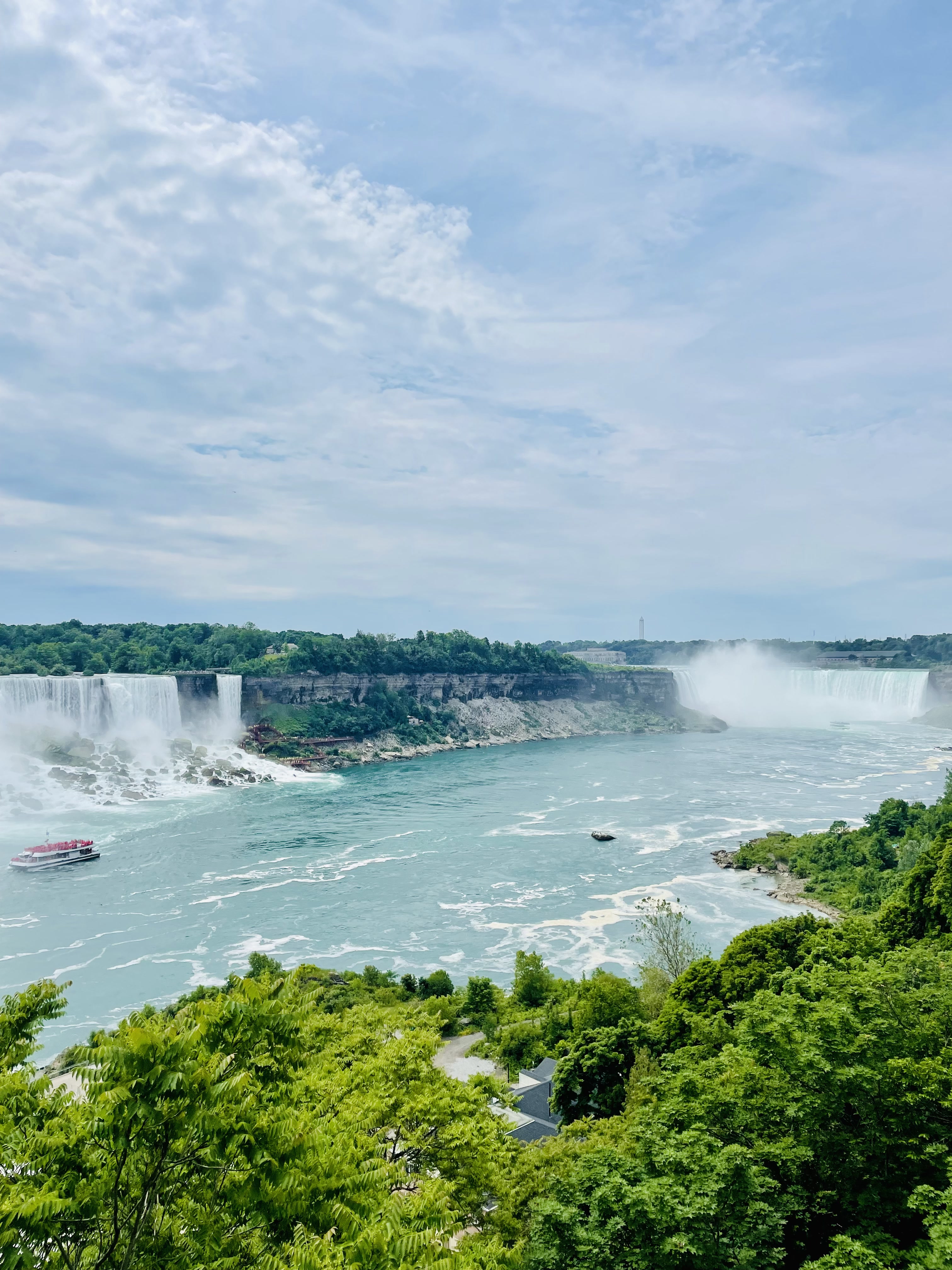
From the Old Fort we headed over the Niagara State Park and Goat Island. I’m not going to get in to too much of the history of the Falls as I feel like most of us know what Niagara Falls is (I feel like I say this and then go on and on and on), but I’ll give a couple fun little nuggets that I learned and found interesting. First off, Niagara Falls is over 12, 00 years old, but is considered “young”. The Falls are comprised of three separate falls: Bridal Veil, American, and Horseshoe falls. Together they produce 2.4 million kilowatts of electricity for the U.S. and Canada. 90% of the Great Lakes (that would be Superior, Michigan, Erie and Huron) drain into Niagara River, and then on to Niagara Falls, before hitting Lake Ontario. Two more facts and then I promise I’ll stop…maybe. Niagara Falls was the first state park in the U.S., designed by Frederick Law Olmstead (the same who designed Central Park). The water has only stopped once, in 1969 at the American Rapids so that scientists and Geologists could come in and study the effects of erosion. During the Winter Freeze and Spring Thaw a little bit more of the rock face is eroded away. 

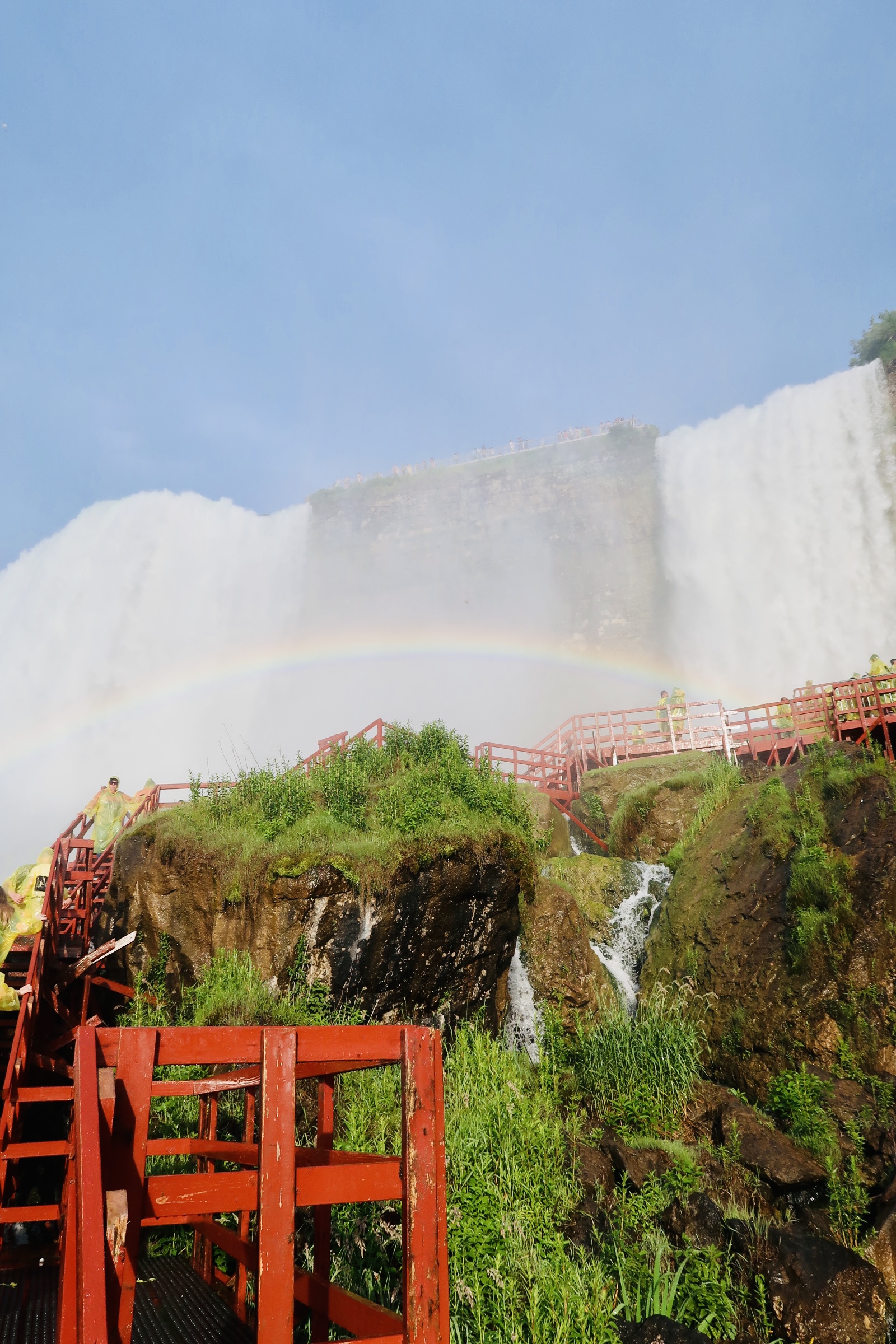
Now, we started our trip to the Falls out on the American side, which is cool in its own way. We went to the overlook of the Bridal Veil and American Falls, where you can see above the falls and look down. We also visited the “Cave of the Winds”, which is located on Goat Island. This attraction originates back to the 1800’s when there was a cave of sorts just under Bridal Falls. Tours to this “cave” began in the 1840’s (though people visited prior to that) before rock fall forced it to close in the 1920’s. It reopened for a time in 1924 where visitors could visit the “front” of the falls and cave. However due to more rock falls and erosion, engineers decided that the cave was no longer a safe destination and dynamited a portion of the rock under the fall. The visiting area was then replaced by what we see today- a grouping of stairs and standing decks at the base/slightly in front of the falls.

This was easily the must do thing on the American Side. Not only from the observation deck you not only get a really neat view of the falls, and, on a sunny day, the rainbow, but you can also feel the full blast of the falls with hurricane force winds and water spray as it rushes down. 

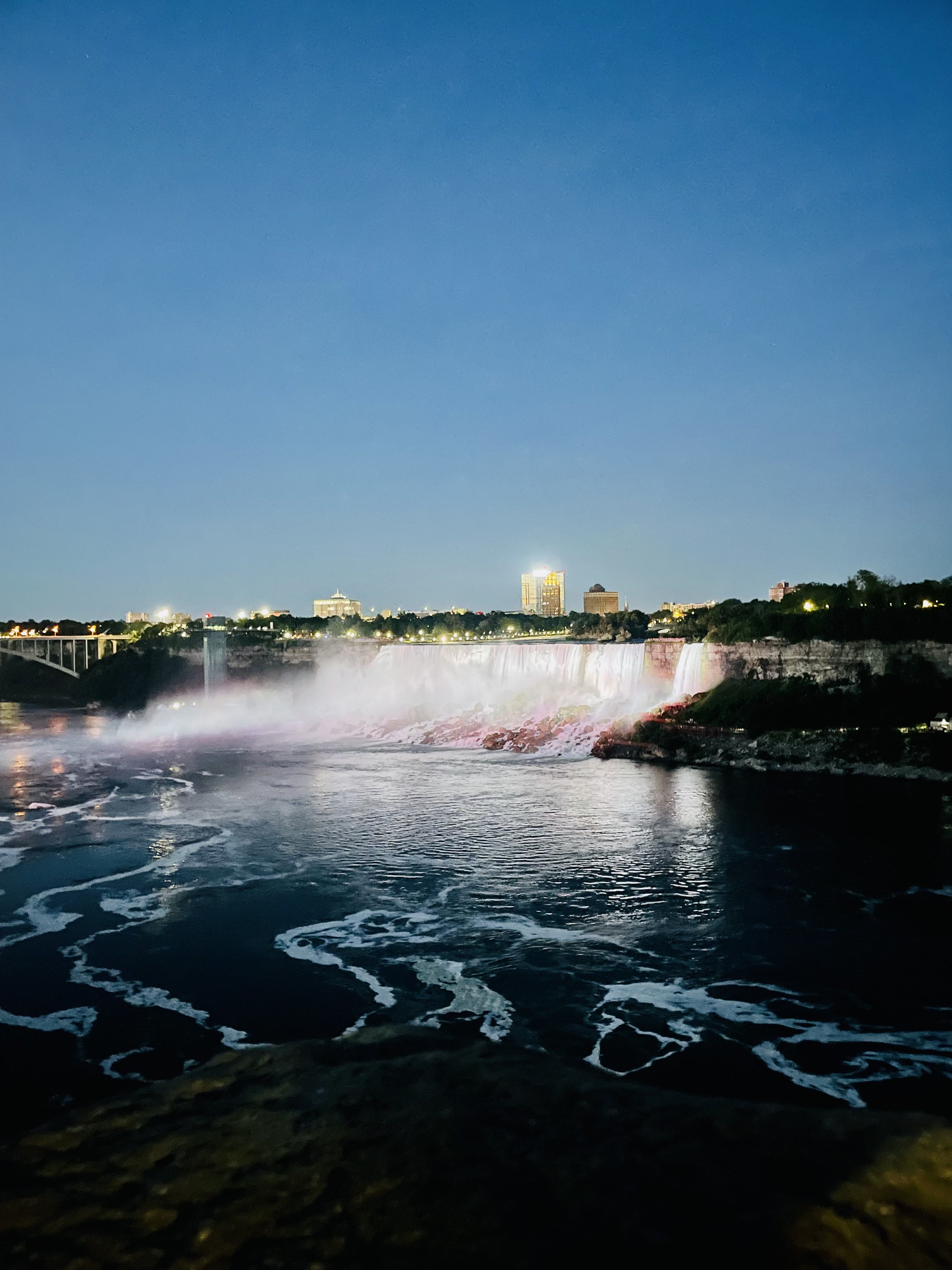
From there we headed across the border and to our hotel for the evening to check in. We stayed at Old Stone Inn Boutique hotel and found that to actually be a really good option. It’s just outside the hustle and bustle of Clifton Hill and Niagara proper, but not far enough that you can’t walk. After checking in we headed back down the Falls, this time on the Canadian Side for the Illumination of the Falls and the Fireworks show. The Illumination is a year-round show, started in 1860 and utilized for a long time for royal and foreign dignitary visits before becoming a permanent attraction in the 1920’s. The fireworks are a summertime special and are every night in the Summer at 10PM. Both a worth seeing and we loved being able to experience it. I would, obviously, suggest getting there early, but if you show up about 15 minutes before 10, you’ll still get a good viewpoint to watch them. They lift off from the same area as the Voyage into the Falls on the Canada side, so closer to Horseshoe falls would not be a bad spot to pick. Likewise, a spot by Queen Elizabeth Gardens or in between the three falls is good too. 

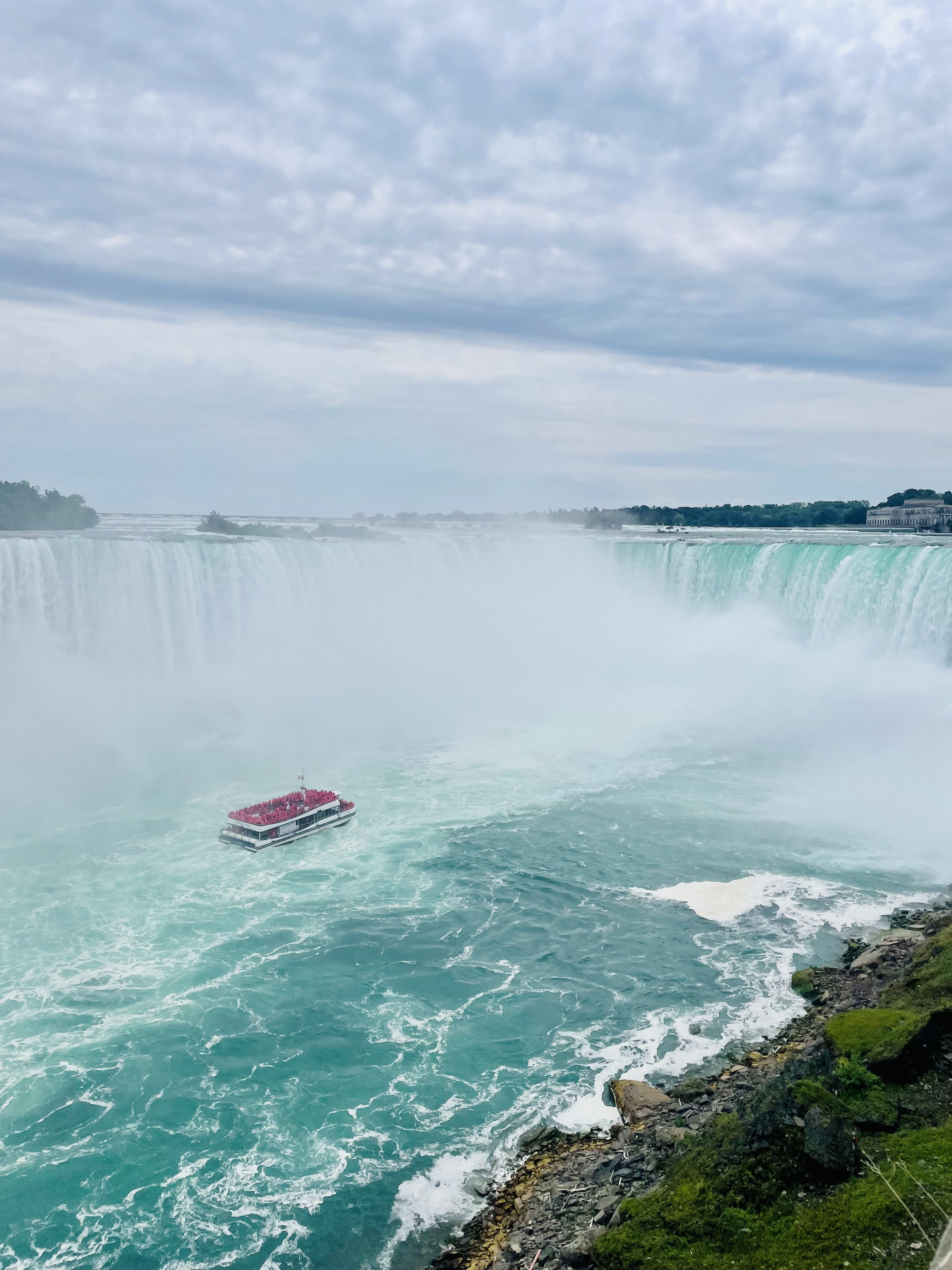
The next day we were up and off for an early morning Voyage to the Falls. A little clarification before I get into the history, Maid of the Mist (of the U.S.) used to be the only operator on the boat tours to get up close to the falls. They initially launched in 1846 as a ferry between the U.S. and Canada but was swiftly closed down in the 1850’s when the suspension bridge was completed. The company then launched with tours in 1854, but was, once again, swiftly closed when the American Civil War started. It re opened in 1885, this time going closer to Horseshoe Falls than previous. The U.S. added boats in 1892, but those burned on the Canadian side in an accident in 1955. In 1960 during a voyage, the Maid of the Mist rescued and saved a young boy who later became the first to survive a jump over Horseshoe Falls only wearing a life jacket. Finally, in 2013 Maid of the Mist split in to two separate entities, Maid of the Mist on the U.S. side, Hornblower Niagara Cruises (later Niagara City Cruises) on the Canadian Side. These days the boats are electric powered with zero emissions- which is great! 

In my honest opinion, whether you choose to do Maid of the Mist or Niagara City Cruises does not matter. They both map roughly the same route and one does not do less than the other (and I can tell you that factually as I watched them sail day in and day out from above- it is the same). It’s really going to be whichever you choose. But you SHOULD do it. It’s truly just incredible and awe inspiring to be able to stand there…in this belly of the beast of sorts and just…revel in mother nature. Truly just incredible. 

In all honesty though, if I could tell you one thing about visiting Niagara Falls, it is to view it from the Canadian side. You are able to actually view the falls from the “front”, rather than above or beside. It is truly a stunning view and one I am so glad we got to see. Once we finished touring the falls from boat, from below, we decided to wander through the gardens and slowly over to where we could go under the falls. 

Journey Behind the Falls started as this…competition between two businessmen. Located at Horseshoe Falls, in the 19th century, the only way to get down to the bottom of these falls was to take a steep hike down, over a rocky path filled with boulders and questionable rope ladders. It was dangerous and other spots that were accessible were covered up by “entrepreneurs” trying to make a quick buck and charge to look through a small peep hole. In 1818, the first set of stairs down closer to the bottom were built, followed by a spiral staircase to go lower. This was great, however it kicked off a feud between two businessmen that led to staircases being purposely broken and people being injured (unintentionally). This lasted until 1855 when Niagara Falls Park Commission was formed and took control. Shortly after the first elevator was installed and then in 1889 the first tunnel was opened to give lucky tourists a chance to go under these legendary falls. The tunnel as they exist now were created in 1944 and the observation deck was added in 1951. 

While I found this to be really cool and gave us a chance to see below all three waterfalls, I don’t know if the tunnels are absolutely necessary. This could have just been an off moment when we visited, or maybe just shining a light on the society we’ve turned in to, BUT the lines to see the portal under the waterfall were awful. If I had to do it again, I would probably have just gone to one portal and then out on the observation deck. 

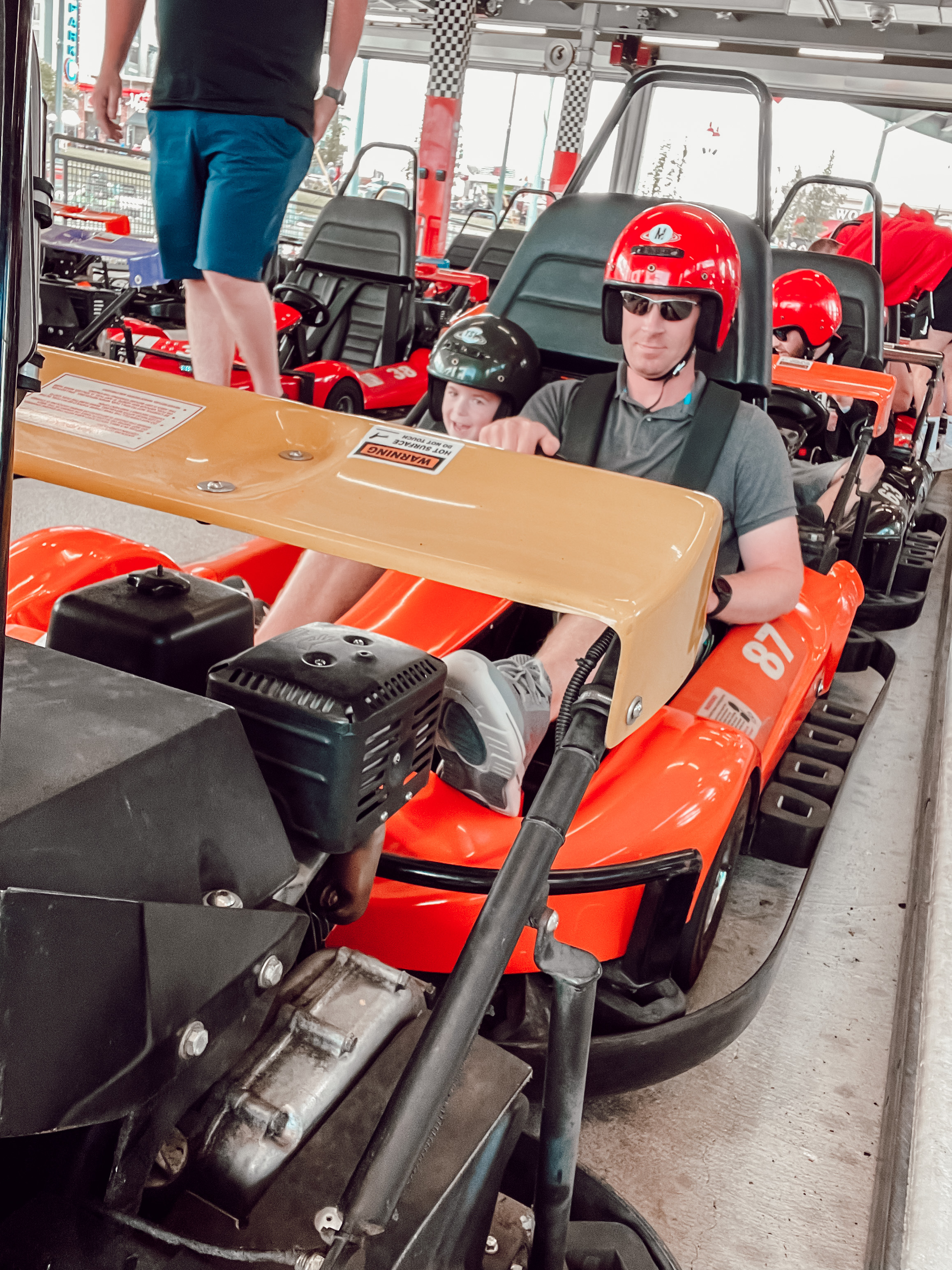
Our final day in Niagara we spent the day on Clifton Hill. Originally Clifton Hill was a sprawling mansion property lived in by both the “owner” of the city and then a U.S. Senator. However, as tourism grew, when Sir Harry Oakes purchased the land, he had business in mind. Before slowing turning Clifton Hill into the fun tourist spot it is now, he created a small quiet garden oasis in the parks, gardens, and outdoor theatre at the bottom of the hill. However, the Hill itself is now basically a carnival park. With Put-Put Golf, a racing speedway (of the go kart variety), arcades, bowling, and haunted houses, you can spend a full day just playing all the games. It was a good way for us to “treat” the boys and ourselves- we did a good amount of the games by purchasing a “FUN” pass- which gave us the Ferris wheel, put-put, and several “roller coaster” 3-D games (including a zombie apocalypse, ghost hunt, and outer space extravaganza). 

All in all, this was the perfect stop to kick start our trip! While Niagara Falls as a whole is very much do able in two whole days, having that half day to explore the American side before going into Canada was fun. If you didn’t want to do anything beyond the actual falls stuff (no fort, no Clifton hill, or if your kids were a bit older and able to withstand later nights better) I think you could easily just do two nights. For us though we’ve learned that sometimes taking the extra time, being able to travel a little bit slower is worth it. 

See you next time…in Detroit!

A Cuppa Cosy Reads – June 2022

Hello! Long time no post! Not really, only a couple weeks, but it was a good, very much needed break away. We had our annual summer holiday and, once again, had a really nice time! We traveled to seven different spots (so look forward to seven blog posts coming your way with all the details) and just really enjoyed the time together, away from work, phones, and computer screens. Somehow, I managed to read 8 books in the month of June, with an average rating of 3.85. A win of a month for sure! Let’s get into those- please keep in mind the reviews might be shorter as it’s been a minute since I’ve read/thought about them so things might slip through the cracks. 

Rivals by Katherine McGee 3 Stars This the third book in this series and I found it…fine. I always enjoy this American Royal reimagining, even if I feel like sometimes, it gets a little dragged out. It’s young adult and there will be a fourth book coming (that I will be purchasing and reading). An average to good book to start the month with!

Tokyo Dreaming by Emiko Jean 3 Stars This is another royal re-imagining, though if I had to pick, I might have enjoyed this one slightly more than Rivals. I think it’s a bit…fresher and the insight/view into a different culture is wonderful. 

Wicked Beauty by Katee Robert 4 Stars Another hit from Katee Robert’s Dark Olympus series. This pushed the boundaries a bit and definitely re imagined Greek Mythology (in a sense, who knows though), but I really enjoyed it!

The Vanishing Type by Ellery Adams 4 Stars I was really in the mood this month for light and fun, so I read two Ellery Adams, this one being her Book, Tea & Scone Society series. I’m not quite sure which I really prefer- I love and relate to both so much. Anyways, another really enjoyable cozy mystery, plus a smattering of romance. 

I Hope This Finds You Well by Kate Baer NR I swung in the complete opposite direction with this one, a black out poetry collection designed to take “hate” or “negative” messages and turn them into a positive argument. And, once again, Kate Baer did an excellent job not only with the poetry, but with the collection as a whole. 

The Sprite and The Gardener by Rii Abrego 5 Stars This was a short, fun graphic novel about a Sprite trying to get back to her…roots of sorts. She’s new to town and she befriends and helps a human with a small garden. It was just quaint and fun to read. 

All of Us Villains by Amanda Foody 4 Stars Ok, I was unsure about this one for a long while, but somewhere it hooked me and I really enjoyed it! We’re following “villains” (at least in their communities’ eyes) as they compete against each other for the final bit of magic left. It’s reminiscent of The Hunger Games, but if every victor trained like they lived in District 1. It was good and I’ll definitely be reading the next one (I think it’ll only be a duology). 

Murder in the Reading Room by Ellery Adams 4 Stars I ended the month on a high note with another Ellery Adams cozy mystery. I don’t have much to say about these, but they’re always just really nice to read in a day or two. 

All in all, it was a great reading month- especially for having traveled the last week or so of it! We are also at the halfway point in the year, so I might be posting a little…mid-yearbook freak out towards the end of this week, so keep an eye out for that bonus post before all the travel content begins!

A Weekend in the City

Before I get into this post, I want to put a little…not disclaimer, but a little word about the delay. We went on this long weekend over Memorial Weekend, which…is now like 3 weeks ago. But let me tell you…the NYC exhaustion is NEXT LEVEL. It took me a week to feel like I wasn’t…tired and then another week to process and write, and now you’re reading it a week later. Sorry, but that’s reality for you! Now, into the post…

So, New York City. One of those “iconic” cities from the U.S. I’ve been several times to the city, but my husband had only been once (though he’s driven through it) for a work trip. Since we live ~5 hours from the city, we figured we could take a long weekend and see all the…big touristy things. Let me say one {more} thing…I let my husband and kids take the lead on this trip. Since I’ve been to the city before, I’ve done most of the highlights…and some of the hidden gems. And…to be honest, New York City is big enough that you won’t see it all unless you live there and even then, you might not. So…we wanted to kind of hit some of the popular highlights of the city. If I go back, I plan on going as a girl’s trip and can do a couple of different things that may not have interested my husband or children (like a Broadway show, some of the neighborhoods, etc.). 

Two more things before I get into the weekend, we stayed very much outside the “city proper”. We stayed on the south end of Brooklyn, and, for us, it was worth it. The public transport in NYC is decent and it was very easy for us to just hop into the city when we wanted, but then be able to hop out for a breather. Second, we had really great weather for the trip! I know, weather?! BUT I feel like you never really know what you’re going to get in the city when it comes to weather, and we had one thunderstorm at the beginning and then blue skies and mild heat the rest of the weekend. 

So, to start off…

We started off our great City adventure by walking to the city across the Brooklyn Bridge. I’ve seen this bridge a million and a half times between photo’s, TV, and movies, but never actually walked across. Since we were staying on the Brooklyn side of things (like very much outside the city), I figured, this would be a great way to “meet” the city for the first time. The Brooklyn Bridge connects Lower Manhattan with Brooklyn Heights over the East River. When the bridge was initially completed in 1883, it was the longest suspension bridge in the world. It has been reconstructed several times to meet larger traffic demands, as well as to install specific bike lanes. It was designated a National Historic Landmark in 1964 and a National Historic Civil Engineering Landmark in 1972. The views crossing over the Brooklyn Bridge are great- you can see just about the entire city, plus the Statue of Liberty. 

We grabbed dinner at a hole in the wall Italian joint and I finally got to have my fast-food pizza. After dinner, we just wandered around the Financial District into the evening. We got our first glimpse at the World Trade Center area, as well as a hint of the battery (looking down- not quite The Battery). 

The next morning, we had an early start as we booked an early security check in for our ferry and tour of the Statue of Liberty and Ellis Island. I think most of us know the history of the Statue of Liberty, so I won’t go too deep into all that history. Gifted to us by the French in 1886 to celebrate the friendship of France and the U.S., Lady Liberty is full of a lot of symbolism. Across the statue, from what she carries, to her stance, even the carved facial expression- everything has meaning. While France financed and created the statue, the U.S. had to supply the Pedestal on which she would stand. Originally it was a copper color, but by 1906 the copper oxidized and the gorgeous green that we see today had arrived. The statue has been renovated once but closed several times during her tenure. For many years following the September 11 attacks the crown was closed to visitors, once re opened it was a limited amount per day (240/day total). 

We spent about an hour and a half or so on Liberty Island, walking up to the pedestal, around the base, and then through the museum. From there, we hopped back on our ferry and headed to Ellis Island. Again, I won’t go through too much of the history as I feel like most of us (well in the U.S.) know the basics of Ellis Island. Built initially in 1892, due to the high volume of immigrants at the time, Ellis Island served as the first stop for any and all new immigrants for 60 years. Over 12 million immigrants walked through its’ doors, though not all got to stay, and some faced rigorous testing and inspections. Upon arrival if you were traveling on anything other than a first- or second-class ticket OR you were sick, you would be sent to Ellis Island. Upon arrival at the island, you would go through several rounds of testing, some just a health screening, others a full interview and evaluation. Around 2% of the immigrants would not be granted entry and would be sent back- reasons being either disease or work concerns. The Island was closed in 1954 after a slowdown in the need of extensive processing (this was when embassies, and more ports started coming in to play). Once closed, Ellis Island became a ghost town. It deteriorated into a group of abandoned buildings, even though it was a recognized landmark (1965). The Foundation, that restored the Statue of Liberty, worked tirelessly on restoring, combining, creating, and finally opening Ellis Island as well now know it. 

I will say, even if you aren’t the family of immigrants or if you know the history, it’s still a pretty incredible place to visit. Not only for the history of the immigrants that went through their (and to learn their history pre-Ellis, during Ellis, and post Ellis), but it’s also pretty incredibly to think about the restoration and rebuild that occurred at the Island. And to know that it’s funded by the public through donations and contributions. Again, it’s just a place to visit and learn about what was a big place for so many. So many of these immigrants have made incredible and everyday contributions to our country. 

Once we got the ferry back to Battery Park, we headed out, once again, to explore the Financial District. We stopped over at the New York Stock Exchange, which is always a bit…smaller than one would think in person. We saw the little girl standing up to the male corporations dreaming of being in their one day (I don’t know if that’s exactly it, but that’s how I see it), the bull of Wall Street (which was packed and I didn’t even bother to re-create any pictures from the past two visits to it), and then over to One Trade Center. Visiting the World Trade Center Memorial, One World Trade Center, and the rebuilt area was something that was important to me. The first time I had ever visited New York City, I had gotten to go inside the Twin Towers, my mother worked with folks who worked inside the Towers, I vividly (like many many others) remember September 11, my husband vividly remembers September 11, and it was important to us that our children know that space and history. So, we visited. It’s such a peaceful spot, somewhere that you can sit for a bite and remember those who died, were injured, or are forever missing from that day. We stopped by the name that my mother knew and rested a bit.

From there it only seemed fitting that we headed to the New York City Fire Museum (mostly for our firetruck crazed 4-year-old). The museum showed not only the history of the fire trucks, fire response, and fire departments, but it also had a spot dedicated to September 11. It was actually quite interesting to see how the city handled fires when it was horse and buggy (here’s a hint…the firemen would pull the buggies) and how it evolved to the modern trucks and water capacity we have now. 

From there we headed over to The Strand, one of only two spots that I requested to go to, and I promptly became incredibly overwhelmed. Dating back to 1927 on “Book Row”, it is a family run business and the only bookstore still open from that street of bookstores. Now The Strand carries well over 2.5 million new and used books and to be honest…as much as I absolutely loved walking through those doors and literally just seeing books from floor to ceiling…nothing can prepare you for that. I need like a full day by myself just to take a crack at what they had. So, needless to say I loved it…definitely need a second go round there. But it was also kind of the perfect way to end the first full day we spent in the city!

The second day we were there, we decided to do a little bit of an easier, slower day and spend some time in Central Park. We always try to seek out parks/nature trails/ anything along those lines wherever we go, and Central Park is so known, that it was a good stop. But before we went into the park, we headed to the second place that was on my personal list, Zabars. Zabars originally opened in 1934 offering a variety of niche high quality food. You can purchase standard fair (pasta, canned options, and the like), but also bringing in small brands and foods from around the world, and fresh made bakery items (the rugelach is incredible, coffee, and lox (and other fish). It is, in so many ways, a Jewish staple, but it also has some of the best bagels and lox and cream cheese there is. I’m obsessed. Initially I went in for bagels, but instead opted for some black and white cookies, wafers, and rugelach for us to eat as we wandered throughout Central Park. 

We wandered not too deep into central park, but enough to hit the high spots and the Zoo. We started at the Alice in Wonderland statue (a favorite of mine), then along the main walk, over to the Zoo, and dropped down to Gapstow Bridge from Home Alone. While it was incredibly peaceful and really cool to see the juxtaposition of the city architecture against this massive nature expanse, it was also frustrating at times. Bathrooms are few and far between and we found ourselves racing from place to place to find a spot for the kids. Just wanting to let other parents know (it’s a struggle if your kids are still learning how to use restrooms in the sense of adults). Regardless, we ended up spending almost the whole day within the park. The Zoo was a real highlight – it has enough to make it worthwhile to visit while you’re already in the park, but not too much that you spend your entire day just within the Zoo. The animals are also fairly active, so you actually get to see them out and about. A quick note- there are two tickets, general admission and a second, higher admission. The only real difference between these two tickets is the 4D movie experience. While we liked the movie, we didn’t NEED to see it.

From Central Park we made our way over to NBC Studios, Rockefeller Center, St. Patrick’s Cathedral, and finally Times Square. 

The next place we actually stopped at (unlike the studios, and Rockefeller, where we just walked and looked) on that list was St. Patrick’s Cathedral. This historic cathedral came up almost side by side with the city itself. The cornerstone was laid in 1858 and the original doors opened about 20 years later for services. The construction was paid for both by immigrants AND the upper echelon of society at the time. The cathedral itself is incredible- very reminiscent of the European Cathedrals. I didn’t stay in too long, they were having a ceremony of some sort, so I felt like I was treading on something special and didn’t want to stay long. 

Our final “stop” of sorts was a quick moment in Times Square. Originally named Longacre squared, Times Square became Times Square in 1904 when the New York Times moved to One Times Square. One intersection within Times Square is also the beginning of the Lincoln Highway (on the Eastern side), which is the first road across the U.S.  To be honest, Times Square is probably one of my least favorite spots, but it was something that my family wanted to see…just to see, so we made it the last thing we did. It was…well Times Square. I don’t have too much to say about it to be honest. 

So, that wraps up our weekend in NYC! We had a lovely weekend, and it was a great kick off to our Spring/Summer/Autumn of travel. 

On Spring/Summer Style

You know, I wouldn’t call myself “stylish”. Or maybe I would (on a good day I would probably say that I have a sense of classic style, on a bad day…well who knows). Really though I wouldn’t say that I am a person that people look to for style advice, tips, or what is “trendy”. HOWEVER, what I will say is that I know what I’m comfortable in and I know what tends to look good on me- which, in my opinion is what style/personal style is actually about.  I never really thought I would right a post on style, but I seem to do just that every year (sometimes twice a year!). 

My style has evolved over the years, as I think everybody’s does over time. On the whole things have stayed the same- I love a good pair of jeans with a tee or sweater and that will never change. I love a dress in the spring/summer or when the occasion calls for it. I go on and off with screen print anything though- has to be the biggest thing that changes haha. However, I think I’ve settled into what I think works for me, between what looks good, what looks comfortable, and what fits my overall…personality/aesthetic for life. 

So…all that to say…I’m living my best cottage core/European Countryside dress life and I’ll never go back. 

It all started maybe a year or two ago when I purchased the above black and white polka dot dress from Old Navy (fun fact- most of these dresses are from Old Navy). It was so comfortable, I felt so good in it, and it flatters any shape, even my petite one. I’ve always loved the flowy dresses, but it’s hard to find ones that flatter, without adding. That dress was quickly followed by a black floral dress, and then a blue and white striped dress (which is a die hard favorite- will wear every chance I can). I still would purchase the short, cute dresses too, there was/is/always will be a variety to the dress game in my closet, but the main theme over all of it is English countryside/European Summer/Cottage Core. 

This year I’ve well and truly fleshed out my spring/summer wardrobe. It’s 80% dresses, 10% shorts/teas and 10% skirts. I wear the shorts the least (though mostly just because the shorts that look good on me personally tend to be the daisy duke style and as I get older/my kids get older I tend to feel less and less comfortable in that). The thing that I love the most about the dresses is that you can be flowy and soft, or short sweet (and sexy). I really can dress for my mood and all of them will work with the weather (aka all options for hot and sweaty days). 

This all shifts (obviously) come Autumn/Winter when I gravitate back to jeans, with scarves, sweaters, and other oversized long sleeved tops (you could say it’s an academia/dark academia style aesthetic), but we’ll talk about that come Autumn. 

A Cuppa Cosy Reads – May 2022

Another month has come to an end and it’s time to talk about the books that I’ve read! I kind of wandered all over the place in terms of stories and genres. Part of it was not really know what I wanted to read, part of it was just life throwing curve balls all over the place. I went from wanting comfort to needing expansive stories, to wanting simple romance. It was all over, but it was also great fun and full of some good reads. I read 9 books and gave an average rating of 3.75. So, let’s just get into those books, shall we?

Under the Whispering Door by T.J. Klune 5 Stars Much like the first book of T.J. Klunes that I read, this is a feel good, life lesson in a soft cute way kind of book. We are following a man as he’s just died. In his path to “the final door” he learns about the meaning of life, love, and what really makes him happy. It was adorable and meaningful, and I definitely cried at the end. 

Miracle Creek by Angie Kim 5 Stars In a completely different direction, this is a court room murder thriller following the lives of several families after a massive tragedy. It is a unique look at parenthood with children who suffer from varying levels of disability as well as the immigrant experience in a small town. I found this to be incredible and I cried at the end. 

Book Lovers by Emily Henry 4 Stars This might have been the cutest, chinchiest book I’ve read this month. We follow to high powered editors who have one goal in mind for their lives, their careers. Of course, life never goes to plan, and they find themselves fighting against what they thought was impossible.  

Electric Idol by Katee Robert 3 Stars Look- I couldn’t help myself, especially after reading the first book in the series last month. This is the second book in the Dark Olympus series, which, at its core, follows four sisters as they live and fight in the city of Olympus. It’s a fun, smutty, reimagining of Greek g-ds that makes for light, but compelling reading. 

The Mayfair Bookshop by Eliza Knight 4 Stars My first proper historical fiction in a while, The Mayfair Bookshop follows two different women in different eras at crossroads in their lives. We see how a family, broken by different viewpoints in WW2 exists and leaves a legacy that intersects with our modern-day protagonist. I really enjoyed this one and would highly recommend it. 

Even If We Break by Marieke Nijkamp 4 Stars, I’ll be honest, this book freaked me out in so many ways, but also left me a bit confused (in a good way) by the end. We are following 5-6 friends as they are closing a chapter of their lives. Things are changing and we are seeing how they fall apart, come together, and fall apart again. All this on the back of a haunting, thrilling, mystery that you (as a reader) never quite know what is real and what is not. I found this to be incredibly well done and atmospheric as all. 

The Palace Papers by Tina Brown NR Here’s another one that…well I just couldn’t help myself when I saw it on sale. I’m a royal fan, and am fascinated by all the scandal, intrigue, and the dynamic of the family and the firm. It’s important to know that the woman who wrote the book has a background of tabloid sensationalism, so that’s good to keep in mind regarding some of her criticism and praise, but still…just soaking all the dynamics and drama. 

Snow White with the Red Hair Volume 1 by Sorata Akiduki 4 Stars I ended the month with a couple Manga options. This is a genre that I dip my toes in to from time to time, just when I need something quick, but storytelling and easy. I found comfort in this selection- even though absolutely nothing happens. It’s very much a slice of life manga, and it’ll be good for when you just want to read something comforting, but easy.

Spy X Family Volume 1 by Tatsuya Endo, translated by Casey Loe 5 Stars Ok, I loved this. I get the “mainstream” hype around it. We are following a spy as he forms this unconventional family with two people, he thinks are normal. But, as with anything else, not all is what it seems and, in this family, everyone has secrets. This is great- it’s easy and approachable for people just getting into manga, but if you’ve read and loved manga before it’s also great. 

And that’s it! Quite the variety to offer and I have a good sense for what I want to read moving forward. Any stand outs for you this past month of reading? Let me know!  

From Our Front Porch

I feel like it’s only right to write this post from our front porch…so here I am sat just marveling at that Spring Morning Breeze, dazzled by the flowers and chimes and birds chirping all around me. I’ve always dreamed of having a front porch- almost exactly like this one ( I mean what I’d really like is a wrap around, but this will do for now). I’d pictured it to be a place to sit at any time of day and just take in the world around us. The boys would be able to play in the front yard and I would be able to read a book. And here we are, I’ve created what I’ve always dreamed of. Our front porch is utilized by almost everyone in our home, and visitors. It’s a true highlight, home to morning teas, afternoon teas, picnics, and everything in between. Once the weather warms, I spend at least 60% of my day on our porch. 

Last year I went a little tame. It was our first year of having this space to work with, and I was really focused much more heavily on our indoor plants if I’m being totally honest. Still, we had some hydrangeas, petunias, marigolds, and such. But this year, this year I had plans. I had a vision. Our last frost was Mother’s Day, so this year, for Mother’s Day, I went on a little shopping trip to pick out the flowers for our front porch. I was not prepared for just how far I would go to create what I dreamed of. I tend to do a combination of big box and garden centers/greenhouses to get what I’m looking for and this year has proven to be no different. 

I wanted to create a little oasis of sorts filled with flowers and cheer and I feel like I’ve done that within the constraints that I have. I am not able to hang anything really (which stinks) as we get the brunt of the winds on our little stretch of the street. I’ve set up some wind chimes and even those are taking a beating from the wind, but the sounds that come from it, combined with the birds chirping, are just a dream. Also, with the winds I have to be mindful of smaller plants. When we are supposed to see an increase of winds, I have to move several of the plants around to ensure that none really topple over or take a lot of wind, so I try to put some thought into where they go so I’m not moving them too much. Finally, I can’t plant anything in the actual ground- everything is potted. This limits quite a few of the plants that I dream of one day having in a full fledged garden (like the iris’s that I had to heartbreakingly pass up). 

However, I am fairly pleased with what I’ve done this year. It’s just about put together, with maybe at most only one or two more plants joining later in the spring into summer season (the fuschia that I had last year are a must get again this year). We’ve got a good variety of flower and color, and hopefully, once things start opening and growing in a bit more, we’ll have a lovely scent profile as well. 

We’ve got two hydrangea’s on either side of the door. Hydrangeas are one of my favorites as not only are they fairly hardy, but the blooms just keep coming. Last year my bloomed from May through to August/September and I was able to chop and bouquet them. I have daisies and petunias as well- always a hardy, easy grow with big payoff. This year I’ve added in some Dipladenia with these beautiful white blooms. Then, rounding out this front corner is an azalea and this little pot of snapdragon and garden grape hyacinth. 

Coming around here to my favorite area in the whole house (ok maybe that’s exaggerating- I really love our whole house) we’ve got quite the set up. The furniture is from Amazon from a couple years back, blanket from Etsy even further back, and the bee happy pillow is a Walmart find. You’ll see another little pot of the garden grape hyacinth and snapdragon, as well as more petunias, snapdragons, and Dipladenia. We’ve also got an Asiatic Lily and Poppy bush, as well as a large climbing rose bush in the very back. These three pots are what I’m hoping fills out and creates the ambiance- a big explosion of smell and color from these blooms. Finally on the table I’ve got a columbine and ornamental rose. I had ornamental roses last year and they really do well in this spot, so I’m hoping for success this year. 

And that really wraps it up for our front porch! I tried to go for simple, but pops a punch. You can follow my Instagram (@acuppacosy) to see how everything blooms, grows and changes over the season!