Bamberg – A Day Trip

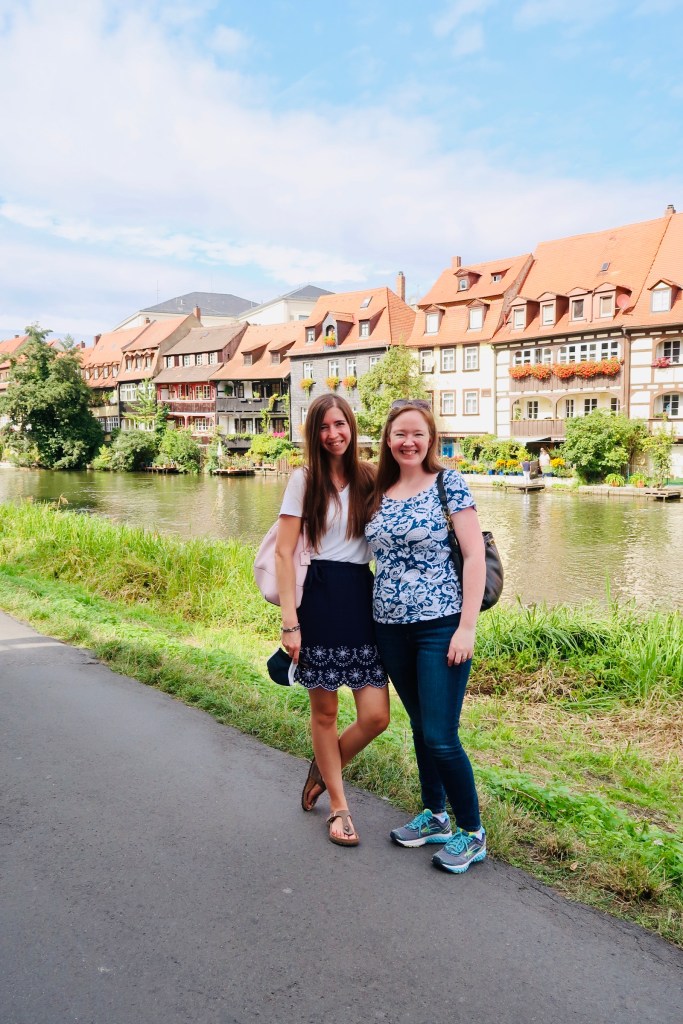
Recently my friend Kim and I went for a little day trip to the nearby city of Bamberg, Germany. Bamberg had been a city I had set my sites on for quite a while, not only for the fact that it’s your typical old-world German town, but also because of its history. We spent a day walking along the streets, seeing the Altstadt Rathaus, the bridges, a never-ending antiquary (old, used books- seriously the coolest), and the churches. We didn’t do everything we could have done, but we had a lovely casual day wandering around.
A little bit of history on Bamberg…

The first mention of Bamberg dates 902 as a mostly Slavic settlement. In the early 11th century, the Holy Roman Emperor (Henry II) made it a family inheritance and a separate diocese from Wurzburg. Once all the border details were sorted out, Henry II ordered the building of a new cathedral AND a Benedictine abbey for the training of clergy. With their involvement, Bamberg became a center point for the Holy Roman Empire; the Pope had visited several times, consecrated some of the churches, and thus, both Henry and his wife, Kunigunde, are buried in the Bamberg Cathedral. 

Through the centuries, the city started to expand and change, going through the reformation and land changes. In the 17th century, the witch trials came to Bamberg and claimed around 1,000 victims. The 17thcentury also ushered in the University of Bamberg. Finally, it 1803 Bamberg became part of Bavaria after losing its independence the year prior. Bamberg has also played a role in the political landscape of Bavaria- being a safe place for the state government in World War 1 (after a communist uprising), the location of the passing of the first republican constitution of Bavaria, and then the venue for the Bamberg Conference, a conference convened by Hitler to stifle dissent within a young Nazi Party. 

In 1993 Bamberg became a UNESCO World Heritage Site for its authentic medieval appearance. 

One final fun fact: Bamberg is known in some places as a “Franconian Rome” as its geography extends over seven hills. Each hill has its own church at the top, overlooking the city. 
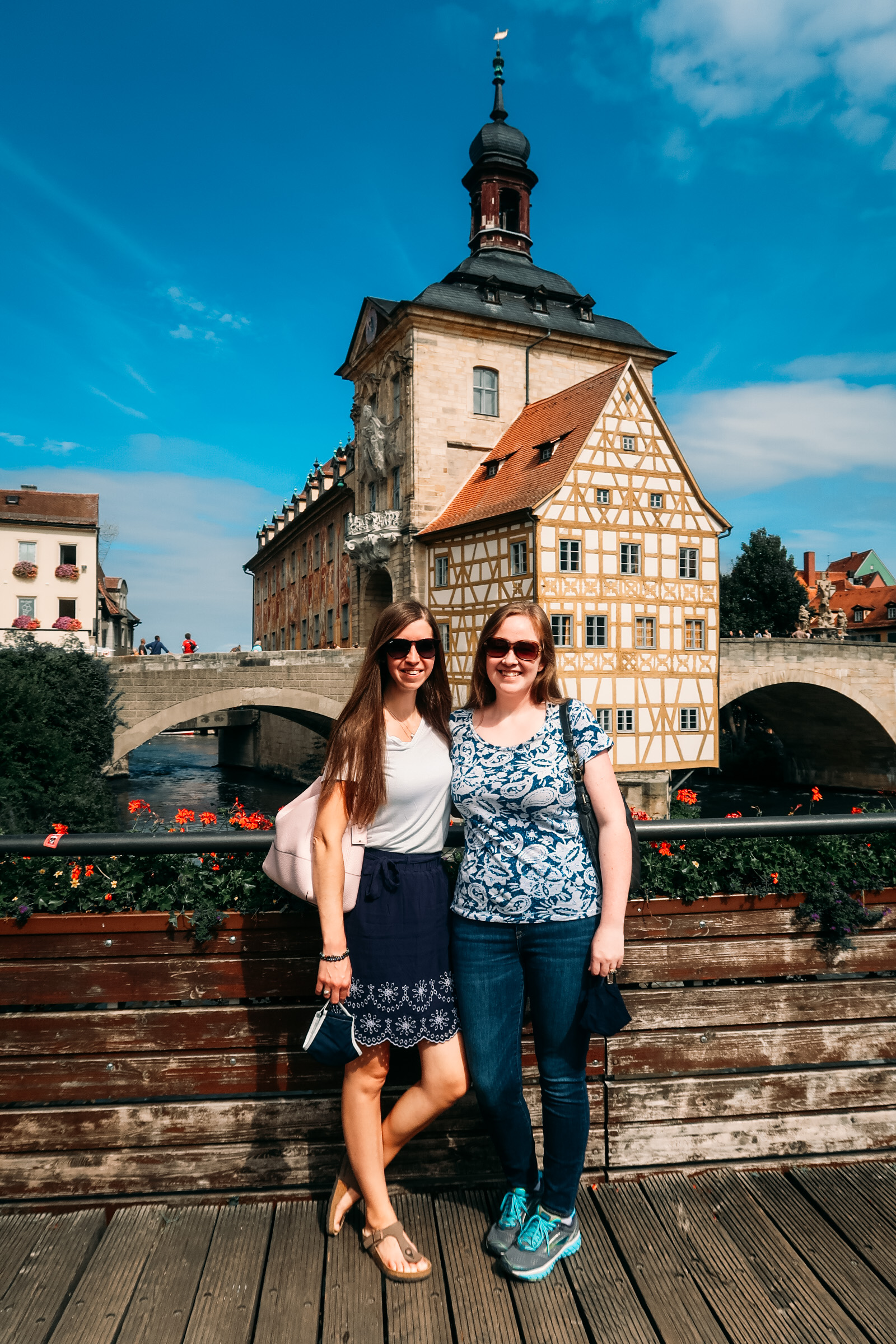
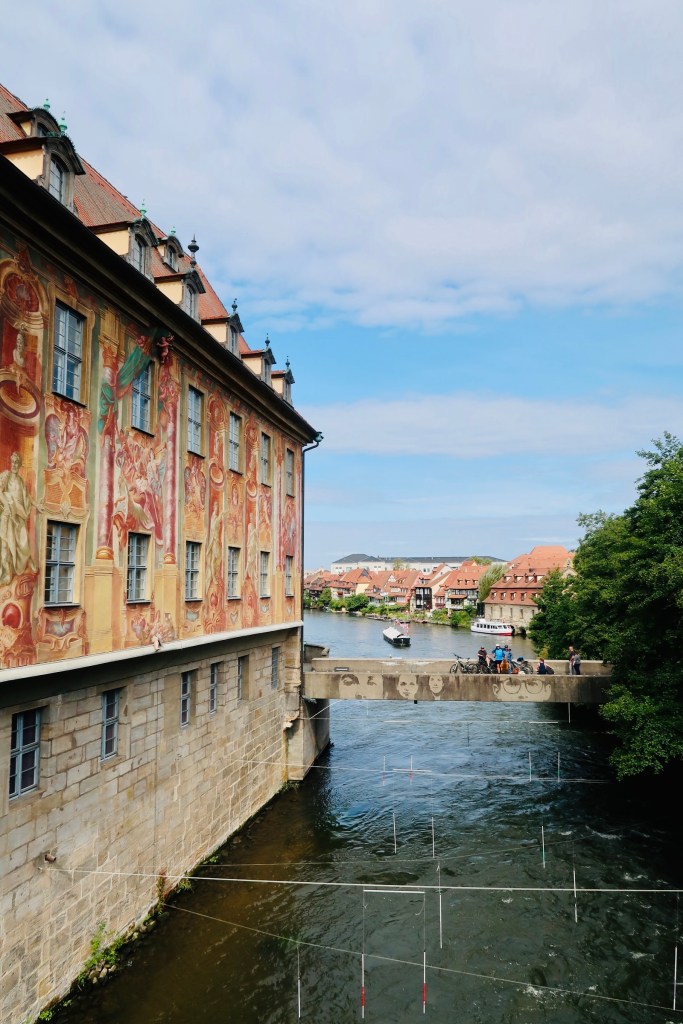
We started our day off walking the Obere Brucke, which is one of the bridges connecting the lower town to the hills. Halfway across this bridge is the Rathaus (town hall). The legend of the town hall is quite typical of the time period: the bishop did not grant the citizens approval to build a town hall, so they took matters into their own hands and rammed stakes into the river and create an “island” on which they built their town hall. The frescoes painted on the town hall are quite incredible, giving it a 3-D appearance- although there are a couple spots where it isn’t just an appearance.  
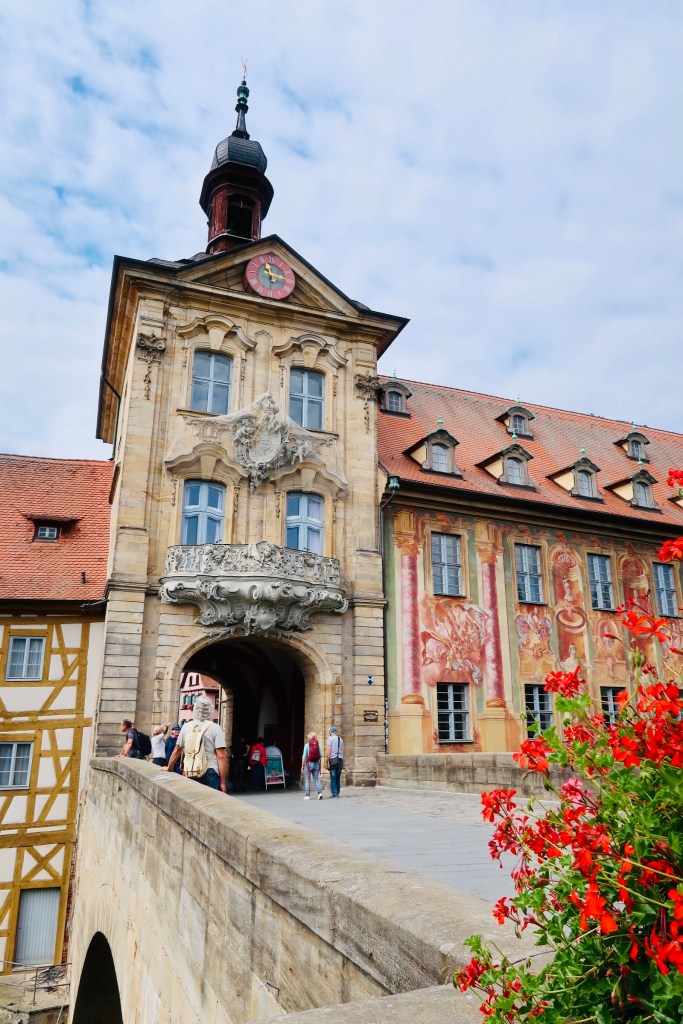
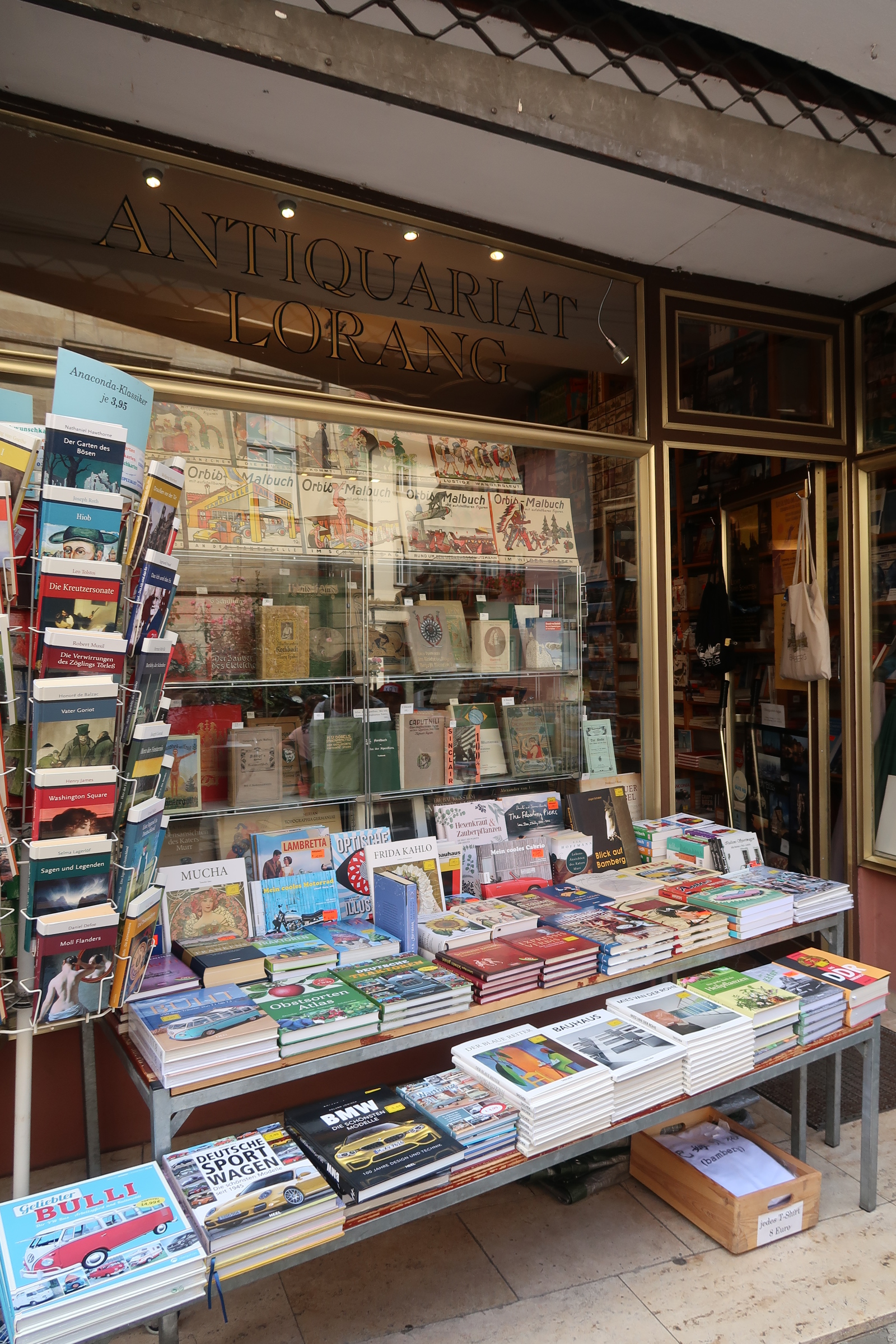
From the bridge we wandered through the streets, stopping in the Antiquariate Lorang. I’m mentioning this mostly because it was basically a store of old books that never ended. If you’re a book or bookstore lover, it’s one of those stores that you dream of going to at least once a week. Filled floor to ceiling with any and all books (and some notebooks), most dating quite far back it was just a dream to walk through and look at everything. It was a great start to our day. 

We wandered the streets a little bit more, then started to climb up on of the hills towards the Church of Our Lady (Obere Pfarre). This church is Bamberg’s only purely Gothic church.
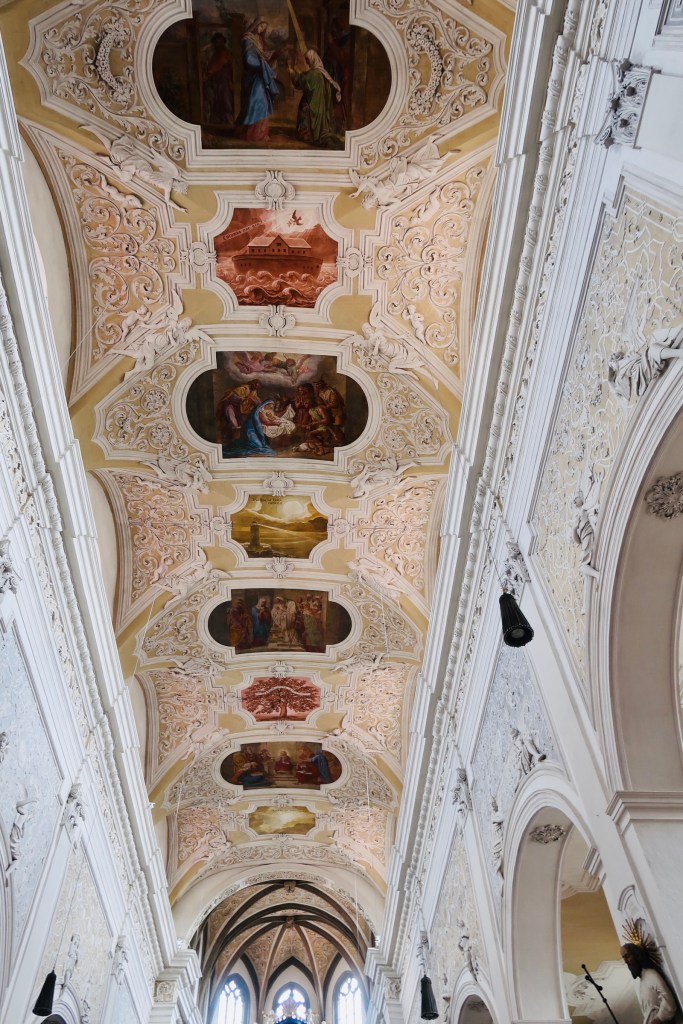
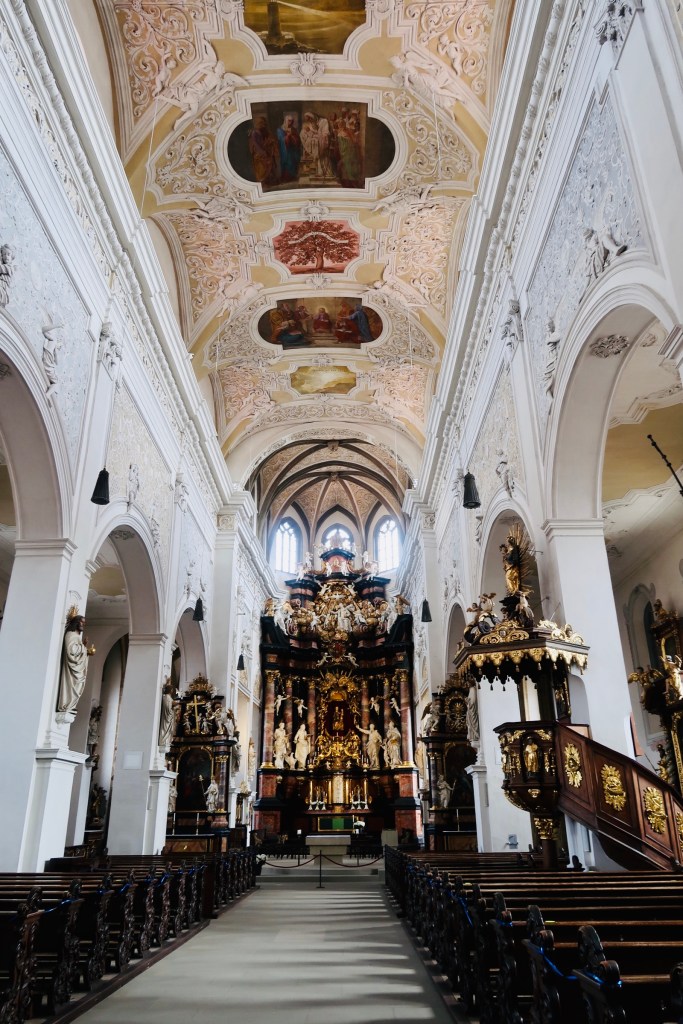
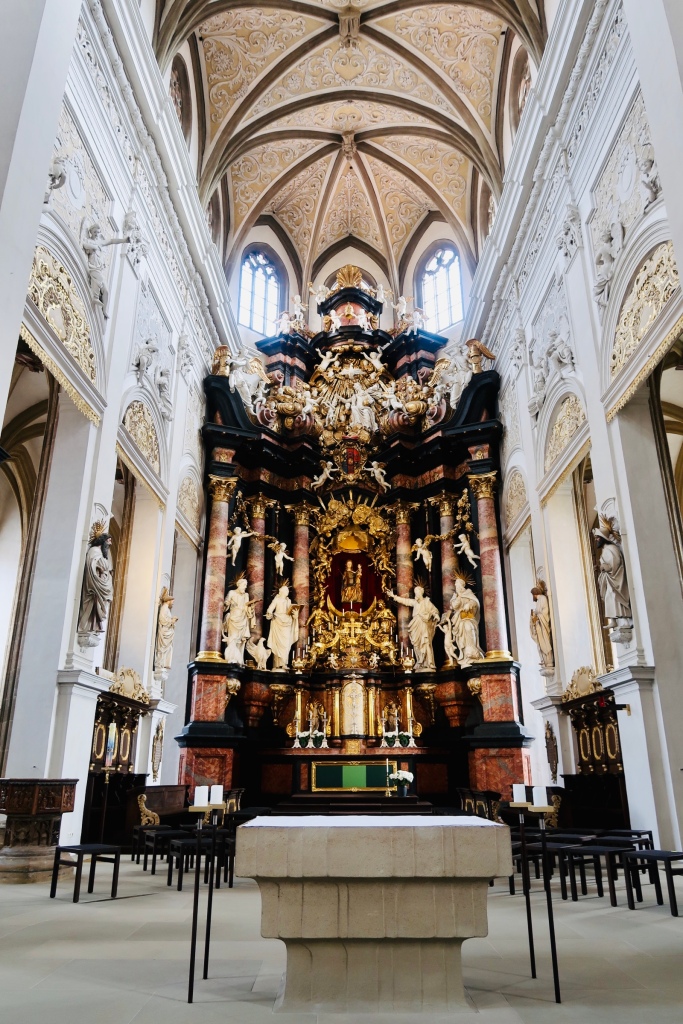
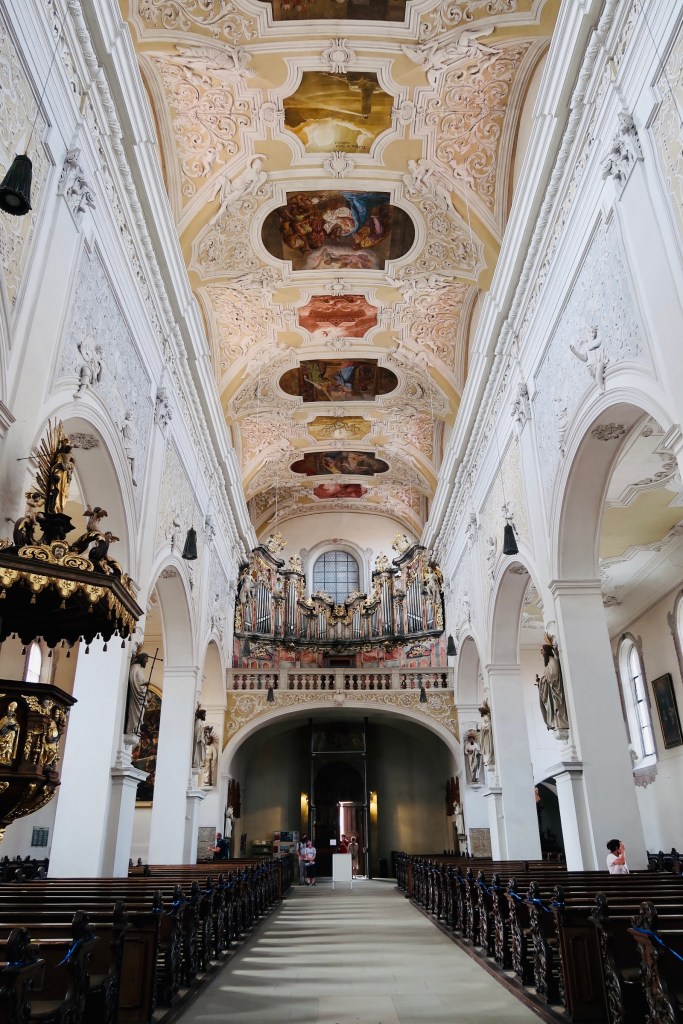
Planning of the church started at the end of the 13th century, with construction starting at the beginning of the 14th (the foundations date 1375). There were quite a few additions and rebuilds to the church, including damage done by an aerial bomb during World War 2. Walking inside the church was breathtaking. I don’t know if I have the words to truly do this one justice, so the pictures will have to speak for me. A few bits- the paintings are from the 19thcentury by Adolf Riedhammer, with some repainted in the 1930’s by Hans Bayerlein. There is a walnut portrait of Mary with Child which was from a school in Cologne dating around 1250. There is an incredible painting of The Ascension of Mary by Tintoretto that you can view as well. Overall, this was one of those churches that you really just have to walk through. 

From the church we headed over to the New Residence. To get to the New Residence you go through the Old Court. The Old Court was originally the Castrum Babenberg and then the palace of Henry II. It then became the Bishop’s residence and it features an incredible gateway from the square to the inner square. Now, the Old Court is a historical museum and a small chapel for civil wedding ceremonies. It was really neat to see (I love Timber Frame anything ha-ha) and there was actually a wedding reception while we were there!
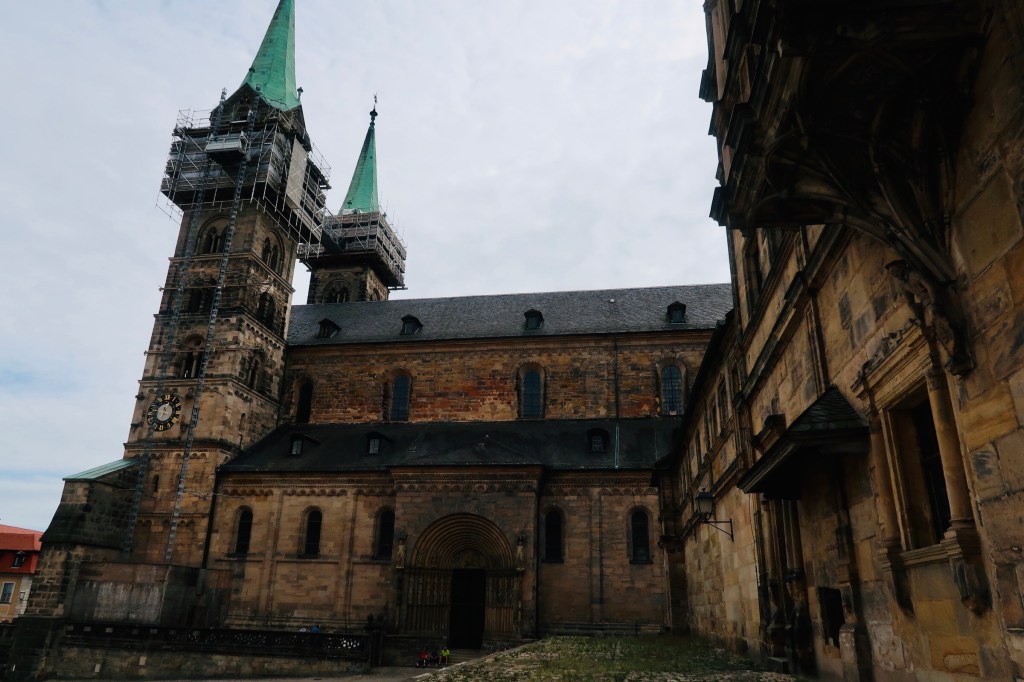
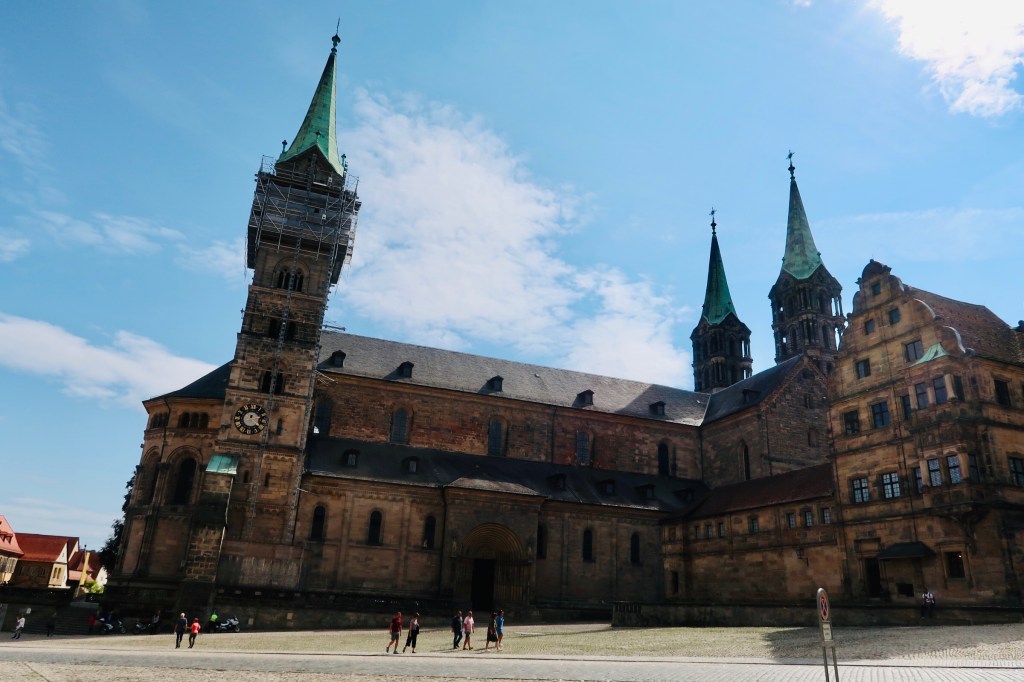
We walked through the gate and on to the main square of the New Residence and Bamberg Cathedral. The Cathedral Square is at the top of one of the seven hills and is the heart of the city. Before we went into the Cathedral, we went over towards the Library, Residence, and Rose Garden. The New Residence served as the seat of Bamber’s prince bishops. There are 40 magnificent rooms filled with artwork and lavish furniture. You are able to tour the inside of the residence which not only takes you through a few of the rooms, but shows you a large Bavarian State art collection. We elected to head over to the Rose Garden in the inner courtyard and take a little rest and relaxation moment. 
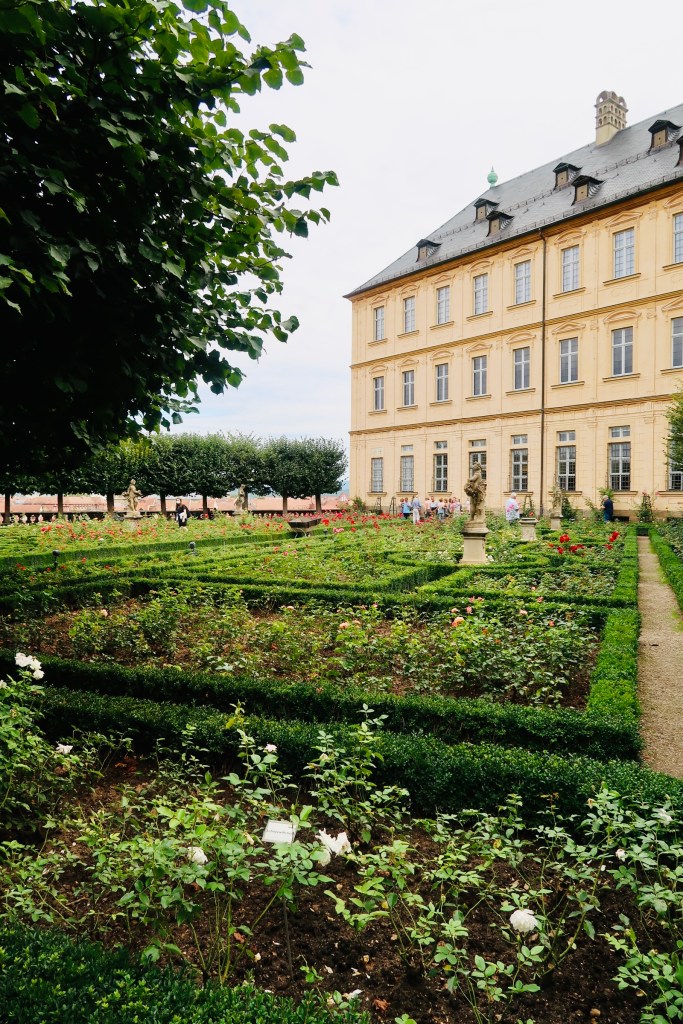
Designed by Friedrich Karl von Schonborn, the Rose Garden contains around 4500 roses, along with several sculptures, a fountain at the center, and an absolutely incredible view of Bamberg. We stopped at the café in the garden pavilion and had a lovely treat of a pear/mint lemonade and light food. In the summers there are musical performances in the garden and the entire area is so enchanting.

After a refreshing pick me up, we started to head out, first stopping real quick at the State Library. 
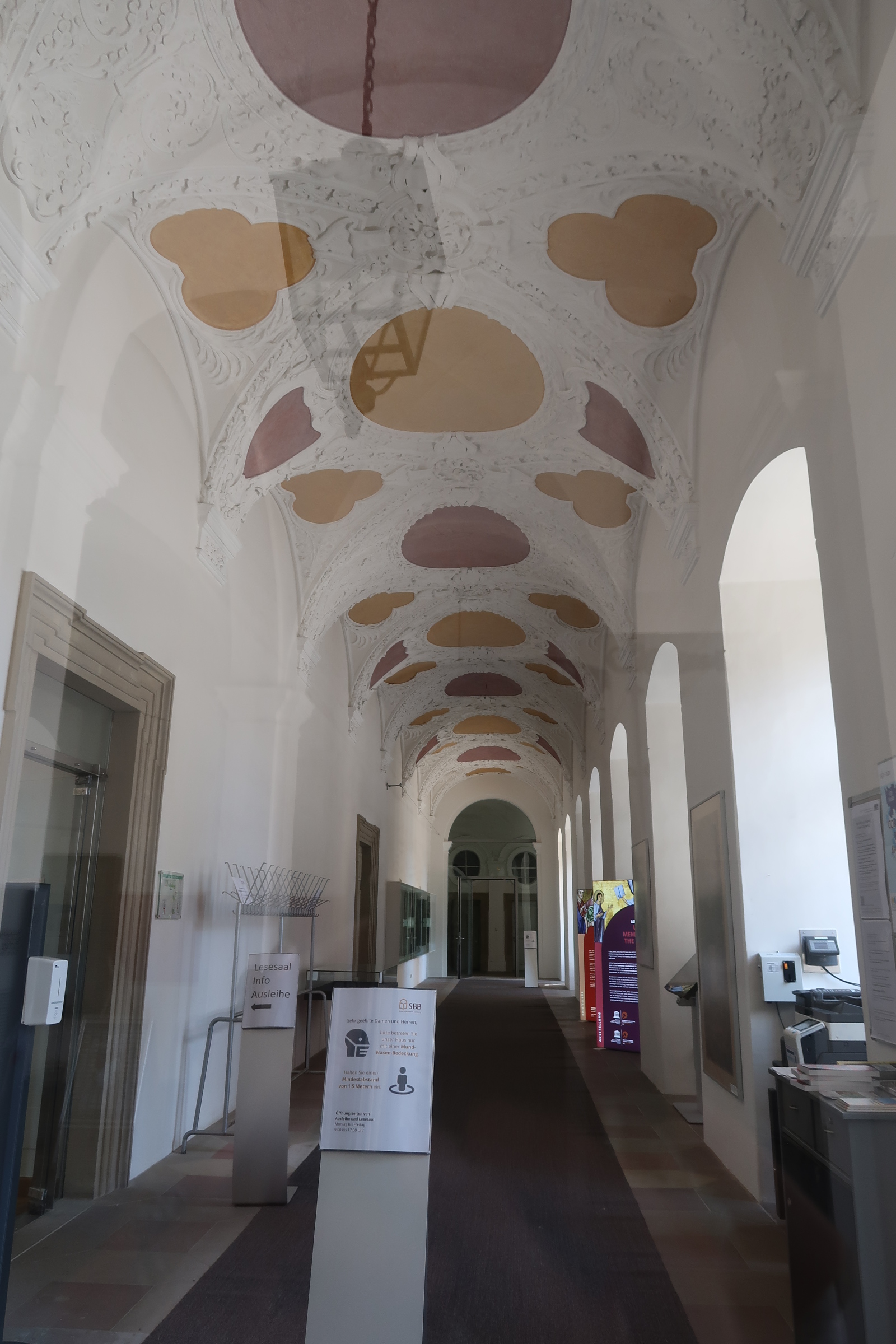
Let me tell you, some of our American libraries can learn a thing or two. The little glimpse we got to see inside was just incredible. The vaulted, painted ceilings, the quiet peace that comes from the library, the pristine collections, it was incredible. Not only that, but the library contains quite a few manuscripts dating from 1000, as well as 3 Reichenau manuscripts that are listed on UNESCO’s World Heritage documents. We only got a glimpse, but it was a pretty neat spot. 

Finally, it was time to make our way to the Cathedral. St. Peter’s and St. George’s Imperial Cathedral is the legacy of Henry II.

The cathedral was completed in 1012 (after only 10 years of being built!), however it took 3 different constructions to get the current cathedral due to fires. Now, when we visited there was quite a bit of restoration and reconstruction being done, so we weren’t able to see the Bamberg Horseman and the alter and such were tucked back in the construction. We were able to see the tombs and the overall look of the cathedral. The thing that makes cathedrals so special in ways, is not how incredible they are on the interior (though they can be) is just the sheer craftmanship it takes to craft and build a cathedral (and most built before our modern engineering and technological advances. 

Our last stop of the day was to head down to Little Venice.
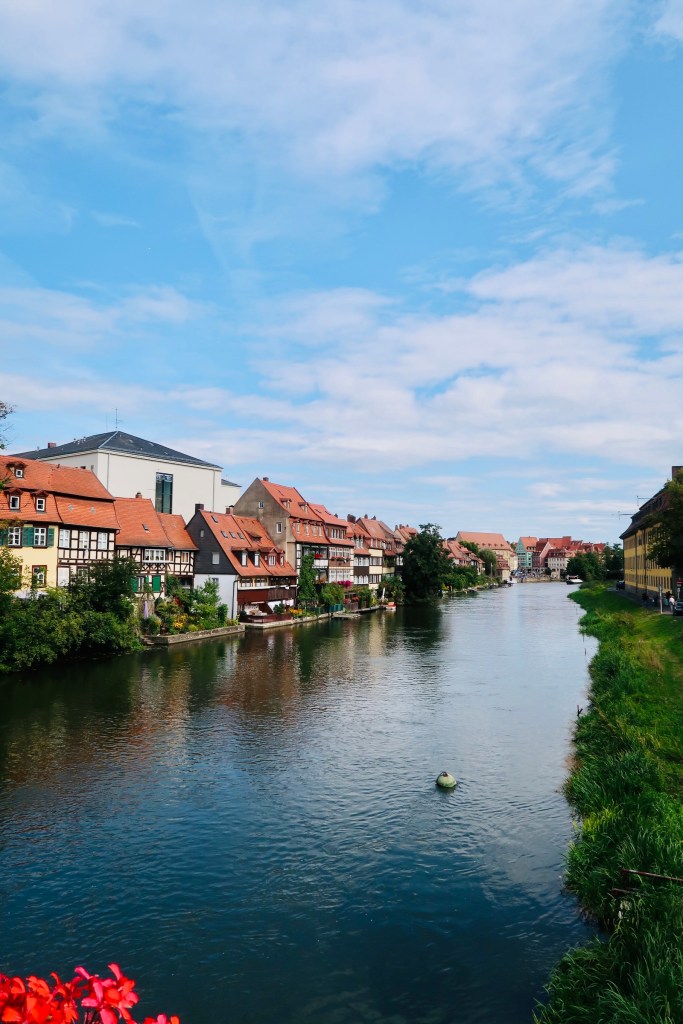
This is a former fish district of the Island City. The river way is lined by half-timbered buildings that date back to the Middle Ages and each has a little tiny garden. The homes are right next to each other, holding each other up in some cases, and sets quite the little backdrop. It is absolutely adorable and was the perfect picture of Bamberg to end our day with. 

The only thing that we missed that I wanted to do would have been St. Michael’s Monastery. This is the home of the abbey that Henry II commissioned. I would have loved to see the monastery and walk its walls and church buildings (and garden), however it is currently closed due to restoration work. If you do get the chance to see it, do!

And that was our day in Bamberg! It was the perfect little outing and day trip for us. 
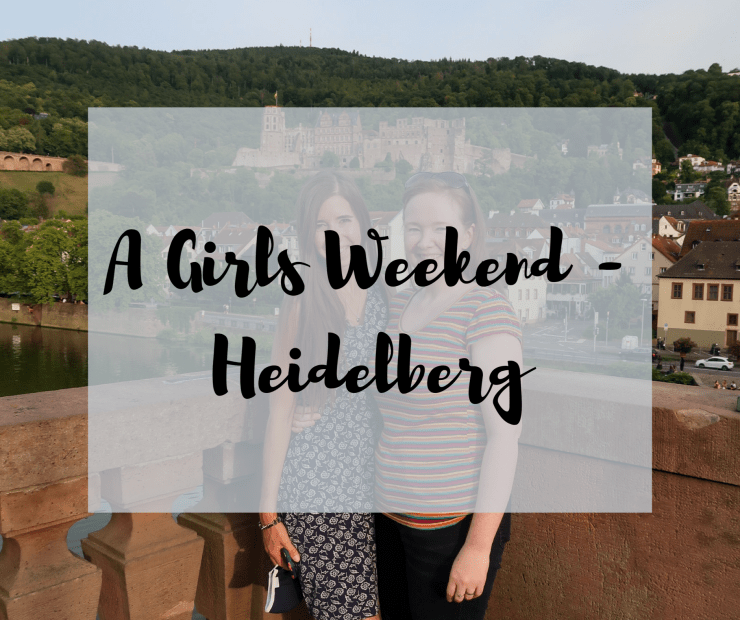
A Girls Weekend- Heidelberg

After months and months, I finally was able to do my little girls’ getaway! Back in March I was supposed to go on a girl’s weekend to Prague. This was something that we had planned, booked train tickets, an Airbnb, and some things to do while we were there. Then everything shut down in Europe and we had to cancel the entire trip (and any hopes of doing any girls things at all that weekend-even locally). In the grand scheme of things, it wasn’t that bad, but it was definitely a bummer for us, and I’ve been waiting since then to be able to do a little get away. So, when a free weekend popped up, I took it and one of my best friends, Kim, and I headed out to Heidelberg.

Heidelberg is a university town in south-west Germany, right on the Neckar River. The city itself has been designated a “City of Literature” and has quite a scientific hub as well within the university. The city also serves as the site of the remains of the earliest signs of human life in Europe ( a jawbone was found in 1907 dating back 600,000-200,000 years ago). Heidelberg as a region dates back to the 5th century BC, with the Celtic people and then the Byzantine/Roman Emperor Valentinian building homes in the location. In the 1st century AD a Christian church was founded inside the Celtic Fortress, with a Monastery and Abbey being added in the 12th century.  The actual founding of Heidelberg is considered to be in 1196. Heidelberg then went through two changes of “rulers” first the house of Hohenstaufen, then the Duke of Bavaria, Ludwig I acquired the city. In 1386, Heidelberg University was founded and, finally, of the upmost importance to me, Heidelberg’s library was founded in 1421, making it the oldest (public library) in Germany. So, a lot happened in the town’s history, long before our more modern history.  

A couple other random facts about Heidelberg, before I get into what we did on our 24 hrs…

Heidelberg went through quite the religious battle (as did most of Europe at one point or another), concerning Lutheranism and Calvinism. In fact, it played a leading role in the conflict, hosting Martin Luther shortly after his Ninety-Five Theses. Heidelberg was also a key player in the beginning of the Thirty Years War, after Frederick V was overthrown in 1621 by the House of Habsburg. Heidelberg has seen several different countries invade, including Sweden and France. And, during World War 2, Heidelberg was a stronghold for the Nazi Party (the NSDAP-National Socialist German Workers Party). The local populace was very much on the side of the Nazi’s and the university served to build an amphitheater and hold rallies during Hitler’s rise. While Heidelberg wasn’t targeted by bombings or other air raid actions, the old treasure bridge was destroyed (3 arches) by Germans fleeing in March of 1945. One final note, Heidelberg has one of the largest American communities outside of the United States (and I can definitely see why), along with an overall large population of expats from around the world. 

Ok, so now that we’ve got the history of the city out of the way (seriously- that was much longer than I had originally intended), let’s talk about what we did. We basically spent 24 hours wandering the Altstadt (Old Town), just reveling in being in an old German Town. The fact that it’s home to so  much history gives it a certain…feel and we just wanted to soak that up. 

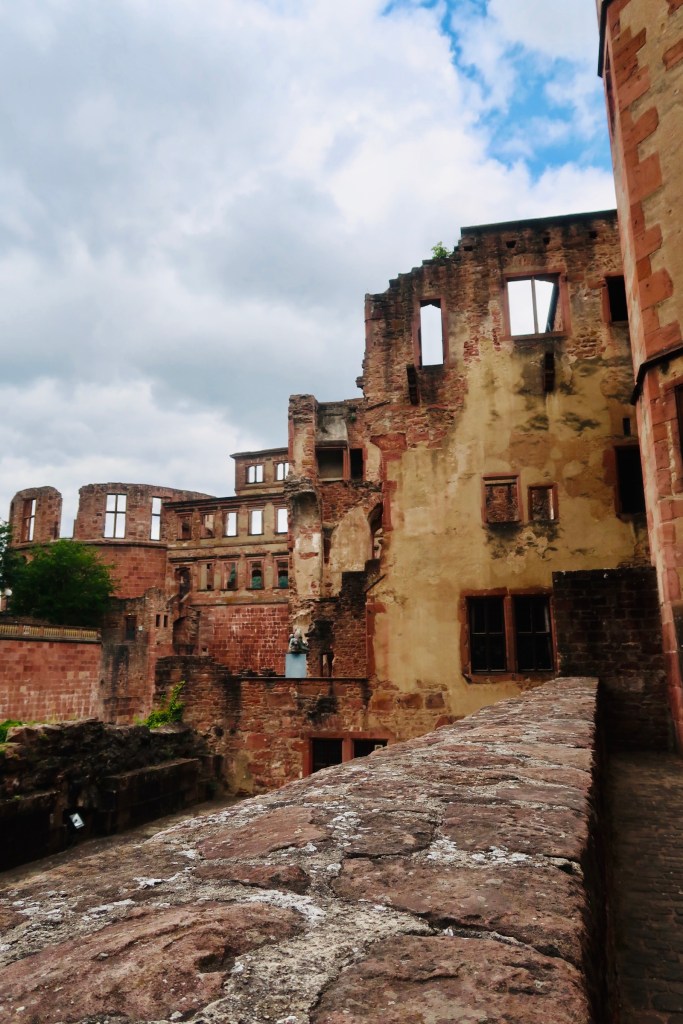
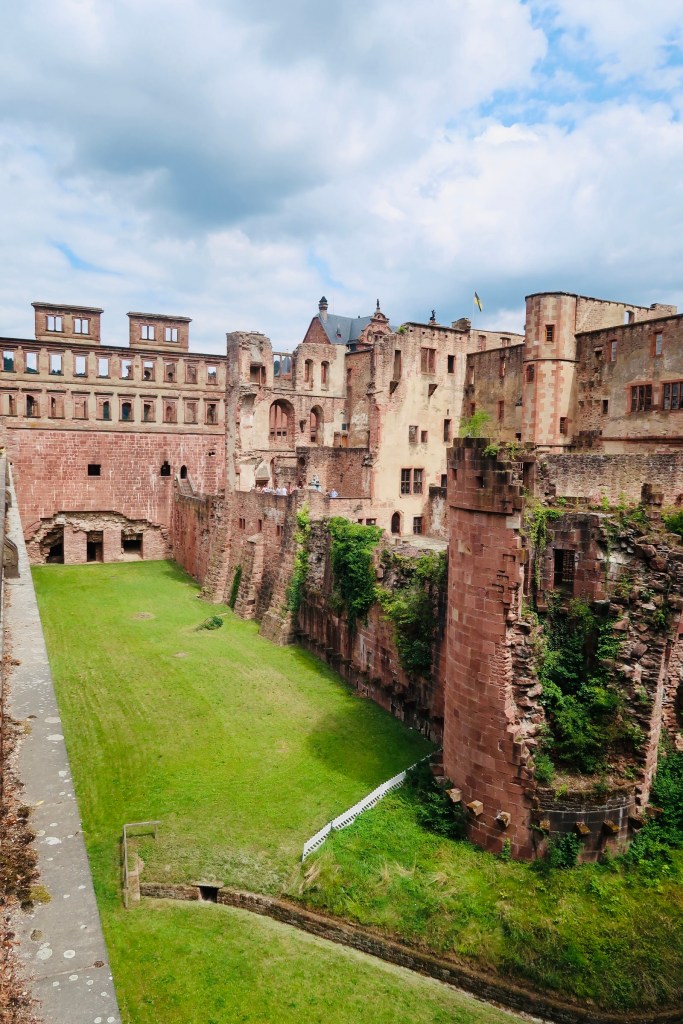
We started off at Heidelberg Castle. I’ll be doing a full castle post on it, but I’ll touch on some of the basic information in this post.

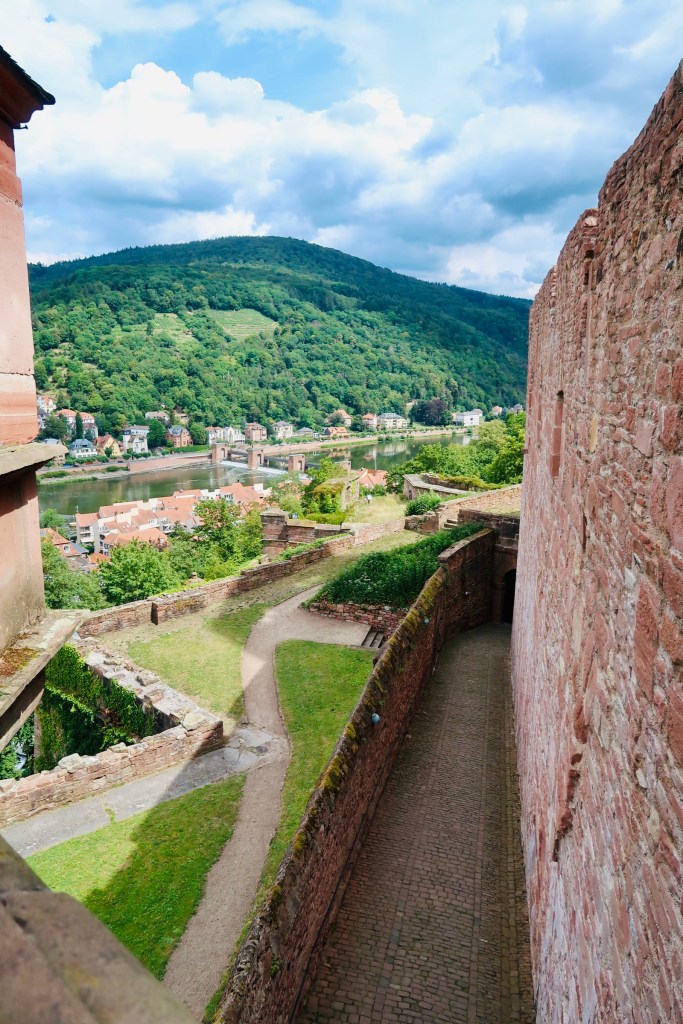
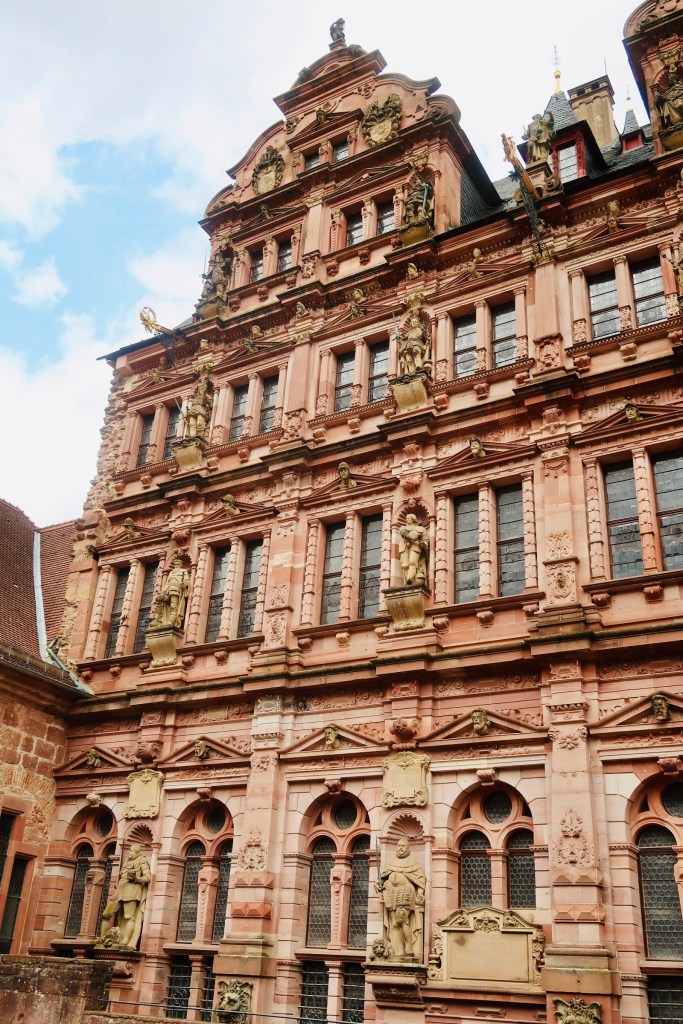
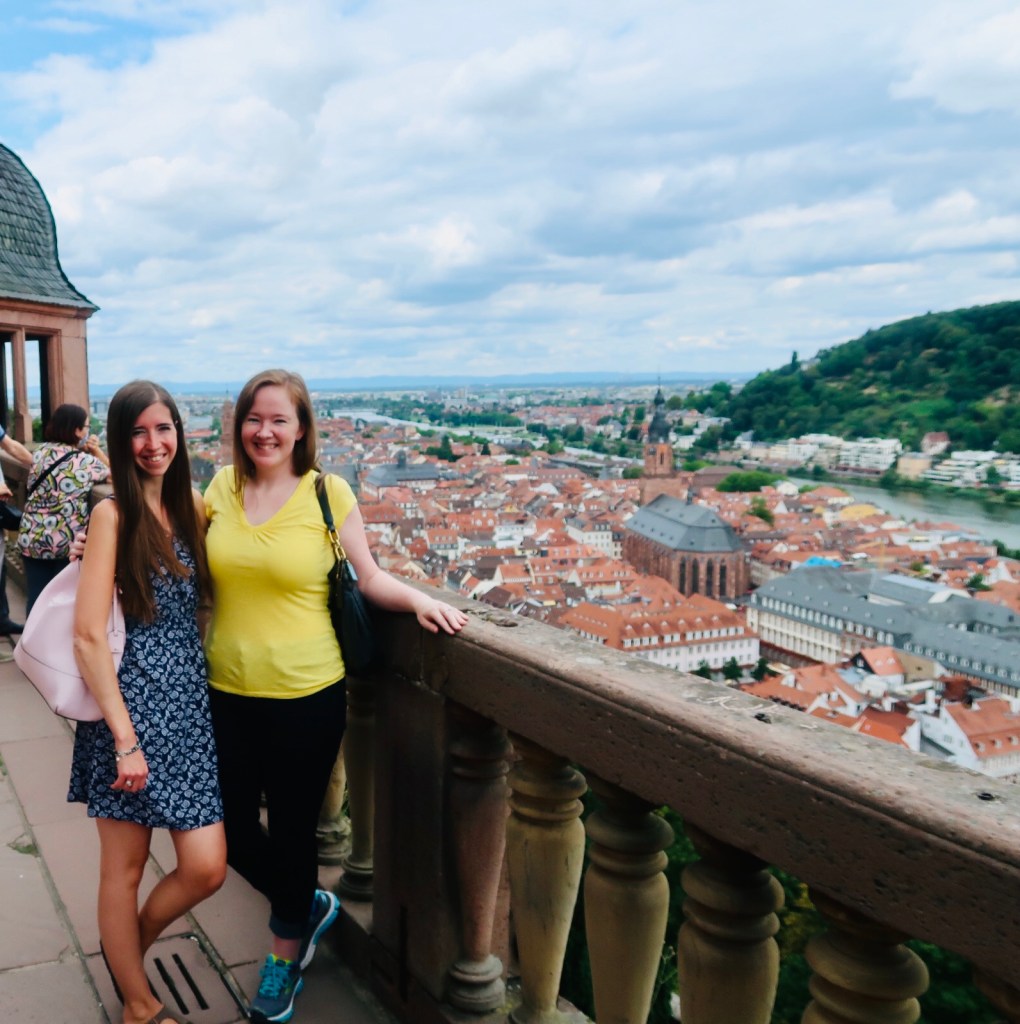
The castle was first mentioned in the early 2nd century when the Duke of Bavaria (Louis I) received it from the Hohenstaufen Emperor. From that point on, the castle became two castles, upper and lower. The Upper castle was destroyed by a lightning bolt in 1537. The present castle was expanded in 1650, to then be damaged by war and fires, before another lightning bolt struck in 1764. It was incredible to walk through the walls of the castle, then along the ramparts overlooking the city, and finally just outside the main walls along the side of the complex. It has a real feel of history and tells a multitude of stories. 

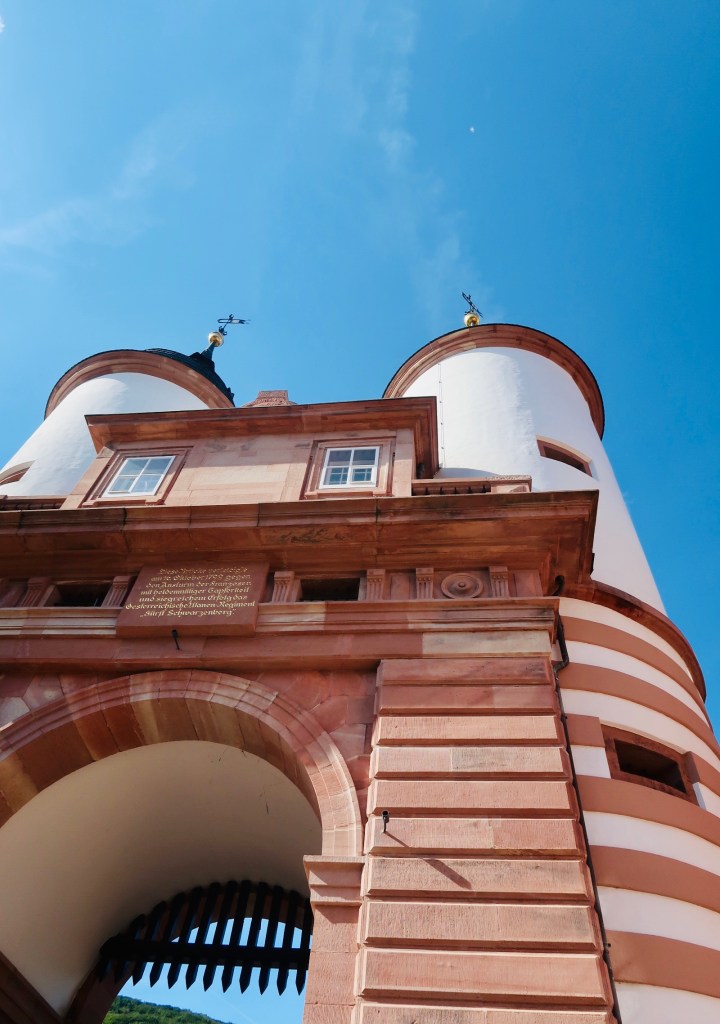
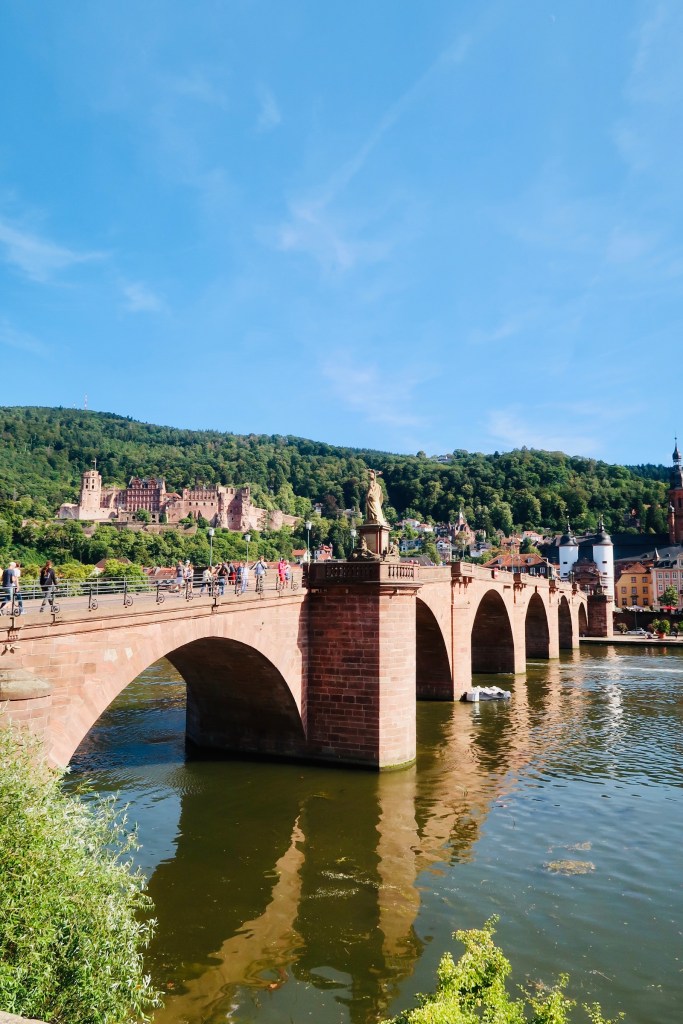
From the castle, we checked into our hotel, and headed to the Old Bridge. The Old Bridge is actually the Karl Theodor Bridge, an arch bridge that crosses the Neckar River.

The current bridge is actually the ninth built and is dated back to 1788. The bridge location has a storied history (it had to have been with Heidelberg being on its’ ninth bridge) of bridges being destroyed by mother nature and wars alike. The medieval bridge gate on the Old Town side of the bridge dates back to the original town wall, however the tower helmets were added with the new stone bridge in 1788.  

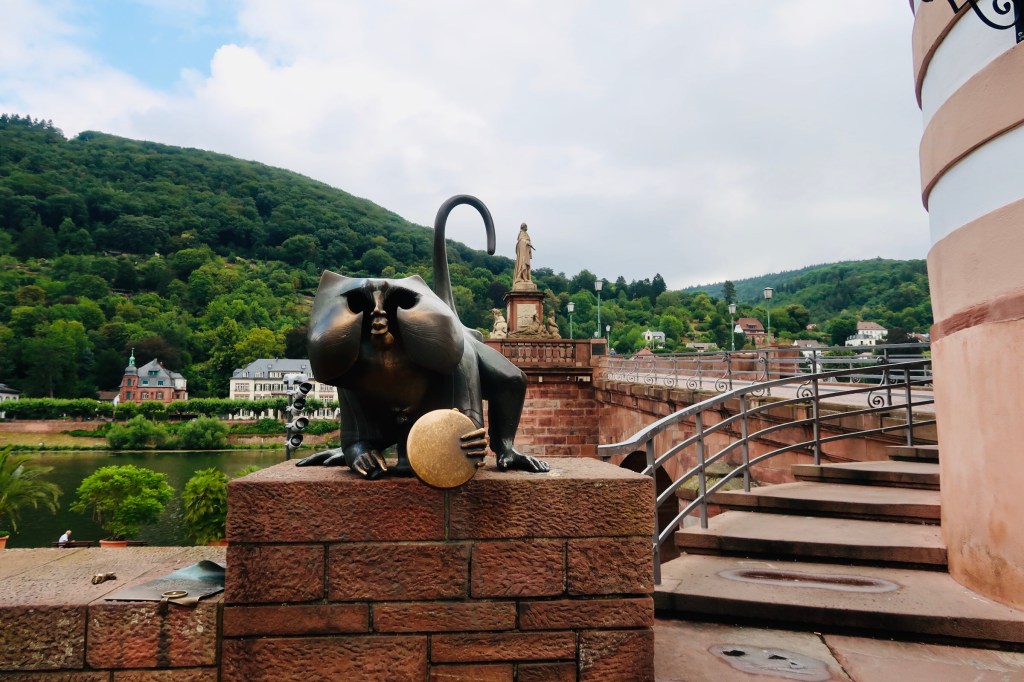
A fun fact, on the gate side of the bridge there is the statue of a monkey (it’s ok if you don’t see the monkey until you read that it was a monkey- we originally thought it was a cat) which has quite the story attached.

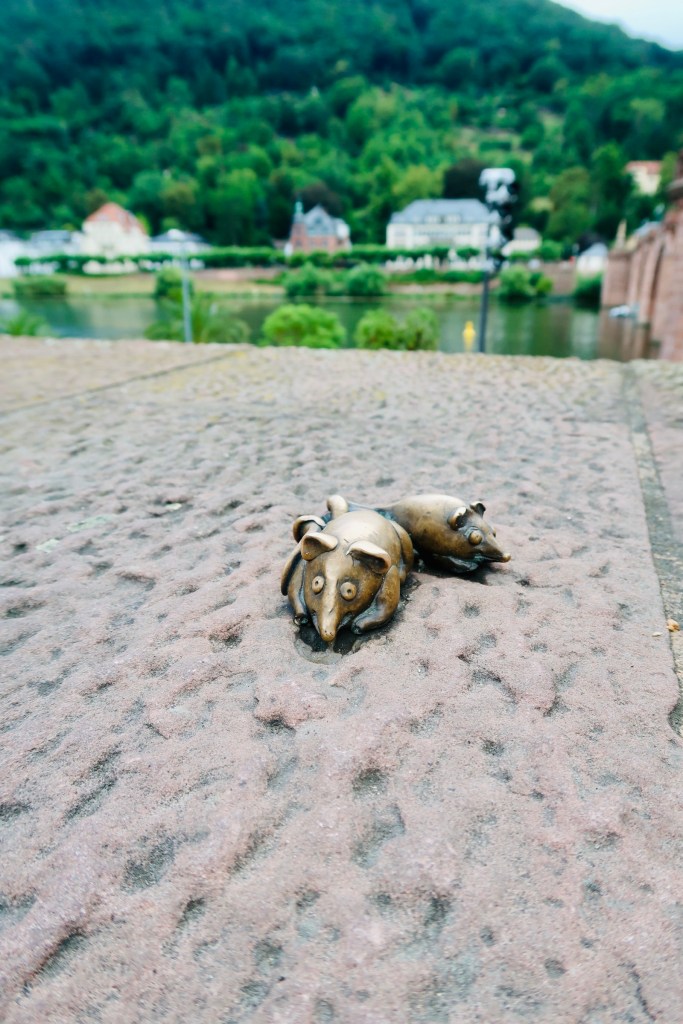
The original monkey dates back to the 15th century and was placed within the tower to represent mockery against the tower’s representation of fear and respect. The monkey had a mirror in one hand (to encourage critical self-reflection) and his other hand on his…rear end. This was turned so that his rear end was facing across the river towards Mainz; which in turn was how the people of Heidelberg told the Bishop of Mainz that he had no power in Heidelberg. The 15th century version of an…eff you. The current bronze statue was installed in 1979 and legend says that if a visitor touches the horns, they will return to Heidelberg, the mice will provide fertility, and the mirror will provide wealth or good luck.

Our hotel was right at the Altstadt side of the bridge, so we were on it…a lot. We walked across to the other side of the Neckar and wandered down the water a bit before heading back over. We got some dinner right off the bridge and then wandered down and around the main street of the Altstadt. It was fun to just wander the streets and take in everything. 

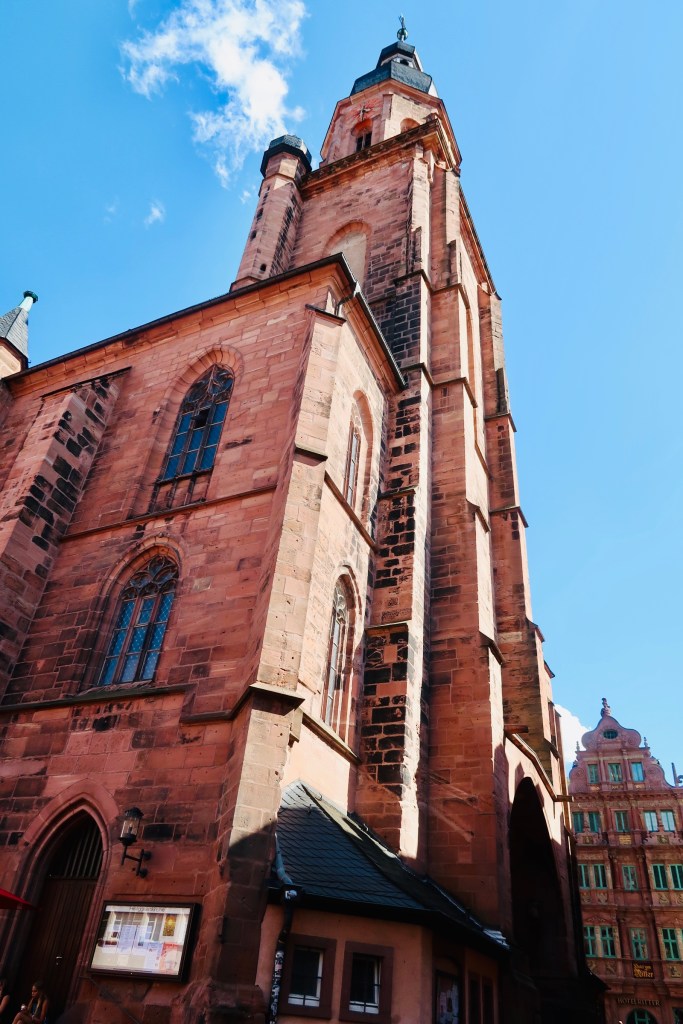
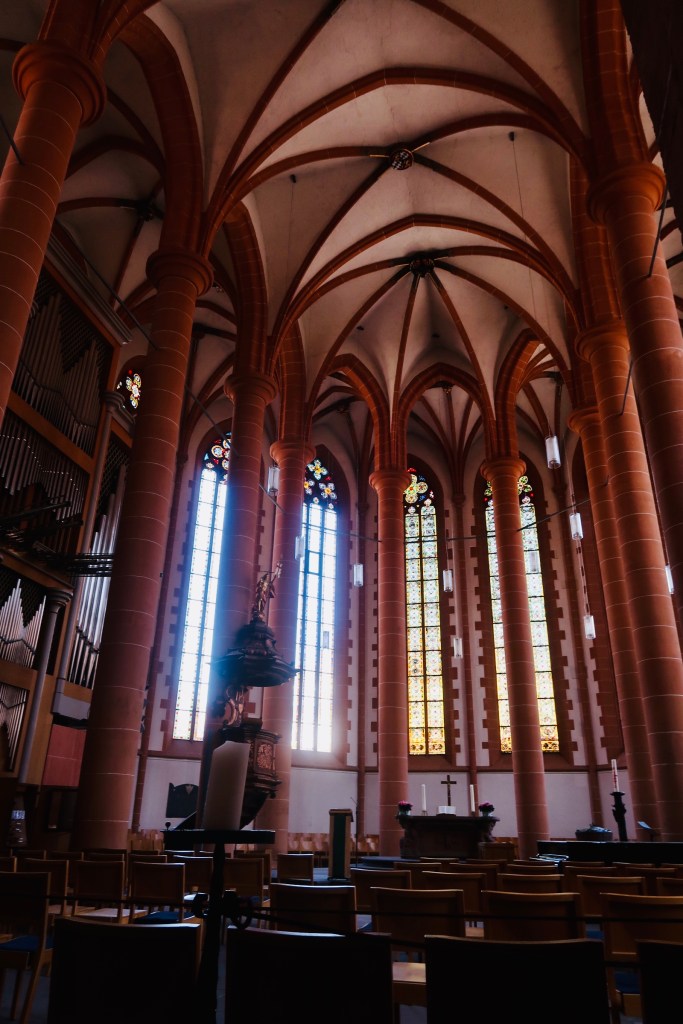
Our final stop of our trip was a stop into the Church of the Holy Spirit, a church that dominates the main square of the Altstadt (and the steeple dominates the entire city).

The first mention of a church on this site is from the 13th  century, then in the 14th century another Gothic Church, and finally this church during the 15thcentury. The construction took around 150 years to complete, however it was interrupted for a period of time, and has been rebuilt once due to being set on fire by the French. The church did have the Palatine Library; however, the collection was taken during the Thirty Years War to the Pope and are now, on the whole (only about 885 manuscripts were returned) in a dedicated section at the Vatican Library. 

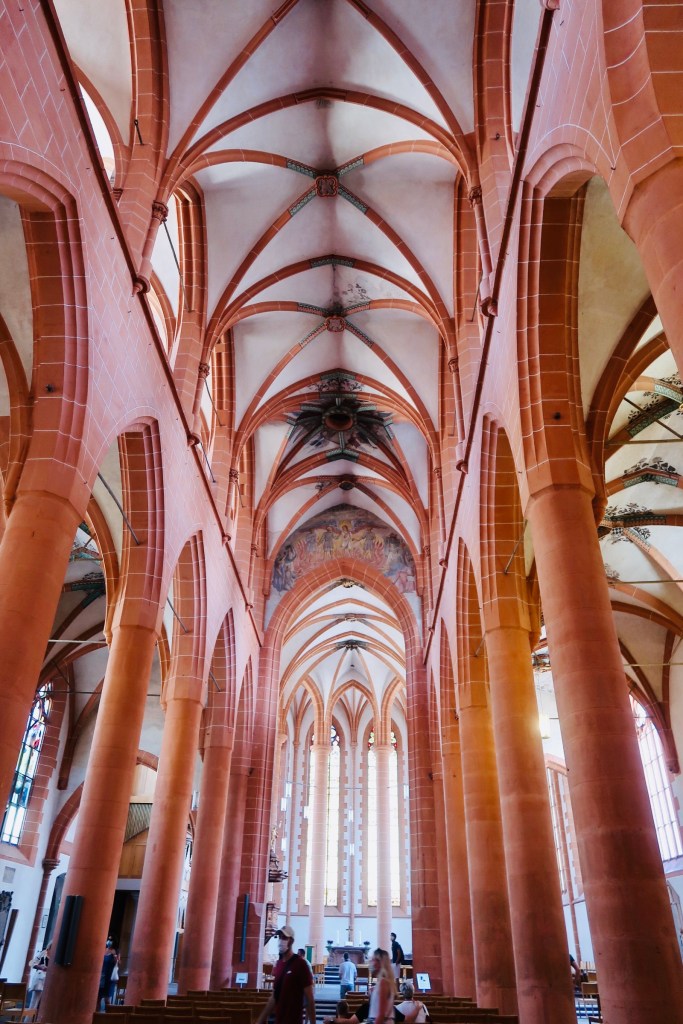
One of the things that I really liked about the church was how there was a little market set up on the direct outer walls of the church. Market stalls were set up within the walls of all different varieties, which reminded me of something straight out of a Ken Follett novel. The church itself was incredible and not what we were expecting at all. The walls and ceiling had a pink hue to them and the church itself had a simple elegance to it. 

The only thing that we did not get to do, but wanted to was walk up the Philosophers Walk. This is a walk (or hike) that offers scenic views of the old town from the opposite side of the river. It was a tradition of the philosophers and professors at the university to walk and talk along the path. If you hike a bit farther up you can see the ruins of the Monastery, the amphitheater, and the Celtic fort.

Overall though, we had such a wonderful time and I really recommend a trip over to Heidelberg. It, once again, reminded me just how much I love Germany and the German Old Towns. There is not a bad choice to make anywhere within the Altstadt and even just sitting along the river is incredibly peaceful. 

A Cuppa Cosy Summer Holiday 2020 – Belgium

Ah, Belgium. This was our second time in Belgium and I’m putting that very lightly as we visited a museum in Bastogne before heading to Luxembourg last year (we also went to Luxembourg this year). This year we wanted to not only stop in Bastogne again to see a couple more stops, but also to see Brussels, Belgium. There are a couple of really pretty cities in Belgium (Utrecht and Brugge are the tops), but we decided on Brussels.

Before we get into Brussels though, I want to talk about our stops on the way to Belgium. Our first stop was the Bayeux Cathedral. The Bayeux Cathedral is easily one of the coolest and most unique cathedrals I think I have yet to see. Consecrated in the late 11th century, this church is not only neat on both the exterior and interior, but also was the original home of the Bayeux Tapestry.

Our second stop was in Bastogne. After leaving Bayeux, we headed to Bastogne to look at the Foxholes and stop at the Airborne Museum in Bastogne. The Foxholes are exactly what you think they would be, but something about it just felt like walking on sacred ground. I think because we all know the story, we’ve heard the names, there is a bit more of a personal note, that walking the forest just felt…different to walking other places.

From the foxholes we went over to the 101 Airborne Museum. The museum is located in the former officer’s mess building of the Belgian Army, which was also used by the German Army during the occupation. Once the war ended, it was used as a Red Cross Hospital. It has been transformed into a museum that displays a collection of items from the fighting as well as a basement that has been transformed into a bomb shelter.

The museum is incredible, BUT fair warning on going down to the basement area. I would not say that it is…kid friendly, but it is important to experience. Walking down the stairs you are taken to a small dark room where you experience what it would be like to live during the battle for Bastogne and that was just…something that was hard to do. I don’t even have the words for that experience, just that I cannot imagine. From there you then walk along hallways that show various scenes (recreated…with mannequins- again not necessarily suitable for kids, depending on your children’s level of coping and understanding) from the battle. This includes the men fighting through crevices in the defenses of the building, to surgery scenes, to items that were found in the nearby forests and on the streets above. It was something to see and experience and something I will not forget for a long time.

Untitled Design 71

Brussels has long been a settlement, but it became fully known in the late 600’s when a chapel was built on the banks of the Senne River. The city was then officially founded about 300 years later and has been a place of rebellions, battles, and economic development. We spent most of our day in Brussels walking around the old town area, snacking on waffles, and absorbing the sights. Brussels was a really cool mix of old world and modern, with a hint of opulence and we enjoyed our day exploring. We stayed in a hotel called Hotel Noga and were very pleased with our room and the service.

IMG_6854We started off with a breakfast of…(drumroll please)…waffles. I mean, we couldn’t go all the way to Belgium and not have some waffles. We stopped at a spot in the National Galerie called Mokafe and had some delicious waffles, Strawberry for myself, chocolate for the boys, and berry variety for my husband. Absolutely delicious. Fun fact about the waffles, there are actually two varieties: Brussels and Liege. Brussels are hard rectangle and topped with powdered sugar and some variety of berry or chocolate. Liege waffles are more oval and tend to be more of your…grab and go waffle. The sugar in Liege waffles is also baked directly into the waffle.

After filling up on the delicious waffle and cappuccino breakfast, we headed out to wander. We started our day at the Church of St. Michael and St. Gudula.

This is a relatively “modern” cathedral and church, having only gained cathedral status in the early 1960’s. The church itself dates back to the 11th century, with completion in the 16th, and is currently used for ceremonies of national interest (it is host to royal family events). It was stunning, one of those churches you can’t help but admire.

From there we headed through more of the Altstadt and over to the Grand-Place of Brussels. This seemed to be a common stop for us throughout the day as we gravitated back here several times- which makes sense as it is the central square of Brussels.

This UNESCO World Heritage Site is the most important tourist destination of Brussels, with guildhalls, Museum of the City of Brussels, and the Town Hall rising up around the square itself. The buildings are displays of opulence with gold touches and gothic architecture. It was voted (at one point) the most beautiful square in Europe and I think I would agree. The square is opulent, but not overbearingly so. It’s definitely the heart and was full of life each time we were there.

We also managed to see Manneken Pis. Yep, you read that right. Manneken Pis is a fountain sculpture of a little boy peeing into the fountain. The first mention of the fountain was from the 15th century when it is mentioned about drinking water for the residents. The first bronze statue was placed in the 17th century, with the current statue replacing it in the mid 20th century. The Mannekin Pis has been the subject of several thefts (of which the punishment was severe) and several legends (which are all quite…interesting to read about). One of the Mannekin Pis traditions is to be dressed up in a variety of different costumes. These can range from famous individuals, to sport options, to holiday attire. Overall though, the Mannekin Pis is a symbol to the people of Brussels; a symbol of the sense of humor that they share and their independence of mind.

The final thing we attraction we saw in Brussels was The Basilica of the Sacred Heart.

First commissioned by Leopold II in the early part of the 20th century after being fascinated by Paris. His original intent was to model his church off of the Sacre Coeur in Parish (HERE) with a street similar to Champs Elysees (HERE) connecting it to the main city center. The Church was consecrate in 1951, awarded the designation of “Basilica Minor” in 1952, completed in 1969, and is now the 5th largest church in the world. This church also holds two museums, The Black Sisters Museum and the Museum of Modern Religious Art. You are also able to go up to a balcony right under the dome to get a bird’s eye view of Brussels.

Once again, this was incredible due to the sheer size. You can definitely feel the more sleek, modern (almost non frivolous, sparse look), art deco style of the church throughout, but the size is just a site to behold.

After finishing up with the Basilica, we wandered back towards the main center square, did a little shopping and picked up some dinner before heading to our hotel. We definitely did not see everything that Brussels has to offer, not even close, but I feel like we got a good amount in our one day there, and were able to get the “feel” of the city.