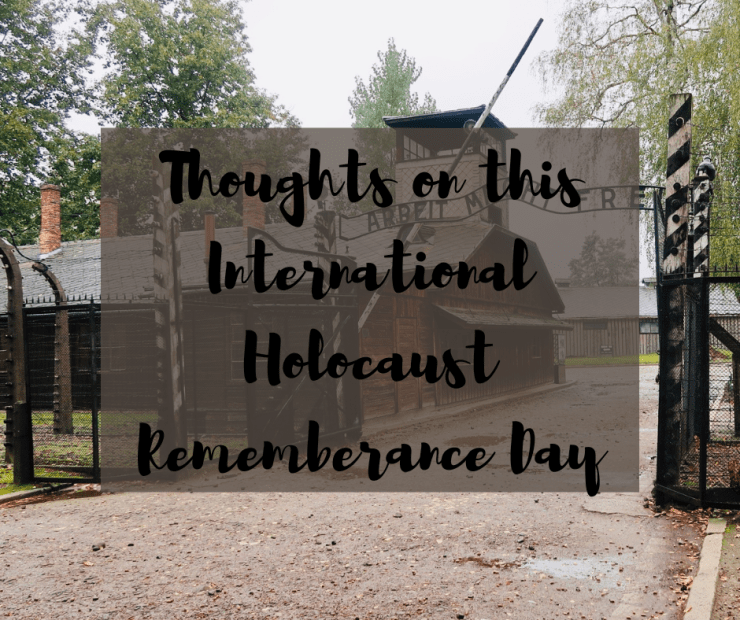
On this International Holocaust Remembrance Day

I said I wanted to share more of my heart on here, I wanted to share more real-world stuff, more of my “unfiltered”/” real world” thoughts, but man it’s scary! Especially on a day like today, in a world like we are in…but here goes.

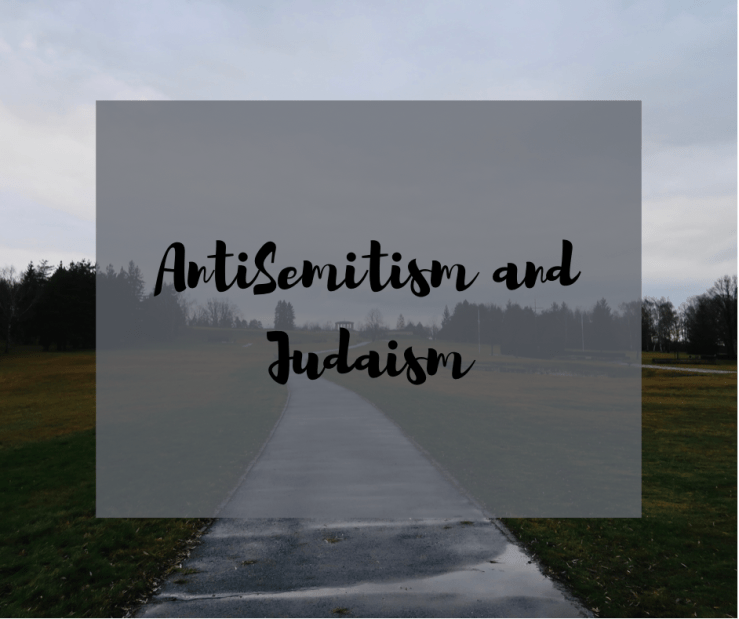
Today (well the day that I am writing this- not sure if it’ll be posted same day or if I’ll sit on it for a couple days) is International Holocaust Remembrance Day. It is the day that the U.N. decided should be used to remember the Holocaust as it is the day that Auschwitz was liberated by the Allies. 80 years ago, today. In fact, the picture in the featured image (also below) is the sign at Auschwitz. The sign that has become synonymous with The Holocaust- which the saying and sign ARE, BUT this Auschwitz sign was actually at the “nicer” side of Auschwitz. Not the side that the Jewish people lived and starved and were murdered in gas chambers.

I feel like it’s important to note that this is NOT the day that the Jewish people mourn and remember- the Jewish people have a dedicated holiday called Yom HaShoah, which is in time with the Warsaw Ghetto uprising (you know- the notable important time when the Jews fought back). ***Don’t worry I’m trying to edit out some of my anger in this post***

Today I feel conflicted. It’s so important to remember (you know- we all say Never Forget like the good little citizens as the rise of Jew Hatred surges to unimaginable numbers), but this year I am filled with anger, with sadness, with heartbreak, with hope (because the Jewish people will survive), with frustration. 

We have people in power politicizing gestures (which- let’s face it, that was what it was regardless of how it was then politicized and the reaction from the person who did it was disgusting at best, horrifying and terrifying at worst- and that margin is microscopic), while Jews are being attacked physically and emotionally/mentally every day. There are BABIES BEING HELD BY A TERRORIST ORGANIZATION, but go off on a hand gesture (which again was what we all thought it was) fam. 

We say, “Never Forget” and then turn a cheek at chants, flyers, disruptions on college campuses intended to terrify, to harm, to disrupt. We say, “Never Forget” and then twist our bodies into pretzels to justify an actual TERRORIST ORGANIZATION kidnapping CIVILIANS and BODIES and holding them hostage for over a year, chanting horrible words, parading their crimes as others cheer. We say “Never Forget” as a holocaust survivor just passed away in December, having survived both Holocaust, but losing two of his GRANDCHILDREN on October 7th

***And let me be clear because there will be those who NEED this disclaimer because they don’t know me, they don’t know my heart, my feelings, my beliefs and they will take this post and turn it into something entirely different. I should not have to say this but here I am- you can be pro the Palestinians living in peace in their own home AND be pro Israelis living in peace in their own homes. You can recognize the actual history of the land and the people and not try to rewrite it to continue twisting your pretzel. You can be with the families of those murdered in cold blood on October 7th and the day, months following, be with the families of these hostages, these CIVILIANS, who were brutally taken, be with all of the people who are now living with very real trauma. You can do all of that and still believe that both sides deserve and need peace. It’s not one side only. Not if you have your humanity intact.***

Words have power if we give them power, right? And how do we give words power? With action. Never Forget means to never forget- it means both holding the memories of survivors, sharing their stories, facing the atrocity head on, AND stopping the rampant Jew Hatred, both overt and subtle, in its’ tracks. 

So, this year, on this International Holocaust Remembrance Day, I want to not only see all the shared posts about “Never Forget”, but I also want to see a post about present day Jew Hatred that needs to stop. I want to challenge you to go beyond the minimum, to truly embrace “Never Forget”. Because we are forgetting. 

Almost 2/3rds of American Millennials (millennials- my generation) and Gen Z do not know that 6 million Jews were killed in the Holocaust. 48% could not name a single concentration camp. 23% believe that the Holocaust is just a myth, didn’t happen or was exaggerated. These are HISTORY facts that folks don’t know about or don’t believe happen. Millennials and Gen Z are those who are leading the way (in a grassroots sense) for the next stage of our future. We have people on video calls saying we no longer need to carry guilt for the Holocaust. We need to move on. If we “move on”, if we do not learn from history, we are doomed to repeat it. And let me say this- we are repeating it. We are repeating it. 

So, I ask that you not simply say the words “Never Forget”, but that you give those words power again. That you speak about what you see. That you stand up. 

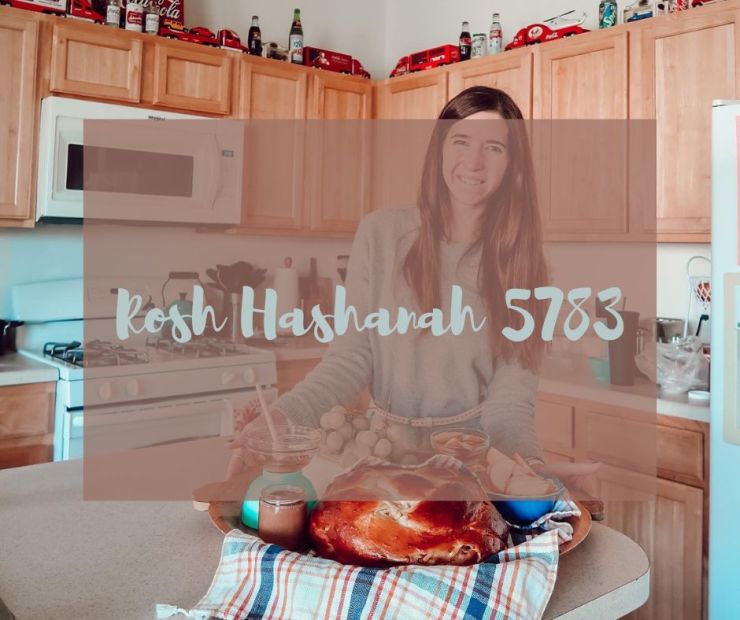
Rosh Hashanah 5785

Let’s be honest, I didn’t know if I was going to write this post. Honest. I didn’t know how to share the happiness, the joy, the celebration that is a new year while there is so much hatred, so much loss, so much heartbreak and anger. But, as I was sitting here getting ready for Chag (it’s currently 9:35 on October 2), I was just so overwhelmed, so moved and I wanted to get some of my words out. 

This year has undoubtedly been one of the hardest. Not to be Jewish- being Jewish is the easiest thing in the world, like breathing, but to exist in a world that wants to see Jews no longer. I know that sounds harsh, but that is the blunt honest reality we are living in. I have never in my life seen such vitriol, such pretzel twisting to make the Jewish people (and their state) the oppressors, such rewriting of history. It has been shocking. 

5784 was a tough one, probably one of the toughest we’ve experienced in a long time (and that is saying something), but it wasn’t all bad. 

Such unity, such embrace, such joy in simply existing, in being alive, in our blessings and protections from above in our faith and community. If it has been heartbreaking and horrifying to see outside the world, it has been heartwarming and comforting to see within our community. 

As we wander into these high holidays (some of the most important in our calendar) I know that we will be both celebrating, holding space for those no longer here, and also waiting with a small amount of bated breath- what next. But above all, we will be praying. Praying for ourselves, our families, our friends, our community, the hostages, the displaced, and our community as a whole. 

For me personally, 5784 was a tough one, but I am looking forward to 5785; to this fresh start, new beginning, and a lightness that I just feel is coming our way. I feel like it is going to be a bit of a transitional year on a personal level. I am doing a lot of looking, not necessarily just inward, but also at our larger community (and not even just the Jewish community). I am trying to once again find my place in it, find where I can do the best, and really strive to make an impact. 

There is a lot our world needs right now, but I believe at the core, we need to hold kindness in our hearts and in our words. I think we need to hold cooler heads, more abilities to listen and engage, and that these will allow for real meaningful change to happen. It’s a big ask, it’s a dreamer’s words, and sometimes it really seems impossible. To that, I think the best place to start is with kindness. Kindness opens doors, allows for cooler heads, and shows us a path forward. So, with that, my word this year is going to be Chesed (which is much much more than just kindness, but it embodies the feeling that I want to bring to this year).  

I hope this year brings peace, kindness, warmth, and joy to all of our lives. 

Jewish Literature 3rd Edition – Young Adult Fiction

It is time for the 3rd Edition of the Jewish Literature series! This time (and the next) I’ve decided to lower the reading levels and take a look at some young adult fiction and then Juvenile fiction works. I tend to read both in the Young Adult and Adult sections, and I’ve got kids who will eventually be transitioning into the Juvenile reading level (though we’ve still got some time). I know several folks who do have children in that age level who are interested, so I figured I would deviate and look to see what is out there. 

For the Young Adult selections-I stayed away from the Holocaust leaning books. I spoke about this several times, why I’m trying to not read Holocaust literature for this (though I will be several times over I’m sure) in my blog post introducing this series HERE. I’ve gone for two books- one a collection of short stories centered around Hanukkah and another a Historical Fiction that I found to be so relevant on so many different levels that I just had to talk about it in depth.

It’s a Whole Spiel: Love, Latkes, and Other Jewish Stories by Edited by Katherine Locke, Laura Silverman

This is a collection of short stories that all revolve in some way around the minor Jewish Holiday of Hanukkah. I read this book actually a couple years back and loved it so much. I included it in my recommendation list and still do to this day. I don’t have too much to say on this one as, being a short story collection there aren’t a lot of themes that I can touch on that push throughout the entire collection (beyond Judaism). When I originally read it, it was at a time where I was starting to share more and more of my own Jewishness online and I hadn’t really read anything like this before. These types of books didn’t exist when I was younger, going through the same ages as these characters, and I think it’s great that they are around now. 

I will say, something I really appreciate about this particular collection is that there is a wide wide variety of levels of faith, practice, and ethnicity. You have everything from Orthodox to agnostic, and almost all the stories, while centered around some aspect of Jewish life, also talk to other issues as well- whether that’s LGBTQIA+, political landscapes, able vs not, and more. I love when we can tie our Jewishness with other issues and conversations as well. Where we can see those through lines in these issues it helps universalize the problems everyone faces. 

I think overall, I think this is a great collection to pick up for teens! It does a great job at intertwining various issues and discussing them, while also keeping the reader engaged. I found that the representation of a wide cross section of Jewish life (that is the various levels of practice and life) to be very well done and representative of Jews in general. 

My Fine Fellow by Jennieke Cohen

Ok to start with- I highly recommend this, to any age level. It’s one of those books that I feel like can really work for anyone. A quick rundown, we’ve got Elijah, a street vendor, Helena a high society culinary student, and Penelope, a culinary student with a non-European background, all three of whom come together in a Pygmalion reimagining (think gender swapped food centered My Fair Lady). But what is at the heart of this book is the conversation around the rights, the lives, and the history of those who are not considered “white” or “Anglo”. In this we have two viewpoints represented – a Filipina and a Jew. 

The way this book effortlessly highlights the microaggressions and the assumptions and the really subtle way that Jew Hatred pervades our everyday is incredible. There are small moments where a character says side comments “Jewish Hawkers” or “those people”, the use of the word “Jew” as something vulgar, degrading, subtle digs at the othering of a group of people that occur even today, but we don’t always pick up on, to the more overt tones of being called a “dirty Jew”. We can really see the range of how being Jewish not only affects businesses- but Jews were also not allowed in the business district, were mostly stuck to selling oranges (thus anyone knowing their oranges was assumed to be a “dirty Jew”), to the history of Elijah’s family, changing their name to try and not “proclaim their religion and heritage to the world”. 

There were a lot of moments in this book that truly applied to our present day, though this was supposed to take place in the 1830’s- which I think just speaks to the unending hatred that the Jewish people face. There is also an element that speaks to the dual edged sword of Jew Hatred- there is hatred when the Jews do well- “the pursuit of wealth”, the greed and money hoarding- but also when they do not “the poor Jews of the street who eked out a living as peddlers and old-clothes men a blight on society”. So often this hatred is this double-edged sword, which is what makes it so long standing and dangerous. 

It’s important to note that this book not only speaks to Jew Hatred, but also to the othering of Penelope who is Filipina and that is something that both her and Elijah bond over. This shared feeling of otherness, the shared almost segregation of self due to experiences and community and life beyond their control. It’s amazing, as a Jewish person, to see a shared experience. As Jews we are often told that we cannot be subject ot discrimination for simply being a Jew because we don’t “appear different”. So, to read this…shared experience of these characters meant so much. 

In terms of the actual religious representation, there wasn’t a lot- mostly as Elijah is trying incredibly hard to be himself and not draw extra attention to any differences. He actually talks about this in the book, after his Jewish-ness is exposed as he doesn’t want to break a rule of Kashrut (Kosher eating). A lot of the Jewish history of this time period and this group of people is just about surviving, about not standing out, about holding on to the candle sticks, or the keys, or the mezuzah, but not practicing, not putting anything out that would easily identify who you are. And that is real, that is honest to how the Jewish People were for a long time. They either practiced under concealment or not at all. 

I highly highly recommend this one- great for all ages!

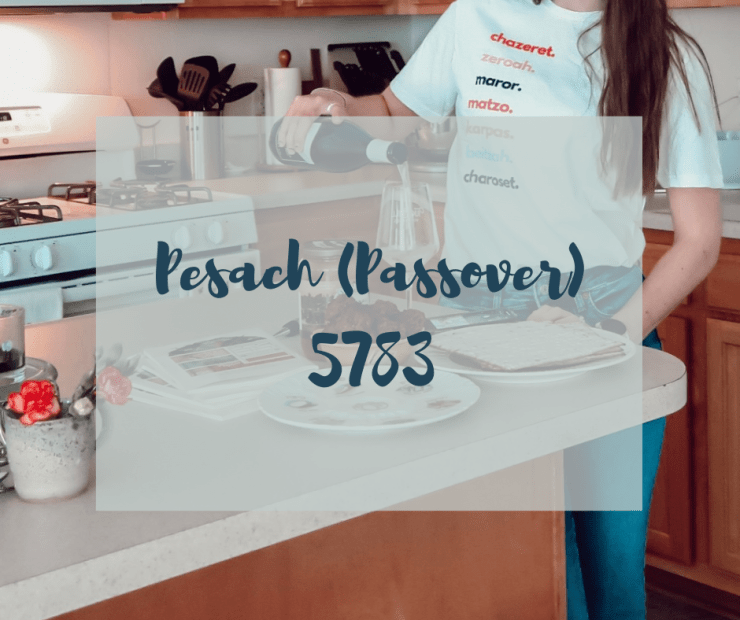
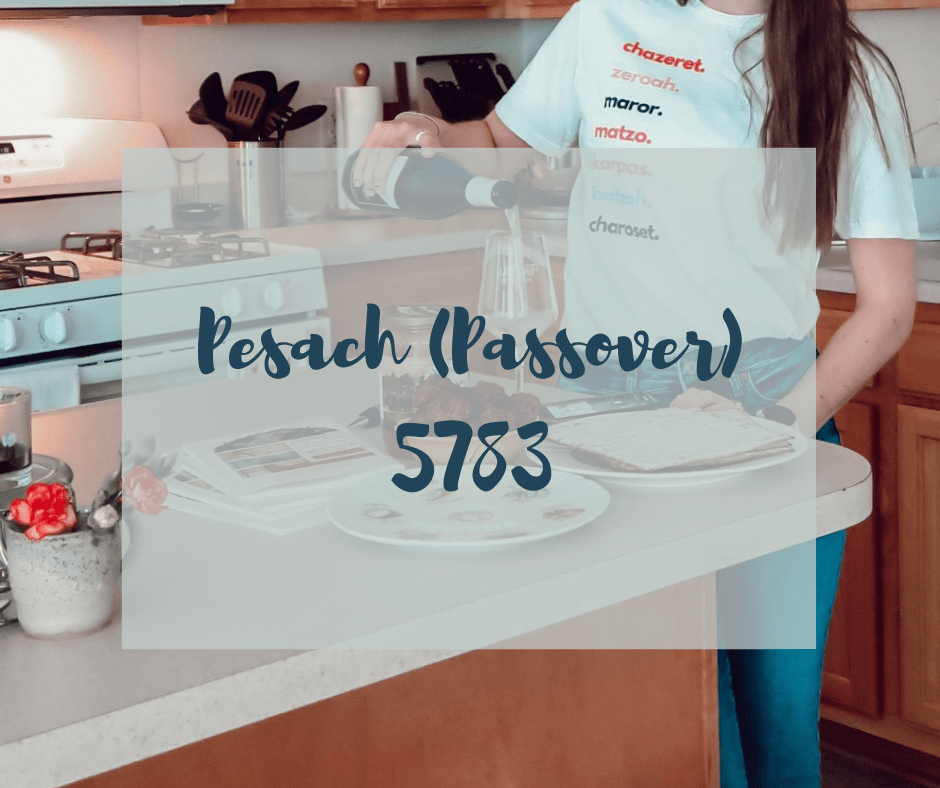
Pesach (Passover) 5783

***Fair Warning- this post jumps a little all over the place- trying to correct in the editing process, but you’ve been warned ***

Every time I think about the variety of Jewish Holidays we celebrate; in the back of my mind, I’m always clocking the kinds of celebrations we have. The level of preparation we put into them, the way that level varies from person to person, the way it’s varied for me over my life. It’s funny to think of them throughout the year- Rosh Hashanah and Chanukah are the ones I easily go the hardest for- they’re hands down my favorite. Purim is the one I probably do the least for, and Sukkot, Tu Bishvat, Simchat Torah all fall somewhere in the middle. Yom Kippur is so solemn that there isn’t sense in counting it- it’s spent in inward reflection and atonement. 

But these holidays are all different in the way we celebrate them within religious institutions as well. For Rosh Hashanah, Yom Kippur, Simchat Torah we celebrate in Shul, with prayers and services and so forth. Sukkot, Tu Bishvat and Passover are all seemingly celebrated outside of the Shul (though still with community and there are still Shul events to be attended). And of those, I personally feel like Pesach requires the utmost care and attention. It’s always, for me at least, been one of the bigger holidays on the calendar. Not only in preparation, but also in content. 

So, a quick word on what Pesach is, how we celebrate it, and then what my family specifically does (as it is different, and different year to year- this may change in the future who knows). 

Pesach (Passover) is the holiday in which the Jews celebrate their freedom from slavery during the Pharaohs time in Egypt. Without getting too nitty gritty, the Jews were slaves in Egypt (all those pyramids? Yea we built them), and Moses was given a task from Hashem to go to save the Jews. Throughout his speaking with Pharoah there were 10 plagues visited on the Egyptians by Hashem, the final being the death of the firstborn son of all the Egyptians. This last plague led to Pharoah releasing the Jews, causing them to flee in the darkness of night across the deserts of Egypt. Pharoah tried to chase after them, but they were free. Of course, they then wandered for 40 days and 40 nights and there was a whole bit about worshipping false idols, but it all ends with the Ten Commandments, and we are on our way. 

Pesach is the holiday where we acknowledge the struggle of the Jews, the fight for the freedom, and the wandering in the desert. How do we celebrate that though?

Well, for starters, because the Jews were not able to wait for the bread to rise before fleeing, we purge our house of all chametz (leavened/ing items) and abstain from eating any bread/grain items for 8 nights. If you are strict in your home, you sell all of the bread/leavening, not kosher for Pesach items in your homes to a non-Jewish person. Most people will just pack the items away and place them outside the home (either with friends or in a garage, etc.). Some will tape up drawers and cabinets that have items they can’t use during the week. Once the house has had all chametz removed, the Kasher practice begins. This is a second step, a cleansing of spaces and cooking items to prepare for Pesach. The night before Pesach begins, there is one final hunt and prayer said to rid any last chametz. Instead of bread products, we eat something called Matzah- which is a dry cracker- unleavened bread. 

The first night a Pesach a Seder is held. This seder is held in a family home, or a community hosts it, where we follow the Haggadah- a book full of prayers, songs, the story of Pesach, as well as various rituals to guide our evening. We have a Seder plate that ties into the Seder itself and is meaningful (and required to have a Seder) and we are commanded to drink 4 glasses of wine/grape juice.  We make sure to acknowledge the plagues, the flight from Pharoah, the struggle of the Jewish people, as well as the freedom of the people. While a seder can be long, it does tend to be celebratory, and there is typically a lot of drinking (I had my first drink at a Pesach Seder). I honestly have some of my fondest memories form Seders in my childhood- ones that I treasure. 

There is another seder on the second night of Pesach, and then things shift a bit as we take the week. The weekdays of Pesach are considered Chol HaMoed- a time for family and typically consist of family outings and time away from work/school. Throughout the week, there is no consumption of leavened products. 

So, what do we do? 

It’s complicated. I will usually tell my children the story of Passover, we will talk about the seder plate and what each item means and its importance, and that turns in to a very abbreviated Seder. We don’t rid our house of Chametz, as my husband does not celebrate and will go about his regular eating habits- as do our children, but I will typically abstain from eating bread products at breakfast and lunch (we still do normal dinners). The boys will each have a bit of matzah and try the various concoctions I create with it. I will eat kitniyot (this is a kosher thing), but dinners by and large will remain the same in our home. In the past I’ve gone all out with a Seder and as a child, some of my fondest Jewish memories are during Pesach, around the Seder table. This may change in the future, but I think it works for us in a way- it allows me to celebrate Pesach, to acknowledge my ancestors, to teach my children about our history, but also acknowledge that my husband is from a different background. (I feel like I should say, we don’t do Easter in our home- though the kids have done Easter egg hunts at their Grandparents and school). 

Any questions? Please let me know- I would love to answer! 

Jewish Literature 2nd Edition – Non-Fiction

It is time for our second edition of my Jewish Literature posts! I’m thinking this is going to be probably a once a month or once every other month schedule for these, mostly because I already have so many to talk about! I’m also going to try and keep with the concept of choosing two books that share some commonality- whether that be in genre, topic, age range, something along the same lines. 

The first edition of Jewish Literature covered two Literary Fiction/Romance novels. You can read that post HERE. I will have a separate page to link where there will be a roundup of all these posts, but I am still working on that.

This second edition we are going to focus on nonfiction, activism style books. I’ve found that this is an area that is interesting to try and find books in. It seems like the books that I’d like to read focus on aspects that are lacking or where the general populations thoughts are concerning Jewish People, and most books seem to focus on the political or the “why not us” style argument. 

Once again, I have two books that I had very different thoughts about. One I really enjoyed, highly recommend, buy for everyone and think everyone should read. The other I liked, but found it swung a bit too far away from what I’d like to see Jewish Activism be (which is an entirely different conversation). I’ll start with the positive – mostly because if you stop reading halfway through- I’d like you to read the recommendation of the book that I’d like you to pick up and think you need to read. 

People Love Dead Jews by Dara Horn

Ok, this book is a masterpiece and something that I feel like we don’t talk about, or honestly, even realize is a thing. Dara Horn takes the most famous or most talked about Jews (all of whom, or most, happen to be…dead) and dives deep into their stories, into why we love them, and why we focus so much on those stories. 

She starts the book out with a startling commentary on how she has only been reached out for commentary about Judaism, Jewish Life, and the like once an act of terror (and I mean an international level newsworthy even- like the Pittsburgh Synagogue or similar, not the acts of violence Jewish people are subjected to almost daily, or the hatred that spews out of people’s mouths every day). It seemed she was only asked for commentary, for a piece of journalism AFTER Jewish people had died. And that triggered something in her brain to examine it from a historical perspective. 

And boy, did she. This book really opened my eyes in a lot of ways, and I found myself equally gasping/saying woah, agreeing with her commentary, and crying at the sheer unfairness of it all. This book had me think about Anne Frank’s Diary in a completely different way- and I guarantee it will you too. But it wasn’t just Anne Frank, throughout history we tend to celebrate the Jewish People, to campaign for them, to help them ONLY AFTER a catastrophe has occurred. There isn’t a lot of the why’s or how’s, but more so a concept of laying bare the reality of what it means to only care about the Jewish people after their dead. 

I will never stop talking about this book and quite honestly think it should be one of those books that everyone picks up. 

Jews Don’t Count by David Baddiel

I’ve had this book on my radar for a minute, in fact I’ve owned it for a little while, but I hadn’t picked it up until the last couple months. Here’s the thing, a lot of my issues with social activism, especially where the Jewish people are concerned, is there is a lot of “What about us?” or “When is it our turn”. Valid questions, ones we ask ourselves as Jewish people all the time, but questions that I don’t care for. It implies that a) you can’t care for more than one cause at one time, which is false as we are all humans and we are multi-faceted and layered as humans and b) it implies that Jewish people should be/are more or less than others, which is just…wrong. We are all people, and we should all care about other people. But that’s a humanity thing and much bigger than this series about Jewish Literature. 

So, at the beginning of the book David addresses this right away. He says something along the lines about how he hates that question and the idea that groups have to “take turns”, but that it seems that in activism we’ve reached this point where that is the best way to explain where we’re at. I don’t know if I entirely agree with that because I feel like there are other ways to handle Jewish Activism, but I’m also not entirely in that realm, so I might (and probably am) missing some of that. 

Anyways, the book is a look at how, historically and in a modern setting, Jewish people are left out of the conversation when it comes to any sort of “ism” talk. There are specific examples stated about how politicians treat accusations of antisemitism, celebrities, and joe shmo across the street as well. I feel like this book is important to read (even though David Baddiel is British, and UK based so some of the sentiment doesn’t crossover to the US well) because there is a lot that we can miss- little things that we may not even think about but are important to call out. However, the book didn’t quite feel the same…call to action or I’m not sure how to word this, fix the problem as I think it could have been. Obviously, you can’t make people love Jewish People, but this felt like a very accusatory book and then didn’t follow up with any sort of…I don’t even know. 

I’ve got a couple of other Non-Fiction books that deal with the Social Activism sphere kind of on my radar as I’d like to read a couple more to compare a bit more in depth, but it’s going to be a bit before I get to those. I think of these two, you definitely need to read People Love Dead Jews by Dara Horn. 

Hanukkah 2022/5783

Ah, Hanukkah- the magical holiday about hope, about holding and fighting on to your beliefs, your traditions, and about having a joyous celebration for 8 long nights. It’s one of my favorite holidays and one of the few that is purely celebratory. We celebrate the Maccabees triumph, and we celebrate the miracle of the oil lasting. This year Hanukkah started this past Sunday evening and goes until Christmas Day (so our original gift giving of the first and last night is not happening this year- I’m thinking first and fourth? Who knows).

This year is a special one as it is the first year, I am going to be sharing Hanukkah in a real way. I’ve been invited into the boys’ classroom to share the holiday, as well as our local library for Storytime. It feels good, in the light of all of the rampant Jew Hatred lately, to be able to share the joy of Judaism through this holiday. To be able to share my Jewish-ness in a real way, in a way that is meaningful. 

Last year I really talked about the holiday of Hanukkah – you can read that HERE (I also talk about the Christmas-ization and the attempt of companies to profit off of Hanukkah more and more). This year, because I am teaching in a public school, I am not able to touch on any religious aspects of the holiday. This actually works out well as a) Judaism is an ethnicity before a religion (though the two are closely tied and it is technically considered and ethnoreligion) and b) Hanukkah is a minor religious holiday- not even really religious at all beyond the fact that they are praying in a temple. 

Since we aren’t fully going into the details of the celebration of Hanukkah (beyond the basic festival of lights), we are going to be leaning heavily into the traditions of the holidays and what exactly we do to celebrate.

Light the Hanukkiah

So, I think this one is pretty obvious if you know anything about Hanukkah and it’s one of the most important, key things. Every night we light one candle on the menorah celebrating every night the oil lasted. We light the candles from right to left using the Shamash (Helper) Candle. Now, a Menorah and a Hanukkiah are two different things. They are often used interchangeably- especially by non-Jews as the menorah is not as universally recognized. A Hanukkiah is specific to Hanukkah and has 8 candles plus the ninth Shamash candle (so a total of 9 candles). A menorah is a more standard 6 candles, plus a seventh helper candle (a total of 7). There is a difference, and to see a standard menorah on a Hannukah shirt bugs me. 

Every night of Hanukkah at sundown we kick the evening off with lighting the menorah, some families might light multiples) before getting down to the celebration. 

Games for Hanukkah

Another obvious one if you know anything about Hanukkah is the game of Dreidel, but maybe you don’t know the history of the game…

So back in King Antiochus’ reign, the Jews were not allowed to study Torah or practice any of their beliefs, this is all well-known knowledge at this point. However, the Jewish people have always found a way, even if it is under darkness and in total secrecy. The Torah Scholars in Antiochus’ day would quickly hide the torah scrolls and studies and pull out the spinning tops when the Greek soldiers would approach. They were “playing” not studying. Later this game would get the name “dreidel” (Yiddish for “to turn around”) and the letters on the dreidel stand for “Nes Gadol Haya Sham” or “A Great Miracle Happened Here” (I would have the appropriate Hebrew here, but Word and WordPress do not take kindly to inserting Hebrew into English- it reads different and then messes the entire document up). 

Dreidel is a fairly simple game that can descend into competitive chaos and great fun. Each side represents a different task- Nun – nothing, Shin – put one in, Hay – get half, and Gimel- get everything. Each player can start with the same amount of gelt, and then the center pot has enough gelt for each player to have one (so 6 players, the pot needs a minimum of 6 pieces- you can choose whether this comes from a separate amount or if the players put in to start). If you do not have enough gelt you can also use chocolate chips, raisins, pennies, whatever little treat. Each player gets a turn to spin the dreidel and follow the direction. Once a player runs out, they’re out! The game ends when there is only one player left with all the gelt. 

What we eat during the Holiday

I’ve actually been asked this this year and the answer is…a lot of food. Food is at the heart of the Jewish community- we show so much of ourselves, our community, our family with food. It’s one of the unspoken love languages (we will ALWAYS try to feed you or fret over food in some way). Most of our holidays have some element of food specifics- i.e., we eat a round challah on Rosh Hashanah, fasting is how we atone for our sins on Yom Kippur, we don’t eat leavened bread during Passover, I mean every holiday has some food element- whether it’s in the traditional foods or a more major atonement or guidance revolving the holiday. 

Hanukkah is no different. Most of the foods that we eat and enjoy revolve around…oil! Shocker since we are celebrating the miracle of oil and light. 

First up- latkes. Latkes are a potato pancake. Literally. That’s it. Shredded potato’s (with some other ingredients) fried in oil and then consumed with either apple sauce or sour cream- which triggers some lively debates (apple sauce for the win over here). 

You’ll also here a food called Sufganiyot, which are fried jelly filled donuts- think of it like if a beignet and a jelly donut had a baby. A delight (if you like that sort of thing) for the senses! 

Again, the main theme with both of these is that it is fried in oil. When we taste and smell the fried oil it is supposed to remind us of the miracle of the oil lasting all 8 nights. 

Most of our holiday celebrations are met with a main course of Brisket. Fun fact- brisket is the easiest of the meats to slice Kosher and it is more affordable, which is why we tend to eat it on all the holidays (it’s also delicious). 

Final- almost all Hanukkah celebrations contain some extent of Gelt. Meaning “money” (Yiddish), Gelt are wrapped chocolate coins commonly used when playing dreidel. They also signify the “gifts” that were originally given to children during Hanukkah. 

Finally, a note on gifts. 

Gifts are a fairly modern idea that mostly American/European Jews participate in, that’s right modern and only on our Western side of the continent (Israeli’s do not gift give during Hanukkah). The thought is that when Jewish families became more “mainstream” and Jewish children more integrated into our heavily Christian leading society, the idea of giving a gift during Hanukkah was introduced as a way for children to not feel “left out” in the rush of Christmas gifts. This tradition is vastly different from family to family, community to community, heck even year to year. 

Any Hanukkah questions? Leave them down below!

Jewish Literature 1st Edition

I haven’t quite come up with a clever title for this series, but I’m going to go with “editions”. I also have no idea what I really truly want this series to look like…or rather I know what I want it to look like, but I don’t know how the format will follow. I am probably making very little sense…here are my thoughts. 

Each post will be devoted to two books, that I will try to have correlate to each other in some way (whether that’s genre, content, whatever) and then I will deep dive/dissect each one individually as well as compare them. I’m going to try and be as balanced and impartial as I can be, but of course I do have my own background and history that seeps into all of this. I’m also going to try and span a wide variety of stories, so that hopefully this is balanced not only in review but also in content for you to then go and read. I’ll avoid spoilers in each post as much as possible, but if I can’t I’ll give a good warning. 

Another exciting thing- I am going to try and do a podcast episode with each book or each post that goes a little bit more in depth with the stories. That’s right, the podcast is coming back- Round the Kettle, and this will go hand in hand with it (but the podcast is not solely for this- more later). 

Honestly, my goal with this is twofold, I not only want to read more Jewish Literature and support more Jewish Authors (in the hopes of seeing more), but I also want to be able to give full, well-rounded recommendations. There is a lot of “Jewish Literature” out there (you can see my full post all about that HERE) and I feel like some of it is great and some of it can be…not as great in the “Jewish” side- with these first two books being great examples of that. 

So, I’ve waffled on long enough, let’s talk about the two books for this 1st Edition of Jewish Literature. 

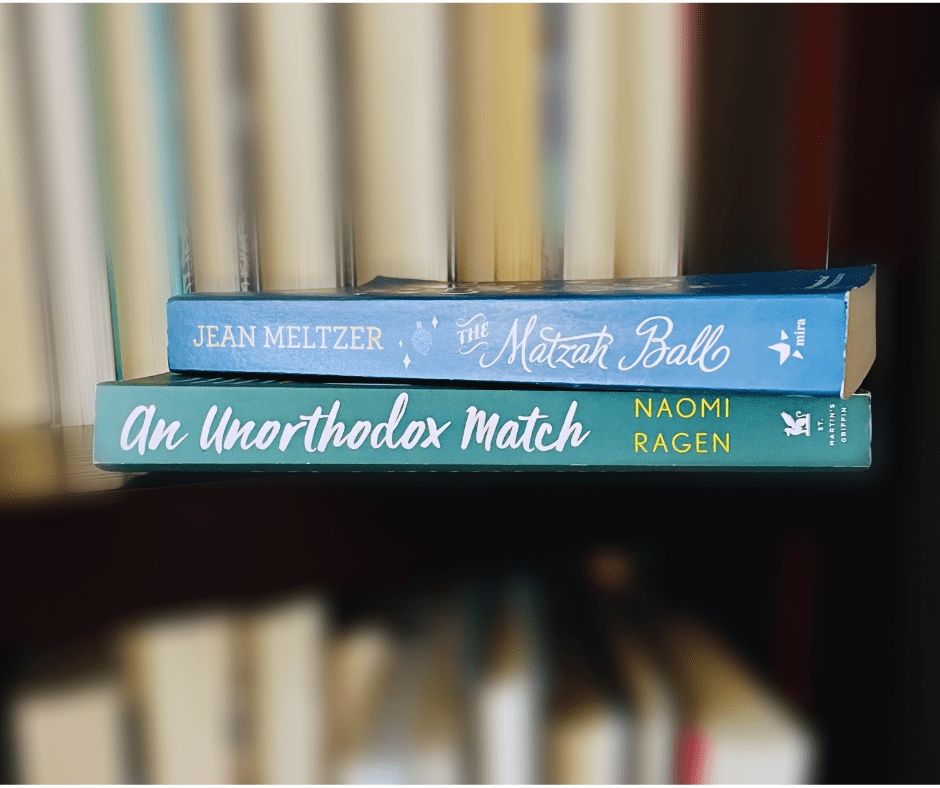
The Matzah Ball by Jean Meltzer

Ok, I wanted to start with this one because a Hannukah Rom Com? It’s the dream for a lot of Jewish Women Readers- in a holiday world that is dominated with Christmas (which- don’t get me wrong, love a good Hallmark Christmas movie) it’s so nice to be represented in a book or a movie. Since we are heading right into the holiday season, I figured it would be doubly important to talk about now, 

The Matzah Ball is about Rachel, a Jewish girl from a prominent Jewish family that loves Christmas and spends her days writing Christmas romance novels…in secret. This year though, her publisher wants her to write a Hanukkah romance. The only problem, Rachel doesn’t feel the joy and magic of Hanukkah, at least not how she feels it with Christmas. Desperate for inspiration, she scores a ticket to what is being shared as the event of the year- The Matzah Ball- hosted by her mortal summer camp enemy. 

Now, you would think this would be a great story to read- a melding of a love for Christmas, a love for Judaism, a main character who is grappling with herself, and an “enemies to lovers” style romance. While I thought this book was ok in a book sense, I found it to be…lumbering and not great from a Jewish person sense. Give me a minute to push my sleeves up and gather my thoughts as I’ve been waiting to talk about this since I read it last year. 

Where to begin? I’ll start with just the representation of Judaism in the book. Rachel’s parents are a level of Orthodox with a well-known Rabbi for a father. The main conflict that we see our “heroine” go through is whether her parents will approve of her chosen career path or if they will see it as a betrayal of everything, they believe in. We, as readers, are given no insight in to why they might think that her writing of Christmas romances will be so horrific, and spoiler alert it is not. Because, spoiler alert, Jews don’t hate Christmas- at worst we have nothing to do with it, at best, those of us in interfaith relationships celebrate some level of it. Further, whenever something was, even slightly, Jewish, the author made a very obvious point of it. To the point, where even a non-Jewish person would feel ostracized reading the story. Little things felt big purely because they were being pointed out in a noticeable way. 

On a positive side, we do have two characters who are from different backgrounds, and we get to see both of their viewpoints. We have Rachel who was raised Orthodox Jewish, only attending Jewish schools, Jewish summer camps, seemingly only mildly aware of the “goyim” world around her and then Jacob, raised Jewish, but by and large stays in her Jewish community. We see her deal with a chronic illness and how that sends her in to the escapism that Christmas provides. 

On the other hand, we have Jacob, her mortal summer camp enemy who has had a drastically different upbringing. From a lesser practicing Jewish family, divorced parents to Catholic high school to finding his way through Judaism and always seeking that community. I found that I preferred Jacob’s point of view, I think probably, honestly, because it matched a lot of my own relationship with Judaism and I found him to be a bit more down to earth, a bit more levelheaded about Judaism, life, and our relationships between everything. It felt like for a lot of the story Rachel was a bit of a whiny brat, though dealing with a lot, and Jacob was a bit more…life experienced.

I talk about this because it’s important when it relates to how the Jewish people are portrayed in books and, to be honest, the two tropes presented in our characters, especially Rachel, are very common tropes applied to regular Jewish people in the real world. While I appreciate the growth that our characters experience and appreciate the full circle moments we get at the end, I just wish I left the book feeling…more of a celebration at this great Hanukkah romance. 

For the most part of the novel, Judaism is presented in a positive light, I’m not going to disagree with that, and Jean Meltzer does talk a lot about the various traditions and important bits. I’m not sure what I’d hoped for with this novel, but I think the fact that throughout the book she is “pitching” this book to be the Hanukkah Grinch…which I feel sums up a lot of my feelings in two words. 

I will more than likely read more books this author writes to see if this theme sticks, or if it changes as we go along. Jean is Jewish, went through rabbinical school, and did suffer with a chronic illness. This was her debut novel, so I’m trying to keep an open mind for future books. 

Overall- this is very much a book written for the Anglo Christian person who wants to read about a Hanukkah romance. There’s nothing wrong with that, however I do feel like there is the potential out there for better books and better characters. This book felt very much like it was trying to fit in with the Christmas Romances and maybe it is, and I don’t think it’s a bad thing…I just feel like there is better out there somewhere. I wish that the Yiddish and Jewish customs had been integrated a bit better, not as word/concept, then definition, word/concept, then definition, etc. If you are trying to “normalize” Jewish-ness, then normalize it, don’t make it obvious over every little difference.  But I think we’ll see that more in the next book…

An Unorthodox Match by Naomi Ragen

Like, The Matzah Ball, this is also a romance book. It’s not tied to any specific holiday, more of an everyday story, which is nice to have, and we are following different levels of observance. In An Unorthodox Match we follow Leah as she struggles to find a place for herself, a home, within the Orthodox community of Boro Park, Brooklyn. WE also follow Yaakov a recently widowed Orthodox Jewish man who is trying to find a way forward with his family after losing the only one for him. In this story we see how beautiful and transformative love, community, and personal strength can be. 

Now, when I pick up a modern Jewish story, this is what I envision it to be…honestly. I won’t make a secret of my love for this book, but I’ll get into the basics and the Jewish side specifics. 

First off, we get to see the process of…returning to the faith. Leah was not raised observing Judaism. It’s important to note that she IS Jewish, her mom was Jewish, though her mom ran away from the faith and her grandparents are Jewish. At the very beginning of the story, we get to learn just a little insight into the different options for Orthodox Jews (of which there are many). We get insights into Chabad, Modern Orthodox, Jewish life in Israel, and then for the rest of the book, the traditional Orthodox of Boro Park Brooklyn. It’s a good breakdown of how to return to the faith or explore a deeper connection with the faith, but in a truly beautiful way. The author regularly reminds the reader that this is her choice, and supplies Leah with characters who serve as “foils” to her maintaining this new life (both in her mom- who’s viewpoint we read from and who views Judaism as a cult- much like a lot of the regular world as well as in one of the children who she nannies for- who views her as not enough for their family). 

I think the true beauty of this book and its representation of an often not represented or harshly judged community of Jewish people, is in its normalcy and continuing to stress the choice each person makes to live this life. It’s truly special and beautiful. 

I think the other choice that this book makes and does well is just…normalizing everything. Unlike the Matzah Ball, we do not get word/concept, then definition, in this there is a glossary at the book that explains everything. By just having the words and concepts in the text it doesn’t make these ideas that may seem strange to those unfamiliar with Judaism so strange…it normalizes everything. I also think having Leah go up against two different foils. Two different forms of thought, the idea that she is joining a cult, and the idea that she is not worthy as she is a “convert” to Orthodoxy, is very telling. 

When you look at Orthodox Jews in the regular world (and I’m specifically referring to this specific community that is in the book- Judaism is wide and far reaching and no two Jews are alike in any way) the external fight is that they are “strange, close minded, closed lipped, tight community” and it is true to an extent. They close ranks around their own, they protect, and they are open but not open to outsiders. That is the way that it is, that is almost the way that it has been forced due to those who do not understand. I feel like this book is a fair representation of the community from someone who is not in the community (so I can’t fully speak to it, just as a fellow Jewish person who holds my faith and ethnicity close/high). The internal fight is always to keep the tradition, the faith alive and so yes, that does mean a high standard of traditions, of care, of ways of life. 

Where I think the Matzah Ball can fall flat in some ways, An Unorthodox Match really shines. It showcases the Jewish culture in such a positive light, while also being realistic about the choices that are made. It highlights struggles from within and out, and normalizes things like going all of Shabbat without electronics or only eating kosher foods, dressing modestly, etc. Little things that mean a great deal. 

So, that’s it! The first Edition of Jewish Literature. Let me know your thoughts and opinions- I’d love some feedback on how this works for you. I’ve got two nonfiction books lined up for the next edition that I’m really looking forward to sharing. 

Rosh Hashanah 5783

Shanah Tovah U’metukah! Happy Jewish New Year! As Rosh Hashanah comes to a close this evening, the Ten Days of Teschuvah begin (actually they start with Rosh Hashanah and then end at Yom Kippur). This period of time is a starting off point to reflection, growth, and returning to being the best that we can be. It’s a chance to jump start your growth and goodness for the year ahead. It’s a process that is meant to be continued year-round, but specifically these ten days are spent making right with relationships and our community. 

Last year’s post is really detailed about Rosh Hashanah and what we do, how we celebrate and what my thoughts were going into the past year- all of which you can read HERE. I’ll just add a little fun fact for this year. On Rosh Hashanah we wish each other a GOOD new year, whereas in the English New Year, you with a HAPPY New Year. This can serve as a reminder that by doing good, being “good”, happiness will follow. 

I normally post my Rosh Hashanah post prior to the holiday beginning, having spent the month of Elul (the last month on the Jewish Calendar, meant as a time of deep reflection and introspection) reflecting on the year, however this year I delayed. It’s been a bit of a weird time. Nothing truly major, nothing truly bad, just a forced time of reflection that had me…not really wanting to share things. I wanted to do some deep inner work and make things right in and with myself before I felt comfortable looking forward and turning outward. 

5782 was a year full of so many highs, a few lows, and a lot of…meh. Not meh necessarily, just a lot of stressful situations that, to be honest, I could have easily avoided or saw my way out of. And I should have. I let a lot of “out of my control” things affect my own self and that is not something that I really liked about myself. It’s not something that is directly in my nature, until I’ve been pushed to a point, and there were a couple of times that I was pushed to that point (and I shouldn’t have been). 

But I’m a deep believer in something higher than us, guiding our way, and placing things in/out of our lives to continue to guide and show us the way forward. And, while 5782 held both good and bad, I feel like I really deepened my own feelings and truths about my thoughts, beliefs, and feelings about relationships. And that is how I spent my month of Elul- deep in introspection over the prior year. I’m not going to be sharing too many of those thoughts, mostly because they are private and not something I want to put out into the world. 

All that being said, I was thinking and reflecting all the way up until Erev Rosh Hashanah. I was trying to figure out where I wanted this year to take me, it’s a year of change for us after all in so many ways, and I what I felt would be best for me, my family, and our community. And when I heard that Shofar Blast, that awakening to a new year, I felt those familiar shivers and goose bumps, and something locked into place for me. It’s a new year, a Shanah Tovah (a good year), and I’m READY. 

So, what does all this really mean???

Well, I’ve got a new…word for the year- really a new mindset. I’ve always been a “find the good” kind of person, but I found that in 5782 I struggled with it a bit more than I have in the past. That may not actually be fair to say…I’ll change that thought. I focused more of my time and intentions and energy on the negative, on the toxic, than I should have, than I normally would have. That’s more accurate. 

So, in 5783 I’m choosing הַכָּרַת הַטּוֹב (Hakarat ha’tov) or quite literally “recognize the good”. I’m also choosing שִׂמְחָה (simcha) or joy. It’s simple- there is no place in my life for the toxic, for the negative, for the bad energy. I recently read a quote that really just…resonated with me and fed into this feeling of needing this to lead my year- “At this big age, I’m only interested in progress and peace. Anything that costs either has to go”- We the Urban. If it does not serve my families progress or peace, if it does not feed our joy, our lives, then it has no place. 

Now, that does not mean that bad days do not come. It does not mean that we do not struggle. In fact, this year (5783) is going to be full of challenges for our family, but it means that either I will toss out of the negativity- treat it with a light laughter, turn it into something humorous, OR I will cling to the good moments when the bad come. 

None of this is really new to me- I’ve always been someone who tries to find the good, find the happiness, in fact this is something I touched on last year when my word was “mechaye” – something that gives great joy or life. This has always been who I am, but sometimes it can get a little lost in the everyday and this is my way of bringing it back to the forefront a little more. 

Beyond that – my goals for 5783 are in flux right now. I have things that I want to accomplish, as I do every year, and I feel like this year could really be a big year for those goals. Both boys are in school, so I have a bit more free time- though I’m rapidly filling it with commitments. However, I’m trying to keep an open mind to really welcome any new opportunities that knock on our day and find new ways that I can help those around me and in my community. 

So, with all those words said…I really just want to with everyone a Shana Tovah U’metukah- I hope 5783 is everything and more. 

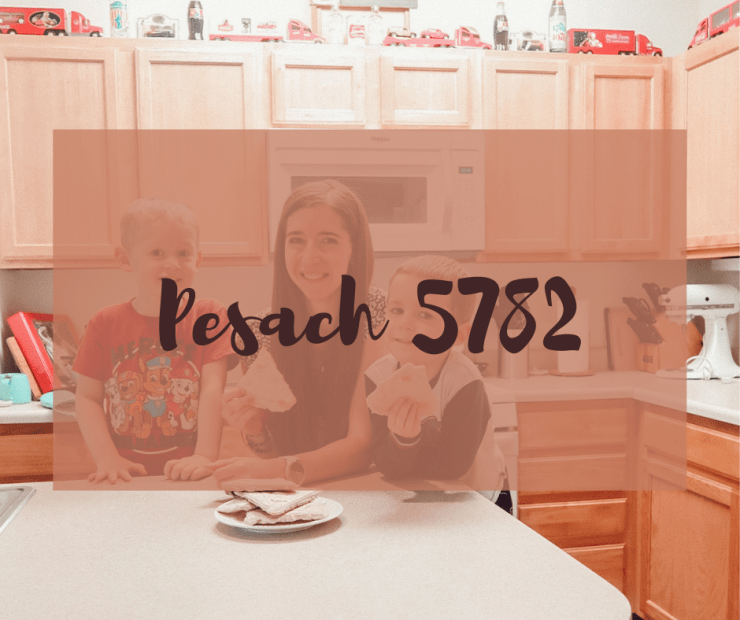
Pesach 5782

***A little aside here at the outset- I don’t really know what this post is going to be, what it’s going to say, or anything really, I’m just putting some thoughts to paper (as it were) and sharing. I do this from time to time when it feels right and right now, I’m clinging to my culture and me Jewish-ness.***

We are currently, as of the time that you are reading this, right smack dab in the middle of Pesach. And it has struck me that while Pesach has always had a big role in my childhood/early adolescence, I’ve never really spoken about it. More so in a passing “oh it’s the holiday that celebrates the freedom of the Jewish people and we don’t eat bread”- which is more for others benefit than actual statement of what the holiday represents. It’s the basic phrase that I’ve answered for more years than I care to admit, the easy way to please someone without overloading them with information and leaving them confused or not caring. 

And in truth, it’s a basic answer. It details what the holiday celebrates and how we honor that celebration. But in reality, Pesach is so much more than that and its meaning and importance from ALL of my childhood Jewishness is much deeper than a simple sentence can convey. So, let’s unpack all of that.

First off, what is Pesach? And I’m going to call it Pesach, even though the English is a word much more familiar- Passover. At its core, Pesach tells the story of the Jews liberation from slavery and Pharoah in Ancient Egypt. It is a celebration of our freedom. As ridiculous as it is, I always like to point to the movie The Prince of Egypt because this movie tells the most basic, easy to understand story of Pesach. The Jews were slaves to Pharoah in Egypt, building his temples, his homes, doing back breaking labor for nothing. Pharoah was a truly horrible leader to his slaves, killing sons so that the population was controlled. The story of Moses birth, then upbringing in Pharaoh’s home is one told again and again. His eye-opening experience finding out he is one of the Chosen, a Jew. His task given to him by Hashem, to free the Jews. 

Moses goes to Pharoah and asks him to “Let his people go”, however Pharoah refuses (whatever will he do without all that free labor to build his grand temples and homes?). Of course, his refusal then leads to the 10 Plagues, with the final plague being the death of the first-born son of every non-Jew. At this, Pharoah tells Moses to get the Jews and get out. The Jews leave quickly, not even allowing enough time for their bread to rise (this is important) and make their way out of Pharoah’s Egypt. But of course, Pharaoh, in his grief, chases after them, cueing Moses parting the sea and the Jews escaping to safety. They then wander the desert of Egypt for 40 years before finding their way to Canaan, Israel. 

So, how do we celebrate this joyous event? Well by not eating any Chametz, or leavened bread, and by hosting a Seder. First, the foregoing of the leavened bread. We abstain from eating any form of gluten (this includes bread, pasta, flour tortillas, ANYTHING that expands when contacted with water) for 7-8 days (depending on how you practice). You are supposed to cleanse your house of all Chametz and do a full cleaning so not even a crumb is left. It’s important to note that there are varying levels of practice, as with anything else in Judaism, and how one practices does not reflect how Jewish one is.  However, no matter how you practice, the tradition of the ridding of Chametz, the eating of Matzah, is to ritualize and remember the breaking away from slavery. The idea of cleansing the house of Chametz, then going forward to 7-8 days with only Matzah (or unleavened crackers) is to symbolize our effective breaking of ties to Egypt. Eating the Matzah (while not always fun) is a symbol of our journey as Jews in the desert. 

As with any other Jewish holiday, Pesach is steeped in ritual. Aside from the cleansing of Chametz and eating Matzah, we also have a Seder. The seder is a very orderly, ritual reading of the Haggadah, telling the story of the freedom of the Jews, feast. This feast has a strict and precise order and details out everything from how many glasses of wine will be consumed during the formal portion (it’s 4), to the washing of hands, to the game of finding the Afikomen. It is a joyous, happy occasion and often times one full of laughter and a true sense of community. As part of the seder we invite both those we know and those we don’t know to join our table as a way of honoring that we were all strangers at one point. Typically, there is a Night One Seder and a Night Two seder as we celebrate the first two nights of the weeklong holiday. 

Starting the second night of Pesach, Jews typically “Count the Omer”, in which we count and pray on the days between Pesach to Shavuot (the next holiday). This is a 50-day period that links the freedom of Pesach and the handing down of the Laws at Shavuot. There is also Yom HaShoah, falling 5 days after Pesach, which is the Day of the Holocaust. This is a day of mourning for the Jewish people to commemorate the six million Jews murdered in the Holocaust. 

Pesach for me is a holiday that I have the fullest, fondest memories of. Of course, giving up gluten for a week is…well torture, it is also one of the few very physical ways to honor that struggle that our ancestors went through to gain our freedom. A freedom that cannot be taken away, no matter how much struggle we have been through since as a people. But I also have some of the best memories of family seders as a child. We always did a night one Pesach Seder with some really close family friends and their extended family. It was a loud raucous night full of singing, laughing, and some great readings of the Haggadah. There was always a spirited hunt for the Afikomen, and the evening ALWAYS ended with a second, third, whatever round of Dayenu. I always loved the holiday of Pesach as it is not only a story of freedom, but also a celebration of finding home. Of having community in each other. Of struggling and triumphing together as a people. 

AntiSemitism and Judaism

I’ll be honest- I’m really conflicted about writing this blog post. I feel like this is something that I NEED to talk about because it is RAMPANT right now in our world, but I also…don’t want to oversaturate or focus too much on it for a variety of reasons- some of which I’ll touch on in this blog post. I’m going to try and edit this blog post, but it is also going to be a bit freeform, going from point to point and just a bit stream of consciousness as I work through my thoughts and feelings. 

I feel like there are incidents that occur with regular frequency against the Jewish community (anything from physical assaults to vocal microaggressions) that don’t get talked about. I’ve come to expect this, but when there is a large news making incident against and involving the Jewish community that quickly gets deflected away from the Jewish community, that is, by and large, swept aside by the non-Jewish world, then we need to talk about it. 

By the time this will actually be posted the Synagogue Hostage situation in Colleyville, TX will have probably been completely “resolved” – and by that, I mean the news cycle has moved on and everyone has forgotten about it…except the Jews. There have also been several additional instances of Jew Hatred ranging from a woman yelling slurs and spitting on children, to rhetoric and swastikas being written on subway signs in NYC to name just TWO of the things that I’ve seen. So, let’s bring everything back up. Let’s talk about it. Let’s talk about the bigger issue at hand…antisemitism. 

But first, let’s talk about the word antisemitism. 

Antisemisism was first used in the late 1870’s by a German to describe the anti-Jewish campaigns that were occurring. It really and truly gained traction during Nazi Germany as a way to…placate those who may have questioned the anti jewish state the country was heading toward. The definition and examples have been expanded as the years go (and the ADL has some great resources in regard to this), but at its core it’s hostility or discriminations to the Jews, whether its towards them in a religious or racial way.  There are a couple things to note about the word…

  1. Jew Hatred stems further back than the introduction of “antisemitism”. It is the oldest hatred that we know, dating back to before Christ. This is a known and documented fact. 
  2. The word Antisemitism is actually not “correct” as it refers to “Semites” which, in some instances, can also include Arabs and other groups, not just the Jews. However, “anti-Semitism” was created to specifical relate to the Jews. Often times this fact gets shoved in when talking about “antisemitism” as a way to discredit or minimize actions.

So, in all honesty, I hate the word antisemitism. I hate it for a couple reasons; the first being that it was really brought to popularity by people who wanted to put a “stomach-able” label to the true horrors they were inflicting on others. While the Jewish community has really kind of taken over ownership of the word and have used it as a way to light upon certain hatred and hostility, we CANNOT ignore the origins of the word and who brought it in to regular use. It has by and large been used as a label to “hide behind” instead of blatantly stating what’s happening. The second reason that I hate the word is that, to be honest, it’s just becoming overused and watered down as a tool. While words have power, if a word is used to often (even if it’s justified) it becomes less powerful. I’ve long felt like “antisemitic” or “antisemitism” has lost its “effect” on the non jewish world and this has just become more obvious to me over the past year. I’ve, by and large, tried to cut that word out of my vernacular. I really want to start giving a bit more power to my words, choose them a bit more carefully, and really call things as they are. So, let’s start calling it what it is- Jewish Hatred. 

There is no actual place in Judaism for or that refers to Antisemitism. Let me kind of explain what I mean. Jewish holidays celebrate a few different things, some are in regard to the earth and what we are given by Hashem (such as Tu B’shevat which just passed- this is a celebration of the trees), some are in regard to Jewish triumph (such as Hanukkah), and some are a celebration of Jewish freedom (such as Passover). Our highest holidays of the year (Rosh Hashanah and Yom Kippur) are days of atonement and judgement. While holidays like Passover and Hanukkah reference hatred, control, slavery, a desire from outside forces for Jews to submit/change, there isn’t a direct reference. It’s more of a celebration of the Jews moving forward and continuing to survive. In fact, a lot of Judaism is a celebration of tradition, survival, justice, and the beauty of our world (and thus taking care of those things). While the hatred of Jews or othering of them is implied, it’s almost just an after statement in a way. 

There is no place in our celebration for hatred from others (or towards others- in fact you can argue that we just want acceptance for who we are and anything that has been done has been not done from a place of hatred, but that’s a whole separate post for a separate day). It’s a celebration of our traditions, our very people, surviving, moving forward, continuing on. It’s a celebration of our world, of the beauty that is in life. And so, most of the time, for most Jews, that’s what we want to share, that’s what we want to focus on, that’s what we want others to SEE when they see US. We don’t want to see, on our end or on others, the sheer amount of hatred there is. Judaism is so beautiful in so many ways and that’s what we want to focus on, share about, and just live. 

So, why can’t we? Please refer to my previous post for more thoughts and words HERE