
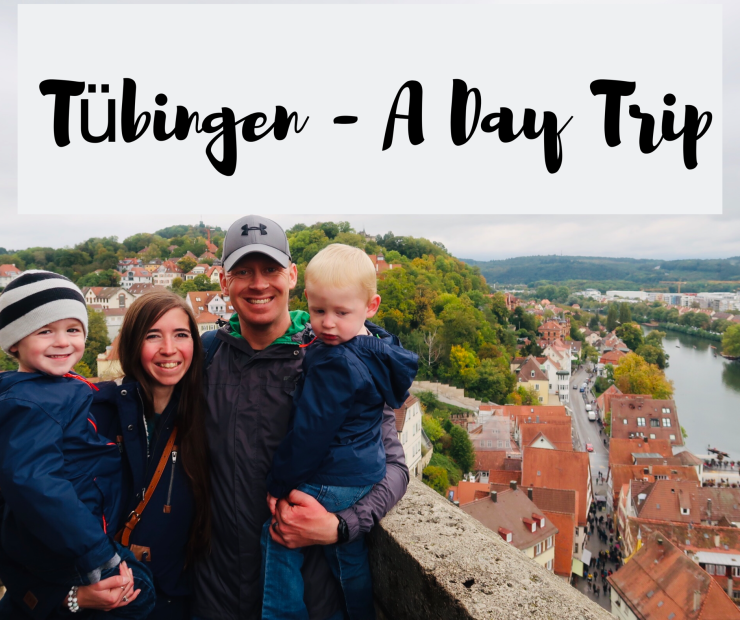
On our weekend away we had a free day in between the castle’s we had planned on seeing. We decided to spend this free Saturday in nearby (to where we were staying) Tübingen. Tübingen is a university town in Baden- Württemberg that is full of old-world charm. My favorite bits happen to be what it’s known for: cobblestone streets (full crooked, tight, bumpy cobblestone) and the traditional timber homes that line the streets.


Tübingen has a very long history (dating back to the 6thor 7thcentury), although the first time there is any official notice of the town involves the town’s castle: Hohentübingen (this is Germany after all – and everything involves castles). Tübingen formally became a city in the 1200’s and “shortly” after that (about 30 years) a monastery was established by the Pope. In the 1400’s the Collegiate church was built AND the Eberhard Karls University was founded. This particular university is one of the oldest universities in Central Europe. The university continues to make a name for itself as one of the biggest universities in Germany and the biggest source of income for the city’s residents. Tübingen has also been a spot for quite the political history being involved in The Thirty Years War, Kristallnacht during WW2, being a center of the German Student Movement, being a part of Protests of 1968, and having student ties to a terrorist group (The Rote Armee Fraktion).
A quick fun fact for you: Tübingen’s Altstadte is one of the few completely intact Altstadte’s in Germany. It was not destroyed during WW2, which allows a visitor to get a real glimpse into what the city would have looked like throughout the years.


We visited Tübingen on a grey rainy day, but that didn’t dampen our spirits. We started out our day walking through the Market Square (Marktplatz). This market square also holds the Town Hall (Rathaus). The day that we went happened to be the day they were holding their Regional Market, so we got to sample a wide variety of goods, including a home made from scratch fresh pizza and Birnensecco ( a locally made pear prosecco). Both were delicious. We also got to peak around the stalls for local handcrafted goods including floral, produce, clothes/crochet/knitted goods, and different salami and cheese products. It was a fun little start to our day (and provided us lunch). This to me was just the European/German experience.
From the market square we wandered up to Hohentübingen to peak around the castle.


By best guesses the castle was originally marked in the 11thcentury, but was completely demolished and rebuilt in the 1500’s. In current day the castle holds the Museum Alte Kulturen, which was opened in 1997 to the public. There is also a section in the castle covering the advances that were made in the realm of sciences- this castle held one of the first biochemical lab worldwide, and talks about DNA. The rooms cover both modern-day sciences, as well as artifacts and the discoveries made at this particular location.
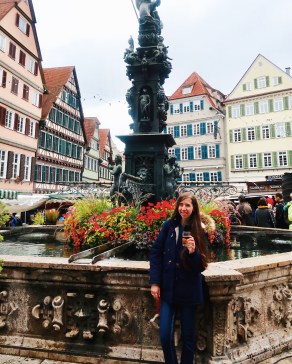 From the castle we wandered back down the street to stop once again at the market to pick up some food/drink and take a little break. Once refreshed (see above for what we ate) we headed over the St. George’s Collegiate Church (also referred to as Stiftskirche).


Dating back to the 15thCentury, this is one hell of a church. Fun fact: this church was one of the first to convert to Martin Luther’s Protestantism, although it still has several Roman Catholic features. We wandered through the main church, then paid a slight fee to head up the church tower. In this particular church, as long as the bells aren’t actively ringing, you are able to walk up the numerous stair steps to get an “eagle eye” view from the tower.


Not only is that an incredible view, but you get to see how the bells actually work from the bells themselves, the weights at the bottom, and the gears that make them ring. Looking at the bells it is actually incredible to think that a long time ago, people actually rang the bells themselves without the benefit of the gears.


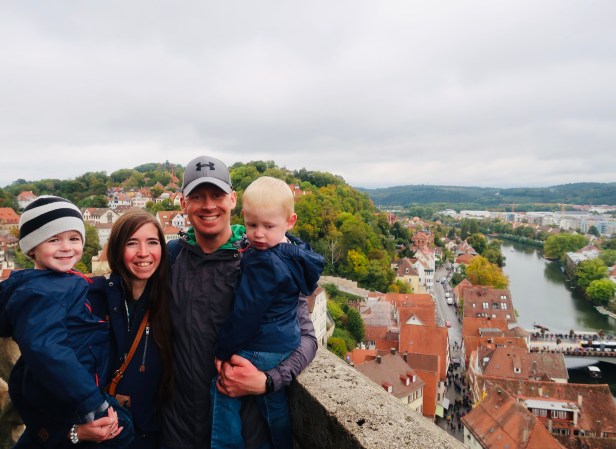
The view from the top really can’t be beat as you get a great 360 view of Tübingen and beyond. You can see the Marktplatz, the Altstadt, the river, the Schloss and so much more. It was worth the very slight fee to pay to be able to see the red roofs, the people milling about, walking along the cobblestone. We made it down the stairs just in time to hear the bells sing in the afternoon. They played beautifully and rang through the entire city.
Finally, we headed down to the Necker River. Crossing the bridge, you can get a view of the brightly colored historic homes and businesses, along with Holderlin’s Tower.


Holderlin’s Tower was the home to poet Frederich Holderlin and is a popular museum and destination. We took a little stroll on part of the Neckar Island (Neckarinsel). On the day that we went they were having their Rubber Duck Race (which we missed by about 30 minutes), so the little Island was packed with various exciting activities.
And with that final stroll our day in Tübingen came to an end! I think this little town might top my list of favorite towns in Germany so far. It is very close with Fussen (which I loved) and may edge it out of that top spot.
I hope you enjoyed seeing Tübingen though our eyes! Honestly, I hadn’t really heard too much about this town until we were in the area, but I feel like it should be on a travel list if you are wanting that German town experience.


 A Cuppa Cosy