
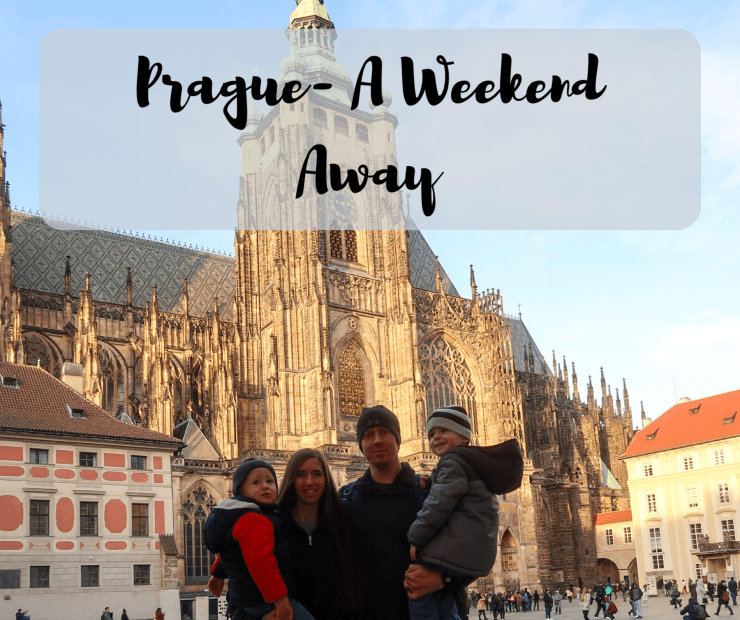
 Our final stop on our Thanksgiving Weekend Away was in Prague for ~2 days. This post is going to only focus on what we did in Prague and the history of those spots. I will be doing separate posts on the Christmas Markets and my Recommendations and Tips. I’m going to break this post down day by day as I think that is probably the best way to handle the information in a concise way. And, one final thing before we get into the post, we fully plan on going back to Prague to do a little bit more exploring. I fell in love with the city and I feel like there is so much more to see. It’s only a couple hour drive (or train ride) so it’s totally feasible for us to go back.
Prague itself dates back to around the 2nd century, but it wasn’t until Charles IV came into power that it really started to find a place on the map. Prague has been through its fair share of ups and downs, crusaders, religious upheaval, and foreign occupations. It’s seen war, nonviolent revolutions, and a modern turn towards capitalism (and a big shift in consumerism). The city itself shows all the different stages of its history and I think that makes it so interesting and easy to explore. Every corner holds a different era.
Now, onto what we did in our short amount of time in Prague…
Afternoon Day 1
We arrived about midday in Prague and decided to start our time off at Prague Castle. This was the highest and furthest point that we wanted to go on this particular trip, so it seemed like a good place to start and work our way back from. We used the public transportation system (buses, street cars, and an underground metro) to get as close as we could and then walked the final hill to the castle entrance.
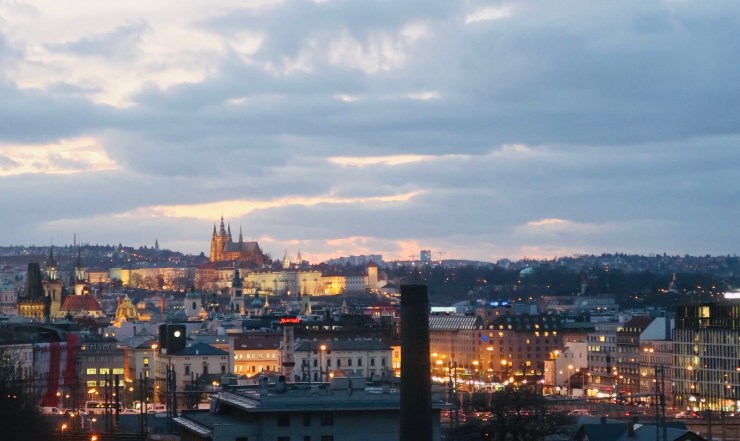
Prague Castle dates it’s foundation laying to the 9th Century, with the Cathedral not being completed until the 20th Century. The castle itself is the largest castle complex in the world. The castle itself is made up of three large courtyards with the cathedral being the most prominent. It dominates any view of Prague and for quite a while was the seat of various rulers. In modern day, it happens to be the seat of the President of the Czech Republic.
Before you even head into the castle, the views overlooking Prague are incredible. Within the castle walls, you walk up the street and see St. George’s Basilica. This is the oldest preserved church. Originally built in the 10thcentury, it was rebuilt in the 12th and then “updated” in the 17th century. It is very impressive and certainly dominates the main first courtyard.


Going around the lane a bit further and you come to the incredible Cathedral of St. Vitus, St. Wenceslas and St. Adalbert. This is the spiritual symbol of the state, building began in the 14th century, but took almost 600 years to complete (with the final touches being completed in 1929). The interior of the cathedral is equally impressive and contains the crypt where the kings were buried, and the crown jewels are housed. It was absolutely gorgeous on the inside (although we didn’t make our way through the entire cathedral). You are able to walk through the rest of the complex and the buildings throughout the complex. We headed out right around sunset and got to watch the sun set on the city, and then see the city start to come to life in the evening.


We checked into our Airbnb (which was a fun exercise) and then headed out to dinner at Restaurace U Houdků. This was a lovely local pub type restaurant and we had a lovely meal of various Czech delicacies. We made it an early night in preparation for the long day ahead.
Day 2:
Saturday was our walking day. I love to walk a city (especially one that is so easily walkable to see so much) and Prague was perfect for that. We woke early, stopped for a quick coffee, and then headed out to be tourists for the day. We started our stroll at the 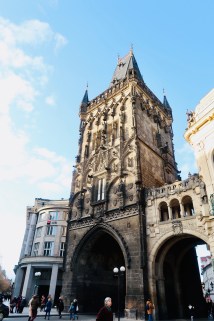 Prašná brána (Powder Tower). Dating back to the 15th century, this was the entrance that all the kings would use to enter The Old Town. It was a gunpowder store in the 18th century, today it serves as not only a viewing gallery to see over the city, but still is the entrance for a royal route to Prague Castle. It certainly was an impressive sight to see and is a good start to your morning/day out in Prague Old Town.
From there it is a quick stroll down the streets to reach Old Town Square. This main square holds not only the markets, but has been restored throughout the years. The Old Town square is circled by several prominent buildings, the first of which being the Church of Our Lady before Týn. This is easily one of the most impressive buildings you will see during your visit to Prague, aside from the Cathedral at the Castle. This particular church also contains the oldest organ in Prague, dating to the 17th century. The church itself dates back to the 14thcentury.


In the square itself there are several things to see before moving on in another direction. There are various steps on the ground itself marking where executions would take place and other little tidbits of what life was like. There is the Jan Hus Memorial in the central. You can walk off to the side a little bit and go to the St. Nicholas Church. This church was completed in the early 18th century and is absolutely incredible. When we went in they had the organ music playing and the grand chandelier was a sight to see. It not only serves as a church, but is also a classical music concert hall. Before leaving the square, do a quick look see at The Prague Astronomical Clock. It isn’t necessary to stick around for the performance (it’s really not anything to write home about0, but it’s definitely something to peak at before leaving the square.
From the square we walked the side streets up to Wenceslas square. It’s not a far walk and by walking we not only got to see a couple more markets, we also got to see a wide variety of the architecture of the city.
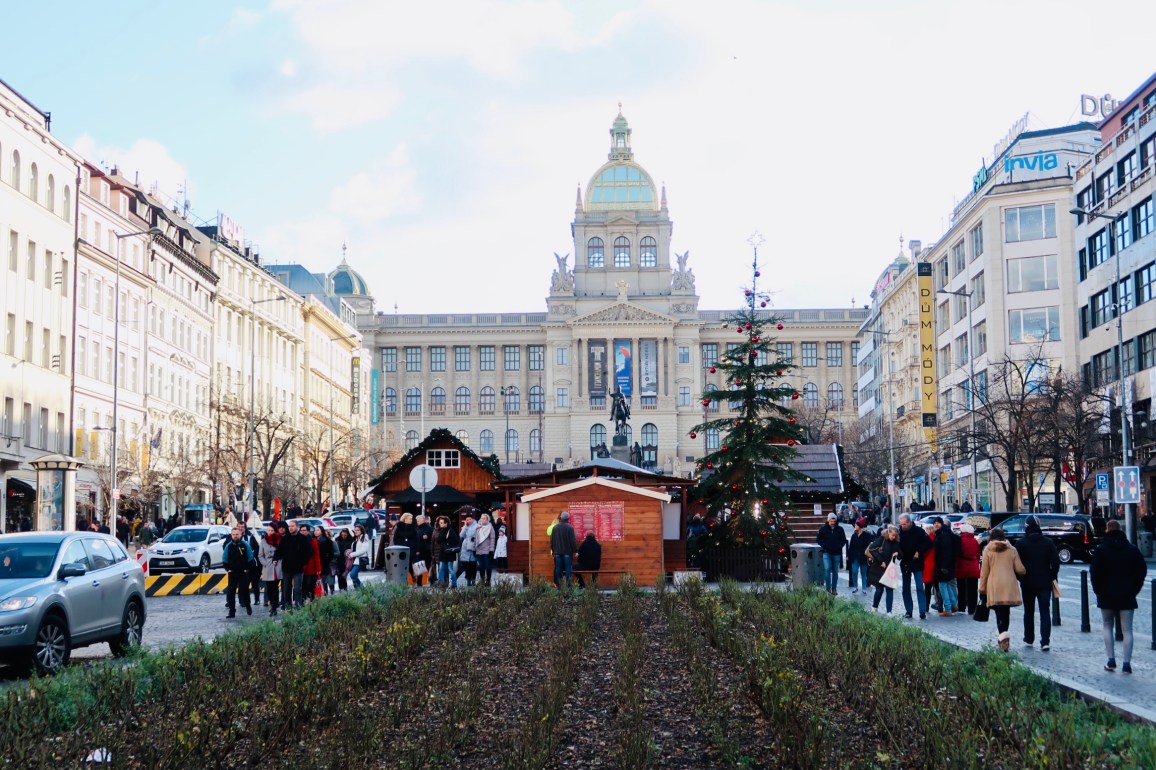
Wenceslas square is at the heart of “New Town” and is full of shopping and commercial life. New Town was commissioned by Charles IV in the 14th century. New Town was intended to be the center of Prague and with this new square under construction Prague became the third largest city in Europe (at that time). While New Town may not be very new by age standards, it certainly is the heart of the modern shopping era. Wenceslas Square is set up as a boulevard or (as its original layout and time period would entail) a horse market. Wenceslas Square has served as a parade ground of sorts, seeing everything from celebrations to uprisings. The square backs up into the National Museum and the Opera House, as well as a statue of St. Wenceslas riding his horse.
From Wenceslas Square we decided to hop on the metro and head over to the Charles Bridge Area.
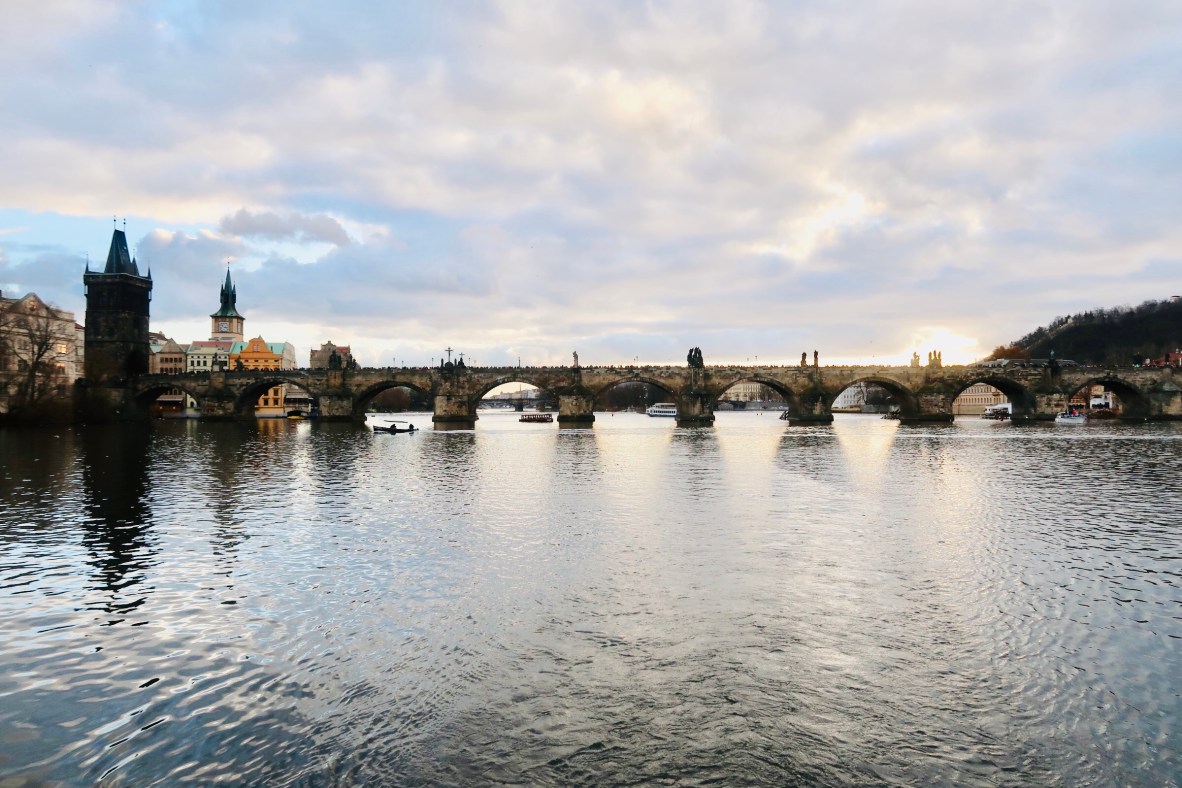
Charles Bridge is the main pedestrian bridge used to cross from one side of the Vitava River to the other. Charles IV commissioned the bridge and even laid the first foundation stone of the bridge in 1357 (there is a marking for it). This was originally intended for tournaments, but has since evolved into the bridge it is now. It is adorned with a total of 75 statues throughout the bridge and is a great option to walk from Old Town to Lesser Town.
On the Old Town side of Charles Bridge, you enter under the Old Town Bridge Tower. This is an incredible tower that continued the path of royalty through the Old Town and up to The Castle. You can climb inside the tower and see opposite the tower and bridge. On the Lesser Town side there is the Lesser Town Bridge Tower. This was built in the 15th century and was modeled off of the Old Town Bridge Tower. The smaller tower that is connected is Judith’s Tower; the only remaining part of the original bridge crossing. You are also able to climb up inside the Lesser Town Bridge Tower and see opposite.


Once in Lesser Town we did a couple of stops, the first of which being a bookstore. Massive thanks to my friend Hannah (who happened to be in Prague at the same time we were), who enlightened me to the existence of Shakespeare and Sons. 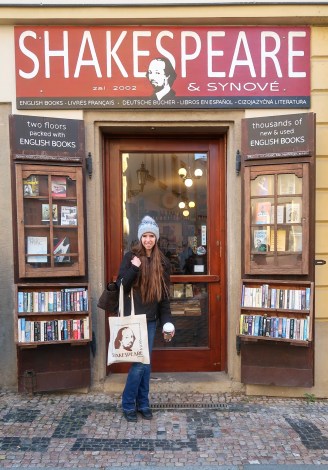 Shakespeare and Sons is a {big} little almost hole in the wall bookstore in a corner of Lesser Town. Situated near Kafka’s house and museum it is the perfect little stop. It has the used and new book atmosphere that I love, with book stacked high along the walls, piled on the floor and behind the cash register. I didn’t have nearly all the time I wanted to browse (thanks to two very active toddlers and one husband who couldn’t believe we were at a bookstore in a foreign country…again), but I did manage to snag a couple books. I got each book stamped with the bookseller’s mark, a reusable book bag, and a bookmark. Such a perfect little stop!
After our stop, we knew we needed a little breather from walking and exploring and a little chance to just relax and take it easy. We were right near the sight-seeing boat docks, so we decided to take a little boat tour of the river. Stay tuned for my full thoughts on this in my tips/recommendations, BUT it did what it intended- gave our boys a chance to rest and eat and us a chance to sit for a bit.
 We headed back to Old Town Square for the Christmas Tree Lighting and the official opening of the Prague Christmas Markets. More on this in the Prague Christmas Market post.
Morning Day 3
On our last morning in Prague we spent a little time in the Jewish Quarter (Josefov). The Jewish Quarter (originally the Jewish Ghetto) originates from around the 10th century, however it’s history really begins around the 13th century when the Jews were ordered to leave their homes behind wherever they were, and were banished to this Quarter. The first pogrom occurred Easter of 1389 and it has had a turbulent history since then. The quarter has gone through radical changes, with its people living at the whim of whomever was in charge at the time and at one point was overcrowded. There is a total of six synagogues in the Jewish Quarter, a Ceremonial Hall, and the Old Jewish Cemetery. Ironically enough, the Jewish Quarter was one of the few Jewish spots that survived World War 2 in the area as Hitler decided it could be a “Museum of an Extinct Race”. There is so much history to the Jewish Quarter, that I know I’ll be learning about everything for a long time to come.
We started with breakfast at this cute little café called Mansson The Danish Bakery. We munched on coffee’s, pastries, and meats before heading into the proper quarter.


We didn’t have a long time in the morning to see all of the synagogues and sights, but we tried to make the most of our time to see the absolute must see. We wandered the streets and admired the architecture of the Jewish Quarter before stopping into our first synagogue, Maisel Synagogue.


The Maisel Synagogue was originally built in the late 16th century and founded by its namesake, Mordechai Maisel. After a fire destroyed the original synagogue, the current synagogue dates back to the 19/20th century. This is an incredible synagogue to stop in and details out what life was like in the Jewish Quarter and a bit of the history around the early years of the Quarter. My personal favorite was hearing details about the book and scholarly life.
The second synagogue that we stopped in was the Pinkas Synagogue.


This was built, again, in the 16thcentury. It originally served as a private family oratory by the wealthy family that commissioned it, but later was adapted to add a women’s gallery and new décor for the Torah Ark. This synagogue was reconstructed and turned into a Memorial. The names of the victims of the Shoah are painted on the walls, arranged alphabetically by residence. It’s the oldest monument of its kind and bares 80,000 names on its walls. This was an incredibly moving memorial and absolutely heartbreaking to see. To have all these names laid out in front of you, all around you on the walls, it’s breathtaking.
Our final stop was the Old Jewish Cemetery, which can be accessed through either the Pinkas Synagogue or next to the Klausen Synagogue. The Old Jewish Cemetery is one of the oldest in the world, having been founded early in the 15th century. The Cemetery contains burials from before 1440 until 1787, when a decree came down prohibiting active burial grounds within inhabited areas of the city. There are around 12,000 tombstones, but even more graves as some of collapsed into the ground and others have been destroyed by the elements. Now, if you’re wondering how the dead are actually buried in this manner (with the tombstones being the way they are), don’t worry, we were too. The community actually would add new soil to the ground when they needed more room, so there are several layers of graves in the cemetery, one above the other. The gravestones became crowded as each site holds multiple graves. Both Rabbi Low and Mordecai Meisel, two big names who helped build the Quarter up, are buried here.


Words can’t even begin to describe this sight. It was incredible not only with the overcrowding of the tombstones and the idea of how old the graves were and how many people were actually there, but just the sheer size. At some points it seemed never ending. The amount of history in this relatively small area of Prague is incredible to think of.
We wanted to see both the Old-New Synagogue (the oldest preserved synagogue in Central Europe) and the Spanish Synagogue (the most beautiful in Europe), but both were not open when we were there.
And that ended our short little weekend in Prague! We are definitely making plans to go back and see more of the city, and have already added a couple of spots to our must-see list. Have you been to Prague? What was your favorite spot? If you haven’t, what would you like to go see the most?


 A Cuppa Cosy