On this International Holocaust Remembrance Day

I said I wanted to share more of my heart on here, I wanted to share more real-world stuff, more of my “unfiltered”/” real world” thoughts, but man it’s scary! Especially on a day like today, in a world like we are in…but here goes.

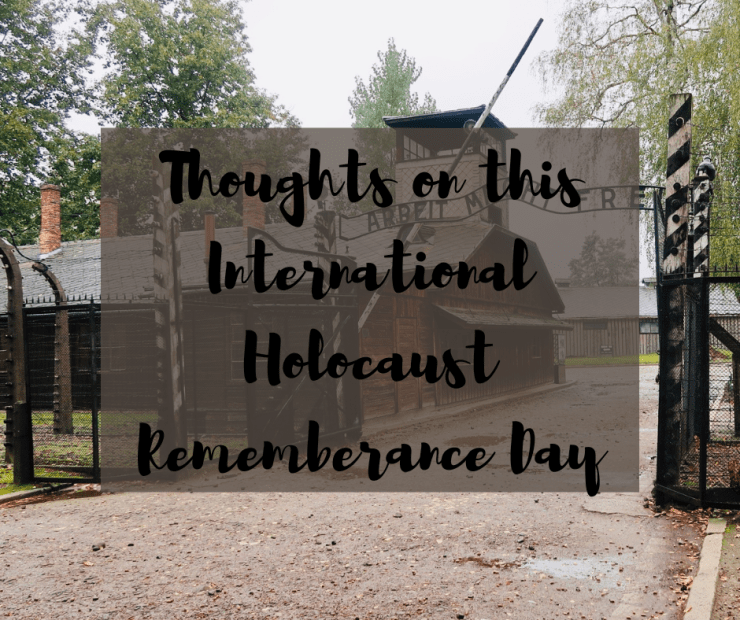
Today (well the day that I am writing this- not sure if it’ll be posted same day or if I’ll sit on it for a couple days) is International Holocaust Remembrance Day. It is the day that the U.N. decided should be used to remember the Holocaust as it is the day that Auschwitz was liberated by the Allies. 80 years ago, today. In fact, the picture in the featured image (also below) is the sign at Auschwitz. The sign that has become synonymous with The Holocaust- which the saying and sign ARE, BUT this Auschwitz sign was actually at the “nicer” side of Auschwitz. Not the side that the Jewish people lived and starved and were murdered in gas chambers.

I feel like it’s important to note that this is NOT the day that the Jewish people mourn and remember- the Jewish people have a dedicated holiday called Yom HaShoah, which is in time with the Warsaw Ghetto uprising (you know- the notable important time when the Jews fought back). ***Don’t worry I’m trying to edit out some of my anger in this post***

Today I feel conflicted. It’s so important to remember (you know- we all say Never Forget like the good little citizens as the rise of Jew Hatred surges to unimaginable numbers), but this year I am filled with anger, with sadness, with heartbreak, with hope (because the Jewish people will survive), with frustration. 

We have people in power politicizing gestures (which- let’s face it, that was what it was regardless of how it was then politicized and the reaction from the person who did it was disgusting at best, horrifying and terrifying at worst- and that margin is microscopic), while Jews are being attacked physically and emotionally/mentally every day. There are BABIES BEING HELD BY A TERRORIST ORGANIZATION, but go off on a hand gesture (which again was what we all thought it was) fam. 

We say, “Never Forget” and then turn a cheek at chants, flyers, disruptions on college campuses intended to terrify, to harm, to disrupt. We say, “Never Forget” and then twist our bodies into pretzels to justify an actual TERRORIST ORGANIZATION kidnapping CIVILIANS and BODIES and holding them hostage for over a year, chanting horrible words, parading their crimes as others cheer. We say “Never Forget” as a holocaust survivor just passed away in December, having survived both Holocaust, but losing two of his GRANDCHILDREN on October 7th

***And let me be clear because there will be those who NEED this disclaimer because they don’t know me, they don’t know my heart, my feelings, my beliefs and they will take this post and turn it into something entirely different. I should not have to say this but here I am- you can be pro the Palestinians living in peace in their own home AND be pro Israelis living in peace in their own homes. You can recognize the actual history of the land and the people and not try to rewrite it to continue twisting your pretzel. You can be with the families of those murdered in cold blood on October 7th and the day, months following, be with the families of these hostages, these CIVILIANS, who were brutally taken, be with all of the people who are now living with very real trauma. You can do all of that and still believe that both sides deserve and need peace. It’s not one side only. Not if you have your humanity intact.***

Words have power if we give them power, right? And how do we give words power? With action. Never Forget means to never forget- it means both holding the memories of survivors, sharing their stories, facing the atrocity head on, AND stopping the rampant Jew Hatred, both overt and subtle, in its’ tracks. 

So, this year, on this International Holocaust Remembrance Day, I want to not only see all the shared posts about “Never Forget”, but I also want to see a post about present day Jew Hatred that needs to stop. I want to challenge you to go beyond the minimum, to truly embrace “Never Forget”. Because we are forgetting. 

Almost 2/3rds of American Millennials (millennials- my generation) and Gen Z do not know that 6 million Jews were killed in the Holocaust. 48% could not name a single concentration camp. 23% believe that the Holocaust is just a myth, didn’t happen or was exaggerated. These are HISTORY facts that folks don’t know about or don’t believe happen. Millennials and Gen Z are those who are leading the way (in a grassroots sense) for the next stage of our future. We have people on video calls saying we no longer need to carry guilt for the Holocaust. We need to move on. If we “move on”, if we do not learn from history, we are doomed to repeat it. And let me say this- we are repeating it. We are repeating it. 

So, I ask that you not simply say the words “Never Forget”, but that you give those words power again. That you speak about what you see. That you stand up. 

Visiting Holocaust Sites Part 1: Dachau and Lidice

**A couple disclaimers before we get into this post…

  1. This is obviously going to contain graphic and triggering content. Please proceed with caution. Obviously my hope is that you read this and take something away, but I fully understand that this is a difficult topic to read about.
  2. I am Jewish. That colors everything, I do. Every part of who I am. More so now as I am starting to learn and realize some things from my past and my relationship with Judaism. But I am Jewish.
  3. This post is going to be jumbled. I don’t know how this is going to go, how this is going to get broken down, how it will be received, how much is just going to be a rambling stream of conscious. I don’t care. This is important.
  4. If you are someone who is a holocaust denier, a holocaust minimizer, an antisemite, racist, or want to disagree you may just move on. (It makes me very….grrr angry and heartbroken that I even have to say something like this, but it needs to be said.)
  5. (I’m just now adding these as I am writing this post). I think this is going to be a two-parter as I’ve only just finished the Dachau portion and I’m already pushing past 1500 words. The second part will be up in short time though- you won’t be waiting long for that.
  6. The second part was written after the incident of Domestic Terrorism on the US Capital, in which the most blatant display of antisemitism was exhibited in my life. I personally saw footage of “heil hitler”, camp Auschwitz sweatshirts, and two congressmen use Hitler’s rhetoric or name. If the tone is off in this second part as opposed to the first, please understand why.
  7. Finally, we are facing drastically rising Jew hatred not only in our country, but across the world. It’s often times hard to voice concerns, content, and information not only about this but also just about being Jewish. In a personal way, I am still learning and trying to figure out how I want to use my voice in regards to this.
  8. This post is being posted way after I originally intended to, but here it is.

Disclaimers over.**

Where do I even begin? During our two years in Germany, we visited a total of 4 Holocaust specific sites, along with numerous monuments and locations relating to World War 2. I’ve written specific blog posts that are just a presentation of the history and facts of each place that I’ll link as I talk about them, but I wanted to talk about the actual opinions and feelings that I experienced at each place. I didn’t do this in the posts for a couple different reasons, most importantly being that I think the actual cold hard facts of these places are not to be overlooked by our feelings of them. But also, I quite simply couldn’t talk about them. I didn’t have the words. I didn’t have the feelings. There is absolutely NOTHING that can prepare anyone for a visit to these places. These places where entire generations of your own people, your own ethnicity, were brutally murdered. I think for a long time after visiting, I found comfort (the very wrong word in this situation, but it’s the only one that makes sense) in the cold hard facts. In not coloring what happened with my own complicated heartbreak. But things change and as I see what is happening in our modern world, our current times, I think that it’s time for me to talk about what this experience was really like. 

I’ve always been well understood, well read, well watched and versed, in the Holocaust. I think I was 11/12 when I really started deep diving into the history of it all. What could make a person single out one group of people as the cause for everything bad in the world? How? I couldn’t understand. I still can’t understand. And there is so much we still don’t know. We will never know. Either way, I learned A LOT. This was in part as it was part of my heritage, of who I was, but also because of the psychology of it all. When we got the orders to come to Germany, I knew that we were going to be visiting some of the camps, maybe even some of the locations that were in shambles, were barely even remembrances of what they were at the time. I had no idea what to expect and, as I said before, nothing could prepare me for what these visits would be.

I think I am going to break this up by location, in the order that we visited each location. Again, I’ll link each location to the “facts/history” post that I’ve already written, but this is just going to be purely my experience at each- good and bad. Each location is unique in both what we see/what you hear/your overall experience. For example, I would say Dachau Concentration Camp is more graphic in its imagery. The museum is excellent, but holds nothing back. A good amount of a visit to Dachau is going to be based in the imagery of the museum and the restorations/recreations of areas. Whereas Auschwitz-Birkenau is vastly different. First off, I would highly recommend a guided tour (first in when the camp opens purely because it’s so much quieter and so much more…just more) and so then you are HEARING. There are few pictures of the atrocities on display, it’s more what your tour guide tells you (which is very graphic) and the artifacts that you see. BUT we will get into all of that. 

Dachau Concentration Camp (FACTS/HISTORY POST)

This was not the first World War 2 site we visited (we had been to both Nuremberg for a day trip and Berlin for a long weekend and seen several memorials/museums), but this was the first concentration camp. And, like many to follow, there are certain aspects that are etched in my mind, firmly planted and tied to my experience. The first being that the day we visited was a brilliant spring day. It was warm, but not hot; brightly sunny and the clearest blue skies you’d ever seen. It was, quite honestly, the perfect spring day and we were spending it visiting one of the most horrific places. That jarring difference made such an impact as the location of the camp, the property was beautiful area of the country and to have this beauty as a backdrop just made the horror of what we were seeing etch in my mind further. Those that lived here didn’t think it was beautiful, and when it was “in action” it definitely wasn’t this beautiful. 

Walking through the museum is an abbreviated look into just how bad Dachau was. Obviously, a good amount of the world knows about the Holocaust and has seen pictures or such in some form. The museum on the campsite is located in the “entrance” building where prisoners would be processed, so you are walked through the camp system from start to finish. You are able to see artifacts, hear stories from prisoners, and see what kept them going. While most of this you may know, there is something unique to visiting it where it actually happened. You are able to see bits from the camp itself, including the actual original gate to the camp (and yes the “Arbeit Macht Frei”) as well as other sculptures relating to the camp and prisoners. The thing from the museum that is really etched in my mind is the story of how this memorializing of the camps came to be. The government wanted to destroy it, but it was actually the prisoners and families that said no and wanted to do something with the camps. Such strength and resilience. 

Something else that will forever be etched in my mind is how…not big it was. When you walk out of the museum you are on the “parade ground” where they would take the roll call of all the prisoners, where they would discipline, and have other displays. You are able to look back along where the “cabins” would be that actually held the prisoners. It’s not big. There are only two prison cabins still intact, which show the progression of the “cabins” as the camp filled and filled and filled. But then, you look back and see the raised bricks where each would be. I repeat, it wasn’t big.

The final memory, the one that will forever haunt me and would haunt anyone that visits, they are where the Nazi’s killed and disposed. Dachau wasn’t set up to be an extermination camp (like Auschwitz-Birkenau was), so the facilities in the back corner of the camp (that you actually leave the fenced area of the camp to walk into another fenced area) are small. In fact, there are two sets of ovens as the original set became quickly overwhelmed with the rate that they were being used. I will NEVER forget walking through this area of the camp. Walking through the showers, into the room where the ovens were is etched so permanently into my brain. When you are in that room you can feel the difference. The difference in the air, in the emotions of the room, in the stillness. It was in that moment that I could feel the air change, I could feel the sheer hatred of a people whose goal was to exterminate. It disgusted me. It terrified me. It changed me. Walking out from that building into the bright spring air was a weird kind of relieving rebirth of sorts. Dachau was not an extermination camp, it was not intended to be used as such, and yet here it was…the extermination techniques. 

I left Dachau feeling raw, beyond upset, and in a bit of a state of shock. You don’t truly understand what these camps were like, unless you are a survivor, but visiting them, walking those steps gets a close idea. This was also the first time I had been exposed to such…hatred. Such callous treatment of other people. Such little care for the lives of those around you. And this was “right down the road” from us…kind of. It was only 1.5-hour drive from us. Even now, I don’t know if I have the right words to express the sheer amount of sadness, anger, fear, heartbreak, sickness, that was going through my body and my mind. 

Lidice (FACTS/HISTORY POST)

If Dachau Concentration Camp wasn’t enough, over the Thanksgiving weekend, we traveled a little bit into the Czech Republic. In between our drive from Karlovy Vary to Prague we stopped at, what was, a little town of Lidice. By the time I left I felt pure anger mixed with just shock. This was the only time where my emotions ran into the facts post because it was horrendous in a completely different way. 

The town of Lidice was destroyed. Completely. Razed over. Homes burned to the ground. Livestock killed. Families killed or sent to camps. Children GASSED. BUT, but, but, but, that simply wasn’t enough. No, they couldn’t just destroy the town, no, they CHANGED THE TOPOGRAPHY OF THE REGION. The leveled the ground, filled the river, and PLANTED CROPS over the town. Because they wanted no trace of a city that MAY have held resistance fighters. Later they found the resistance fighters that they thought were in Lidice somewhere else, but it wouldn’t have mattered. 

The difference for me, from Dachau and Lidice were night and day. When walking in Dachau it was pure shock, the pure feeling of standing there where all this had happened. Everything that I had read and learned about and here I was. Lidice I didn’t have all this foreword knowledge of, I was learning as I was walking and then later on when we got back home. I felt heartbroken for everyone who lived there at the time, but mostly I can single my feelings to shock and anger. The lengths that were taken to completely wipe this village from every map, every memory, over the sheer rumor of resistance. Those feelings are etched in my mind and will be forever. 

One other thing etched in my mind from Lidice is a statue/monument that they have to the children of Lidice. I’ve never seen a sculpture be able to convey the very real emotions in a moment until stepping up to this monument. The hollowness, the fear, the sheer shock of the situation. I WILL NEVER not see those eyes in my mind whenever I think about Lidice. 

Dachau Concentration Camp – A Day Trip

***Disclaimer at the start of this post, there may be content in here that is painful to view . Please be cautioned***

We recently did a very hard, but very important trip to Dachau Concentration Camp. We plan on going to several Concentration Camps during our time here in Germany and originally I had wanted to do one post talking about each of the camps and our overall experiences and feelings. Now, having been to one, I don’t think it is possible to do only one blog post. Not only is there just too much to share (and yet no words to share it, but I’ll get into that), but each camp is different and each camp (I’m assuming here) will bring with it different feelings. How can that be, you may be wondering…Well, not every camp was intended to be a death camp and each camp, while designed the same, holds different information and experiences.

I am going to touch very briefly on the history of the camp itself as I feel like it is important to note, because while many died at Dachau (I think 41,500) it was not originally intended as a death camp. I am focusing on the camp itself, NOT what happened within the camp. There is a much {much} longer history and I you can take a look at the site HERE for a full timeline breakdown.

Dachau was the first camp to exist and was originally created for political prisoners in 1933. Later on, it was used as the model for other concentration camps, and many of the soldiers that lead and worked at other concentration camps received their training in Dachau. It was considered the cream of the crop. In 1935 they started sending larger amounts and different prisoner groups to the concentration camps. In 1937 they re worked the camp and “expanded” to create space for a larger number of prisoners. This is when the number of prisoners start to rise drastically, conditions start to go downhill, and many prisoners start to die. In 1943 they started creating “subsidiary camps” where the prisoners were forced laborers. The camp was liberated in 1945, a little over 12 years after it was opened. In its time it listed 200,000 prisoners total in the main and subsidiary camps.

One more thing before I get into my own experiences, pictures, and such- this memorial and preservation was done in part by the survivors of the camp. The survivors of the camp banded together and worked with the Bavarian government to turn it into a Memorial Site. I feel like that is important to note.

I quite honestly did not know what to expect. I was raised with the faith and practiced for quite a long time. I consider being Jewish as part of my heritage and as part of who I am (even though I don’t practice). When I was in Middle School/Jr. High School I was obsessed with reading and learning everything I could about the Holocaust. I read a fair amount of books about the Holocaust, still do, watched documentaries and tried to comprehend what happened. My husband is a WW2 fanatic and has seen his fair share of documentaries and together we’ve watched almost all of the WW2 and Holocaust documentaries that are out there. I thought I had a good idea of what to expect.

Let me say this, it is one thing to read about these places, to watch documentaries, to see footage, to listen to survivors’ stories and it is a COMPLETELY different thing to actually be there. To actually walk through a place that held so much terror. So much pain. So much death. There are no words to describe it. Not a single word would do justice the feelings that I, and I’m sure others, experienced walking through the steps of the prisoners. No words.

So, I’m not going to give you words. A picture paints a thousand words and I am going to let the pictures tell the story. I encourage you to look through the pictures (each will have a brief description of what it is), try and imagine yourself walking the steps as you look at the pictures. Take a moment out of your day to just sit with the pictures, to honor the memories of those that walked here, that suffered here, that died here.


***WARNING. Some hard images are going to be coming next. The crematorium, gas chamber’s and execution area’s were some of the hardest parts to walk through. Even though Dachau was not intended as a death camp, many still died and executions happened and the gas chambers were used. I debated whether or not to actually post these photos. Standing there was unreal, sobering, heartbreaking, and intense. Even looking back at the pictures elicits the same reactions. This is a cemetery of sorts for so many who died here and in a way it felt wrong, BUT it is too important not to share. You have been warned.***

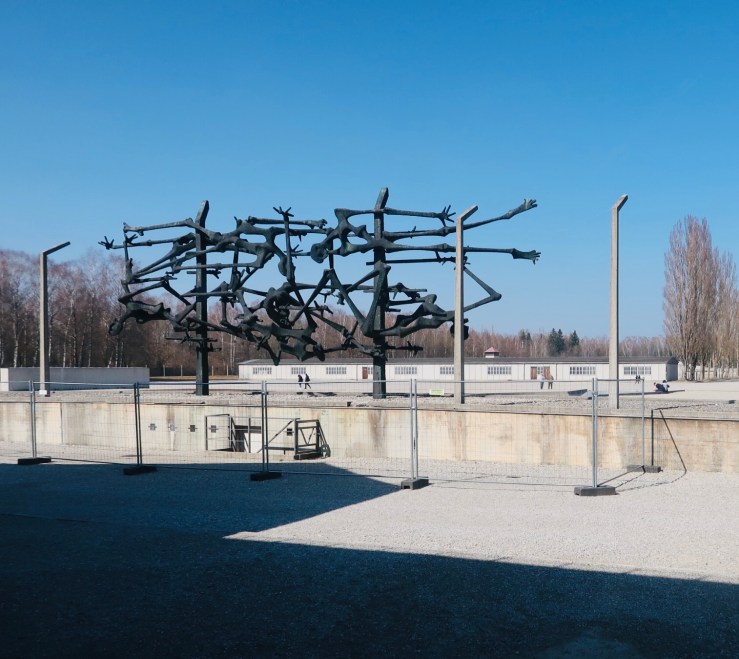
Some final images and remembrances to leave you as we exited the camp. Sculptures that represent the Victims and Survivors, A memorial Plaque, and the full look at the administration building turned museum.

“May the example of those who were exterminated here between 1933-1945 because they resisted Nazism help to unite the living for the defense of peace and freedom and in respect for their fellow man”