A Cuppa Cosy Summer Holiday – Detroit Michigan

Our next overnight stop on our Summer Holiday was Detroit Michigan, but before we crossed the border back to the States, we hit up Point Pelee, the southernmost tip of mainland Canada. A small National Park founded in 1918, this little area of the country has been occupied in some way since 700-900AD (that’s been documented). Initially a hunting area, the Europeans found it in 1670 and it’s been in dispute for a long while until it became a national park. You are able to camp and picnic in the park, even enjoy the waves on the beach front, but we headed further up to the small museum and bus ride out to the tip and then a walk on the marsh boardwalk. This spot is a boon for birdwatchers, and we saw several while we walked. It was a nice little stop and stretch your feet while being somewhere really cool. 

From there we did head straight through to Detroit. We stayed in the Financial District, close to the water and not far from the spots we really wanted to see- mostly on the auto factory side of things. We had one full day in the city, so we started off early the next morning by stopping in the GM headquarters (scoping out all the new and old vehicles on display as well as quite a few displays about what GM does beyond cars- it’s fascinating), then a short walk along the water- seeing both the statues and Canada across the way, before stopping in at the DNR Outdoor Adventure Center. 

Owned and operated by the Department of Natural Resources the Outdoor Adventure Center provides a variety of hands-on exhibits and activities meant to highlight the offerings of the region. Originally committed in the 1990’s, the museum and surrounding park area had quite the struggle to open up between funding issues and property ownership difficulties. However, in 2015 they were able to open up and logged 100,000 visitors in their first year. There is a little history, and a lot of nature information. The boys were able to “snowmobile”, ride an “atv”, practice “hunting”, as well as sit in an airplane, eagles’ nest, and learn about the environment of Michigan (which is a lot more than just Detroit). It was just as fun for us adults as it was for the kids. 

From there we headed back down the water and over to the tram for a ride to the Ford Piquette Avenue Plant. Built in 1904 this was the second building of Ford’s, however the first purpose-built factory. BUT in order to understand the importance of Ford and his mind and motor company, let’s take a minute to quickly talk about Henry Ford. 

Henry Ford was really a pioneer of his time. He was, what I like to refer to, as a tinkerer with a brain that didn’t stop. In 1892 he built his first motor car (he was 29- so if you’re younger than that and still haven’t figured anything out or are just starting to figure things out at 29- you’re in good company!) after becoming an engineer at Edison Illuminating Company of Detroit. Yes, that Edison. In 1893 he became Chief Engineer and in 1899, cheered on by Edison and several others, he founded the Detroit Automobile Company. In 1901 it was dissolved. However, in late 1901 Henry Ford designed, built and raced an auto that got some attention and he, tried again, founded the Henry Ford Company towards the end of 1901. However, once again, it was not to last as once Henry Leland was brought in as a consultant, Ford left, and Leland then renamed it to Cadillac. 

Finally, in 1903 Ford Motor Company was founded, with the Dodge Brothers as investors (!) and then in 1908 the ever-popular Model T was debuted. It would sell that year for $825 with a price that would continue to drop year after year. Something that Henry Ford is known well for is forward thinking and in 1913 he introduced the concept of the moving assembly belt to his factories (though this could not be only attributed to Henry Ford- several employees helped design and produce this concept). Some interesting facts about Henry Ford to end this little side tangent…He was an early backer of the Indianapolis 500, he was a notorious anti-Semite (both Hitler and Himmler were big fans of Ford and some of his writings were combined and published in Nazi Germany- AND Ford is apparently mentioned TWICE in Mein Keimpf, but he didn’t financially donate to the party – I don’t know why that was such a distinction that needed to be made…), and while he introduced the $5 dollar wage, and 40/48 hr. work week, he HATED labor unions and fought fiercely against his workers unionizing. 

So, the Ford Piquette Avenue Plant. Built in 1904, this was the second location owned by the Ford Motor Company and produced the Models B, C, F, K, N, R, S and finally the Model T during its 5 years. Initially cars were manufactured with hand tools that would be carried to the vehicle and a single location. This plant is where the idea of a moving assembly line was created. Just before the Model T debut in 1908, employees experimented with the idea that the chassis of the car moved along to the workers, rather than the workers moving to the chassis. They continued experimenting by using a rolling option, instead of the previous rope maneuvering, before coming up with the initial moving assembly belt (a precursor to the one Henry Ford later put in place at the Rouge Facility). Now, once the Model T was completed and out in the world sales quickly skyrocketed. Demand became so much that the Piquette Plant closed for two months to help catch up and the plant itself quickly became too small. In 1909 Ford Motor Co started packing up to move over to the Highland Park Ford Plant to continue. The plant building itself went through a couple different owners and businesses before being sold in 2000 to the Model T Automotive Heritage Complex (after hearing that it was going to be torn down) and re purposed the building into a museum full of over 40 early automobiles. The plant was added to the National Register of Historic Places in 2002 and a National Historic Landmark in 2006. 

Finally, a few fun facts about the cars…most Model T’s (post assembly line introduction) were black due to the fact that it was the fastest drying of all the colors, when the production of the Model T concluded (in 1927), Ford had produced 15, 007, 034 cars. 

That about summed up our day in Detroit. Heading back towards the hotel, we stopped over at the Fox Theatre and Comerica Park just to take a little look and then stopped for some food. Our second day, on the way out of the city, we stopped over in Dearborn to see The Henry Ford. 

The Henry Ford is the massive complex that houses the Henry Ford Museum of American Innovation, Greenfield Village, and works in partnership with the Ford Rouge Factory (The Henry Ford is also known as the Edison Institute). It is the largest indoor/outdoor museum in the United States and was added to the National Register of Historic Places in 1969, with the National Historic Landmark label attached in 1981. Where to begin?

We started our day with the Ford Rouge Factory Tour. The Ford River Rouge Complex is well known in the auto industry. Construction beginning in 1917 (opened for production in 1927, completed in 1928) it is the largest integrated factory in the World. The concept was to have everything that was needed to manufacture vehicles right at your fingertips. With the docks, the interior railroad, electric plant, and steel mill, there was no need to wait on much to be delivered in order to complete a car. The complex itself is made up of 93 buildings with 16 million square feet of factory floor space and, while the first products produced were the WWI Eagle Boats, it currently produces all of the Ford F-150 and soon to be Ford F-150 Lightning trucks. The factory tour is really interesting, showing the history of Henry Ford and the current projects, as well as a look at the factory tour (this was not in action when we toured, but you can tour when it is in action). 

From there we headed into Greenfield Village. Greenfield Village is known as an Outdoor Living History Museum- the first in the nation and a model that many other “living history museums” follow. The village is made up of various homes and buildings that were upended from their original locations and moved to the property with the end goal of showing the history of living and working in America since its’ founding. The village is a total of 240 acres, with 90 being used by the village itself. Some of the notable homes are those of the Wright Brothers, Edison and Ford, as well as the courthouse where Lincoln practiced law and a covered bridge from Pennsylvania. There is also the Farris Mill- one of the oldest in America. As part of the admission, you can pay to ride in an authentic Model T (some of which are replicas, some of which are actual authentic – we were lucky to get an authentic Model T), as well as on the Weiser Railroad. 

Finally, we headed into the Henry Ford Museum of American Innovation. Henry Ford was a bit obsessed with collecting and preserving historically interesting items that portrayed what the Industrial Revolution was like, both from an everyday life perspective (think items in the home, kitchen, toys, etc.) and from an industrial machine perspective. The museum is full of a variety of artifacts that range from massive steam and coal locomotives to presidential motorcade vehicles, to doll houses and tractors. There is also the Rosa Parks bus, the Oscar Meyer Weiner Mobile, a variety of engines, and restaurant signage. 

The museum itself was started as his personal collection on a 12-acre site. The building was designed with the Philadelphia Historical Park in mind (namely the Old City Hall, Independence Hall, & Congress Hall). Initially opened in 1929 as the Edison Institute, a private education site, it was later opened to the public in 1933. I will say that between all three (the village, the factory and the museum) we spent almost all day here and still didn’t see everything there was to see. We could have spent much longer if we hadn’t really needed to hit the road to make it to our next stop before bed time.

And with that we headed to my favorite spot on the entire trip…any guesses as to where that was? I’ll share it soon! 

A Cuppa Cosy Summer Holiday 2022- Niagara Falls

It is time to start sharing all the details and history of this year big Summer Holiday. We had quite the adventures, seeing a full loop of the upper northeastern portion of the U.S. and the some of the lower portions of Ontario, CA. I already talked previously about the requirements to enter Canada (I believe I did in my Montreal post), but I’ll touch on them again. These may or may not be up to date when you are reading this post (as they still change day to day), so I would recommend checking the Canada travel site HERE for the most up to date information. To enter Canada as an adult you must be fully vaccinated and fill out the ArriveCAN app on the phone (you can do this via we browser and print the certificate as well if that is easier for you I believe). Kids aged 5 & Up are required to be vaccinated unless they are traveling with fully vaccinated adults. For the vast majority of Ontario, we were not required to wear masks. 

A couple things to note before we get into these posts…in some places I’ll be sharing our hotel and food options, but in others I won’t. To be honest, I treat most hotels as a place to lay our head for the night and what I mean by that is, I don’t always have to be in the heart of downtown, best of the best, right in the action accommodation. Sometimes the best for us is valet parking, close to public transport, or best bed configuration. The same goes with food, though we are a bit pickier about that. However, with food I find that this is a personal varied choice. If a restaurant really stood out for me, I’ll share it, but otherwise I don’t have much in the way for either of those recommendations. 

Ok, so now on to the actual vacation (I’ll post the rules and restrictions once again when we enter back into Canada later on in the trip…). A brief overview of our route of sorts: Niagara Falls, Canada  Detroit, Michigan Mackinac/Upper Peninsula Region, Michigan Sudbury, Ontario  Toronto, Ontario Kingston, Ontario  Home. We took a total of 14 nights/15 days to hit everything, usually spending a minimum of 2 nights in each place, except Kingston which is close enough to our home (aka we can see it whenever) that we didn’t need to do more than a single night. Today kicks everything off with a post on Niagara Falls.

We started our time in Niagara on the American side at Old Fort Niagara. This fort is unique in several different ways; the oldest structure in North America between the Appalachian and Mississippi, was manned by three different countries, and expertly shows the way in which military life and conflict has changed over time. The region was originally occupied by the Seneca in the 17th century as a seasonal hunting and fishing spot. When the French took charge in 1679, it was a key access point for the Great Lakes. The fort passed from the French, who built the oldest building- the “French Castle”- in 1726, to the British in 1759. The British held it from 1759-1796, and again from 1813-1815. The Americans finally got a piece of the Fort (aside from that little loss 1813-1815) in 1796, and then permanently in 1815. While the War of 1812 was the last conflict at the Fort, it has been used in some shape or another through major conflicts in our history. In World War One it was used as an Officer Training Camp, In World War Two it was used Induction Center for troops and a POW Camp. In the Cold War it housed Anti-Aircraft troops. In 1929 & 1934 restoration projects went underway to fix the French Castle and other encampments and buildings within the fort. 

The fort itself is pretty cool if only to see the ways the natural resources and land were used to create an effective barrier. The French Castle also is a really great way of showing how they secured items and lived in an age that we can’t even fathom (wooden nails for example). They’ve also got the originally US colony flag that flew over the fort. If you are into war history, battle or forts, this is a really great stop. 

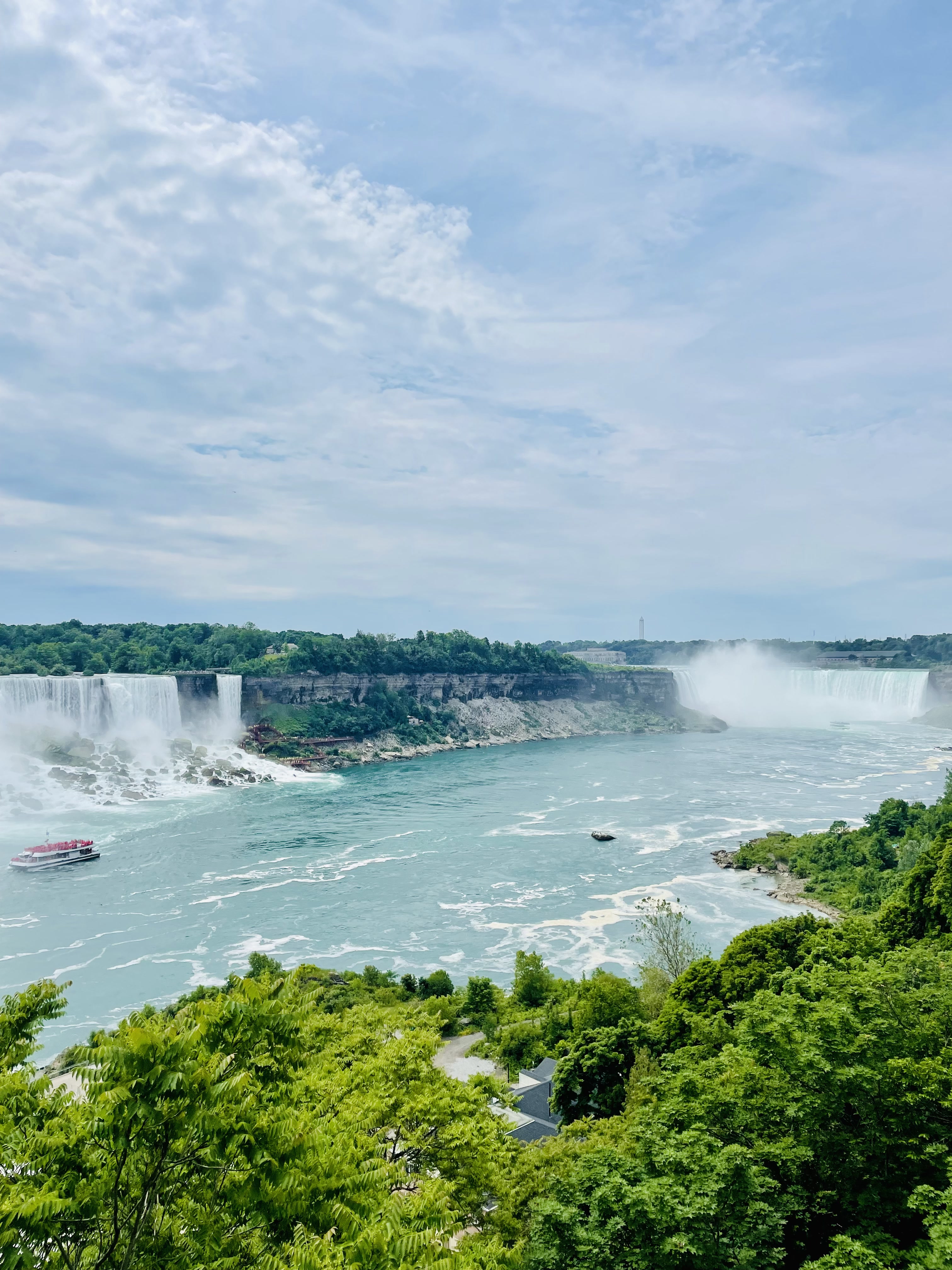
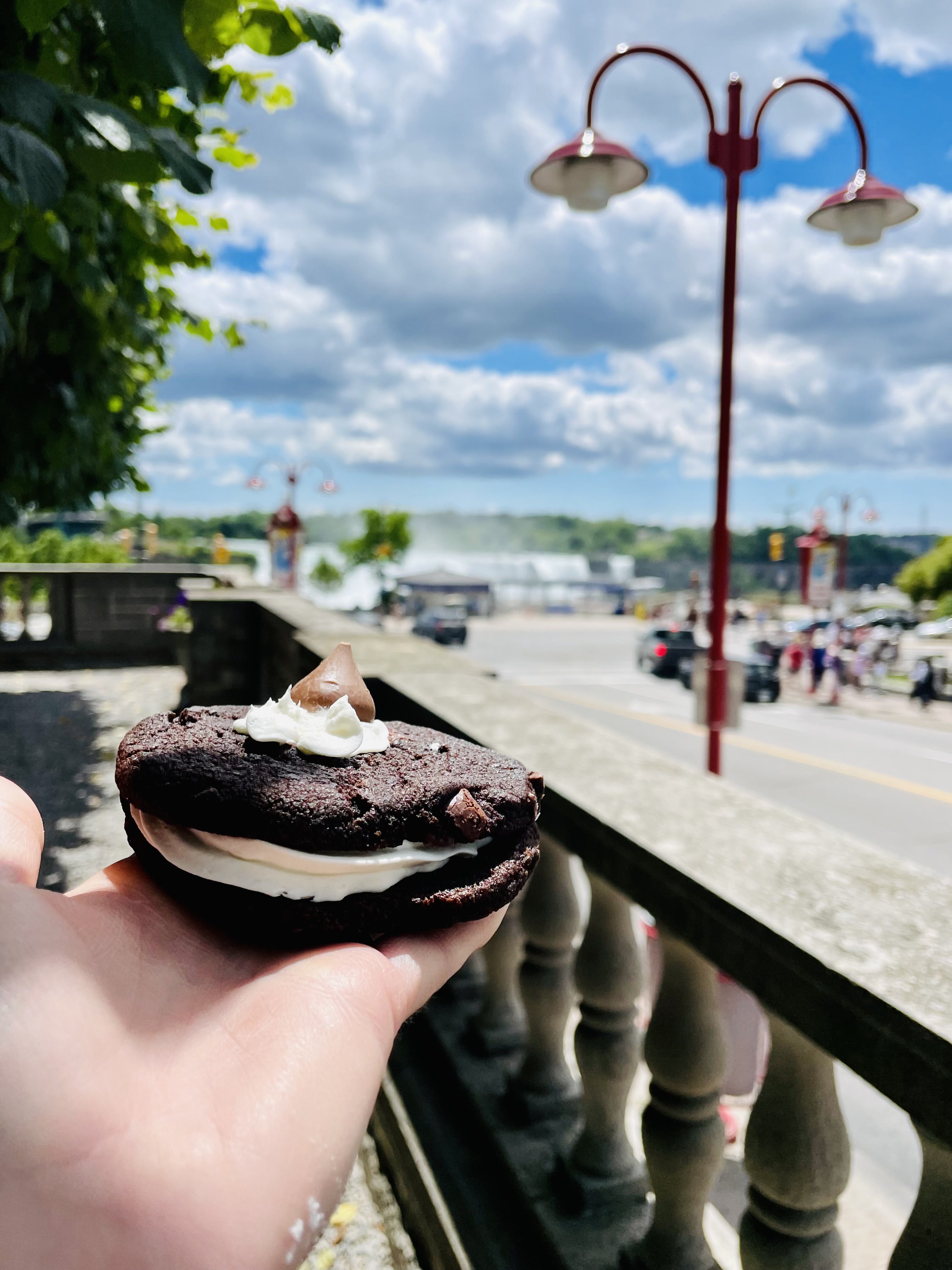
From the Old Fort we headed over the Niagara State Park and Goat Island. I’m not going to get in to too much of the history of the Falls as I feel like most of us know what Niagara Falls is (I feel like I say this and then go on and on and on), but I’ll give a couple fun little nuggets that I learned and found interesting. First off, Niagara Falls is over 12, 00 years old, but is considered “young”. The Falls are comprised of three separate falls: Bridal Veil, American, and Horseshoe falls. Together they produce 2.4 million kilowatts of electricity for the U.S. and Canada. 90% of the Great Lakes (that would be Superior, Michigan, Erie and Huron) drain into Niagara River, and then on to Niagara Falls, before hitting Lake Ontario. Two more facts and then I promise I’ll stop…maybe. Niagara Falls was the first state park in the U.S., designed by Frederick Law Olmstead (the same who designed Central Park). The water has only stopped once, in 1969 at the American Rapids so that scientists and Geologists could come in and study the effects of erosion. During the Winter Freeze and Spring Thaw a little bit more of the rock face is eroded away. 

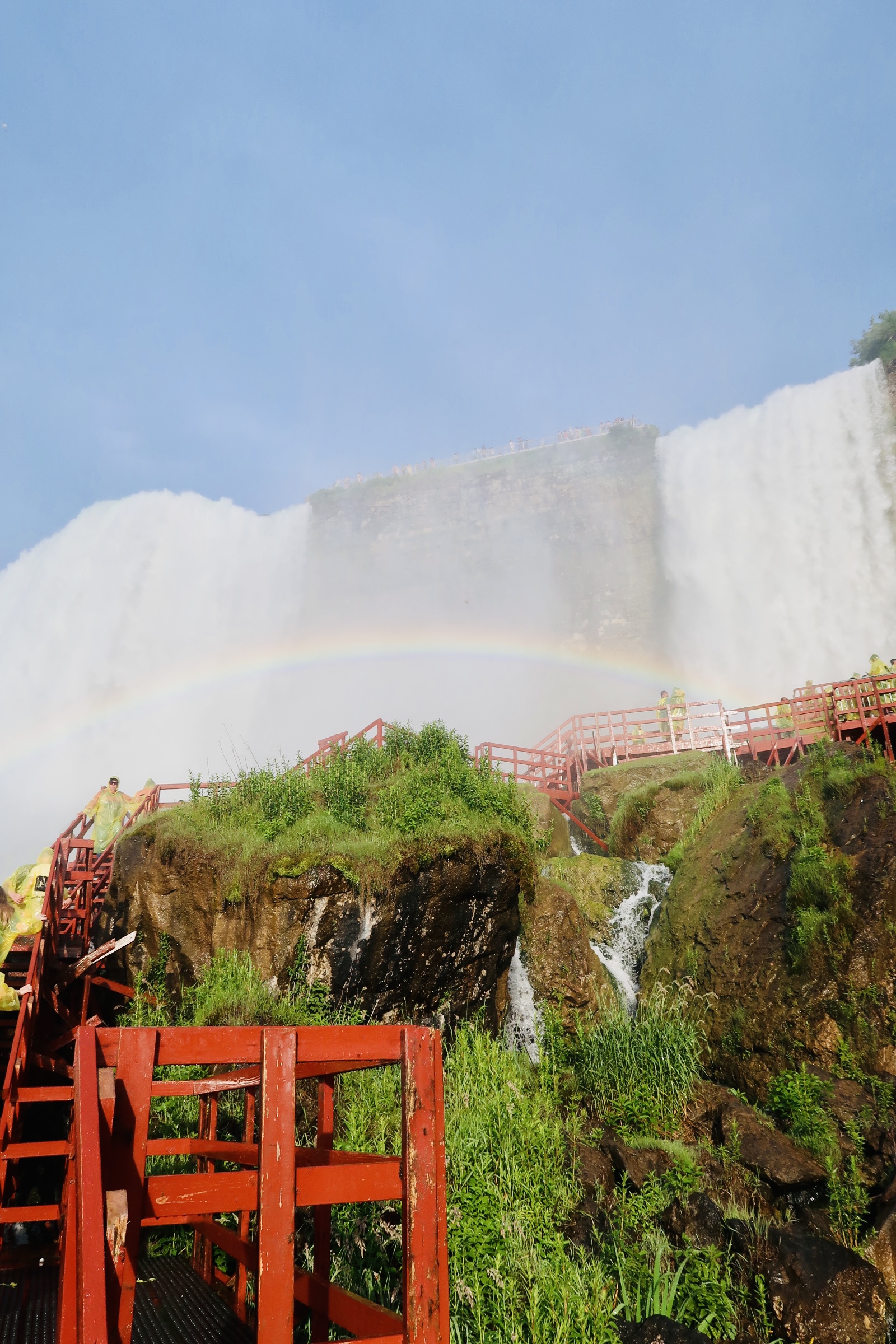
Now, we started our trip to the Falls out on the American side, which is cool in its own way. We went to the overlook of the Bridal Veil and American Falls, where you can see above the falls and look down. We also visited the “Cave of the Winds”, which is located on Goat Island. This attraction originates back to the 1800’s when there was a cave of sorts just under Bridal Falls. Tours to this “cave” began in the 1840’s (though people visited prior to that) before rock fall forced it to close in the 1920’s. It reopened for a time in 1924 where visitors could visit the “front” of the falls and cave. However due to more rock falls and erosion, engineers decided that the cave was no longer a safe destination and dynamited a portion of the rock under the fall. The visiting area was then replaced by what we see today- a grouping of stairs and standing decks at the base/slightly in front of the falls.

This was easily the must do thing on the American Side. Not only from the observation deck you not only get a really neat view of the falls, and, on a sunny day, the rainbow, but you can also feel the full blast of the falls with hurricane force winds and water spray as it rushes down. 

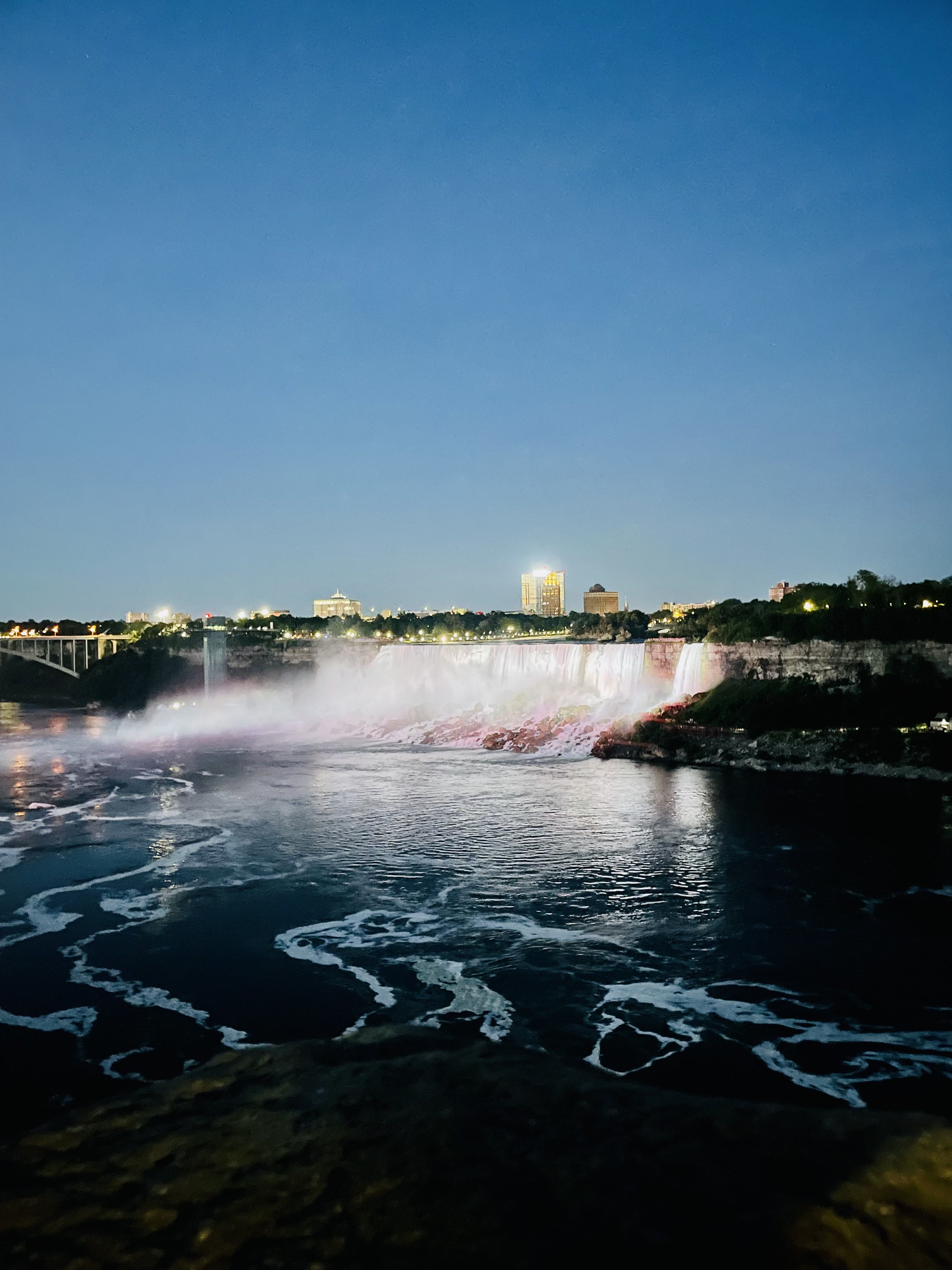
From there we headed across the border and to our hotel for the evening to check in. We stayed at Old Stone Inn Boutique hotel and found that to actually be a really good option. It’s just outside the hustle and bustle of Clifton Hill and Niagara proper, but not far enough that you can’t walk. After checking in we headed back down the Falls, this time on the Canadian Side for the Illumination of the Falls and the Fireworks show. The Illumination is a year-round show, started in 1860 and utilized for a long time for royal and foreign dignitary visits before becoming a permanent attraction in the 1920’s. The fireworks are a summertime special and are every night in the Summer at 10PM. Both a worth seeing and we loved being able to experience it. I would, obviously, suggest getting there early, but if you show up about 15 minutes before 10, you’ll still get a good viewpoint to watch them. They lift off from the same area as the Voyage into the Falls on the Canada side, so closer to Horseshoe falls would not be a bad spot to pick. Likewise, a spot by Queen Elizabeth Gardens or in between the three falls is good too. 

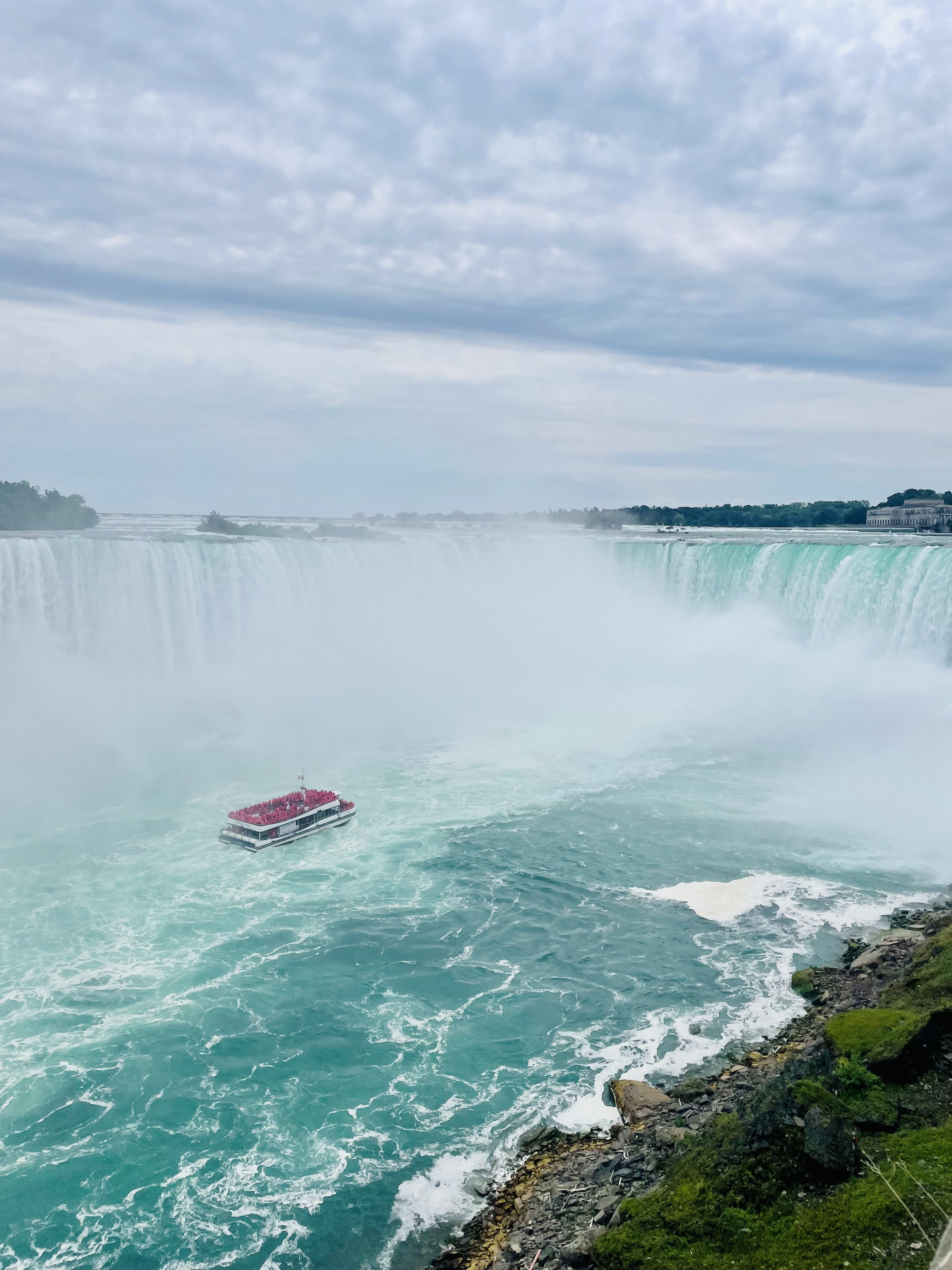
The next day we were up and off for an early morning Voyage to the Falls. A little clarification before I get into the history, Maid of the Mist (of the U.S.) used to be the only operator on the boat tours to get up close to the falls. They initially launched in 1846 as a ferry between the U.S. and Canada but was swiftly closed down in the 1850’s when the suspension bridge was completed. The company then launched with tours in 1854, but was, once again, swiftly closed when the American Civil War started. It re opened in 1885, this time going closer to Horseshoe Falls than previous. The U.S. added boats in 1892, but those burned on the Canadian side in an accident in 1955. In 1960 during a voyage, the Maid of the Mist rescued and saved a young boy who later became the first to survive a jump over Horseshoe Falls only wearing a life jacket. Finally, in 2013 Maid of the Mist split in to two separate entities, Maid of the Mist on the U.S. side, Hornblower Niagara Cruises (later Niagara City Cruises) on the Canadian Side. These days the boats are electric powered with zero emissions- which is great! 

In my honest opinion, whether you choose to do Maid of the Mist or Niagara City Cruises does not matter. They both map roughly the same route and one does not do less than the other (and I can tell you that factually as I watched them sail day in and day out from above- it is the same). It’s really going to be whichever you choose. But you SHOULD do it. It’s truly just incredible and awe inspiring to be able to stand there…in this belly of the beast of sorts and just…revel in mother nature. Truly just incredible. 

In all honesty though, if I could tell you one thing about visiting Niagara Falls, it is to view it from the Canadian side. You are able to actually view the falls from the “front”, rather than above or beside. It is truly a stunning view and one I am so glad we got to see. Once we finished touring the falls from boat, from below, we decided to wander through the gardens and slowly over to where we could go under the falls. 

Journey Behind the Falls started as this…competition between two businessmen. Located at Horseshoe Falls, in the 19th century, the only way to get down to the bottom of these falls was to take a steep hike down, over a rocky path filled with boulders and questionable rope ladders. It was dangerous and other spots that were accessible were covered up by “entrepreneurs” trying to make a quick buck and charge to look through a small peep hole. In 1818, the first set of stairs down closer to the bottom were built, followed by a spiral staircase to go lower. This was great, however it kicked off a feud between two businessmen that led to staircases being purposely broken and people being injured (unintentionally). This lasted until 1855 when Niagara Falls Park Commission was formed and took control. Shortly after the first elevator was installed and then in 1889 the first tunnel was opened to give lucky tourists a chance to go under these legendary falls. The tunnel as they exist now were created in 1944 and the observation deck was added in 1951. 

While I found this to be really cool and gave us a chance to see below all three waterfalls, I don’t know if the tunnels are absolutely necessary. This could have just been an off moment when we visited, or maybe just shining a light on the society we’ve turned in to, BUT the lines to see the portal under the waterfall were awful. If I had to do it again, I would probably have just gone to one portal and then out on the observation deck. 

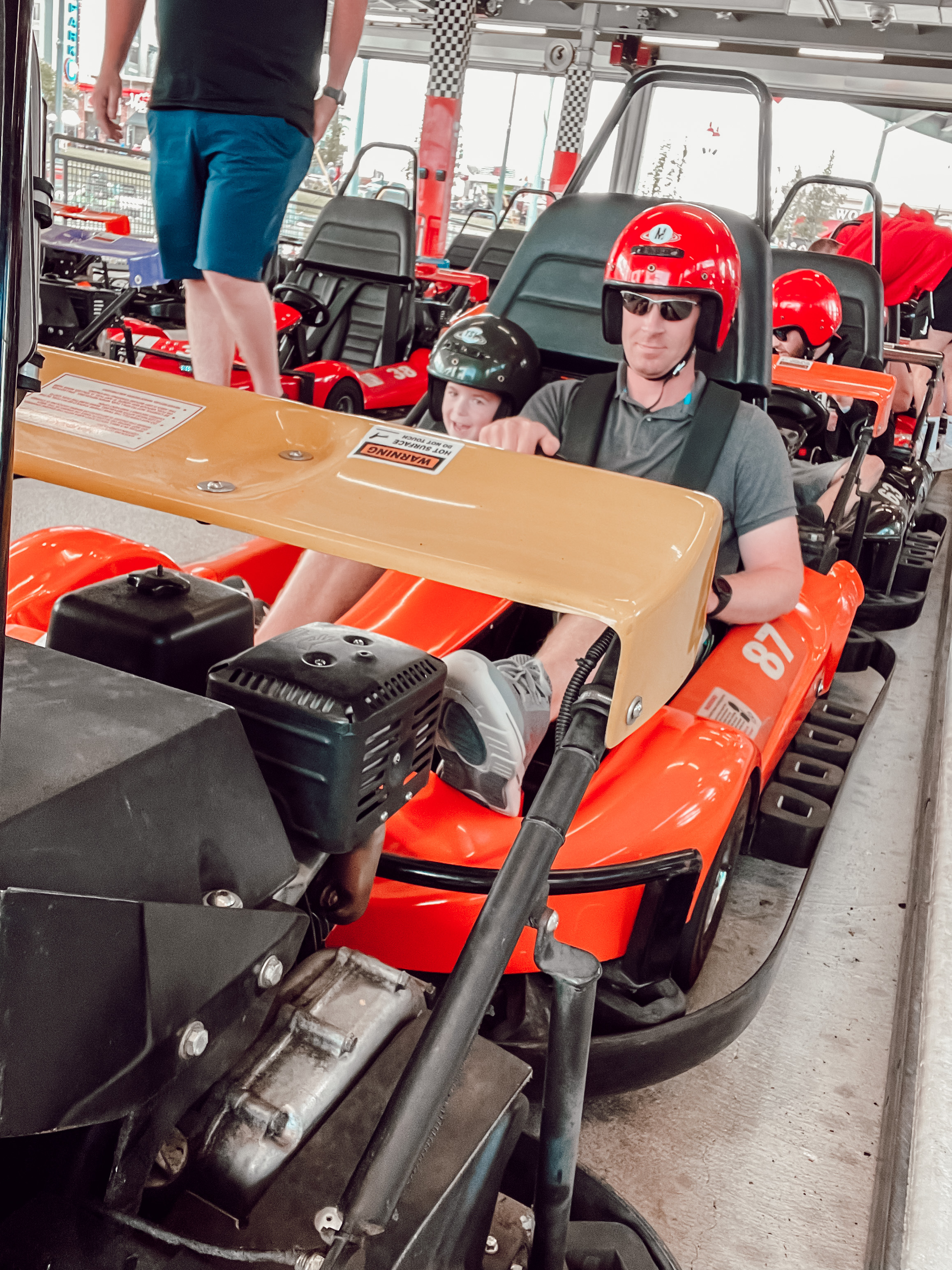
Our final day in Niagara we spent the day on Clifton Hill. Originally Clifton Hill was a sprawling mansion property lived in by both the “owner” of the city and then a U.S. Senator. However, as tourism grew, when Sir Harry Oakes purchased the land, he had business in mind. Before slowing turning Clifton Hill into the fun tourist spot it is now, he created a small quiet garden oasis in the parks, gardens, and outdoor theatre at the bottom of the hill. However, the Hill itself is now basically a carnival park. With Put-Put Golf, a racing speedway (of the go kart variety), arcades, bowling, and haunted houses, you can spend a full day just playing all the games. It was a good way for us to “treat” the boys and ourselves- we did a good amount of the games by purchasing a “FUN” pass- which gave us the Ferris wheel, put-put, and several “roller coaster” 3-D games (including a zombie apocalypse, ghost hunt, and outer space extravaganza). 

All in all, this was the perfect stop to kick start our trip! While Niagara Falls as a whole is very much do able in two whole days, having that half day to explore the American side before going into Canada was fun. If you didn’t want to do anything beyond the actual falls stuff (no fort, no Clifton hill, or if your kids were a bit older and able to withstand later nights better) I think you could easily just do two nights. For us though we’ve learned that sometimes taking the extra time, being able to travel a little bit slower is worth it. 

See you next time…in Detroit!

A Weekend in the City

Before I get into this post, I want to put a little…not disclaimer, but a little word about the delay. We went on this long weekend over Memorial Weekend, which…is now like 3 weeks ago. But let me tell you…the NYC exhaustion is NEXT LEVEL. It took me a week to feel like I wasn’t…tired and then another week to process and write, and now you’re reading it a week later. Sorry, but that’s reality for you! Now, into the post…

So, New York City. One of those “iconic” cities from the U.S. I’ve been several times to the city, but my husband had only been once (though he’s driven through it) for a work trip. Since we live ~5 hours from the city, we figured we could take a long weekend and see all the…big touristy things. Let me say one {more} thing…I let my husband and kids take the lead on this trip. Since I’ve been to the city before, I’ve done most of the highlights…and some of the hidden gems. And…to be honest, New York City is big enough that you won’t see it all unless you live there and even then, you might not. So…we wanted to kind of hit some of the popular highlights of the city. If I go back, I plan on going as a girl’s trip and can do a couple of different things that may not have interested my husband or children (like a Broadway show, some of the neighborhoods, etc.). 

Two more things before I get into the weekend, we stayed very much outside the “city proper”. We stayed on the south end of Brooklyn, and, for us, it was worth it. The public transport in NYC is decent and it was very easy for us to just hop into the city when we wanted, but then be able to hop out for a breather. Second, we had really great weather for the trip! I know, weather?! BUT I feel like you never really know what you’re going to get in the city when it comes to weather, and we had one thunderstorm at the beginning and then blue skies and mild heat the rest of the weekend. 

So, to start off…

We started off our great City adventure by walking to the city across the Brooklyn Bridge. I’ve seen this bridge a million and a half times between photo’s, TV, and movies, but never actually walked across. Since we were staying on the Brooklyn side of things (like very much outside the city), I figured, this would be a great way to “meet” the city for the first time. The Brooklyn Bridge connects Lower Manhattan with Brooklyn Heights over the East River. When the bridge was initially completed in 1883, it was the longest suspension bridge in the world. It has been reconstructed several times to meet larger traffic demands, as well as to install specific bike lanes. It was designated a National Historic Landmark in 1964 and a National Historic Civil Engineering Landmark in 1972. The views crossing over the Brooklyn Bridge are great- you can see just about the entire city, plus the Statue of Liberty. 

We grabbed dinner at a hole in the wall Italian joint and I finally got to have my fast-food pizza. After dinner, we just wandered around the Financial District into the evening. We got our first glimpse at the World Trade Center area, as well as a hint of the battery (looking down- not quite The Battery). 

The next morning, we had an early start as we booked an early security check in for our ferry and tour of the Statue of Liberty and Ellis Island. I think most of us know the history of the Statue of Liberty, so I won’t go too deep into all that history. Gifted to us by the French in 1886 to celebrate the friendship of France and the U.S., Lady Liberty is full of a lot of symbolism. Across the statue, from what she carries, to her stance, even the carved facial expression- everything has meaning. While France financed and created the statue, the U.S. had to supply the Pedestal on which she would stand. Originally it was a copper color, but by 1906 the copper oxidized and the gorgeous green that we see today had arrived. The statue has been renovated once but closed several times during her tenure. For many years following the September 11 attacks the crown was closed to visitors, once re opened it was a limited amount per day (240/day total). 

We spent about an hour and a half or so on Liberty Island, walking up to the pedestal, around the base, and then through the museum. From there, we hopped back on our ferry and headed to Ellis Island. Again, I won’t go through too much of the history as I feel like most of us (well in the U.S.) know the basics of Ellis Island. Built initially in 1892, due to the high volume of immigrants at the time, Ellis Island served as the first stop for any and all new immigrants for 60 years. Over 12 million immigrants walked through its’ doors, though not all got to stay, and some faced rigorous testing and inspections. Upon arrival if you were traveling on anything other than a first- or second-class ticket OR you were sick, you would be sent to Ellis Island. Upon arrival at the island, you would go through several rounds of testing, some just a health screening, others a full interview and evaluation. Around 2% of the immigrants would not be granted entry and would be sent back- reasons being either disease or work concerns. The Island was closed in 1954 after a slowdown in the need of extensive processing (this was when embassies, and more ports started coming in to play). Once closed, Ellis Island became a ghost town. It deteriorated into a group of abandoned buildings, even though it was a recognized landmark (1965). The Foundation, that restored the Statue of Liberty, worked tirelessly on restoring, combining, creating, and finally opening Ellis Island as well now know it. 

I will say, even if you aren’t the family of immigrants or if you know the history, it’s still a pretty incredible place to visit. Not only for the history of the immigrants that went through their (and to learn their history pre-Ellis, during Ellis, and post Ellis), but it’s also pretty incredibly to think about the restoration and rebuild that occurred at the Island. And to know that it’s funded by the public through donations and contributions. Again, it’s just a place to visit and learn about what was a big place for so many. So many of these immigrants have made incredible and everyday contributions to our country. 

Once we got the ferry back to Battery Park, we headed out, once again, to explore the Financial District. We stopped over at the New York Stock Exchange, which is always a bit…smaller than one would think in person. We saw the little girl standing up to the male corporations dreaming of being in their one day (I don’t know if that’s exactly it, but that’s how I see it), the bull of Wall Street (which was packed and I didn’t even bother to re-create any pictures from the past two visits to it), and then over to One Trade Center. Visiting the World Trade Center Memorial, One World Trade Center, and the rebuilt area was something that was important to me. The first time I had ever visited New York City, I had gotten to go inside the Twin Towers, my mother worked with folks who worked inside the Towers, I vividly (like many many others) remember September 11, my husband vividly remembers September 11, and it was important to us that our children know that space and history. So, we visited. It’s such a peaceful spot, somewhere that you can sit for a bite and remember those who died, were injured, or are forever missing from that day. We stopped by the name that my mother knew and rested a bit.

From there it only seemed fitting that we headed to the New York City Fire Museum (mostly for our firetruck crazed 4-year-old). The museum showed not only the history of the fire trucks, fire response, and fire departments, but it also had a spot dedicated to September 11. It was actually quite interesting to see how the city handled fires when it was horse and buggy (here’s a hint…the firemen would pull the buggies) and how it evolved to the modern trucks and water capacity we have now. 

From there we headed over to The Strand, one of only two spots that I requested to go to, and I promptly became incredibly overwhelmed. Dating back to 1927 on “Book Row”, it is a family run business and the only bookstore still open from that street of bookstores. Now The Strand carries well over 2.5 million new and used books and to be honest…as much as I absolutely loved walking through those doors and literally just seeing books from floor to ceiling…nothing can prepare you for that. I need like a full day by myself just to take a crack at what they had. So, needless to say I loved it…definitely need a second go round there. But it was also kind of the perfect way to end the first full day we spent in the city!

The second day we were there, we decided to do a little bit of an easier, slower day and spend some time in Central Park. We always try to seek out parks/nature trails/ anything along those lines wherever we go, and Central Park is so known, that it was a good stop. But before we went into the park, we headed to the second place that was on my personal list, Zabars. Zabars originally opened in 1934 offering a variety of niche high quality food. You can purchase standard fair (pasta, canned options, and the like), but also bringing in small brands and foods from around the world, and fresh made bakery items (the rugelach is incredible, coffee, and lox (and other fish). It is, in so many ways, a Jewish staple, but it also has some of the best bagels and lox and cream cheese there is. I’m obsessed. Initially I went in for bagels, but instead opted for some black and white cookies, wafers, and rugelach for us to eat as we wandered throughout Central Park. 

We wandered not too deep into central park, but enough to hit the high spots and the Zoo. We started at the Alice in Wonderland statue (a favorite of mine), then along the main walk, over to the Zoo, and dropped down to Gapstow Bridge from Home Alone. While it was incredibly peaceful and really cool to see the juxtaposition of the city architecture against this massive nature expanse, it was also frustrating at times. Bathrooms are few and far between and we found ourselves racing from place to place to find a spot for the kids. Just wanting to let other parents know (it’s a struggle if your kids are still learning how to use restrooms in the sense of adults). Regardless, we ended up spending almost the whole day within the park. The Zoo was a real highlight – it has enough to make it worthwhile to visit while you’re already in the park, but not too much that you spend your entire day just within the Zoo. The animals are also fairly active, so you actually get to see them out and about. A quick note- there are two tickets, general admission and a second, higher admission. The only real difference between these two tickets is the 4D movie experience. While we liked the movie, we didn’t NEED to see it.

From Central Park we made our way over to NBC Studios, Rockefeller Center, St. Patrick’s Cathedral, and finally Times Square. 

The next place we actually stopped at (unlike the studios, and Rockefeller, where we just walked and looked) on that list was St. Patrick’s Cathedral. This historic cathedral came up almost side by side with the city itself. The cornerstone was laid in 1858 and the original doors opened about 20 years later for services. The construction was paid for both by immigrants AND the upper echelon of society at the time. The cathedral itself is incredible- very reminiscent of the European Cathedrals. I didn’t stay in too long, they were having a ceremony of some sort, so I felt like I was treading on something special and didn’t want to stay long. 

Our final “stop” of sorts was a quick moment in Times Square. Originally named Longacre squared, Times Square became Times Square in 1904 when the New York Times moved to One Times Square. One intersection within Times Square is also the beginning of the Lincoln Highway (on the Eastern side), which is the first road across the U.S.  To be honest, Times Square is probably one of my least favorite spots, but it was something that my family wanted to see…just to see, so we made it the last thing we did. It was…well Times Square. I don’t have too much to say about it to be honest. 

So, that wraps up our weekend in NYC! We had a lovely weekend, and it was a great kick off to our Spring/Summer/Autumn of travel. 

A Weekend in Montreal

Over the Easter Holiday Weekend we decided to get out of town and head up north across the border to Montreal. We’ve been to Canada several times, but never Montreal. This comes on the heels of Andrew and I heading up north with a friend when the border re opened without testing for those who are vaccinated. We went up for a day to Kingston, shopping in a little district area (including an independent bookstore- finally!) grabbing some lunch and enjoying the beautiful waterfront that Kingston offers. After that little day trip, our plans for a longer weekend were solidified. We’ve always loved Canada and wanted to see more, and it’s gotten a bit easier for us to do that. 

First off, for full transparency, Covid protocols…you’ll want to check the Canada website HERE for a full breakdown of the most up to date rules. When we headed across the border by car, there were no testing requirements for fully vaccinated. The rules apply to all those age 5+, but there is some verbiage for families traveling together with young children who may not be fully vaccinated, but the adults are (it involves testing). Regardless of the protocol at the time, you will need to have downloaded and filled out the ArriveCan documentation, which is super simple and straightforward. You’ll input your passport info, vaccination or testing info, and travel info.  Specific requirements will also vary depending on what province you travel to. For instance, when we went to Kingston (in Ontario) masks were not required to be worn inside, but in Montreal (which is Quebec) they were mandatory. You’ll need to check the specific province and city you are heading to as with any other travel. Beyond those two items, traveling to Canada was much the same as it was when we went three or four years ago. 

So, our weekend in Montreal. Where do I begin?

We arrived around dinner time on Friday evening and immediately got settled in our hotel. We stayed at the Le Saint-Sulpice Hotel Montreal which was every bit of incredible. Located right behind the Notre-Dame Basilica Montreal it is located almost in the heart of the Old District of Montreal. It is also conveniently located right near the river, with the Rue St. Paul (the pedestrian shopping street of Montreal) just a 30 second walk away. We had a “ground floor” room with a window looking out on the street below. 

Once settled we decided to just take a quick walk around the district to get some of the road trip energy out for the boys before dinner. I will say that reservations are very much a thing in the city. Most restaurants will still be able to seat you, but if you have something in mind, I would definitely get on their books ahead of time. This was something we ran in to twice, once with a restaurant and once with the Biodome and Botanical Gardens. So, reserve, reserve, reserve. This is something that we normally do, but the lead up to this trip was a bit hectic between sickness and family visits. Anyways…

We didn’t have any definite plans while we were in Montreal, just a few general ideas. A spot we really wanted to see was the Biodome, botanical Gardens, and Olympic Complex, but we were not able to get the reservations in time (good thing Montreal is only a few hours away, so we could go back if we really wanted to). Instead, we decided to just sort of walk/wander the city- which is one of our favorite ways to see new cities. Our first stop was breakfast, and we really wanted some crepes to start our day. A quick stop at Chez Suzette for some truly delicious crepes and mimosa’s and we were set for the day. We started at the Notre-Dame Basilica of Montreal. 

This church dates back to 1672 when a small stone church was built. The church was quickly outgrown and the church as we see it started in 1824 after a long period for approval of the plans. As many cathedrals, it took quite a while to be built into the massive church we see today. In 1982 it was declared a minor Basilica by Pope John Paul II and in 1989 it was recognized as a national historic site. The crowning interior was designed and created by Victor Bourgeau and features a variety of pieces, including 4 scenes from the Old Testament at the altarpiece. The organ is a feature piece of the church currently featuring 7,000 pipes. There is also an incredible Notre-Dame du Sacre-Coeur Chapel in the back of the cathedral which features a bronze altarpiece. The altarpiece is said to represent humankinds overcoming life’s hardships in the march to the Holy Trinity. It was incredible to see. 

From the Basilica, I made a quick stop to Le Petit Dep, which is a small marche with several locations. Known for its bright green storefront, delicious coffees, and wide selection of local artisanal goods it was a nice little spot to grab a coffee or tea. Quick word of advice though- go during the “off” time of day unless you are prepared to wait. I grabbed a tea and a mug and was set to go- it was truly a charming little stop. 

Then we headed off on the Metro to Mont Royal Parc. The Mont Royal is first mentioned in our history by Jacques Cartier, but it was occupied, hunted, and used by Indigenous People (the Hochelaga are who showed Cartier the way) for long before that. However, it was Jacques Cartier, in 1535, who gave it the name Mont Royal. The mountain has been home/location for many things, the site of several cemeteries (which are still in existence- 1852), a religious site, a hospital (1861), a college (1821), and finally, a park. In 1872, after many discussions of what to do with the Mount, the city purchased the land to officially turn it into a park. Frederik Law Olmsted (of Central Park) was brought in to design the park with the goal of it being a refuge from the city at large. In 1876 the park was inaugurated with great fanfare. In 2005 the park gained heritage status and the land itself will be protected from further development. 

We hiked up the park using the stair option, which was not only quite a workout, but provided several spots to look out at the city and a peaceful refuge from the city. We stopped at the lookout spot in front of the Mount Royal Chalet. This chalet was built in the 1930’s as part of the Make-Work project during the Great Depression. It hosts historic works of arts, chandeliers, and such and is used today as not only a reception hall, but also a gift shop and restaurant. It was a really pretty spot to stop- not quite the summit of Mont Royal, but still a beautiful view. 

From the Chalet we ended up catching the bus over to Saint Joseph’s Oratory. Originally a small chapel built by Brother Andre in 1904 in honor of Saint Joseph. It very, very, quickly grew in both size and worship. In 1914 new plans were approved for what would become the current basilica. The Crypt church dates back to 1917, with the basilica construction starting in 1926. Brother Andre died in 1937, with over a million people visiting his coffin. In 1946 construction of the votive chapel and Brother Andre’s tomb alcove begin, with completion and blessing in 1950. In 1955 the Oratory is marked as a Minor Basilica and it was officially opened in 1956 with construction on the interior being completed in 1967. Fun fact, in 2010 Brother Andre was officially declared a Saint. There is currently construction taking place to make the Basilica easier to access by visitors, but that didn’t stop it from being incredible. 

My first thought upon seeing the exterior of the Oratory is that it is Montreal’s very own Sacre-Coeur. It is very reminiscent (though I don’t know which came first…ok just researched-the timelines ever so slightly overlap with Sacre-Coeur be finished as the design plans for the Oratory are released), though they say that they leaned towards the Italian Renaissance when designing. The interior of the Basilica is incredibly modern (even by today’s standards, let alone when it was actually built) and vast- seating 2028 people. There is also the Crypt Church which is located right off the Votive Chapel (we’re getting there). This church features a statue of the Saint Joseph, where Brother Andre would pray right at the heart of the sanctuary. Then there is the Votive Chapel. This is a space that wasn’t included in the original design, but rather added as a space between the Crypt Church (to connect it to the Basilica) and to provide a space for Brother Andre’s tomb. Opened in 1949, one of the unique features of this space is the cane’s/crutches that are hung between the pillars, left behind by pilgrims who visited during Brother Andre’s time. The central lampstand in front of the tomb features 3500 candles, and his tomb (located through a tunnel underneath) is made of black marble. Following a path behind the lampstand and tomb, you are able to see a statue of the Virgin Mary, between the chapel and the mount rock. 

It was an incredible site to see and history to learn, to know how this man impacted so many in his life. Once we finished at the Oratory, we caught the metro back to the Old District to find a spot for dinner. While walking through town, we headed in to the Bonsecours Market. This is a two-story domed public market. Located on Rue St. Paul, the market originally opened in 1847. This has not only been used as a marketplace, but also a banquet hall and at one point, hosting the Canadian Parliament for a session. It reached historic site status in 1984 and was a really neat space to walk through and see some local treasures. 

We ended the day with dinner at 3 Brasseurs, which features its own brewery and beers. The food and drinks were delicious, and everyone loved their meal. A final wander through Rue St. Paul as we headed back to our hotel and our time in Montreal ended. 

Overall, I would say that Montreal is a great, culturally driven city. It’s a great spot to stop for a night or two and just enjoy the “city” life while also knowing some of the history of the area. There’s plenty to do and see AND if you’re an art and culture lover- there is an abundance of galleries to explore. 

A Year In…

It’s been a year. A whole year being in New York. A {little over a} year back in the United States. I figured I might take a minute and just…reminisce? Share some of the things that I’ve learned? I don’t want this to be a recap post or anything of the sort (I already did that with my New Year’s post HERE), but there are some things that I’ve learned that I want to briefly share about. 

In 2021 we moved away from our little village in Germany back to the US. We took a month to visit some family, before heading on our way to very {veerrrryyyyy} Upstate New York. As someone who was very sad to be leaving Germany, even the excitement of being back in the States, setting up a new home, and being in a new location wasn’t enough to bring me out of my blues. Also, the move back was a bit overwhelming, as was the adjustment of being back in the States. I was excited, but also sad, and a little apprehensive. This would be a different life for all of us. 

I will say this, I have fallen in love with this area of the country. We truly live in a very beautiful area, close to a lot of outdoors activity, smaller town living, and really…not much can top Upstate New York in Autumn. We still have easy access to a lot of travel spots, and we’ve even tried out some different travel options (and fell in love with one or two). It’s been something special this past year, but a lot of that “get out of the blues” feeling is due to one thing…

Romanticizing my life as it is. 

Now, let me make this clarification (and I’ll probably make this several times throughout this little post) …this doesn’t mean that life is easy or grand or beautiful every day. It doesn’t mean that everything is perfect and wonderful and easy. BUT what it does mean is accepting that those days come, but celebrating, reflecting, and holding on to those little moments of joy- that first cup of coffee in the morning, a picnic on the front porch, the quiet of the afternoon while the kids are at school, the beauty of a sunrise or sunset. Or bigger things like walking in a field of flowers, picking some fresh for the table, sitting at the edge of a mountain in the middle of Autumn with the vibrant reds and yellows all around. Those little joys are what I share, what I reflect on, what I treasure, making sure those are the moments that hold me through…that’s what this means to me. It’s finding those little moments in the midst of the chaos and holding those close when it is chaotic. 

I know it might sound cheesy, but if you’ve been following my social media over the last 6-9 months, you’ll have seen me share a lot of those moments (I mean how many times can I wonder at opening my blinds up in the morning to greet the day?! It’s glorious!). 

It’s really easy to get swept away in life and the world living in Europe. Like beyond easy to feel like you’re living in a dream, living in a fairytale. I didn’t want to lose the joy and wonder I had when waking up in Europe every morning when we moved back to the US. And while the US is incredible and the area, we live in is beautiful, I needed to find a way to carry that feeling from Europe into our new life in New York. So, I started doing little things. Our new routines and scheduled meant for less time for “dallying” in the morning, so I tried to take little moments, making that first cup of tea, opening up all the blinds in the house, playing calming music in the morning, etc. It’s nothing I wouldn’t already be doing, but it’s more so putting a bit more intention into these little moments. I find that if I take a couple extra seconds in the morning to put on a calming playlist (I have several to choose from) and just take a couple extra minutes when opening up the windows to truly take in the day- it shifts my mindset. It reminds me that life is beautiful (even if not always perfect and calm) no matter where we are or what we are doing. 

It doesn’t mean that life isn’t chaotic, or busy, or that my children don’t throw fits and I don’t feel like screaming and crying all at the same time…it simply means that I am constantly looking around and reminding myself how wonderful life is in the good moments. It doesn’t change that we have bad moments (because oh boy do we), but it makes a small difference in them. 

And that to me is what Romanticizing my life is all about. It’s about putting myself in the movie, in seeing the beauty in all the little moments throughout the day, to help get through the bad moments (also throughout the day). It’s about reminding ourselves that life can be incredible and celebrated and enjoyed. 

2021 Wrap Up

Well…2021…the year that was. I don’t know if it’s my frame of my mind while I’m writing this or if it’s just the general…meh ness of this past year, but I’m just not feeling a wrap up. We had a lot of good, some not so good, and a whole bunch lumped in together to end the year out (which if I’m honest, is probably what’s making this wrap up feel meh). However, this end of year reflection is kind of becoming a tradition and it’s one that I want to keep going. I feel like reflecting on a time allows us to learn lessons and continue to grow as long as it’s done from a place of honesty (as in- recognize if you are viewing it through rose colored glasses – which is fine but should be noted- and don’t change the bad stuff around to suit your current status or feelings). 

So, 2021…

Our year started with a big move, from Germany to the US. We said a very sad, very fond, very long (seriously- our flight was delayed for two days) farewell to our German adventure. It was a kicking and screaming moment as we really loved our home, our neighborhood, and the friends we made there. There was a bit of culture shock once we got back to the States, namely a) you can get anything, anytime, b) the cost of…well everything, and c) the general “busy, busy, busy” lifestyle read about it: LEAVING GERMANY, ADJUSTING TO AMERICA, DIFFERENCES). 

We ended the first quarter of 2021 making a new home, a new community in upstate New York. We’ve settled in really nicely into our new house, creating a imperfectly perfect space with what we’ve got and I’m really in love with how it all has come together. I’ve still got some décor bits and bobs I’m working to find, but I’m trying to be slow and mindful with those purchases. We’ve settled into a new community, jumping into a new school, some new volunteer opportunities, and new friends all around. It’s been a real blessing how everything here has seemingly clicked into place. 

We spent spring exploring some of our area (ALEXANDRIA BAY, LAKE ONTARIO/WELLESLY ISLAND), and summer exploring a part of the East Coast we hadn’t gotten to see (PLYMOUTH, BOSTON, BOSTON PT 2, SALEM, PORTLAND). Then Summer started to turn to Autumn, and we went a final couple of places on our list (ALBANY, FINGER LAKES, LAKE PLACID). I feel grateful for the amount of traveling that we have been able to do this year and for the truly incredible places we’ve seen. We fell in love with a couple new places, solidified what’s important to us when traveling, and maybe how we want to do a couple trips differently in the future. 

The boys have settled in remarkably well, reminding me just how resilient our children truly are. They’ve fallen right into the swing of things with Colton properly starting Kindergarten this year and Andrew…well, being Andrew. We’ve had a couple of struggles that come with the changing years as they grow, and we’ve had a couple of trips to the hospital (remember when I said everything bad seemed to come at the end of the year all at once?), but throughout it all, the boys weathered with a smile on their face and excitement in their eyes. Well, the excitement might have been a troublemaker’s gleam, but we’ll go with excitement. 

As a family, I think we are in the strongest shape we’ve ever been in. We just continue to grow individually and as a unit and I’m just so happy and at peace with life. That feels so good to say. Robert and I celebrated 10 years together and hit 7 years married. Safe to say, we’ve come so far and have so far to go. 

Finally, have I changed? Grown? Experienced something new this past year? Yes and no. I feel like I’ve really started to learn how to use my voice, what I want to use my voice for, solidified some boundaries, and learned how to “manage” certain things. I don’t think that we’re meant to learn something every year or grow massively or experience great things. Some years we are just meant to carry on and I feel like that has really been my sole focus of 2021. Carry on, move forward, and see the light. That I feel like I accomplished. 

Visiting Holocaust Sites Part 1: Dachau and Lidice

**A couple disclaimers before we get into this post…

  1. This is obviously going to contain graphic and triggering content. Please proceed with caution. Obviously my hope is that you read this and take something away, but I fully understand that this is a difficult topic to read about.
  2. I am Jewish. That colors everything, I do. Every part of who I am. More so now as I am starting to learn and realize some things from my past and my relationship with Judaism. But I am Jewish.
  3. This post is going to be jumbled. I don’t know how this is going to go, how this is going to get broken down, how it will be received, how much is just going to be a rambling stream of conscious. I don’t care. This is important.
  4. If you are someone who is a holocaust denier, a holocaust minimizer, an antisemite, racist, or want to disagree you may just move on. (It makes me very….grrr angry and heartbroken that I even have to say something like this, but it needs to be said.)
  5. (I’m just now adding these as I am writing this post). I think this is going to be a two-parter as I’ve only just finished the Dachau portion and I’m already pushing past 1500 words. The second part will be up in short time though- you won’t be waiting long for that.
  6. The second part was written after the incident of Domestic Terrorism on the US Capital, in which the most blatant display of antisemitism was exhibited in my life. I personally saw footage of “heil hitler”, camp Auschwitz sweatshirts, and two congressmen use Hitler’s rhetoric or name. If the tone is off in this second part as opposed to the first, please understand why.
  7. Finally, we are facing drastically rising Jew hatred not only in our country, but across the world. It’s often times hard to voice concerns, content, and information not only about this but also just about being Jewish. In a personal way, I am still learning and trying to figure out how I want to use my voice in regards to this.
  8. This post is being posted way after I originally intended to, but here it is.

Disclaimers over.**

Where do I even begin? During our two years in Germany, we visited a total of 4 Holocaust specific sites, along with numerous monuments and locations relating to World War 2. I’ve written specific blog posts that are just a presentation of the history and facts of each place that I’ll link as I talk about them, but I wanted to talk about the actual opinions and feelings that I experienced at each place. I didn’t do this in the posts for a couple different reasons, most importantly being that I think the actual cold hard facts of these places are not to be overlooked by our feelings of them. But also, I quite simply couldn’t talk about them. I didn’t have the words. I didn’t have the feelings. There is absolutely NOTHING that can prepare anyone for a visit to these places. These places where entire generations of your own people, your own ethnicity, were brutally murdered. I think for a long time after visiting, I found comfort (the very wrong word in this situation, but it’s the only one that makes sense) in the cold hard facts. In not coloring what happened with my own complicated heartbreak. But things change and as I see what is happening in our modern world, our current times, I think that it’s time for me to talk about what this experience was really like. 

I’ve always been well understood, well read, well watched and versed, in the Holocaust. I think I was 11/12 when I really started deep diving into the history of it all. What could make a person single out one group of people as the cause for everything bad in the world? How? I couldn’t understand. I still can’t understand. And there is so much we still don’t know. We will never know. Either way, I learned A LOT. This was in part as it was part of my heritage, of who I was, but also because of the psychology of it all. When we got the orders to come to Germany, I knew that we were going to be visiting some of the camps, maybe even some of the locations that were in shambles, were barely even remembrances of what they were at the time. I had no idea what to expect and, as I said before, nothing could prepare me for what these visits would be.

I think I am going to break this up by location, in the order that we visited each location. Again, I’ll link each location to the “facts/history” post that I’ve already written, but this is just going to be purely my experience at each- good and bad. Each location is unique in both what we see/what you hear/your overall experience. For example, I would say Dachau Concentration Camp is more graphic in its imagery. The museum is excellent, but holds nothing back. A good amount of a visit to Dachau is going to be based in the imagery of the museum and the restorations/recreations of areas. Whereas Auschwitz-Birkenau is vastly different. First off, I would highly recommend a guided tour (first in when the camp opens purely because it’s so much quieter and so much more…just more) and so then you are HEARING. There are few pictures of the atrocities on display, it’s more what your tour guide tells you (which is very graphic) and the artifacts that you see. BUT we will get into all of that. 

Dachau Concentration Camp (FACTS/HISTORY POST)

This was not the first World War 2 site we visited (we had been to both Nuremberg for a day trip and Berlin for a long weekend and seen several memorials/museums), but this was the first concentration camp. And, like many to follow, there are certain aspects that are etched in my mind, firmly planted and tied to my experience. The first being that the day we visited was a brilliant spring day. It was warm, but not hot; brightly sunny and the clearest blue skies you’d ever seen. It was, quite honestly, the perfect spring day and we were spending it visiting one of the most horrific places. That jarring difference made such an impact as the location of the camp, the property was beautiful area of the country and to have this beauty as a backdrop just made the horror of what we were seeing etch in my mind further. Those that lived here didn’t think it was beautiful, and when it was “in action” it definitely wasn’t this beautiful. 

Walking through the museum is an abbreviated look into just how bad Dachau was. Obviously, a good amount of the world knows about the Holocaust and has seen pictures or such in some form. The museum on the campsite is located in the “entrance” building where prisoners would be processed, so you are walked through the camp system from start to finish. You are able to see artifacts, hear stories from prisoners, and see what kept them going. While most of this you may know, there is something unique to visiting it where it actually happened. You are able to see bits from the camp itself, including the actual original gate to the camp (and yes the “Arbeit Macht Frei”) as well as other sculptures relating to the camp and prisoners. The thing from the museum that is really etched in my mind is the story of how this memorializing of the camps came to be. The government wanted to destroy it, but it was actually the prisoners and families that said no and wanted to do something with the camps. Such strength and resilience. 

Something else that will forever be etched in my mind is how…not big it was. When you walk out of the museum you are on the “parade ground” where they would take the roll call of all the prisoners, where they would discipline, and have other displays. You are able to look back along where the “cabins” would be that actually held the prisoners. It’s not big. There are only two prison cabins still intact, which show the progression of the “cabins” as the camp filled and filled and filled. But then, you look back and see the raised bricks where each would be. I repeat, it wasn’t big.

The final memory, the one that will forever haunt me and would haunt anyone that visits, they are where the Nazi’s killed and disposed. Dachau wasn’t set up to be an extermination camp (like Auschwitz-Birkenau was), so the facilities in the back corner of the camp (that you actually leave the fenced area of the camp to walk into another fenced area) are small. In fact, there are two sets of ovens as the original set became quickly overwhelmed with the rate that they were being used. I will NEVER forget walking through this area of the camp. Walking through the showers, into the room where the ovens were is etched so permanently into my brain. When you are in that room you can feel the difference. The difference in the air, in the emotions of the room, in the stillness. It was in that moment that I could feel the air change, I could feel the sheer hatred of a people whose goal was to exterminate. It disgusted me. It terrified me. It changed me. Walking out from that building into the bright spring air was a weird kind of relieving rebirth of sorts. Dachau was not an extermination camp, it was not intended to be used as such, and yet here it was…the extermination techniques. 

I left Dachau feeling raw, beyond upset, and in a bit of a state of shock. You don’t truly understand what these camps were like, unless you are a survivor, but visiting them, walking those steps gets a close idea. This was also the first time I had been exposed to such…hatred. Such callous treatment of other people. Such little care for the lives of those around you. And this was “right down the road” from us…kind of. It was only 1.5-hour drive from us. Even now, I don’t know if I have the right words to express the sheer amount of sadness, anger, fear, heartbreak, sickness, that was going through my body and my mind. 

Lidice (FACTS/HISTORY POST)

If Dachau Concentration Camp wasn’t enough, over the Thanksgiving weekend, we traveled a little bit into the Czech Republic. In between our drive from Karlovy Vary to Prague we stopped at, what was, a little town of Lidice. By the time I left I felt pure anger mixed with just shock. This was the only time where my emotions ran into the facts post because it was horrendous in a completely different way. 

The town of Lidice was destroyed. Completely. Razed over. Homes burned to the ground. Livestock killed. Families killed or sent to camps. Children GASSED. BUT, but, but, but, that simply wasn’t enough. No, they couldn’t just destroy the town, no, they CHANGED THE TOPOGRAPHY OF THE REGION. The leveled the ground, filled the river, and PLANTED CROPS over the town. Because they wanted no trace of a city that MAY have held resistance fighters. Later they found the resistance fighters that they thought were in Lidice somewhere else, but it wouldn’t have mattered. 

The difference for me, from Dachau and Lidice were night and day. When walking in Dachau it was pure shock, the pure feeling of standing there where all this had happened. Everything that I had read and learned about and here I was. Lidice I didn’t have all this foreword knowledge of, I was learning as I was walking and then later on when we got back home. I felt heartbroken for everyone who lived there at the time, but mostly I can single my feelings to shock and anger. The lengths that were taken to completely wipe this village from every map, every memory, over the sheer rumor of resistance. Those feelings are etched in my mind and will be forever. 

One other thing etched in my mind from Lidice is a statue/monument that they have to the children of Lidice. I’ve never seen a sculpture be able to convey the very real emotions in a moment until stepping up to this monument. The hollowness, the fear, the sheer shock of the situation. I WILL NEVER not see those eyes in my mind whenever I think about Lidice. 

Autumn in the Adirondacks

Oh, the pure bliss of it all. Autumn in upstate New York is one that you hear talked about a lot, along with Vermont and New Hampshire (ok basically all of New England). It’s one that everyone says is absolutely incredible (actually I’d argue that people tend to exclude New York from that conversation, which is completely unfair, but that’s a post for another day), but you always wonder…”can it really be that good?”. The answer is yes, yes it can be, in fact it’s better. 

In fact, when I dreamed about what Autumn in New York would be like, I dreamed of spending a weekend in a cabin in the middle of the forest and just watching in wonder at the beauty around me. However, rentals go FAST around here, and you’ve got to plan almost a year out to get what you really want at a decent price (and I was determined NOT to do a hotel in a city for this particular dreamy weekend). My husband took over the plans and ended up booking us an RV and a campsite for the weekend in the Lake Placid/Whiteface Mountain area. There aren’t a lot of words that I can really give to the sheer beauty of it all, and so, while there will still be words in this post, the real star of the post will be the pictures that I took throughout the weekend. 

Now, before we go much further in this post, I’ll address the elephant in this post. Yes, we stayed in the RV in a KOA campground…and we LOVED every minute of it. My husband has been trying to sell me on the whole RV thing and while I wasn’t opposed to it, I also wasn’t jumping up and down and going out to buy one. This weekend convinced me though that an RV for the bulk of our travel is actually a really good idea. Let me briefly explain. When we travel to certain locations, we do a lot of outdoor activities. We are big outdoors people, loving to explore nature, hike through the woods, see waterfalls, and just general do everything we can within nature. When you spend all day just reveling in Mother Nature and the beauty that is around you, only to go back to a hotel in a city it can be a bit…jarring. Especially if what you are craving is an escape from “the real world”. Enter: the RV. It was brilliant and honestly, really added to our weekend. The boys loved it and, at least for this weekend, I didn’t feel like I was truly missing anything by staying in an RV instead of a hotel. It is something that, while we will be renting a few more times first, we are definitely going to be looking at investing in. I would say we do a fairly equal amount in our travels between visiting cities and escaping into nature, so this would definitely be something to have. 

Anyways, tangent over back to our post about Autumn in Upstate. We pulled in on a Friday afternoon and got all set up and unpacked at the campsite. Made up the beds, set up our little cooking and dining area and feasted on some dinner. Like I said, we stayed at the Lake Placid/Whiteface Mountain KOA and we really liked it. It had good amenities, very active and sweet owners (this was actually their last weekend there) and was VERY beautiful. It is a perfect spot to stay due to its location close to everything to see in the immediate region. 

Our first full day in the area we spent chasing leaves across Whiteface Mountain. Whiteface Mountain is the 5th highest mountain in New York and part of the Adirondack High Peaks. It is unique in that you are able to access the summit by car, with the Whiteface Memorial Veterans Highway. This highway was constructed as part of the New Deal public works projects and funded entirely by New York State. It winds up the mountain giving absolutely incredible views of the valley below (with several pull off points to step out of the vehicle and stare in awe), stopping just shy of the summit you are able to then walk through a tunnel and ride an elevator to the fully developed summit OR hike the stairway trail to the summit. The tunnel walks you through to the center of the mountain where an elevator whisks you to the top. We chose to take the elevator due to weather and little children (if the weather hadn’t been windy and damp, we would have probably hiked the trail up). The summit is the most incredible view of Lake Placid and the surrounding area. On a clear day you can even see the skyscrapers of Montreal on the distance. We didn’t have a clear enough view to see Canada, or even Vermont, but we were able to see down to Lake Placid and our further out surrounding area. Whiteface Mountain Summit is only open May to October (in fact the weekend we went was the last weekend), in part due to weather at the summit, but also because on the opposite side of the mountain is the Whiteface Ski Resort. The workers who work the roads and top, also work the ski resort, so they transition from one side to the other to prep for winter and the upcoming ski season.

So, like I said, the opposite side of the Veterans Highway is the Ski Resort. The Ski area is noted by the Olympic Regional Development Authority as a major ski area and is known for hosting the alpine events of the Winter Olympics as well as an Olympic Training Site and just a generally good spot to ski. There are two double black diamond trails within the ski area, as well as quite a few standard trails, and a great separate beginners’ area. Year round, you are able to ride the Cloud splitter Gondola up to the summit of Little Whiteface, which is what we did after leaving the summit of Whiteface Mountain. I will say- this is totally not necessary. In fact, I would recommend just choosing to drive the Veterans Highway and summit Whiteface Mountain. Yes, the gondola rides up to Little Mountain is INCREDIBLE, but it’s just not as good as the drive up the mountain. Just a personal opinion. 

We finished our day out at High Falls Gorge, a nature park that has been around since 1899. This nature park provides trail access to look throughout the falls of the AuSable river with bridges, clear viewing platforms and several photo spots to get close to the falls. There is also a nature trail that walks you through a protected untouched forest called Climax Forest. While the trail, river, and foliage was gorgeous, I don’t know that it was entirely worth the cost. It’s a really pretty area and maybe if we hadn’t spent time touring various waterfalls in the Finger Lakes (HERE) the month previous I would have felt differently, but this just wasn’t absolutely worth the cost. It’s one of those, I recommend, but I also wasn’t overly enthusiastic about it. It was neat I suppose.

And that wrapped up our first full day in the Lake Placid region. I’ve literally never been so in love with a trip (maybe if we had rv’d or camped that Finger Lakes trip, but we stayed in a hotel instead) and a space at a moment in time, but I just kept looking around in awe at every turn. A tear may have been shed over just the sheer beauty of it all. After the High Falls Gorge, we went back to the RV for the evening and spent our night around the fire, munching on some smores and just reveling in the area. 

On our second full day in the region, we headed into Lake Placid proper. Lake Placid, originally known as North Elba, started as a location for an iron ore mine. It started to grow in the late 19th century, starting as a place for former slaves to own land (thanks due to Gerrit Smith and John Brown) before turning in to a resort town. The name change was brought about by Melvin Dewey (of the Dewey Decimal System) who made a “Placid Park Club”. Lake Placid was incorporated in 1900 and became known as a resort spot, as well as a rest and recouperation area (especially for those suffering from tuberculosis- Saranac Lake had a sanatorium for those sick with the disease to convalesce). Before too long Lake Placid became known for alpine sports, later on going on to host the 1932 and 1980 Winter Olympics. 

We started our morning off on the lake itself, taking a boat tour and looking at all the different “camps” and lodges that sit right on the water. It was a peaceful start, giving us a little look into some of the more “known” families that lived there at one time or another. We were also able to spot loons on the water and an eagle up in one of the pine trees. Not to mention, the leaves were just starting to wane from peak season, so all those beautiful reds/yellows/oranges were still standing amidst a sea of green and gray (from the trees that had already lost their leaves). It was a special bit of time. 

Once finished with the boat tour, we headed into downtown Lake Placid. Lake Placid is actually currently under construction…yes, the entire town is undergoing a massive overhaul. This made walking the main street a bit of a struggle, but we wandered down amongst all the shops and scenery of Mirror Lake. We did not make it to the Olympic Complex in town as it was under construction too. It was open to the public, however the reviews that we had read, it was only a fraction of the complex and so we decided to head to a different Olympic attraction from the overall complex. 

The Olympic Ski Jump Complex is one to see. You cannot accurately understand what the jumps are like, until you are standing in front of them, on top of them, riding the lift up next to them. They are MASSIVE. The current jumps are the only free-standing jumps and are listed at 90 and 120 meters tall. The 120 Meter jump is the one open to tourists, but we’ll get to that in a minute. The original jump was built into the mountain in 1920 and was known as the Interval 35 Meter. This jump was initially lifted, still within the mountain, to 50 meters in 1923. In 1927 they built the first tower to increase the jump to 60 meters. Ever few years this was increased, with a 75-meter used for the 1932 Olympics, until 1977 when the entire complex was demolished to build fresh towers for the 1980 Olympics standing at 70 & 90 Meters. The current towers date back to 1994. Another feature of the complex is the freestyle aerial training center, seen from the right of the jump towers. Athletes can train on two similar jumps and jump into a massive pool of water. 

Now, I’m terrified of heights. More specifically, I’m terrified of FALLING from high up. I do not have the personal strength to actually do this jump, just standing up at the tower, a few feet above where the ski jumpers would launch from was more than enough for me to get nervous (aka panic panic panic), but it was pretty incredible to think that people actually do jump and enjoy it. 

And that really wrapped up our weekend in Lake Placid and the Adirondacks. It was one of the most incredible trips.  I really just fell in love with this area of New York (and specifically at this particular time of year, but I’m sure of its beauty year-round) and will happily go back again. I think that we talk about New England as being such a hot spot for Autumnal Foliage, but don’t write off Upstate New York. It’s just as incredible and I would highly recommend checking it out. 

A Morning in Salem

It’s officially October, officially the Spooky Month, and officially time for me to talk about our stop during our Summer Holiday (HERE, HERE, HERE, HERE) that I haven’t yet. I’ve been waiting, because to me, Salem is the heart of October, and while we went during the middle of Summer, I held on to that spooky feeling the entire time. We only stopped for a few hours, for several reasons, and didn’t do much, but it was a really exciting stop. 

With all of that, it’s definitely time for me to level with you…I went to Salem mostly for Hocus Pocus. I wanted to see the history, pay homage to those who were killed during the Witch Trials and learn their stories, but I also very much wanted to stop at certain points for filming purposes to see them for myself. There was A LOT more that we could have done, but after leaving Boston, the boys were tired, it was sunny and hot, and so we tried to limit our stops. 

So, a little recap on Salem history…

Salem was founded in 1626 by a group of immigrants from Cape Ann, with the Massachusetts Bay Company arriving two years later in 1628 to settle it for the Puritans. Over the following decades the town grows, militia is established (Salem would later be recognized as the birthplace of the National Guard), trade is established, a cemetery is created (“Old Burying Ground” or Charter Street Cemetery), a custom house is built to deal with taxes, and so on. In 1668 the House of Seven Gables is built, known later as a home of Nathaniel Hawthorne, and in 1675 the Witch House is completed, which played a large role in the Salem Witch Trials as one of the presiding judges lived there and some cases were heard in the home.  Finally, in 1692 the Salem Witch Trials, what would bring this little town to the history books, began. I think we all have a fairly good idea of what the Salem Witch Trials were, but you can read through HERE to get a good look into that history. The trials concluded (after a whopping 3 months and an accusation levered at the governor’s wife) with at least 20 dead by ruling and many others dying in prison. 

After the trials, life in Salem quieted down for a time until 1775 when Salem conducted the first armed resistance of the Revolution. The British were attempting to collect ammunition that had been stored in the town, but the militia of Salem successfully blocked them. The town of Salem continues to grow and expand and in 1799 a group of Sea Captains worked together to found the Peabody Essex Museum, the oldest continuously operating museum in the country. It features culture from the New England area, as well as around the world. 

Once again, a period of time passes; Nathaniel Hawthorne publishes a Salem local book (Fanshawe in 1828 and in 1836 Salem is incorporated as an actual City.  Then, thanks to Nathaniel Hawthorne, Salem comes back in the spotlight with the publishing of The Scarlet Letter in 1850. The residents were not a fan as they felt it mis portrayed the residents. However, Hawthorne followed up with The House of the Seven Gables, which turned the house into one of the most famous historic houses in the country. In 1866 Salem held the first public demonstration of a long-distance phone call. 

After a massive and devastating fire in 1914, and a National Historic Site designation in 1938, Salem becomes part of pop culture when the seventh season of the show Bewitched is filmed in town. This reignites interest in the city and the city starts to lean a bit more into its…darker past. In 1982 it hosted a one-day Haunted Happenings Festival, which still continues to this day (every October for the entire month now) and offers a variety of spooky and historical events to attend. You can see the site HERE if you’re interested! 

In 1992 they added the Witch Trials Memorial, which is simple, but contains stone benches around the perimeter with the names of every accused witch along with the execution date.  Finally, in 1993 Hocus Pocus is released into theatres and catapults Salem not only from the history books, but into a constant pop culture sphere (in my opinion). Fun fact, the very very opening scenes (think like opening credits) were actually filmed overhead the Plymouth Patuxet that we visited in Plymouth (you can follow the first link in my vacation above or HERE). 

So, what did we actually manage to see on our quick morning? Well, first I could not help myself but see the house from Hocus Pocus. It’s privately owned and while they don’t mind folks taking photos of the front, be courteous. Don’t leave your trash, don’t block traffic, don’t blast their personal information (such as cars, license plates, etc.) into the online world. We literally pulled over long enough for me to take a couple photos and then we left- a total of maybe 5 minutes. Then, we parked at the downtown mall, paid for two hours parking, and trekked through main street. 

We stopped to pay our respect to the accused Witches at the Memorial, we wandered over to Town Hall, to the Witch House, and stopped at the Ropes Mansion. The main street is absolutely delightful and the perfect spot to buy all your souvenirs, take in the sights, grab a bite to eat and just enjoy the small-town vibes. It was all in all, a delightful stop and I would definitely recommend making a least half a day to a full day to learn the history and take a step into both real life history and a world of pop culture.

A Weekend in the Finger Lakes

Our final trip of the Summer was over Labor Day weekend and involved over 12 miles of hiking! It was a last-minute trip of sorts as we wanted to do something but didn’t know if schedules would work out for us to go anywhere. When it came out that we were going to be able to make it work, we decided to opt for a weekend in nature. We are a big “outdoors” active family, we love walking and hiking as a key part of our travel. I personally am a big water person (think lakes, streams, waterfalls, NOT beach). So, we decided to opt for a weekend in the Finger Lakes Region of New York. 

The Finger Lakes is a region in New York featuring ~11 lakes that run North to South. The Finger Lakes were actually formed during the last ice age when glaciers in the area receded to form these unique gorgeous lakes that do look like fingers from above. Each lake even has its own “claim to fame”, with Skaaneateles Lake being considered one of the cleanest lakes in the United States, Keuka Lake (the third largest) being a “crooked lake” like Lake Cuomo as well as for providing an excellent microclimate for wine. Cayuga is the longest lake in the grouping, running just under 40 miles and 435 ft deep. Seneca Lake is the largest by volume, with 618 ft deep. Finally, in fun facts, Canadice Lake – the smallest of all the lakes- is the most “untouched” of all the lakes making it the perfect peaceful spot for hikers and wildlife. 

Though the Finger Lakes have been existence for quite a long time, they weren’t actually referred to as “The Finger Lakes” until the 1800’s. The region was home to several Iroquois Tribes, which are referenced and respected throughout the areas you visit. The Tribes were actually able to fend of colonization for quite a long time, some of the last in their area to be colonized after putting up a large fight. 

Ultimately The Finger Lakes region is known for Waterfalls & Wine (or Beer), making it a pretty perfect vacation destination. This region is actually the main wine region in New York. In some ways it reminded me of Lauterbrunnen Switzerland (although, much to my disappointment it is very much not Switzerland- haha), in that you can be driving or walking down a road, look to your side and there is a waterfall. It is also the home to Watkins Glen International Raceway, which is home to several races of varying caliber drivers. 

We decided to explore the more Southern Region of the Finger Lakes, Seneca Lake and Cayuga Lake. Our initial plan was to RV or camp in the area, but a) camping wasn’t going to be an option and b) RV sites (and RV rentals) book up months and months in advance. So, instead we booked a hotel in Horsehead (which was all that was available!) to stay in. I will say, in some ways this would have been the only thing I would have changed about our trip. We spent 75% of our time out in the woods, in nature, and to leave that to come back to a hotel was a bit jarring. Otherwise, it was the perfect weekend. 

Our first stop was Buttermilk Falls State Park.

This is a park featuring a foaming cascade of waterfalls coming from an offshoot creek heading towards Cayuga Lake. There is a large amount of hiking trails throughout the park as well as camping, RV, Cabin, and Cottage sites to stay in the park. We walked the Gorge and Rim Trail, which allows you to see the different water spots. There are a couple of trickier spots to navigate, but overall, I would say these two trails are fairly easy for any level of hiker. I did not actually where my hiking boots for this trail or the next if that tells you anything. As for the falls themselves, these were pretty incredible to see. They are definitely a cascade effect, so you’ll be able to see several different smaller falls that lead down to the bigger Buttermilk Falls at the “bottom”. From Buttermilk Falls State Park we went over to the sister park of Robert H Treman State Park.

Similar to Buttermilk this State Park is home to not only waterfalls, but also campsites, hiking spots, AND (unlike Buttermilk) you are able to swim in the stream fed pool at the base of a waterfall. There are two waterfall spots; the one I previously mentioned that you can swim in and then the Lucifer Falls which is a 115-foot waterfall. Now, normally you would be able to hike through Enfield Glen gorge and get up close and personal with Lucifer Falls, however when we went there was a section that was closed, so we weren’t able to hike it down. We still managed to hike the trail opposite and see the falls in all of their glory, which were incredible. The trail was a bit more up and down than Buttermilk, but otherwise still pretty straightforward. After that we decided to call it a day, head to the hotel and let the kids do a bit of swimming in the pool. 

The next morning we were up bright and early to head to what became the real highlight of the trip: Watkins Glen State Park. I’ll say it here and now, Watkins Glen State Park was my favorite of the whole weekend hands down. The Park and falls were beautiful and expansive, the gorge trail was easy to navigate and if you walk the gorge in, the rim out, you get the perfect mix of both water and woods. 

The gorge was formed over time, starting during the same glacial event that formed the Finger Lakes.  As the water of Glen Creek cascades through the glen, cutting away at the rock. This is an ever-changing gorge, and you can feel that what you are walking through will continue to shift and change and move over time. The gorge opened for tourists in the 1860’s as a privately owned resort destination. In the very early 1900’s, New York State purchased the gorge in an effort to protect the land, the wildlife, and the people who would trek through. The goal was to create a safe and welcoming environment for everyone to enjoy. The stone trails that make walking the gorge so easy were crafted in the 1930’s through a program to help put Americans back to work post Great Depression. 

Like many of the other State Parks we’ve visited, there are camping options in the park, both primitive and basic cabins. The hiking trails were fairly easy (the official pamphlet calls them “moderate to challenging”), but I would definitely wear some sort of hiking shoe boot as the trails are wet. Another thing to note is that the Gorge trail does close during winter so you’ll want to keep that in mind as you plan a trip, and I would highly highly recommend walking the gorge trail. It’s incredible. 

We spent a good 2-3 hours in the park before wandering through the main street of town and over to Seneca Lake. We had a little snack and walk to the end of the pier at the lake before heading out. We stopped over to Shequaga Falls, which were easily the most incredible “side of the road” waterfalls as well as Hector Falls. From there we decided to do end our weekend on a high note of things for the boys and went to look at the international speedway and play a round of mini golf. 

Our final stop on our weekend was Taughannock Falls State Park. Taughannock Falls is a 215-foot waterfall right near Cayuga Lake. Like many of the other parks we’ve been to, it provides hiking, campsites, and cabins, along with a boat launch and marina for Cayuga Lake. We walked the Gorge Trail, and it was probably the easiest walk we did the entire weekend, the most accessible for anyone. I’ll be honest, the great thing about these falls is the accessibility, you can easily see them from above or below and while they are really nice, but they weren’t a highlight. 

And that really rounds up our weekend in the Finger Lakes! It was easily one of my top long weekend trips (rivaled by…of course Switzerland) and I think that it was the perfect way to close out the summer. As I previously stated, I do wish that we had camped/RV’d or stayed a little more remote in a cabin, but it was still a phone trip and the boys got to have a little hotel pool time.