A Weekend in the Finger Lakes

Our final trip of the Summer was over Labor Day weekend and involved over 12 miles of hiking! It was a last-minute trip of sorts as we wanted to do something but didn’t know if schedules would work out for us to go anywhere. When it came out that we were going to be able to make it work, we decided to opt for a weekend in nature. We are a big “outdoors” active family, we love walking and hiking as a key part of our travel. I personally am a big water person (think lakes, streams, waterfalls, NOT beach). So, we decided to opt for a weekend in the Finger Lakes Region of New York. 

The Finger Lakes is a region in New York featuring ~11 lakes that run North to South. The Finger Lakes were actually formed during the last ice age when glaciers in the area receded to form these unique gorgeous lakes that do look like fingers from above. Each lake even has its own “claim to fame”, with Skaaneateles Lake being considered one of the cleanest lakes in the United States, Keuka Lake (the third largest) being a “crooked lake” like Lake Cuomo as well as for providing an excellent microclimate for wine. Cayuga is the longest lake in the grouping, running just under 40 miles and 435 ft deep. Seneca Lake is the largest by volume, with 618 ft deep. Finally, in fun facts, Canadice Lake – the smallest of all the lakes- is the most “untouched” of all the lakes making it the perfect peaceful spot for hikers and wildlife. 

Though the Finger Lakes have been existence for quite a long time, they weren’t actually referred to as “The Finger Lakes” until the 1800’s. The region was home to several Iroquois Tribes, which are referenced and respected throughout the areas you visit. The Tribes were actually able to fend of colonization for quite a long time, some of the last in their area to be colonized after putting up a large fight. 

Ultimately The Finger Lakes region is known for Waterfalls & Wine (or Beer), making it a pretty perfect vacation destination. This region is actually the main wine region in New York. In some ways it reminded me of Lauterbrunnen Switzerland (although, much to my disappointment it is very much not Switzerland- haha), in that you can be driving or walking down a road, look to your side and there is a waterfall. It is also the home to Watkins Glen International Raceway, which is home to several races of varying caliber drivers. 

We decided to explore the more Southern Region of the Finger Lakes, Seneca Lake and Cayuga Lake. Our initial plan was to RV or camp in the area, but a) camping wasn’t going to be an option and b) RV sites (and RV rentals) book up months and months in advance. So, instead we booked a hotel in Horsehead (which was all that was available!) to stay in. I will say, in some ways this would have been the only thing I would have changed about our trip. We spent 75% of our time out in the woods, in nature, and to leave that to come back to a hotel was a bit jarring. Otherwise, it was the perfect weekend. 

Our first stop was Buttermilk Falls State Park.

This is a park featuring a foaming cascade of waterfalls coming from an offshoot creek heading towards Cayuga Lake. There is a large amount of hiking trails throughout the park as well as camping, RV, Cabin, and Cottage sites to stay in the park. We walked the Gorge and Rim Trail, which allows you to see the different water spots. There are a couple of trickier spots to navigate, but overall, I would say these two trails are fairly easy for any level of hiker. I did not actually where my hiking boots for this trail or the next if that tells you anything. As for the falls themselves, these were pretty incredible to see. They are definitely a cascade effect, so you’ll be able to see several different smaller falls that lead down to the bigger Buttermilk Falls at the “bottom”. From Buttermilk Falls State Park we went over to the sister park of Robert H Treman State Park.

Similar to Buttermilk this State Park is home to not only waterfalls, but also campsites, hiking spots, AND (unlike Buttermilk) you are able to swim in the stream fed pool at the base of a waterfall. There are two waterfall spots; the one I previously mentioned that you can swim in and then the Lucifer Falls which is a 115-foot waterfall. Now, normally you would be able to hike through Enfield Glen gorge and get up close and personal with Lucifer Falls, however when we went there was a section that was closed, so we weren’t able to hike it down. We still managed to hike the trail opposite and see the falls in all of their glory, which were incredible. The trail was a bit more up and down than Buttermilk, but otherwise still pretty straightforward. After that we decided to call it a day, head to the hotel and let the kids do a bit of swimming in the pool. 

The next morning we were up bright and early to head to what became the real highlight of the trip: Watkins Glen State Park. I’ll say it here and now, Watkins Glen State Park was my favorite of the whole weekend hands down. The Park and falls were beautiful and expansive, the gorge trail was easy to navigate and if you walk the gorge in, the rim out, you get the perfect mix of both water and woods. 

The gorge was formed over time, starting during the same glacial event that formed the Finger Lakes.  As the water of Glen Creek cascades through the glen, cutting away at the rock. This is an ever-changing gorge, and you can feel that what you are walking through will continue to shift and change and move over time. The gorge opened for tourists in the 1860’s as a privately owned resort destination. In the very early 1900’s, New York State purchased the gorge in an effort to protect the land, the wildlife, and the people who would trek through. The goal was to create a safe and welcoming environment for everyone to enjoy. The stone trails that make walking the gorge so easy were crafted in the 1930’s through a program to help put Americans back to work post Great Depression. 

Like many of the other State Parks we’ve visited, there are camping options in the park, both primitive and basic cabins. The hiking trails were fairly easy (the official pamphlet calls them “moderate to challenging”), but I would definitely wear some sort of hiking shoe boot as the trails are wet. Another thing to note is that the Gorge trail does close during winter so you’ll want to keep that in mind as you plan a trip, and I would highly highly recommend walking the gorge trail. It’s incredible. 

We spent a good 2-3 hours in the park before wandering through the main street of town and over to Seneca Lake. We had a little snack and walk to the end of the pier at the lake before heading out. We stopped over to Shequaga Falls, which were easily the most incredible “side of the road” waterfalls as well as Hector Falls. From there we decided to do end our weekend on a high note of things for the boys and went to look at the international speedway and play a round of mini golf. 

Our final stop on our weekend was Taughannock Falls State Park. Taughannock Falls is a 215-foot waterfall right near Cayuga Lake. Like many of the other parks we’ve been to, it provides hiking, campsites, and cabins, along with a boat launch and marina for Cayuga Lake. We walked the Gorge Trail, and it was probably the easiest walk we did the entire weekend, the most accessible for anyone. I’ll be honest, the great thing about these falls is the accessibility, you can easily see them from above or below and while they are really nice, but they weren’t a highlight. 

And that really rounds up our weekend in the Finger Lakes! It was easily one of my top long weekend trips (rivaled by…of course Switzerland) and I think that it was the perfect way to close out the summer. As I previously stated, I do wish that we had camped/RV’d or stayed a little more remote in a cabin, but it was still a phone trip and the boys got to have a little hotel pool time. 

A Weekend Upstate

One of our final Summer Hurrahs was a weekend in the greater Albany region. We spent a total of 3 nights in Schenectady, exploring Saratoga Springs, Schenectady, and Albany. It was a relaxed weekend trip that covered quite a few cute spots. Our first evening was spent getting settled into our Airbnb and heading over to a nearby park for some live music. We didn’t really “start” our exploring until the next morning. 

Fueled with some delicious bagels, we headed out for a day in Saratoga Springs. Saratoga Springs is really known for two things, horse racing and spring spas. The city’s slogan is actually “Health, History, Horses”. We started with the latter and ended with the former. So, Spring Spa’s. This dates back to the Native Americans believing that the springs (High Rock Spring) held medicinal properties- this is nothing new, there has long standing been a belief that mineral springs are good for you/your soul/your body/etc. This was then expanded when a British soldier was brought by the Native Americans to the spring to treat wounds from the French and Indian War. 

But back up for a moment… The land was originally “settled” by the British who built the Fort Saratoga in 1691, which was actually now Schuylerville. This is most noted in the location of The Battle of Saratoga, which actually took place in what is now Stillwater and the surrender at Saratoga took place in Schuylerville. Saratoga Springs was settled in 1819, incorporated in 1826, and then became a city in 1915. There are two turning points for tourism in the history, one of which was the arrival of the railroad, which made it much more possible for anyone to visit and be cured by the legendary springs. The second was the doctor Simon Baruch advocating for the “European Spa” (aka springs and bathhouses) coming to America. At one point in time, Saratoga Springs was the home of the largest hotel in the world.

Saratoga Spring State Park was developed in 1962 when the state of New York to control to preserve the springs. The property was then labeled a state park and gained National Historic Landmark status about 25 years later. There is a wide variety of activities to do within the park, between walking trails and taking in the springs, to snowshoe and cross-country skiing in the winter, to golf courses and pools to enjoy. We enjoyed walking along the creek and seeing a couple of the springs, as well as the wells that would have been used in its heyday. 

After we were entirely relaxed from the Springs, we headed over to the excitement of the Racetrack. The Saratoga Racecourse is the fourth oldest racecourse in the US, though many think it is the oldest. The track dates back to 1863 and has been in use almost every year since (notable exceptions would be during an anti-gambling legislation, as well as during World War II). The track itself has three tracks within the complex, a dirt track, a turf track, and a second inner turf track, which offers steeplechase races. We watched I think 4 or 5 races and enjoyed the excitement of the tracks and were swept away in the anticipation of the race. The boys enjoyed it and then were able to go in the kids’ zone to play some games in between. It was a fun way to spend a couple hours and an experience to have (this was my second time going to the races). 

We spent much of the rest of the day wandering the downtown shopping district, popping into bookstores, clothing stores, and tea shops and enjoying the afternoon in the quaint little town. It was a lovely way to spend a day in Saratoga Springs and the city itself is a really nice spot to stop for a weekend of fun and relaxation. 

Our second day of the weekend we headed into Albany. Albany is the state capital of New York (as of 1797) and a relatively modern city in the area (whereas quite a bit still has some original architecture, I saw a much more modern look to Albany). Originally founded by Dutch colonists in 1614 (though inhabited by the Mohican tribe at the time), the city of Albany was officially chartered in 1686 (under the English). The Albany region has its’ own long and storied history involving the Native Americans, the fur trade, and the shipping trade. It is one of the oldest of the original 13 Colonies and the longest continuously chartered city.  We headed into the city with no real plan, just a list of sites we’d like to see. This actually came out to be quite handy as we quickly learned that there is very little open in the city on Monday’s and Tuesdays. Every museum and attraction, save for the State Museum is actually closed those two days of the week. A bit of a bummer, we ended up driving past two of the attractions we wanted to see (The Schuyler House and The USS Slater (DE-766)) so we could still see them, even if we couldn’t tour them. The one place we were actually able to visit was the New York State Museum. Located within the Empire State Plaza (which also houses the State Library and Archives) and across from the Capital, this imposing building and museum details the history of the state of New York. It is the oldest and largest state museum in the US. As we walked through, we learned about the mining activities, the native American presence in the state, the history of New York City and its diverse makeup and neighborhoods. There is also a section devoted to September 11, which was incredibly meaningful and special to see. 

From the state museum we walked over to the Capital (though due to security you are not able to tour it at this time), and up through some of the neighborhood streets, admiring the old architecture (all of which is plaque dated and so awesome). We spent most of the rest of the day stopping in at different antique stores and bookstores as we wandered from little town to little town. 

The final thing we did on this little weekend away was see one of the Erie Canal Locks. The Erie Canal was built to provide a route from the Atlantic to the Great Lakes (Hudson River to Lake Erie was the original stretch). Originally proposed in the 1780’s, it was considered again in 1807, this time gaining approval and funding. Construction started in 1817 and finished in 1825 with a total of 34 locks. At the time water was the most cost-effective way to ship goods (as there were no railways) and this was a way to transport goods at less cost and faster transport. By and large this is considered the most successful human built waterway and one of the most important works of civil engineering in the United States. We saw Lock 7, also known as Vischer Ferry, though we also drove past Lock 8 (and have since seen the Oswego Canal). I will say, the sheer engineering of these locks is impressive, and it was very cool to stand right at the edge and see it first-hand. 

And that was our weekend in Upstate New York.

A Cuppa Cosy Summer Holiday 2021 – Portland ME

It’s time for our final stop on our Summer Holiday, a couple of nights up in Portland, Maine (you can see our other stops by clicking the following links: PLYMOUTH, BOSTON 1, BOSTON 2). We did make a stop in Salem on our way up from Boston, but I’m gonna save that post for a little bit closer to Halloween time ;). Anyways, I’m a big fan of Maine. This was our second time in the state, with the first being a cabin in the Rangely Lake are and this second one in Portland. I swear, I don’t know many prettier spots than upstate North East and Maine is certainly a dreamy spot no matter where you look. 

I”m going to start this post out by saying, that I think a trip to Portland can have a lot gained by simply going child free. Portland is the home of a lot of breweries and such and we could have done some tastings, hopping around from place to place had we gone without our children, but alas, we still had a fun time. The main shopping district is brimming with people and music and cute, quaint little shops, you are able to do just about anything you’d like on a boat, and you can get some incredibly fresh (and delicious) seafood. 

Portland is the biggest city in Maine (or the most populated at least). It has a good mixture of the older district and modern convenience. The region was originally called Machigonne by the local Native American tribes, however in 1623 the English moved in to settle the land. The first settlement attempt ended in failure and dissapearences of all those that went. In 1632 a fishing and trading village was settled called Casco, then it was “re settled” with the name of Falmouth, before finally being named Portland in 1786.  Historically, Portland has served as a…port city a hub for transportation and shipping. Nowadays it still serves that shipping and transport purpose, BUT it also is home to a thriving community. 

So, two things to note about our time in Portland…1) It was HOT. Like I think probably the hottest temps we had our entire trip. Not only hot, but sunny clear blue skies too. So no relief. 2) This was our last stop, so we were a bit tired, the kids were tired, and Portland is much…further spread apart than the previous stops we had made (and parking is a bit more expensive). Also, we had our kids, and this is very much a hipster town with breweries and nightlife, more so, so there was that to take into account. 

So, we got to Portland kind of mid day to early afternoon, We checked into our hotel and then headed in to town. We mostly spent that first chunk of time just walking through Old Port and the main streets of the “downtown district”. We got some dinner, local seafood, right on the water and then just walked up and down the streets. We also were able to watch the evening fog start to come in, as well as a couple of shipping boats and tug boats navigate the canal space. It was a relaxing nice way to spend the afternoon/evening.

The next morning we were up early (ish) and out the door to go explore some of the sights. We had started with a plan of seeing some trains for the kids, a mansion and lookout for us, and then a couple lighthouses to finish out the day. This quickly changed as we realized the weather and distances between attractions was going to make it a bit difficult for us to see everything we wanted. 

We started off the day at Hifi Donuts for a little donut and coffee moment. From their we headed over to the Maine Narrow Gauge Railroad Co & Museum. When Maine started its rail travel, they not only implemented regular railways, they also implemented what is known as a narrow gauge railroad. The rails on a narrow gauge are only 2 feet apart, as opposed to almost 5 feet apart. In its’ height there were a total of 5 narrow gauge railways that transported both freight and passengers. The benefit of narrow gauge is since it’s narrower than standard rail tracks, you are able to lay tracks in a wider amount of places, connecting rural spots that wouldn’t have been able to utilize a standard railway. 

When visiting, you are able to choose from a variety of seat options, we decided on first class just due to the outdoor seating options. I will say, that we visited this attraction mostly for the children and if they (or perhaps your own) were not as interested in trains, then I would honestly pass this along. The train ride is a total of about 40 minutes long, just taking you along the waterfront. Halfway through the train stops for a break and kids are allowed to go up to the engine and pull the whistle. Our train obsessed boys loved it, BUT if you/you’re kids are not as obsessed or interested in trains, I would give it a miss. 

From there we ended up deciding to skip on the two other sites that we had picked out for within Portland proper. We had intended on going to Victoria Mansion and the Overlook (as well as maybe the Botanical Gardens of the Longfellow House), but the heat and sun were very quickly getting to both kids, as well as us, so we did a quick pivot in our plans and headed straight for some lighthouses. 

Lighthouses are one of those things that I feel like the Maine Coastline is really known for and they are beatiful and well worthy of that. The first lighthouse we visited was the Spring Point Ledge Light. This is what’s known as a caisson-style lighthouse located on the grounds of Fort Preble, right next to the community college. The lighthouse itself sits at the end of a 950 foot breakwater (what the rock outcroppings are called- which I JUST learned). You are able to walk out on the breakwater over to the lighthouse and even tour the interior on certain weekends. Dating back to 1898, this lighthouse is still functioning and has become a landmark in its own right. 

The second lighthouse we went to is probably the most photographed lighthouse in Maine, definitely in Portland (whcih- rightfully so, there are just some spots that lend themselves to that). That would be the Portland Head Light. This is Maine’s oldest lighthouse, built in 1791, it is located right along Fort Williams Park and is still in use today (we heard the bell/horn), as it sits right at the entrance of the shipping channel into the bay. It was incredible, easily one of the highlights of our entire trip, just to stand there and listen to the sounds of the water and the punctuations of the lighthouse horn. 

And that pretty much sums up our time in Portland. In so many ways I wish that we had done more with our time in this gorgeous place, but I also recognize that there is usually one spot on our “multi city” trips that ends up being a bit less than the others and this just happened to be that spot on this trip. We still loved it (and it settled my love of the state of Maine) and I still think it’s a great spot to visit. 

A Cuppa Cosy Summer Holiday 2021 – Boston, MA Pt.2

It is time for the second part of our few days in Boston (you can read the first part HERE). As much as I had thought that I wouldn’t write too much about the history, I found myself getting swept away in it all. So, here we are, a second post. Todays post is going to be all about The Freedom Trail located within Boston. We split the Freedom Trail into two days, doing half each day, but it is completely feasible to do it in one day if you’d like. I always appreciate when a city puts something like this together (and trust them when they do) as they usually have the best directions to hit everything you want to see- Luxembourg City did this very well too.

The Freedom Trail is a highlight of a trip to Boston as it is a 2.5 mile red line that wanders through the city, taking you to all the important spots in Boston history. Dating back to 1950, it allows you to view museums, meeting houses, churches, and other buildings that hold a special significance to the city. Anything from churches and cemeteries (with Samuel Adams, Paul Revere, and others gravesites) to a plaque on the side of a building signifying the first book store, The Freedom Trail will give you a little bit of everything. The tour (or at least the direction we went with) starts you off in Boston Commons. 

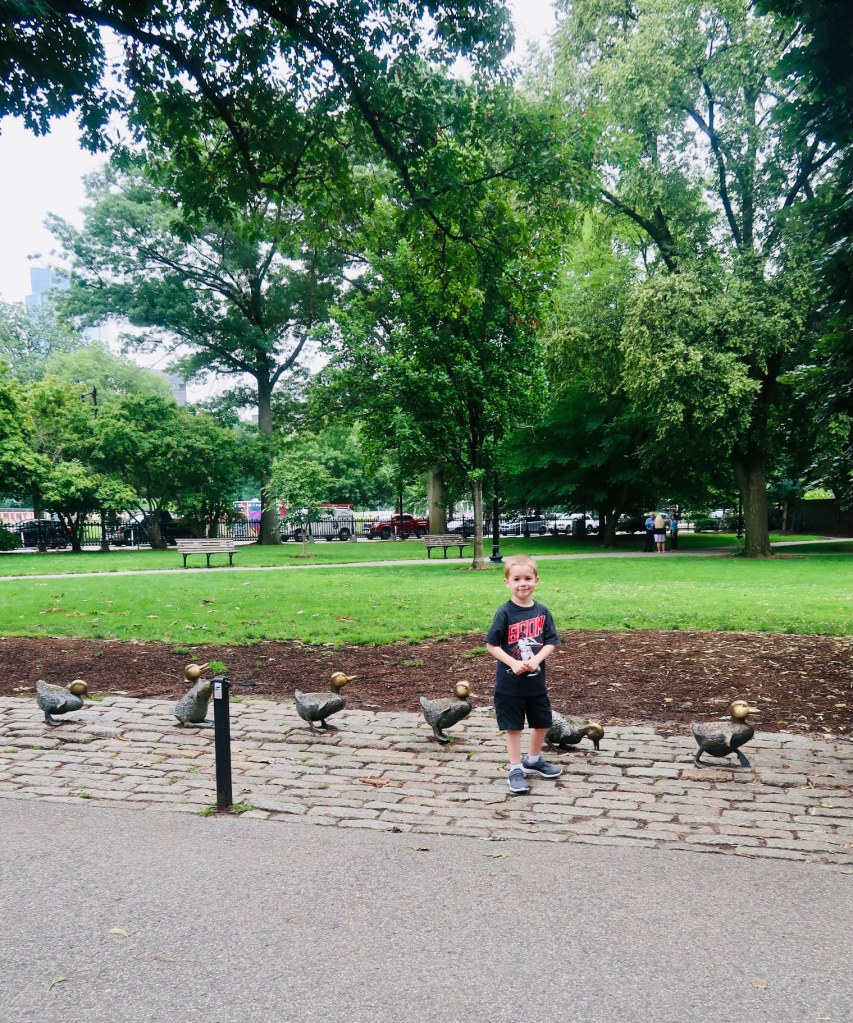
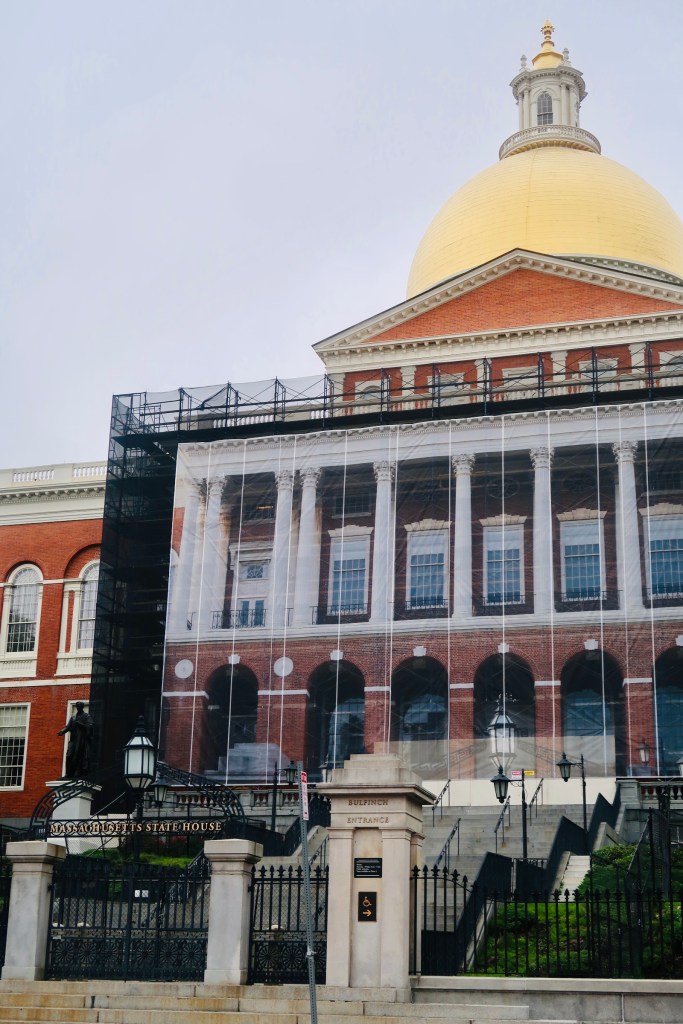
Boston Common is America’s oldest public park, dating back to 1634. The Puritans purchased the grounds from William Blackstone, it was originally used as a common grazing land for local livestock. It also became a spot for public punishments (featuring everything from stocks and pillory for theft to the hanging of witches and others). During the Revolution it served as a training and camp ground for the British. Today it serves as a public park (the smaller park across the street is where you can find the famous ducks) and a place for rallies and marches, as well as live music and festivals. Towards the end of the park there is a monument to Robert Gould Shaw and the 54th Regiment. This memorial honors and commemorates the first all-Black volunteer regiment during the Civil War. Most of them died during an assault in South Carolina, but they are forever memorialized here.** You also get a glimpse of the Massachusetts State House as you exit the Common. This has been the home of the state government since it was opened in 1798. 

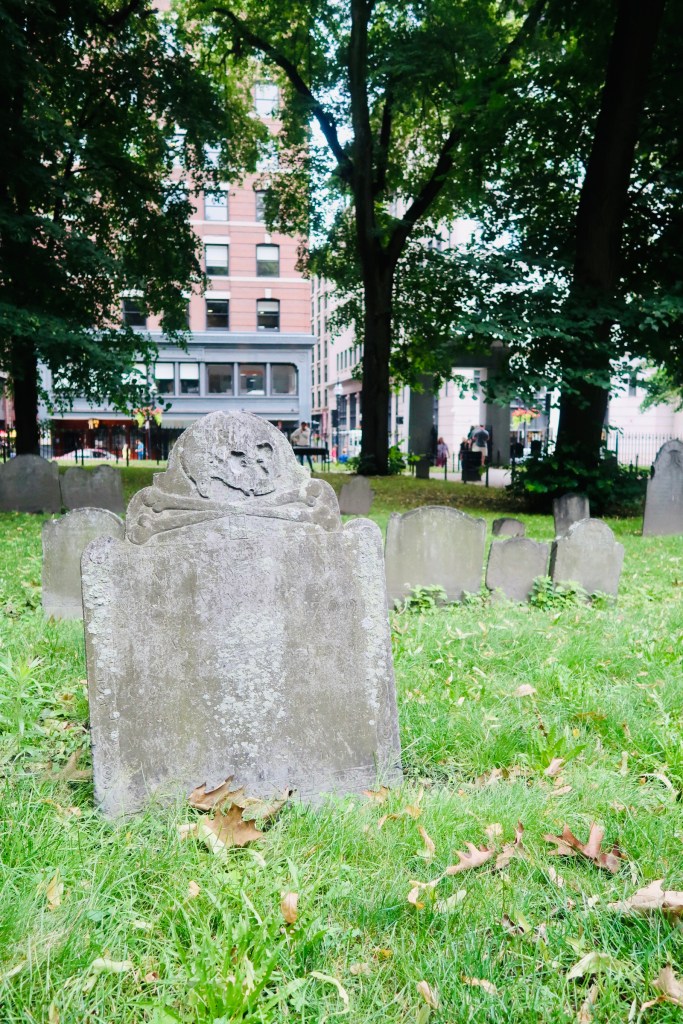
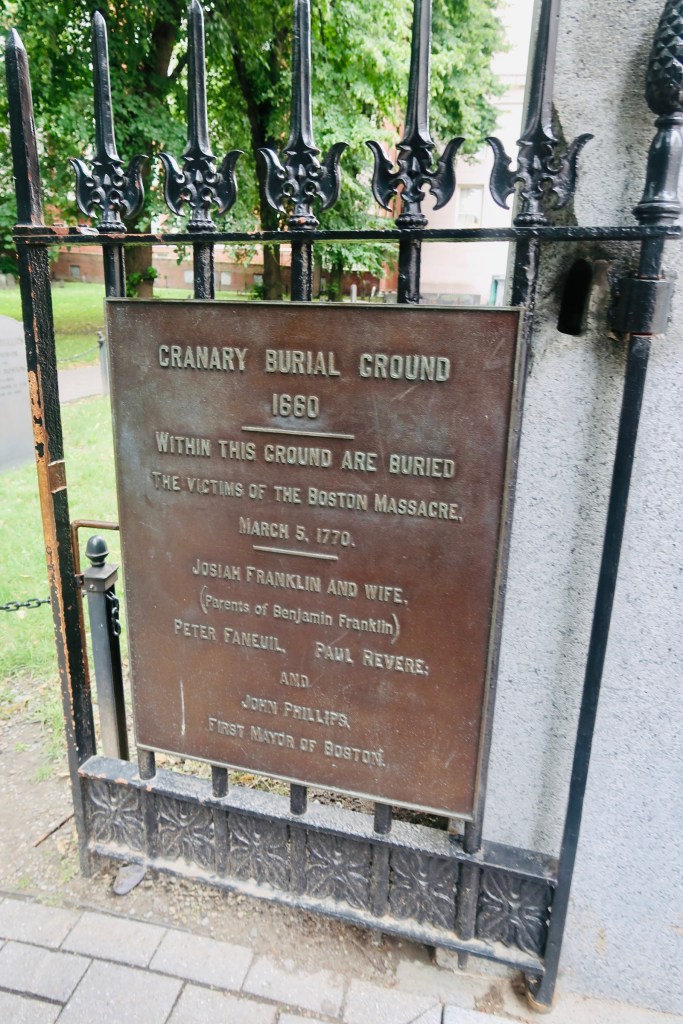
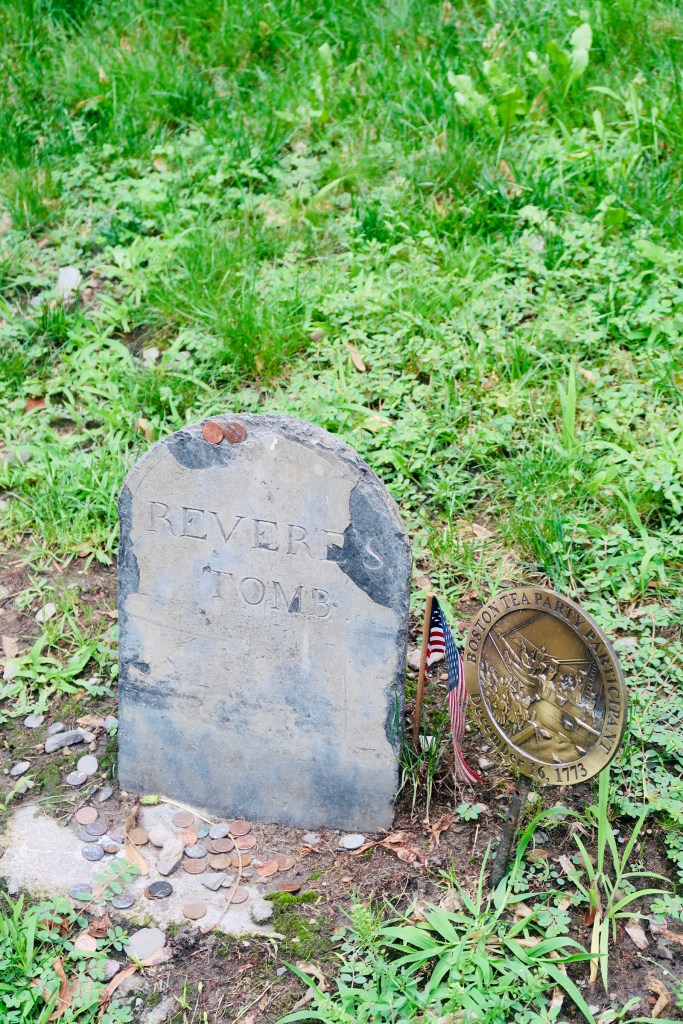
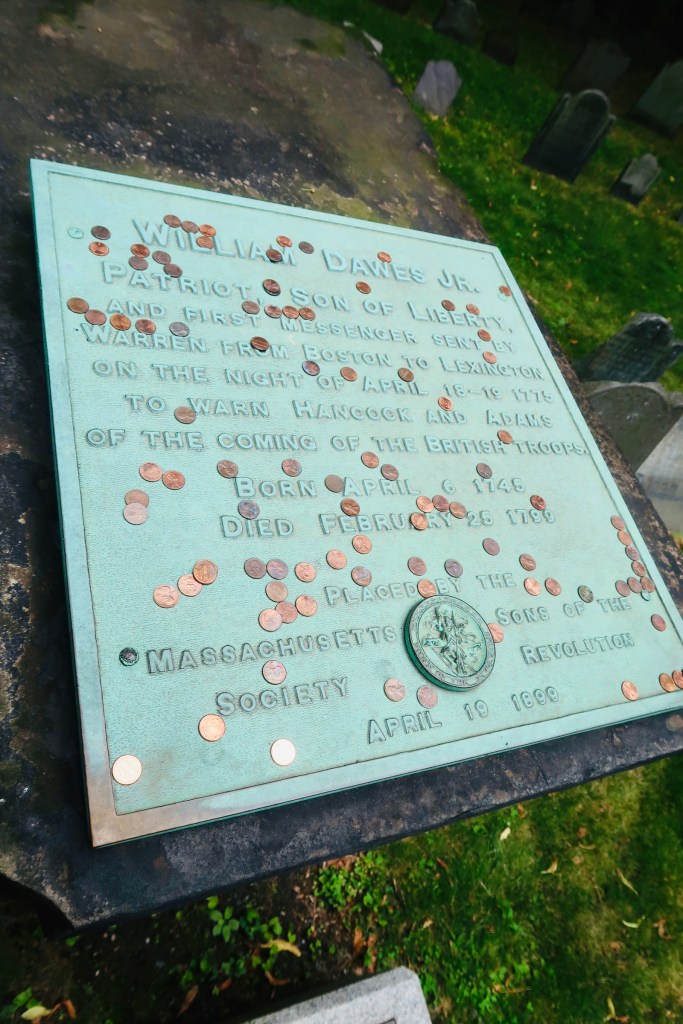
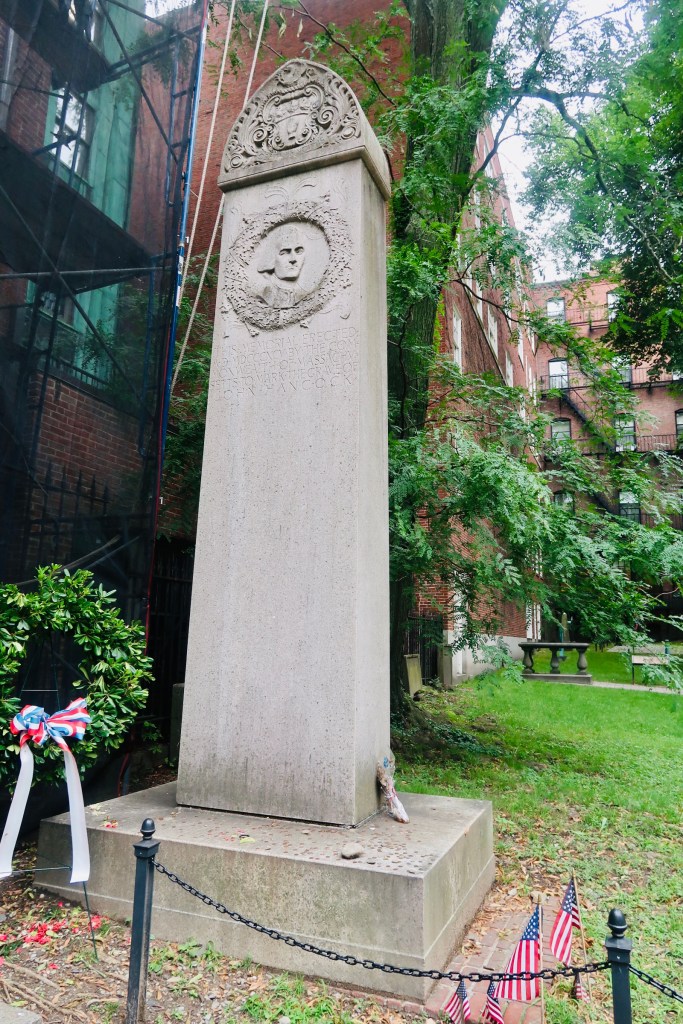
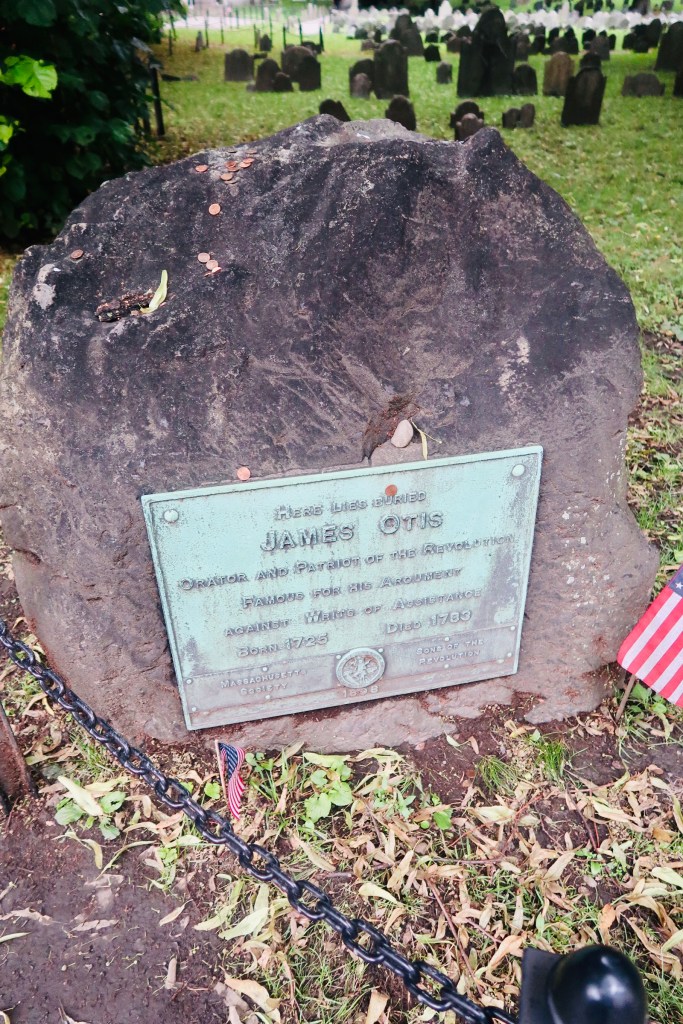
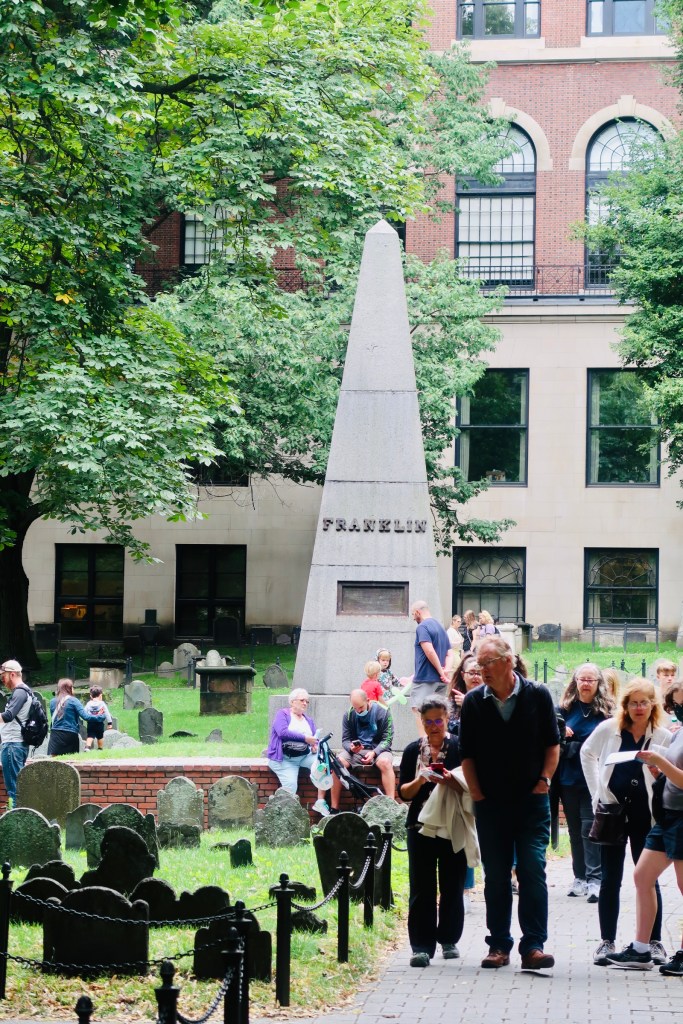
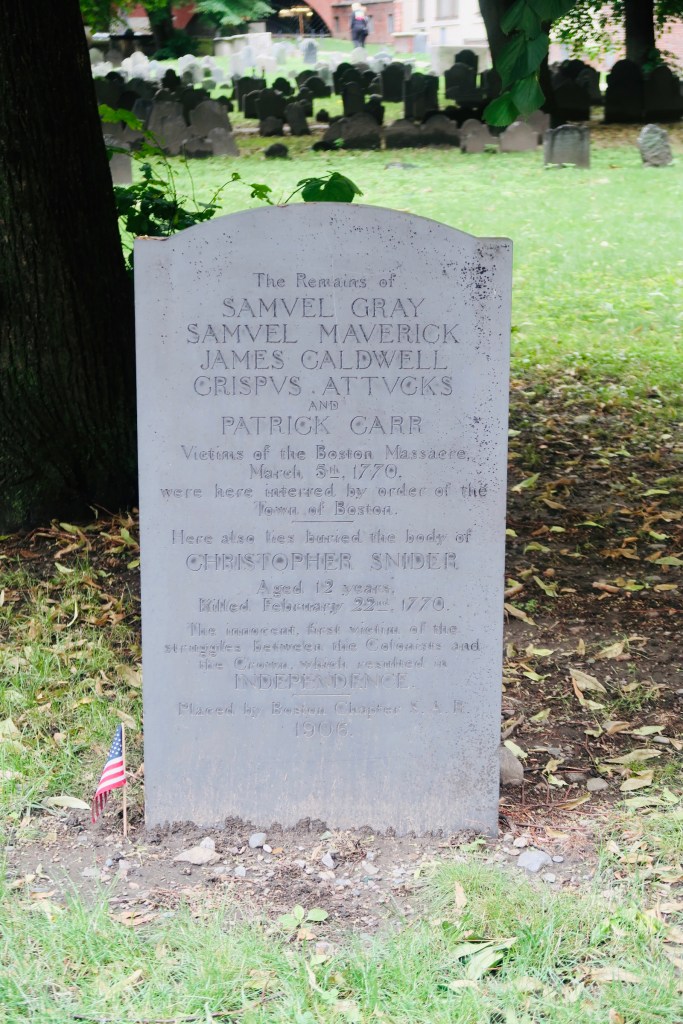
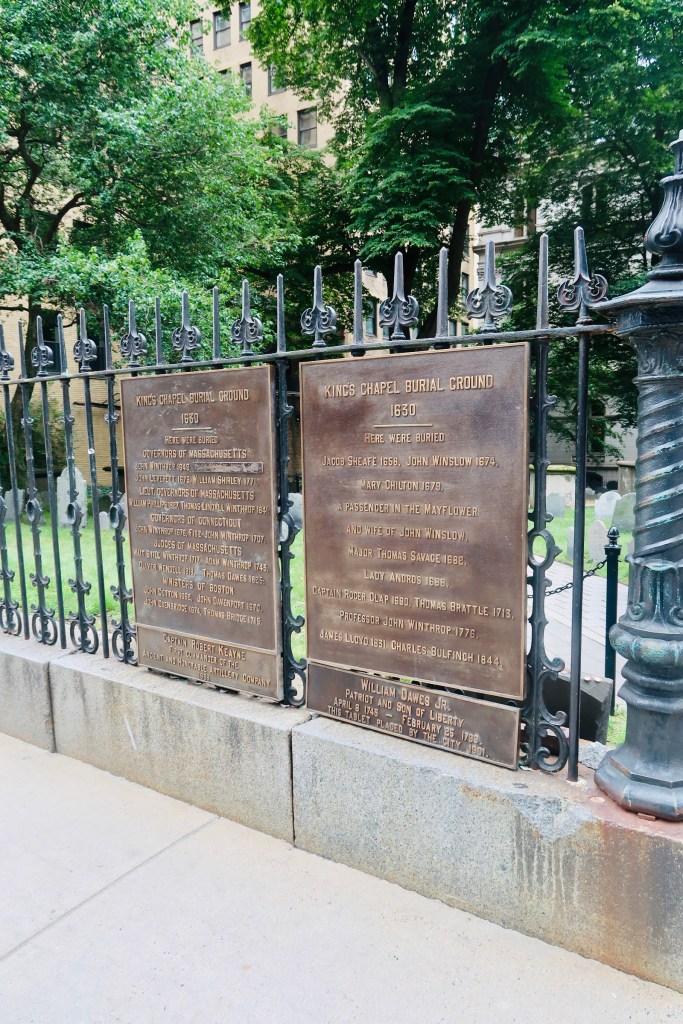
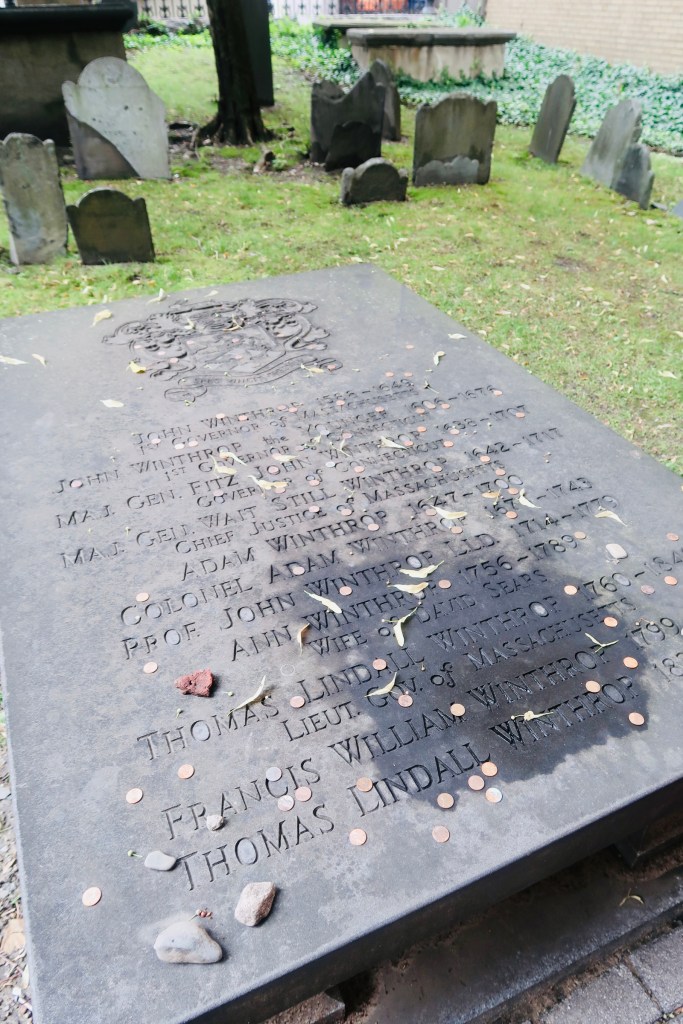
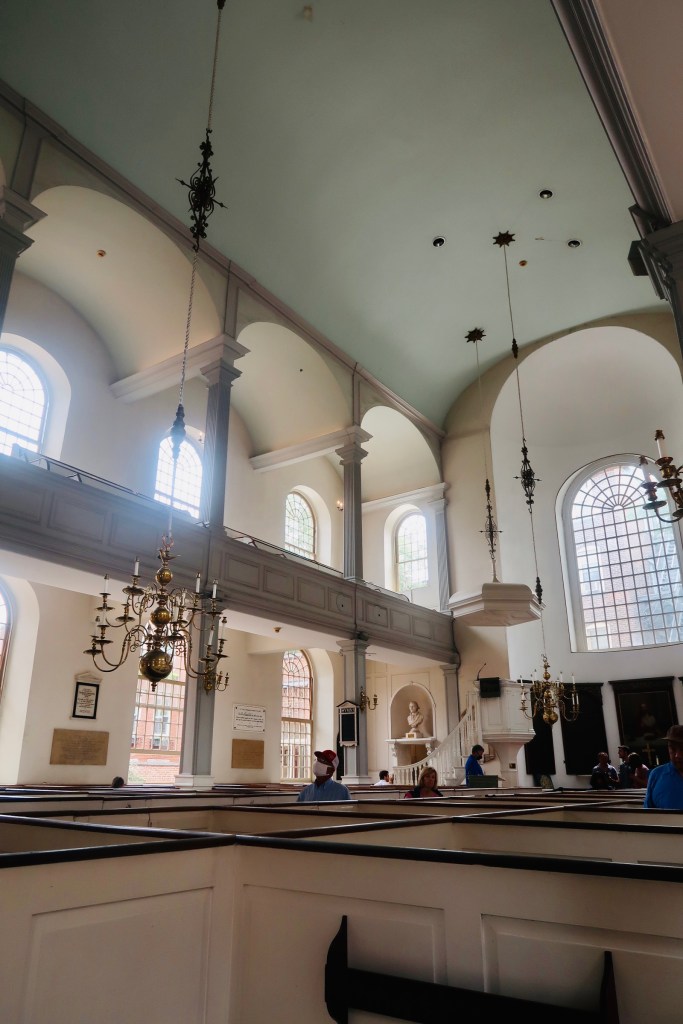
The next stop on The Freedom Trail that we made was to the Park Street Church and Granary Burying Ground. The church dates to the early 1800’s, but the burying ground is the real attraction at this stop. This cemetery is the final resting place for some of the key players of the founding and fighting for the colonies of America. This is the final resting place for around 5,000 of Boston’s own, though there are only markers and knowledge of 2,300. Notably buried here are Benjamin Franklin, Paul Revere, John Hancock, Samuel Adams, and a memorial for those massacred at the Boston Massacre. On these headstones you won’t find religious markers, rather these motifs of skulls with wings (to symbolize flying to heaven). Keep an eye out for grave markers- similar to those in Plymouth, there are metal markers signifying when the person participated in a momentous occasion, such as the Boston Tea Party. You are also able to go to another church and burying ground- the oldest in the city. We didn’t end up going in the church, but we did have a peak at the cemetery. Similar to Granary, this boasts several “big names”, the first woman off the Mayflower, Mary Chilton, William Dawes Jr, messenger sent to warn that the British were coming, as well as many others. 

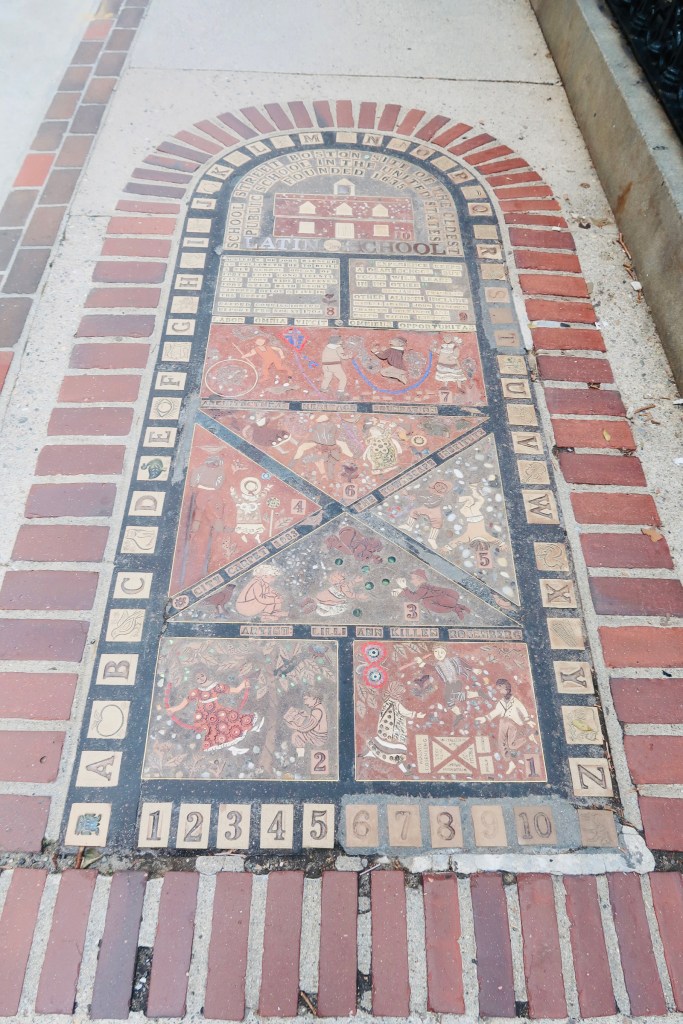
The next few stops on the trail are “bunched” together in that you have the first public school of America (which boasts educating 5 of the signers of the Declaration of Independence), a statue of Benjamin Franklin (who actually dropped out of the school just mentioned), and the Old Corner Bookstore, which is the oldest commercial building in the city (it’s now a Chipotle). 

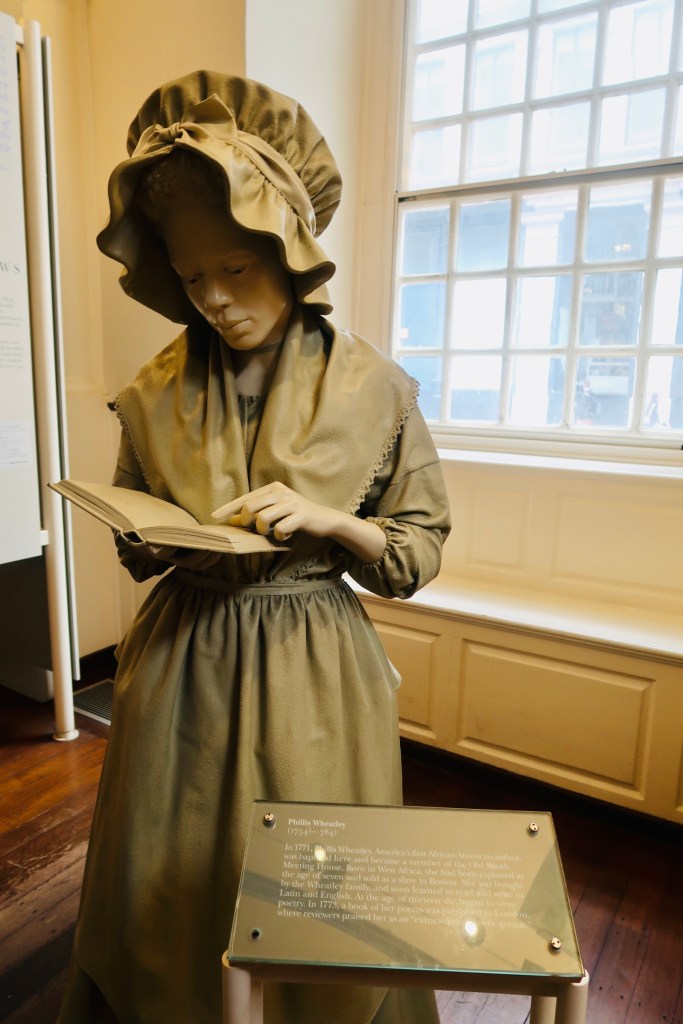
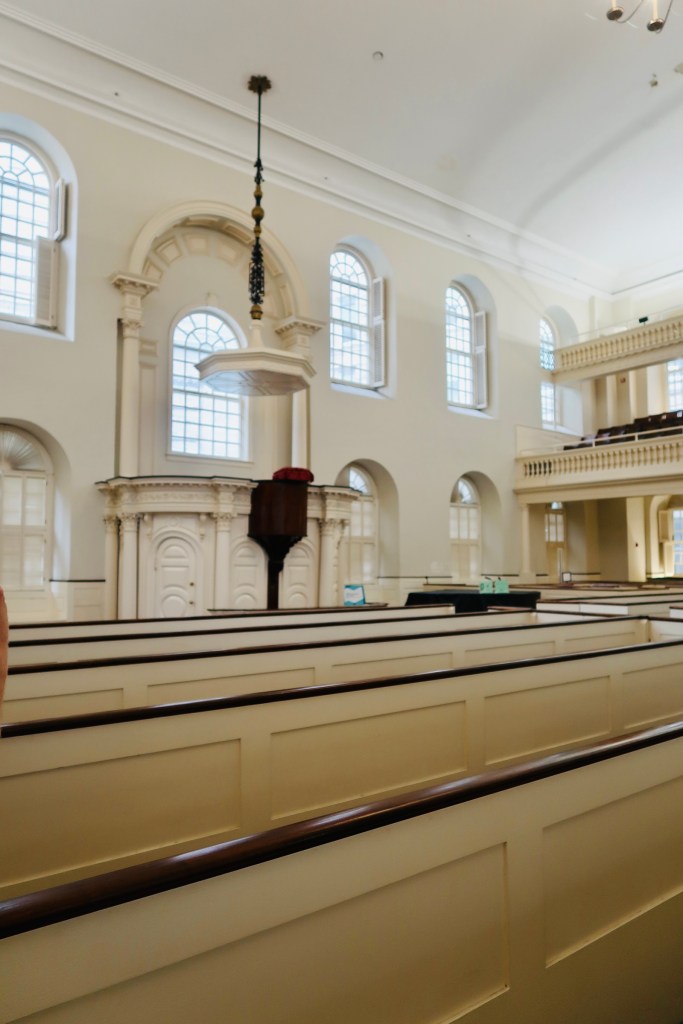
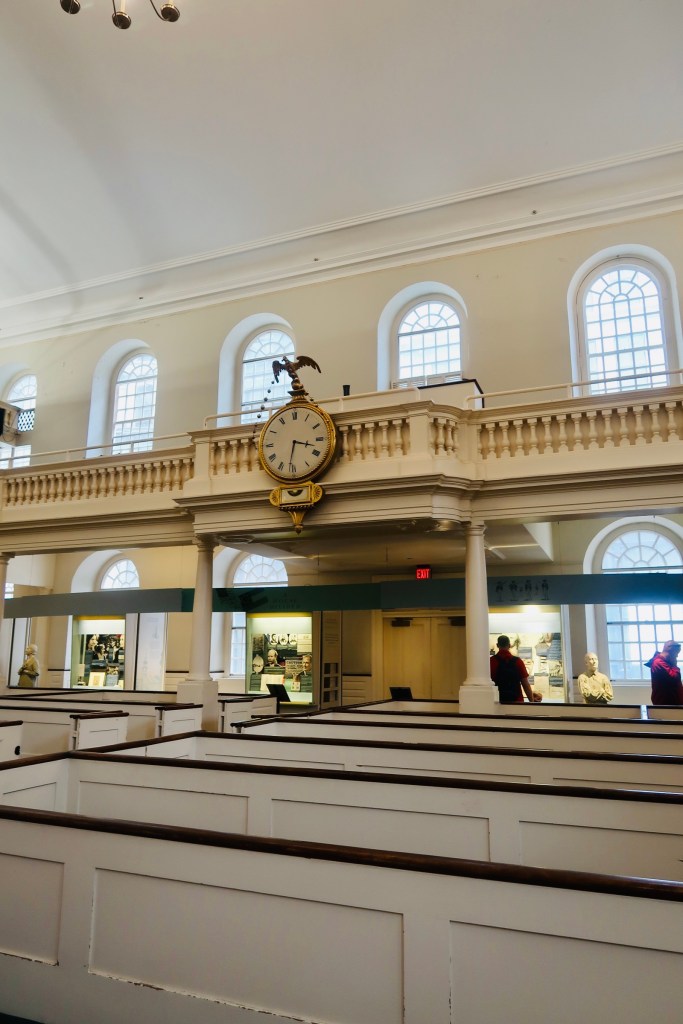
From there we headed over to the Old South Meeting House (this deviates slightly from the trail, but as I said, we split this in half so there was some deviations here and there). The Old South Meeting House is “the room where it happened”. It was the center piece to debate, to sermons, to public meetings. The largest building in colonial Boston, this was originally built as a Puritan meeting house. The congregation boasted members such as Samuel Adams, William Otis, William Dawes, Benjamin Franklin, and Phillis Wheatley, the first women and enslaved women to publish a book. The building also served as THE site, where the Boston Tea Party was decided, with 5,000 men in attendance debating the tax and what to do about it.  It now is recognized as the first in what are now regular history conservation projects. But the road was not easy, the building was actually sold in the 1870’s and it took a group of 20 women to save the building from being demolished (which also makes it the first building to be saved due to historical significance- lots of history in just one building). It has been a museum since 1877 thanks to their efforts. 

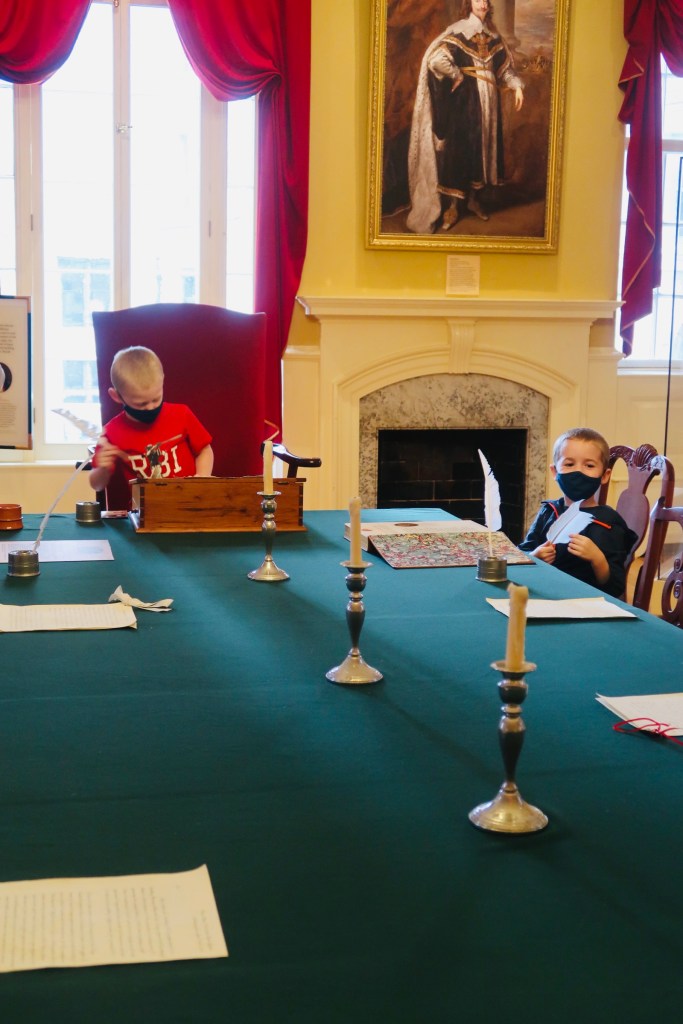
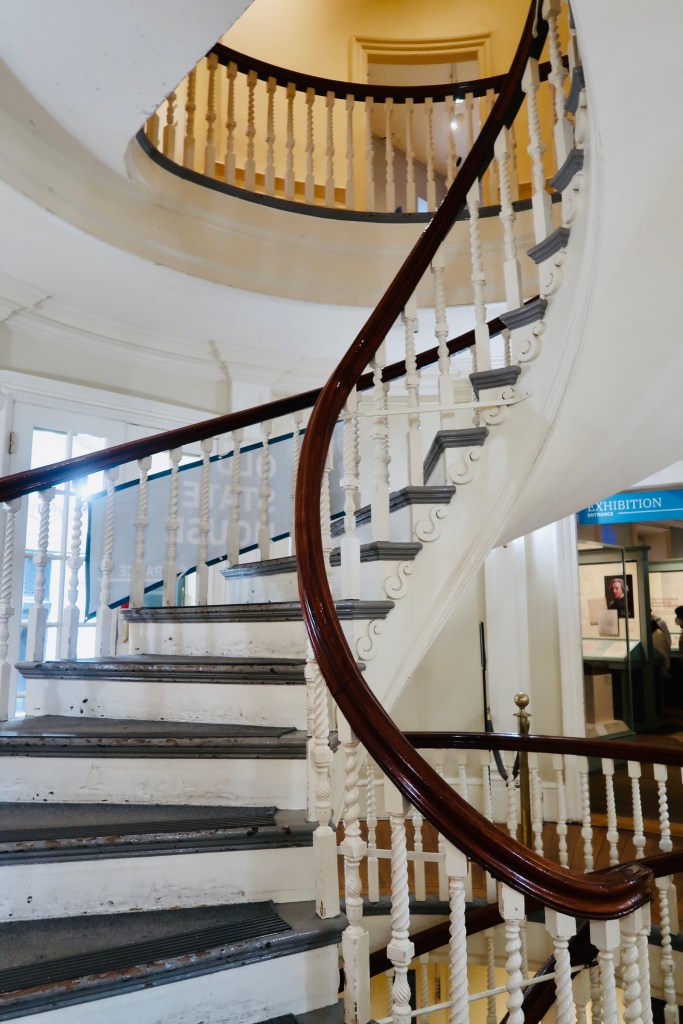
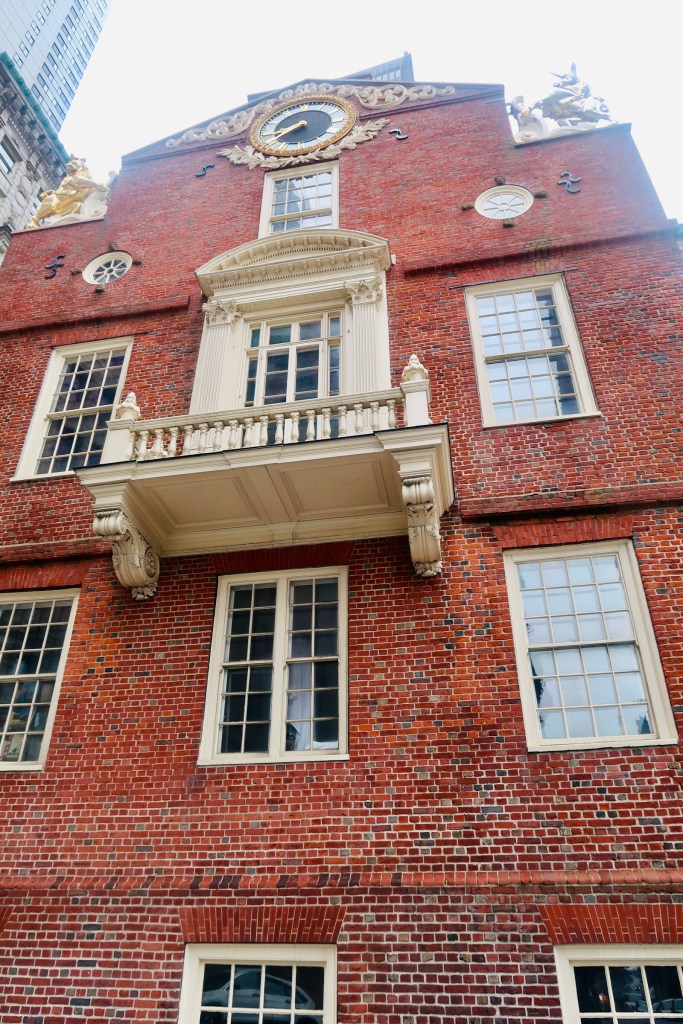
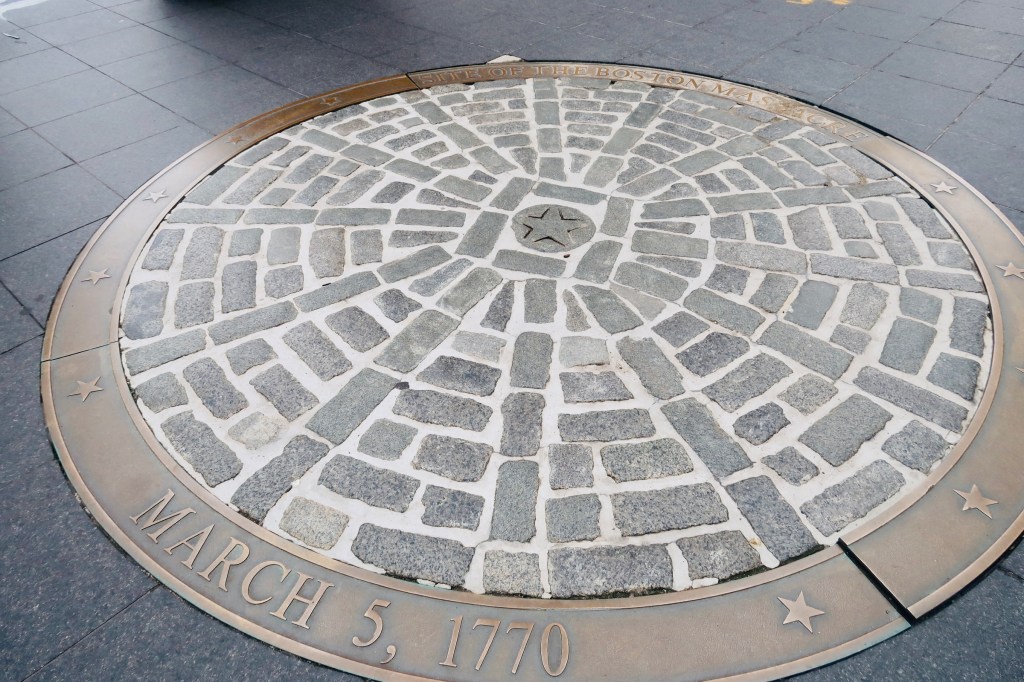
We made a last stop on our first day of the Freedom Trail over to the site of the Boston Massacre and the Old State House. The Old State House is the oldest surviving public building in the city, dating back to 1713. It now serves as a multi functional museum, documenting not only life in Boston, but the revolution, the Boston Massacre, and has a hands on second floor exhibit for kids to see what certain aspects of life were like. The boys especially loved this as they got to play “King” and “Governor” and dictate things. Right in front of the Old State House is a marker for the location of the Boston Massacre. Taking place on March 5, 1770 the Boston Massacre was a fight between the Redcoats and the people of Boston that ended with the death of 5 people. The tension between the two groups of people had finally boiled over and this tragedy became a turning point leading to the fight for independence. 

The next stops on the Freedom Trail are to Faneuil Hall/Quincy Market. I talked about Quincy Market in my previous Boston Post (HERE) and we didn’t actually get to properly go into Faneuil Hall during our time in Boston. Faneuil Hall served as a meeting place for public speech and commerce. You were able to protest, loudly, you could conduct various forms of business, you could swear an oath of allegiance. Basically it was a center of politics, conveniently located right next to the markets and commerce place. 

And that was the end of our first half of the Freedom Trail. I am noting this BECAUSE I feel like, if you want to split it into two days, that is a good place to split it. Most of the above attractions are within the same are of Boston, with convenient and easy walking distances. Then, the below would be the other half of The Freedom Trail. Again, you can do it in one day if you like (and public transport is actually decent if you need it), but this would also be a good stopping point for the day. 

**I also want to note, that there is an African American portion of The Freedom Trail. This trail takes you through the sections that the freed African Americans would have lived, their meeting house, the various monuments (including Phillis Wheatley) and other spots. You can find the trail right off of the Robert Gould Shaw Memorial at the end of the Boston Common. 

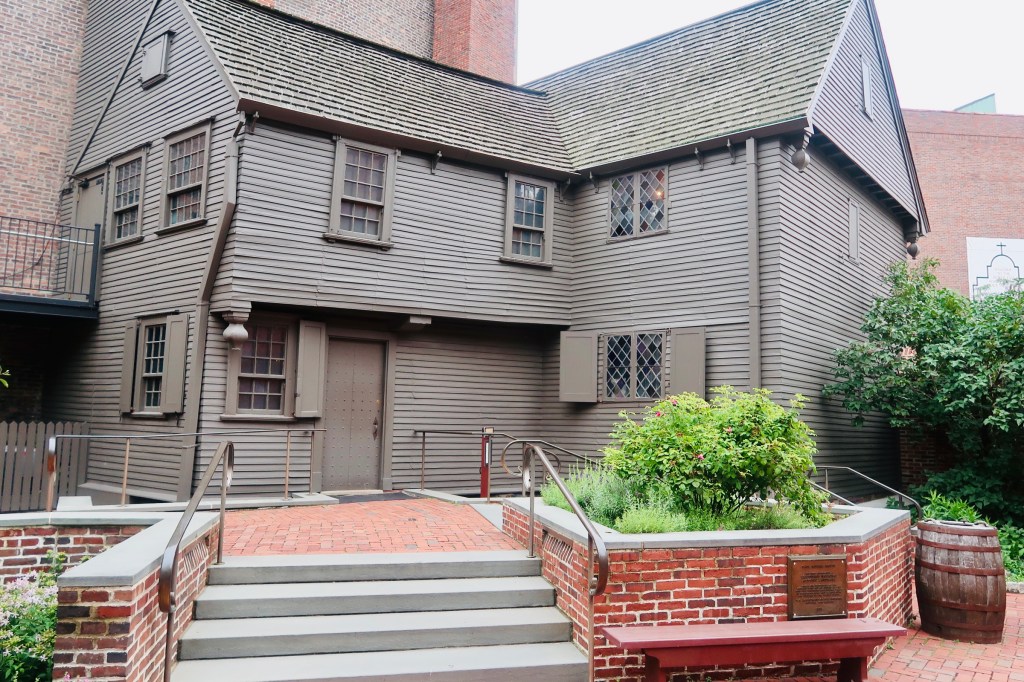
The second half of the Freedom Trail gets a little bit more into the battles of the city. Starting at Paul Revere’s home, you are able to get a good glimpse into how folks of his stature, in his time, would have lived. Built sometime near 1680, his home is the oldest remaining structure in downtown Boston. It is also the only “home” listed as part of the Freedom Trail. You are able to walk through the home, see the kitchen, the sleeping areas, AND see quite a few of the artifacts from his life. You can also see the famous Revere Bell (as we always seem to forget the Paul Revere actually was a craftsman by trade). THis is a quick but easy stop to make and a great way to start off a second day of the trail. 

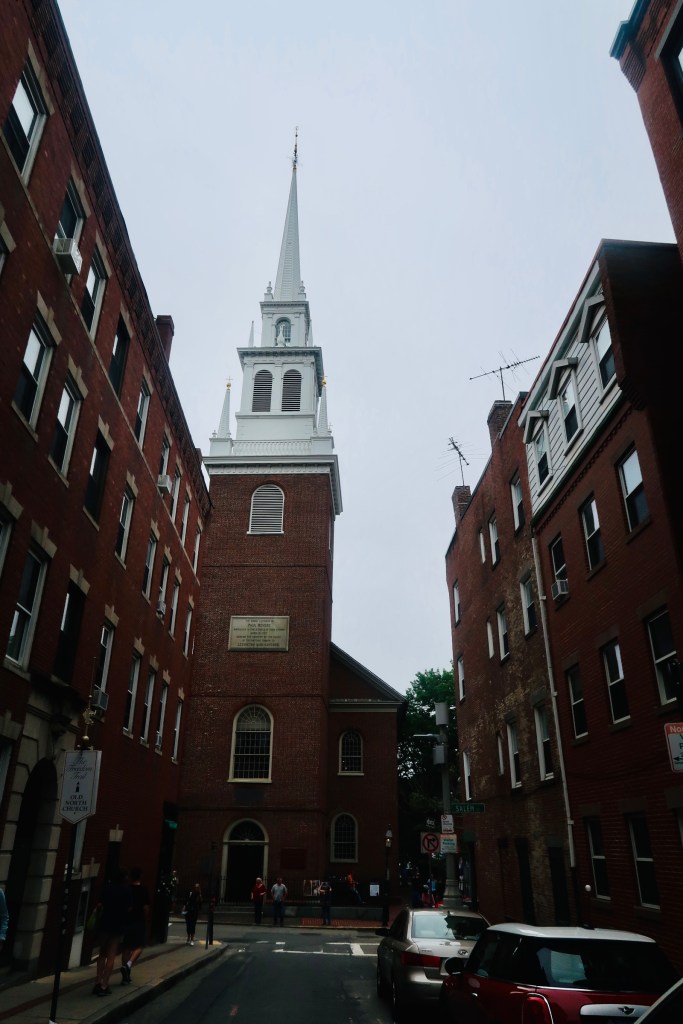
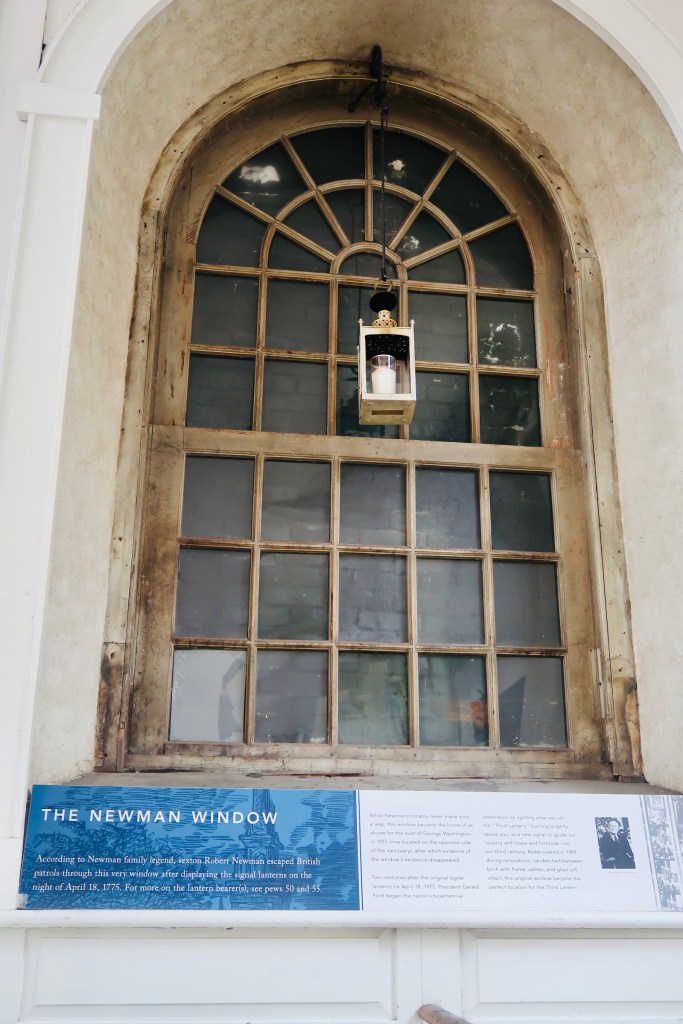
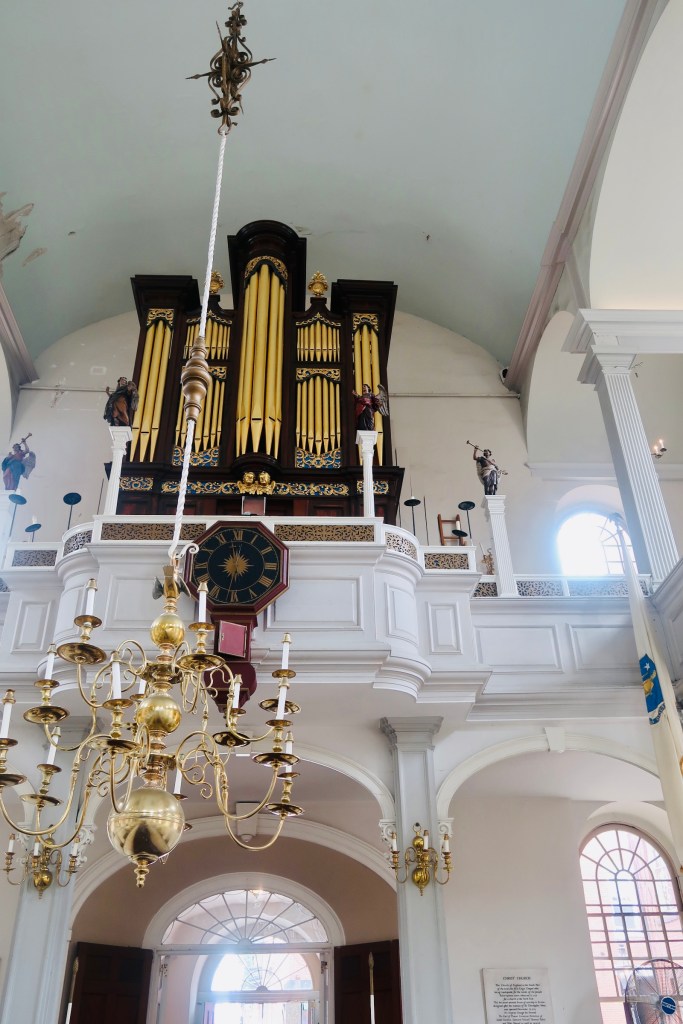
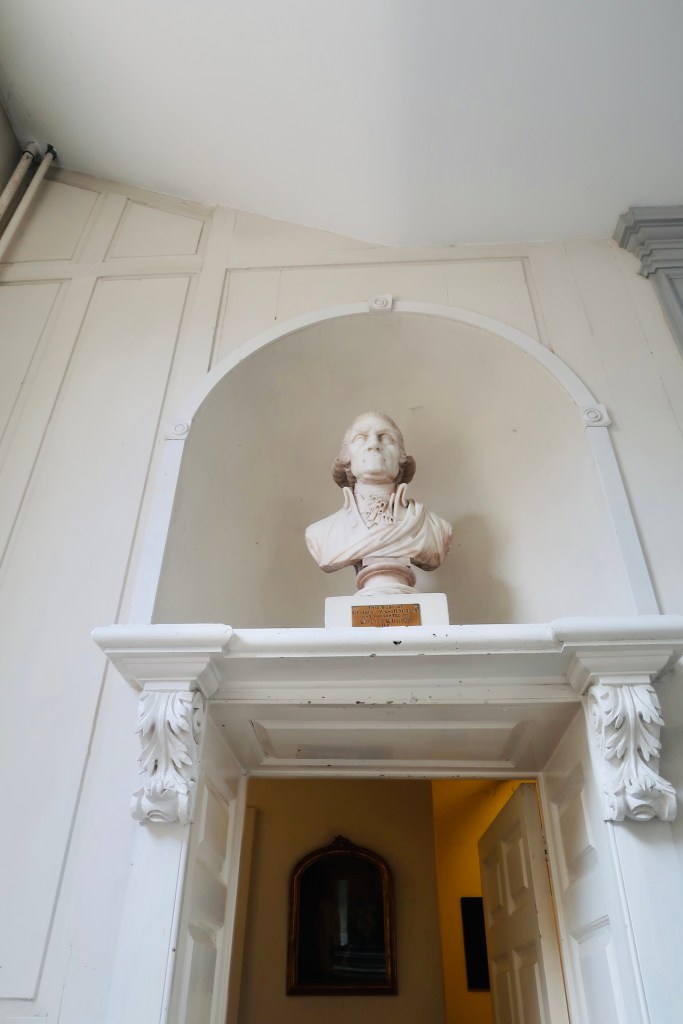
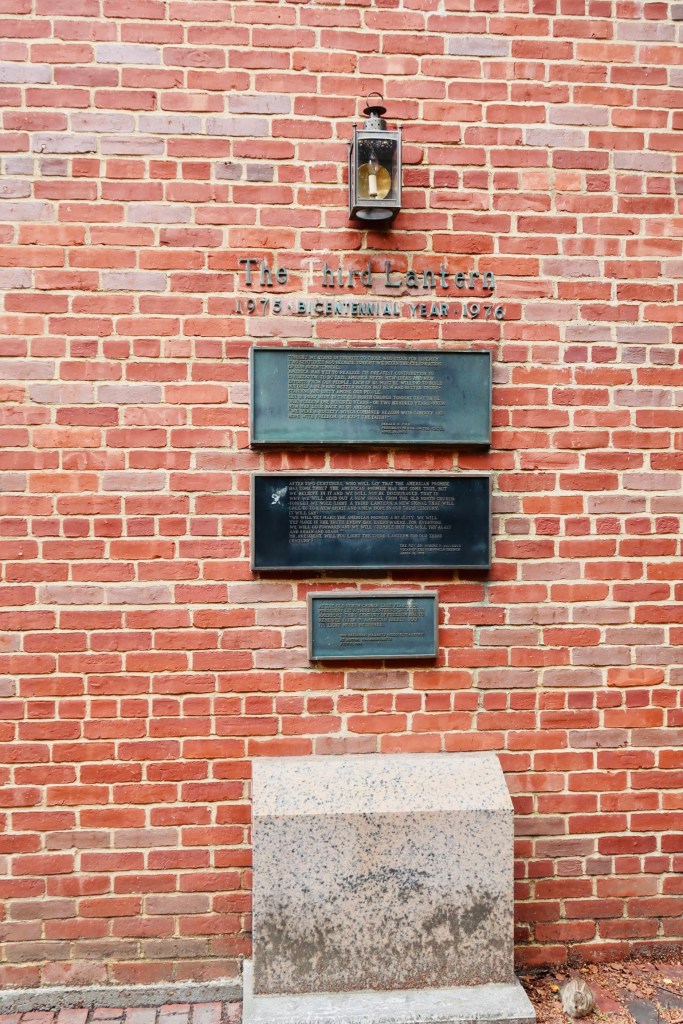
From the house, you then head over to your third and final church The North Church. This church plays an important role (maybe even more important than the other two) as it was THE church that the light was put up in to signal the midnight ride. Dating back to 1723, inside the church you are actually able to see one of the lanterns that was placed in the window for the ride. You are also able to see the bust of George Washington that Lafayette said was the best representation of him. Right around the corner from the church is Copp’s Hill Burying Ground. This was, by and large, the burying site of many of the craftsmen and merchants that lived on the North side of Boston. A couple notable people buried are two of the ministers involved in the Salem Witch Trials, the founder of the Black Freemasonry, as well as the man who hung the lanterns on the night of Pau Revere’s ride, and a builder of the USS Constitution. This particular burying ground was also a marker for the British to aim at during the Battle of Bunker Hill (which we ARE getting to, I promise). 

Speaking of, the next stops that you can make are entirely up to you. You can either go up to Bunker Hill at this point (which is what we did), OR you can go down to the USS Constitution. We chose to go up first, then back down, and at the end we took the Ferry back to the “main” part of Boston. It is entirely up to you how you want to walk this part. 

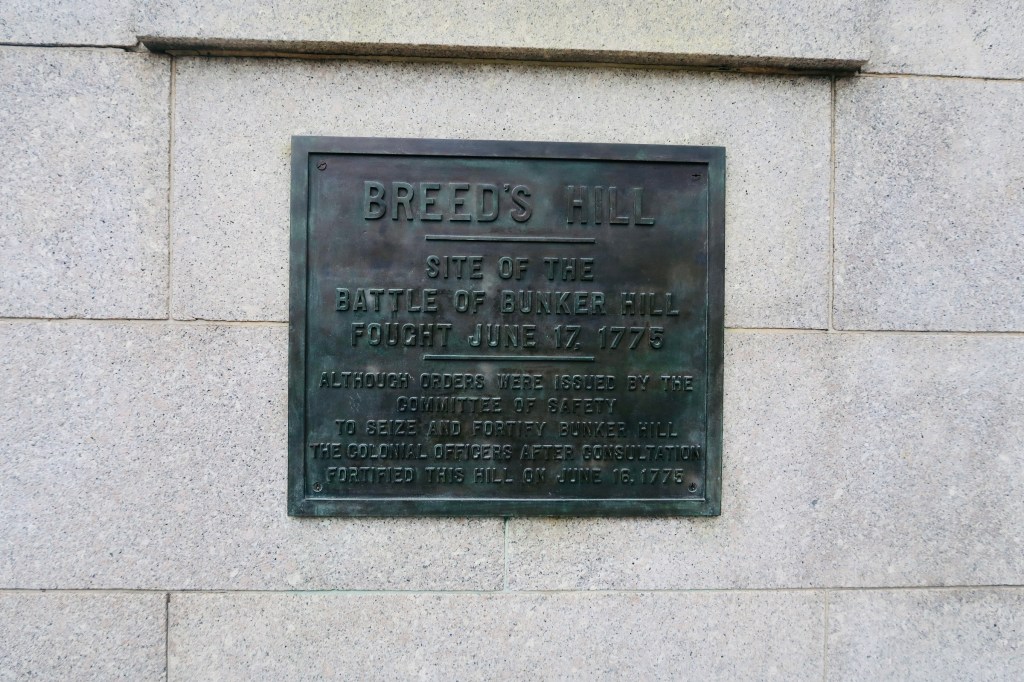
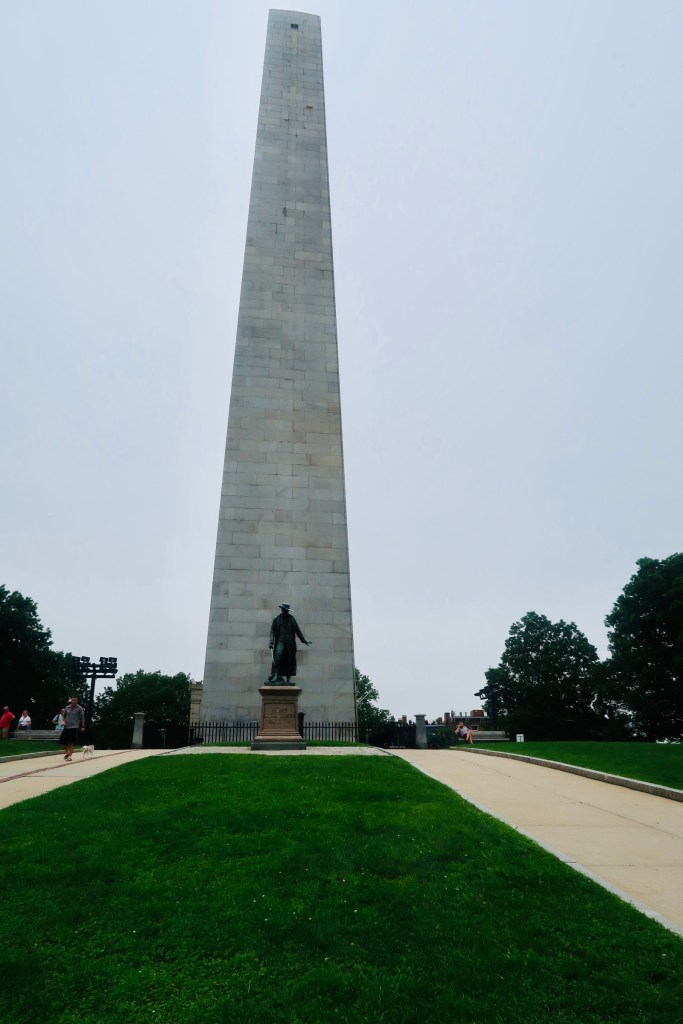
The Battle of Bunker Hill was the first battle of the Revolutions, and while the British technically won (after three assaults) it did prove that the colonists were not going to go down without a fight. The order of “Don’t fire until you see the whites of their eyes” is believed to have originated in this very battle. The monument was started with the laying of the first stone by Lafayette (excuse me, The Marquis De Lafayette) in 1825. It was completed in 1842. 

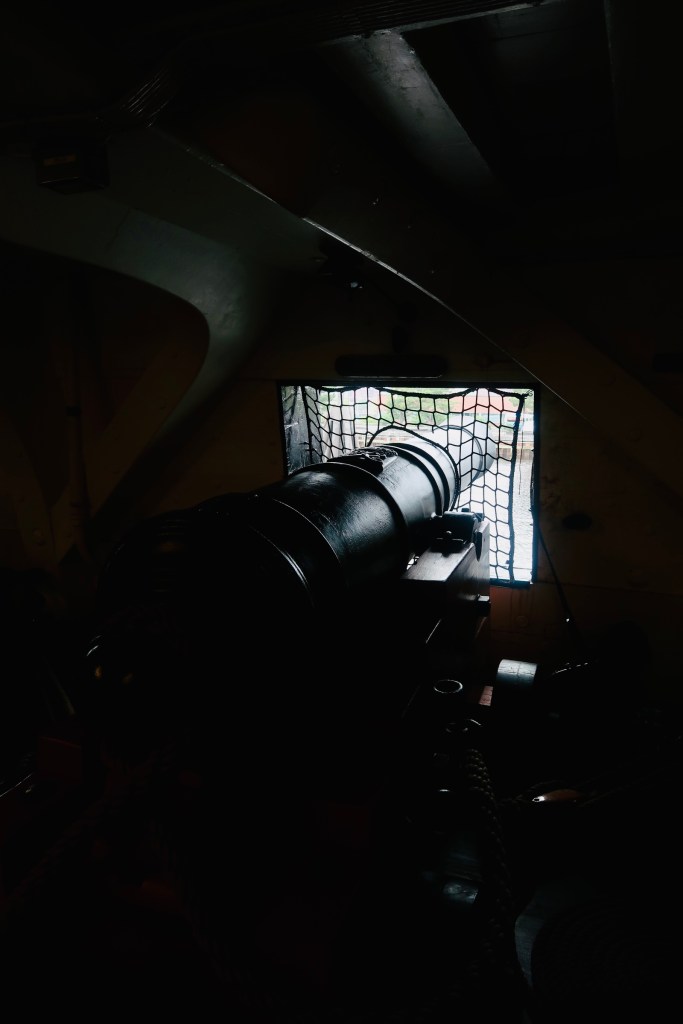
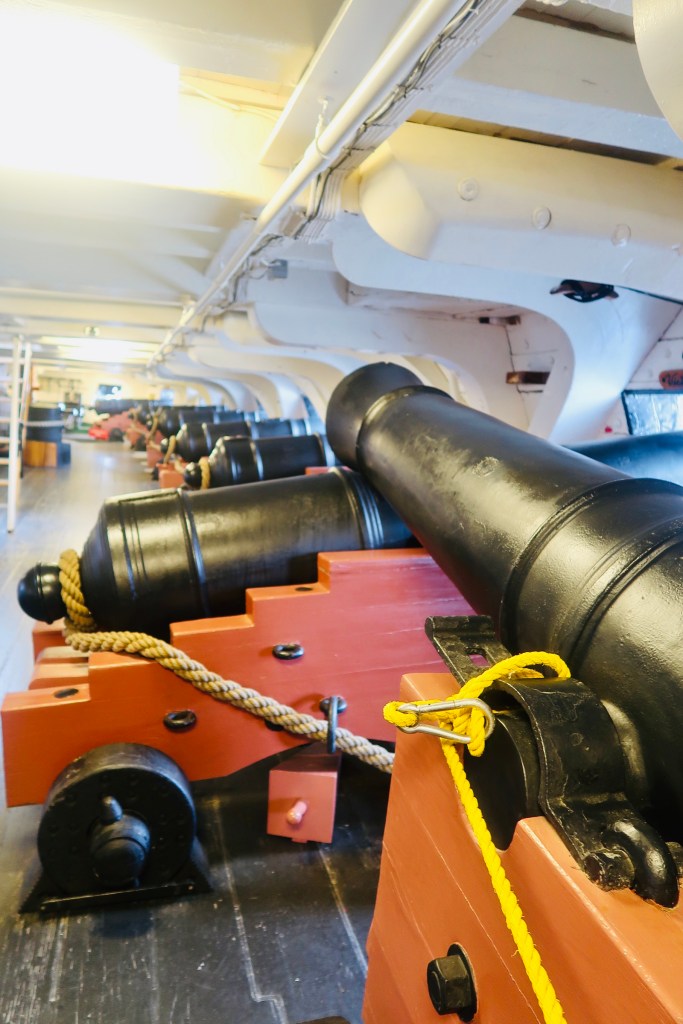
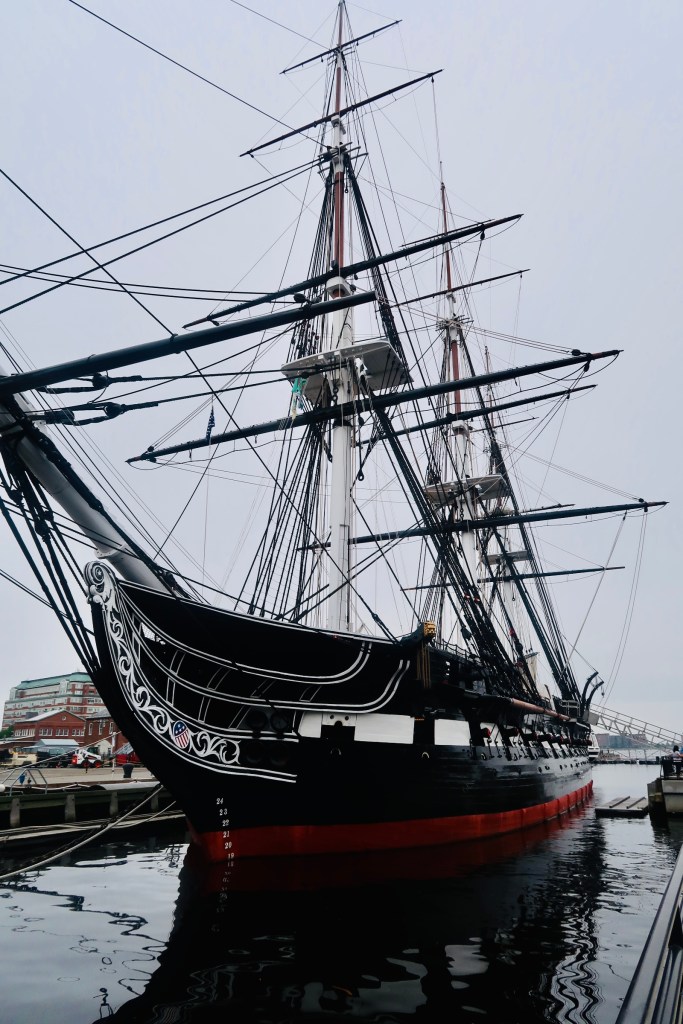
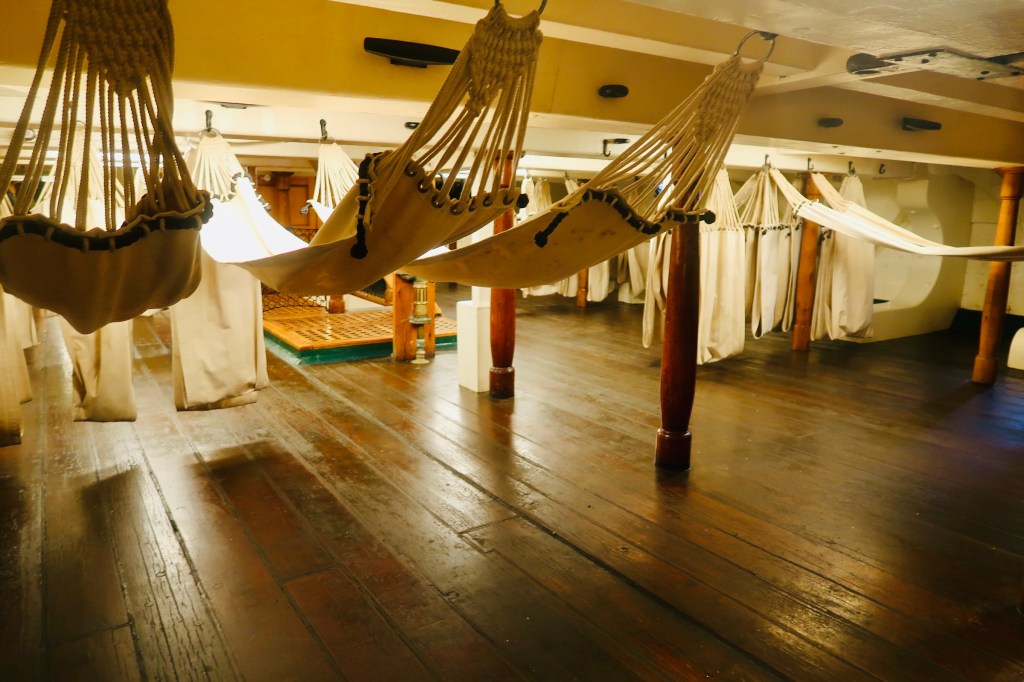
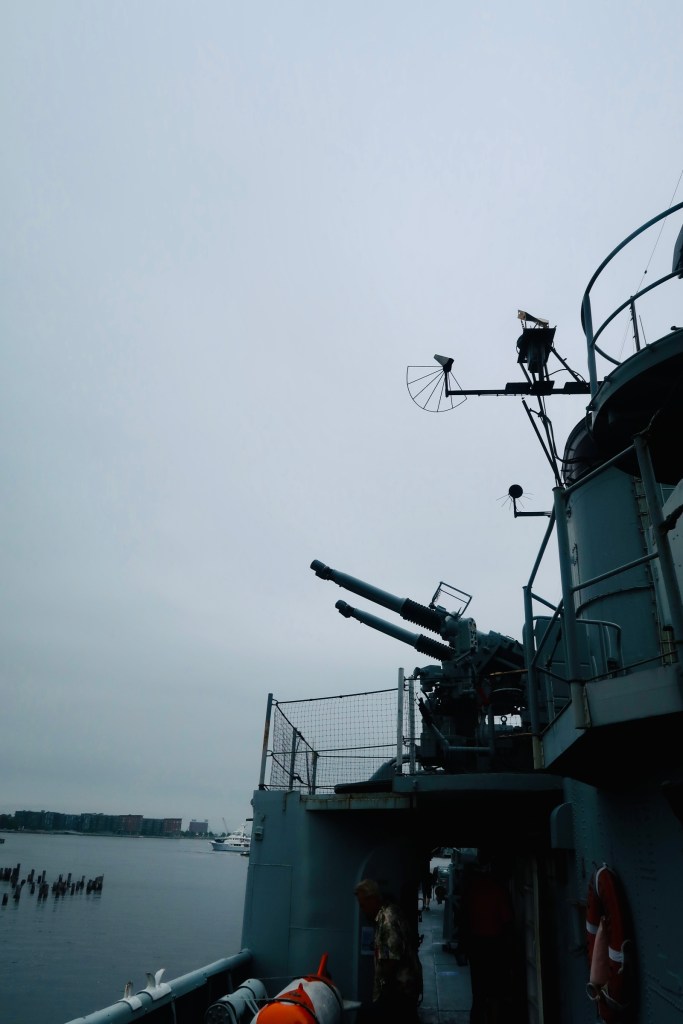
The final stop (for us) on the trail was at the USS Constitution (and then the USS Cassin Young DD 793). The USS Constitution is the oldest, still afloat, commissioned warship. It was launched in 1797 as a three-masted heavy frigate, one of six authorized by the Naval Act of 1794. The ship is known for the War of 1812 and the defeat of 5 British Warships and where the nickname of “Old Ironsides” was given. The Constitution was retired in 1881and was designated a museum ship in 1907. It is still a fully commissioned Navy ship and is manned by active duty Navy personnel on special duty assignment. 

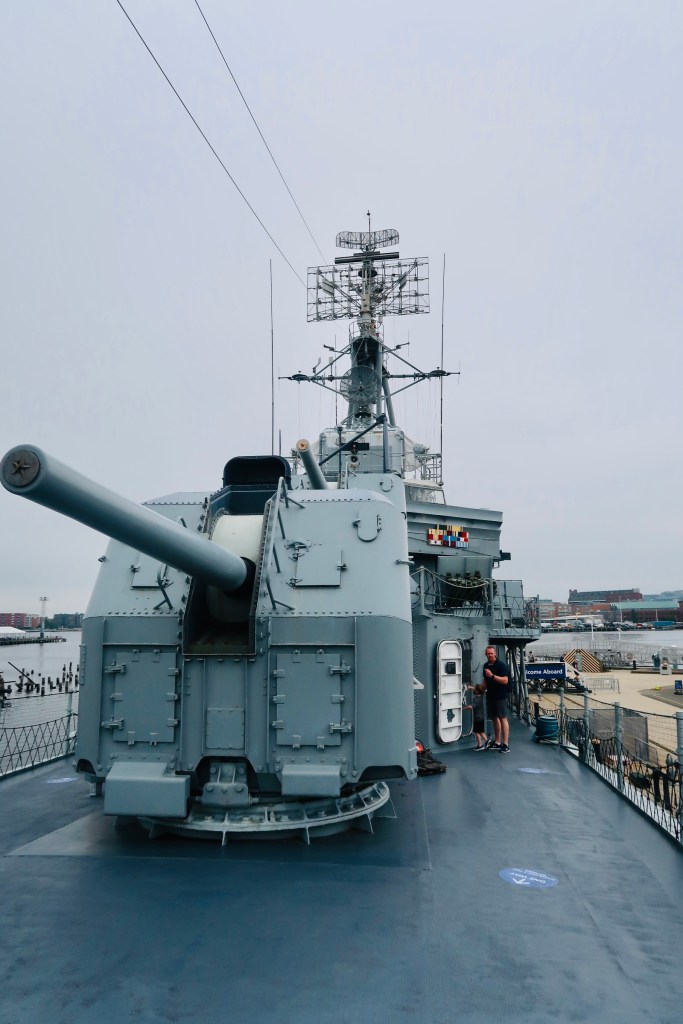
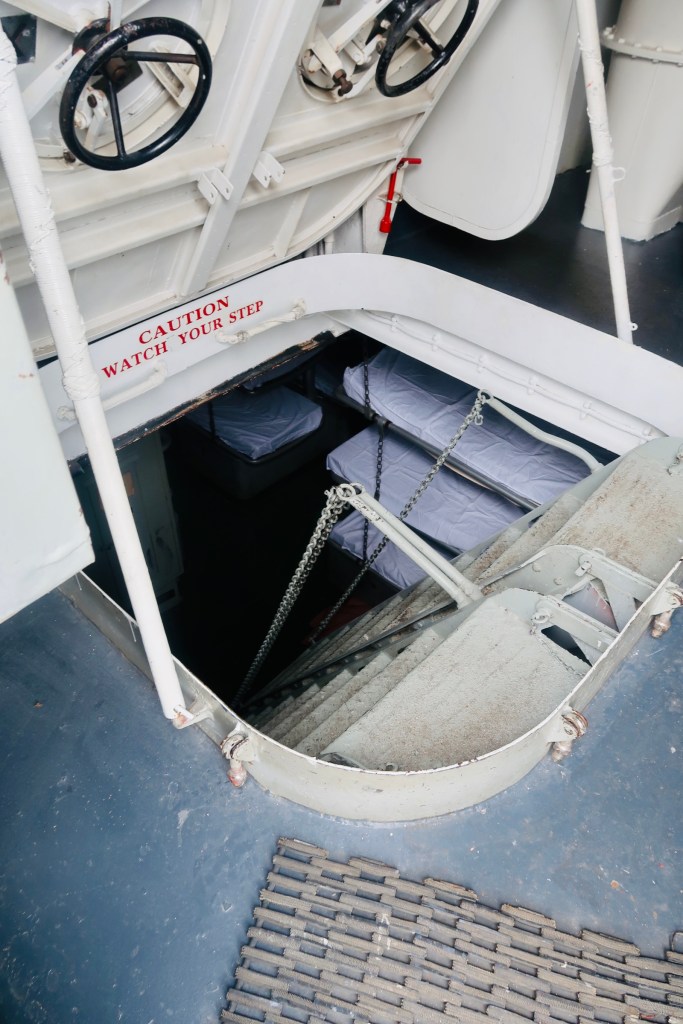
The USS Cassin Young is a destroyer from World War II. It was launched in 1943 and is only one of four of the Fletcher Class destroyers still afloat. The ship served in both World War II (where it was damaged in two kamikaze attacks) and the Korean War, being retired in 1960 and serving as a memorial ship ever since. The ship was intended to serve as an escort to the larger ships and defend them from attack. Unlike the USS Constitution, this ship has been permanently loaned to the National Park Service and it maintained and operated by them rather than The Navy. 

And that wrapped up our time in Boston! Boston was a definite highlight for our entire family. The boys loved the history, the boats, the endless exploring and my husband and I loved the pace of the city (and obviously the history). I don’t know that we’d ever be “city people” (most are just too crowded and busy for us), but Boston was such a nice surprise! 

A Cuppa Cosy Summer Holiday 2021 – Boston, MA Pt. 1

The second stop on our Summer Holiday was undoubtedly our favorite and that was Boston. I think this is going to have to be divided up into two posts just due to the amount that I will actually blabber during this post. Again, I know that a good amount of people know a good amount of American History, so I’m just going to touch on basics or little tidbits as I talk about what we did/saw, but I really just love learning about the history and interesting facts about places we visit. Boston is the center of A LOT of the United States of America’s history and it has done a really good job and transitioning through history and coming into a more modern era, without losing any of the historic sites or feel to the city. So, a post today and a post on Friday (woop- a bonus post!) to cover everything I want to share and not overwhelm or bore you.

Before we start, I also want to note that for a “big city” Boston felt quite relaxed. In a lot of the “big cities” you get that big city rush feeling, where everyone is just go, go, go as fast as you can. Boston was refreshingly relaxed (or at least from what we saw and experienced). It was something that we actually really enjoyed about our time there. I’m not sure if this was a covid specific instance or if it’s always this way. Regardless Boston has definitely become a highlight for us. 

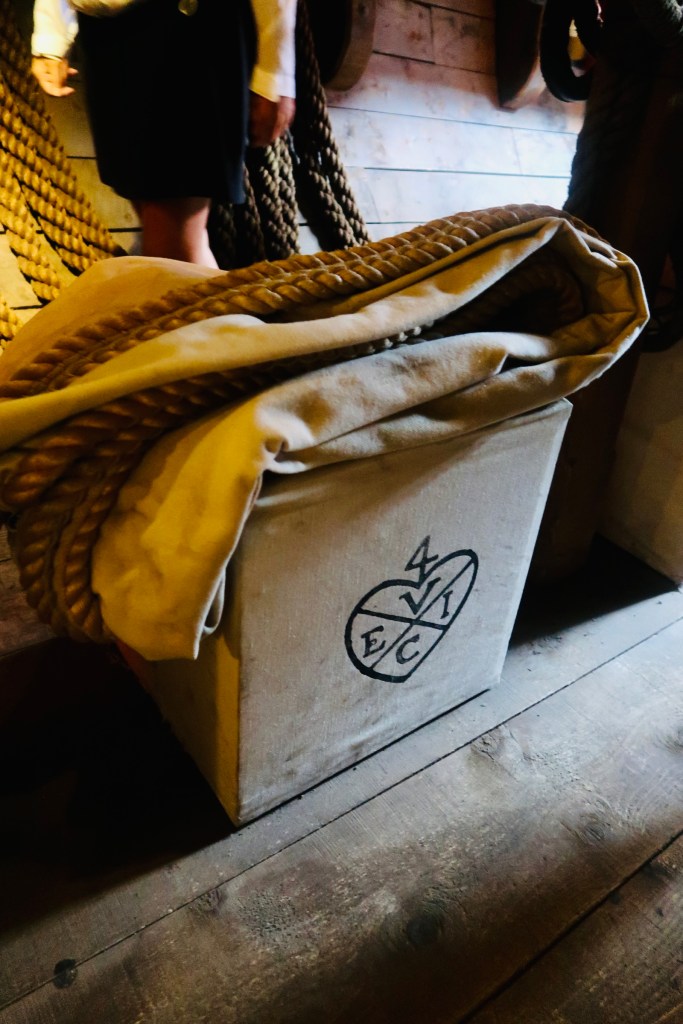
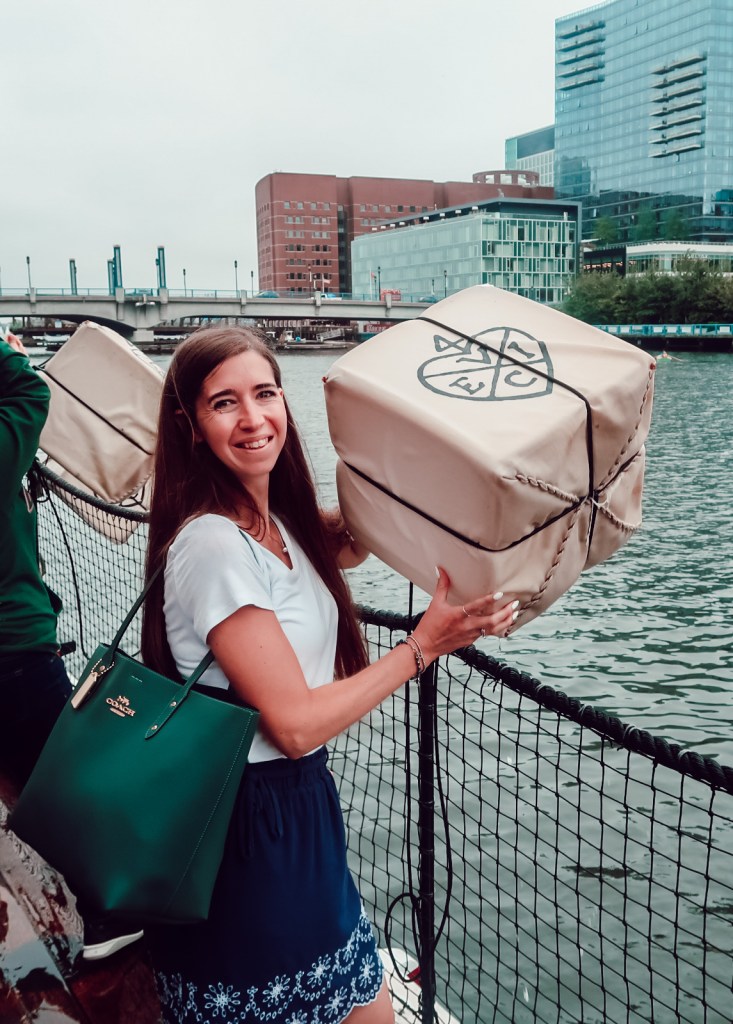
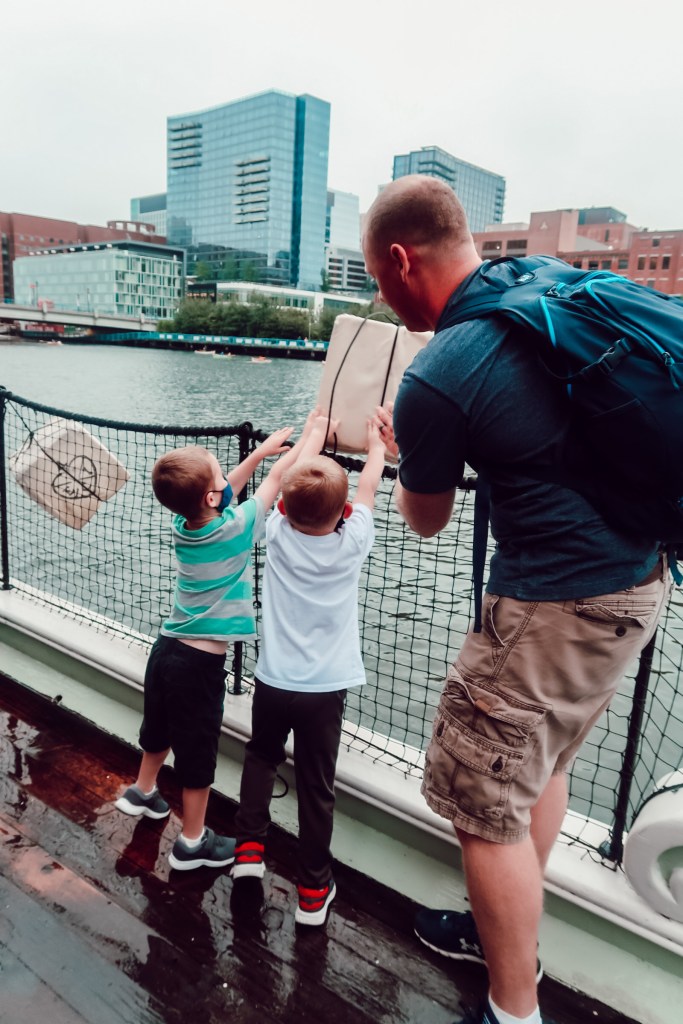
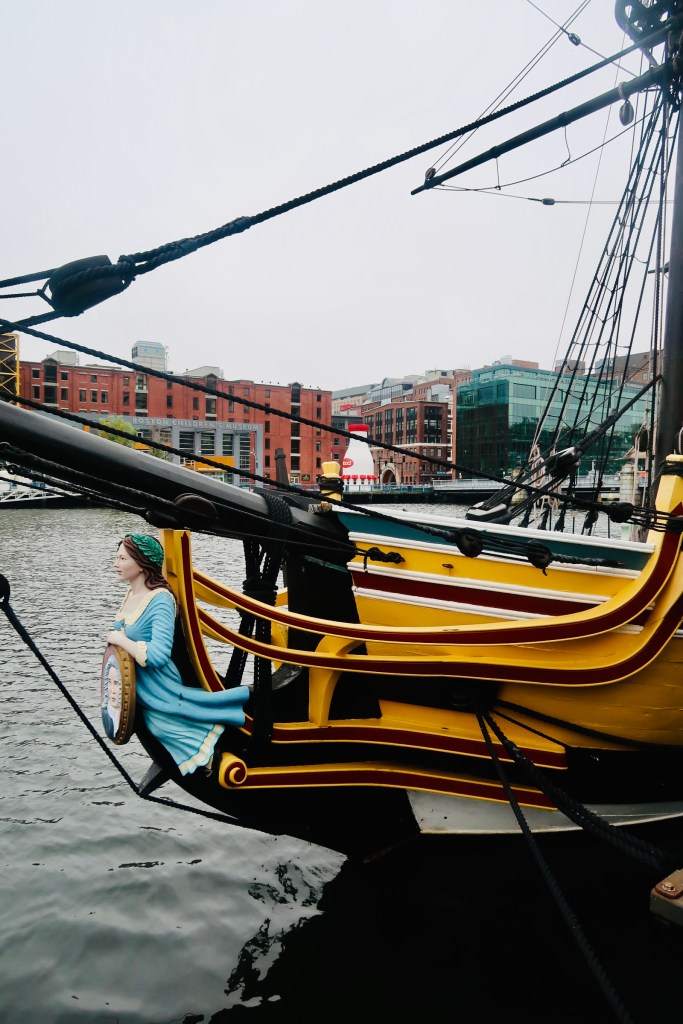
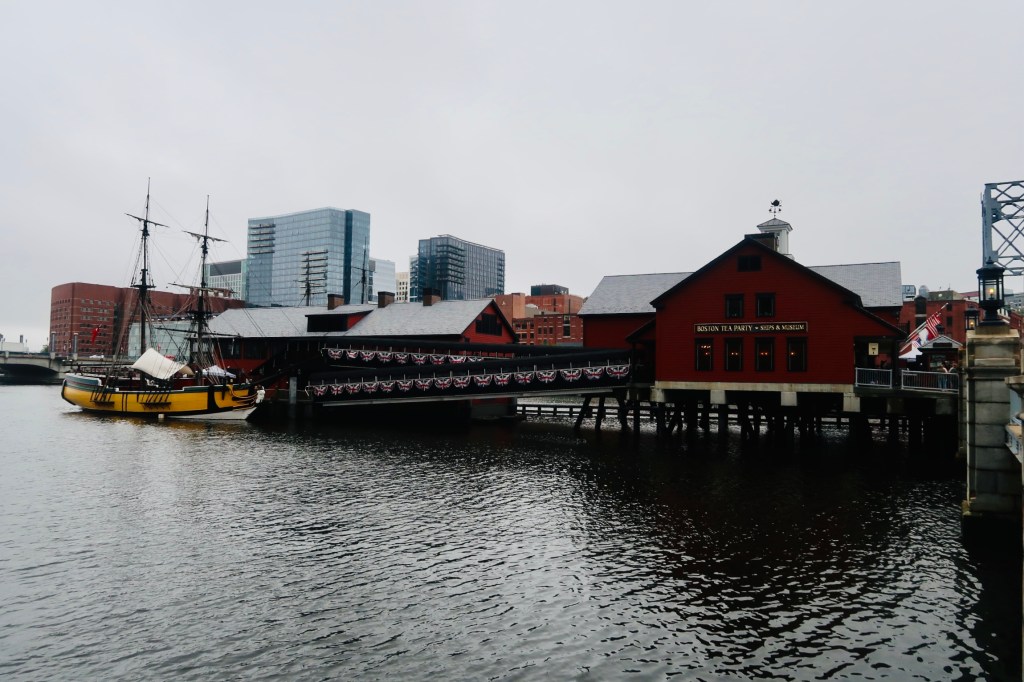
So, our time in Boston started where much of the history started (or at least the history of the start of the revolution), at the Boston Tea Party Ships & Museum. I think a good amount of us know the history of the Boston Tea Party. In December 1773, disguised men from the “Sons of Liberty”, after immense planning, quietly boarded the Beaver Dartmouth, and Eleanor with the intention of destroying the tea. They destroyed 92,000 pounds of tea (in 340 chests), but only the tea. They did not steal tea, they did not steel or even so much as touch anything else aboard the ship. The statement they wanted to make was abundantly clear, which was “we will not take your leadership any longer”. The British Tea Party was but one step in a much larger fight, which was against the crown and the ability for someone so far away to hold governance in the colonies. Of course after the destruction the “Sons of Liberty” who participated had to flee Boston, and those who stayed would go out in boats to the harbor to continue to ensure that any tea or tea chests in the harbor were not able to be rescued or used. The Boston Tea Party was an incredible success, but it created hardship for the colonists as well, sparking more and more “rebellious talk” and ultimately (after several more edicts and back and forth with the King of England) sparked the American Revolution in April of 1775.

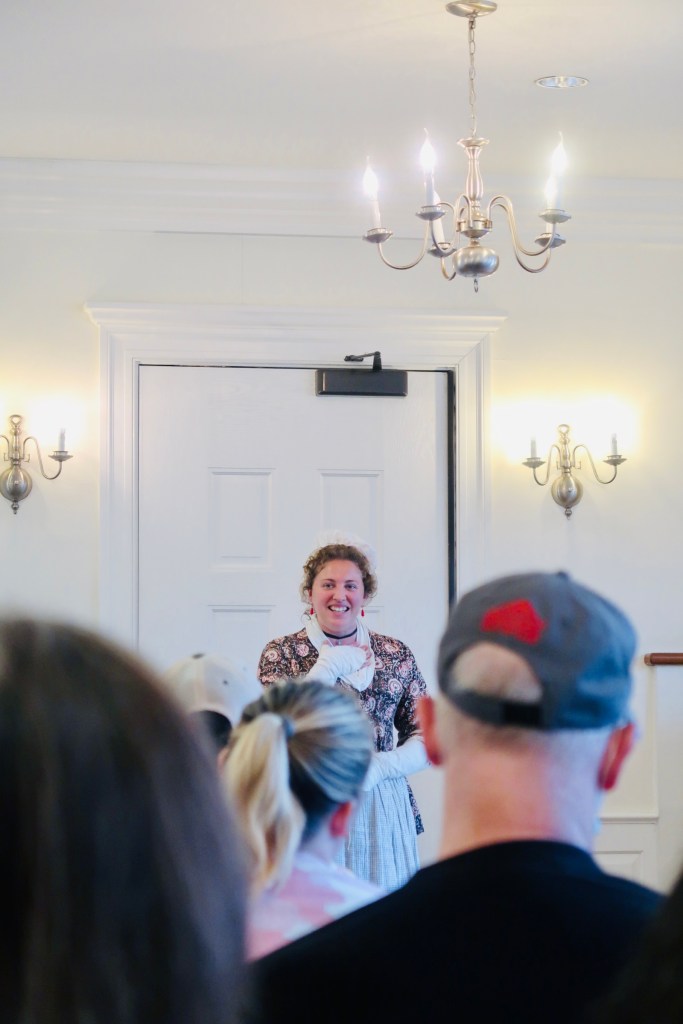
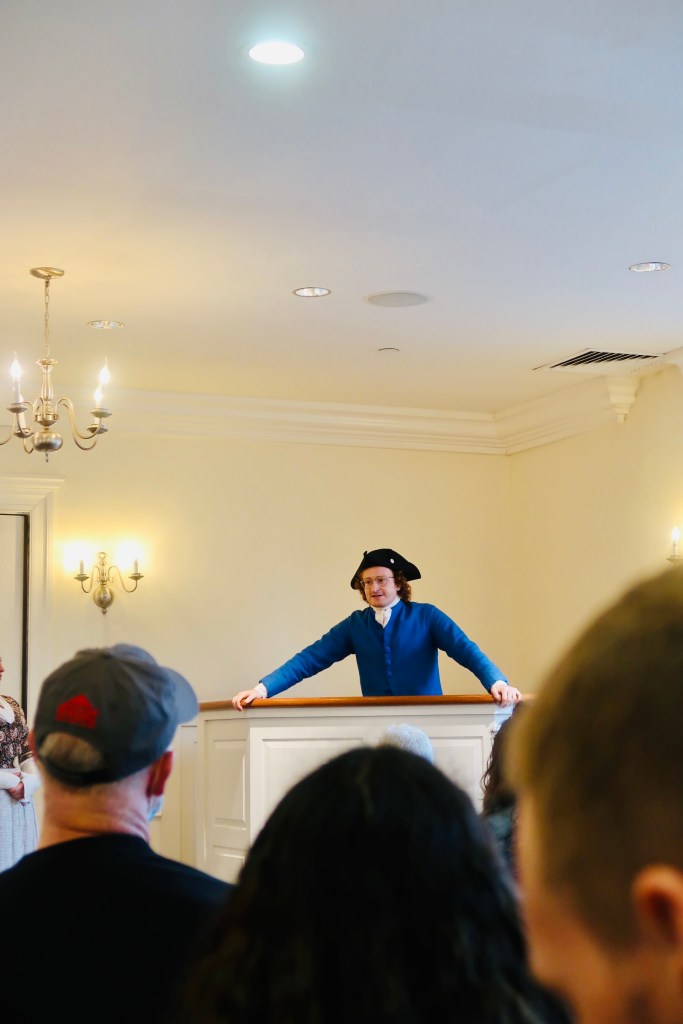
At The Boston Tea Party Ships & Museum, they do an excellent job of utilizing first person interpreters to put you right in the action of that fateful night in December. You are given character cards that tell you about a single person who lived in Boston at the time- these are then yours to keep as you continue along your tour. You start in the “state hall” with two actors taking you right up to those destructive lines uttered. Then you follow over to the boat where you can see what the Sons of Liberty would have seen, and throw your own tea overboard into the harbor. From there, you walk through the museum that talks about (with actual talking projectors and portraits) what followed the tea party. There is an original chest to see, along with a small vial of the tea that was tossed overboard (who rescued it remains a mystery). Finally, you can finish up at Abigail’s Tea Room, where you can sample the 5 tea blends that would have been on board the ship in the harbor (and subsequently enjoyed). It was the perfect start to our time in Boston and really put us in the revolutionary spirit. 

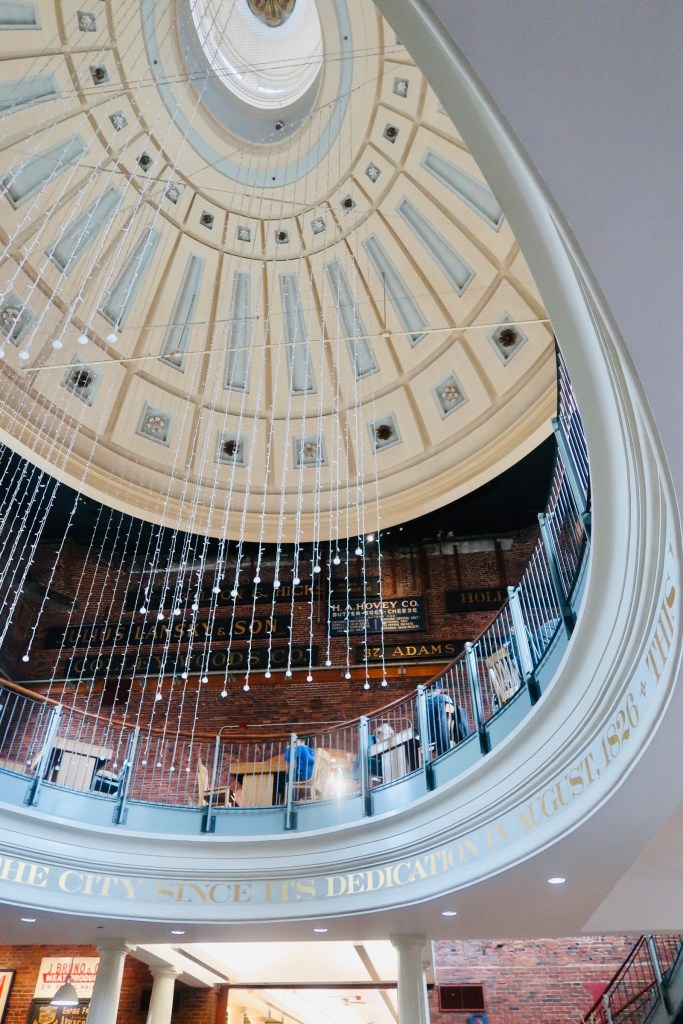
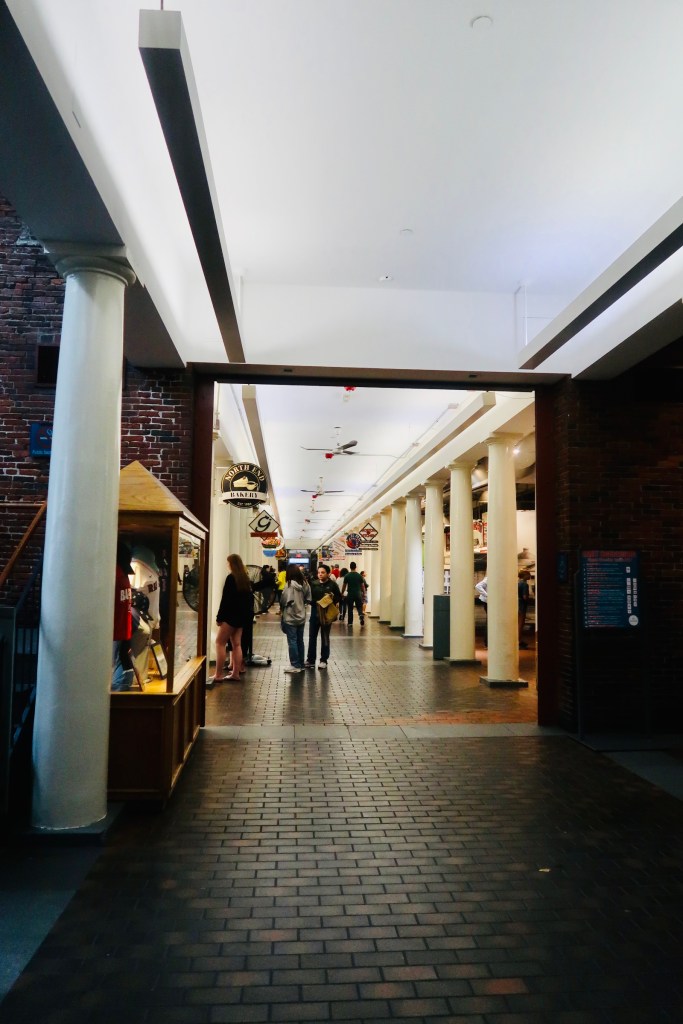
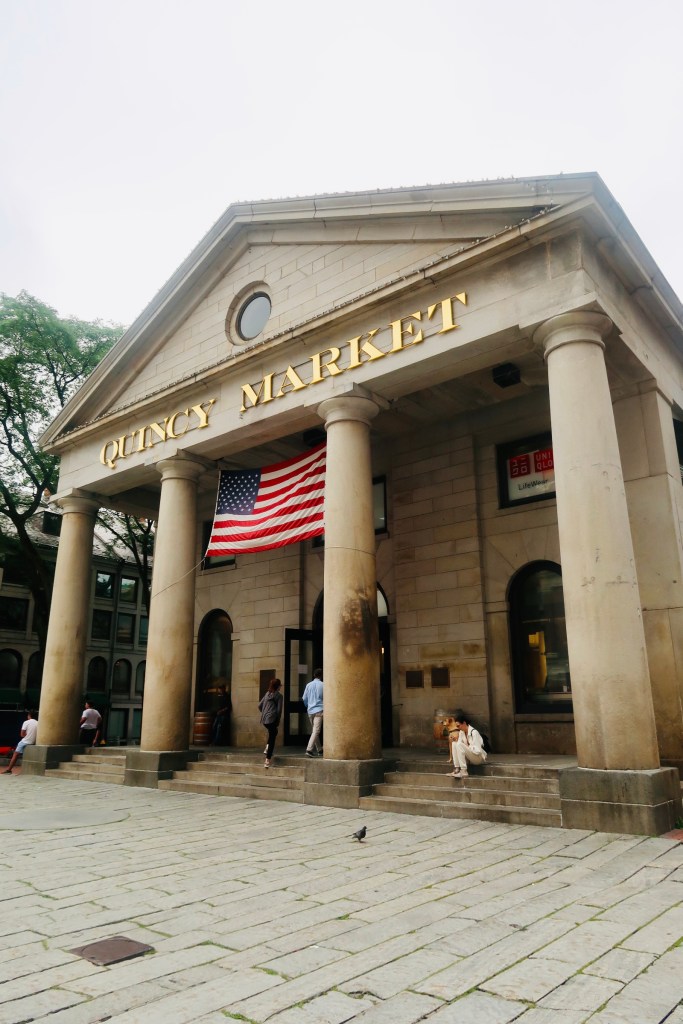
From there we mostly meandered around the area, letting the boys play at a playground (after being cooped up in a car and then on best behavior at the museum they were due to expend some energy) and trying to decide what we wanted to do. It was a bit later in the day, so we couldn’t do much more in terms of touristy bits. We ended up wandering over to Quincy Market (in a bid to see a museum which ended up being closed on that day anyways) and grabbing dinner at the food stalls located inside. I really loved Quincy Market. It reminded me of being at a farmers market of sorts and I had some of the best pizza since returning from Europe.

Quincy Market has quite the history. Dating back to 1826, the idea for the market came from Mayor Josiah Quincy. Shortly after being elected, Josiah realized just how much he disliked the chaotic, noisy, dirty view from his office in Faneuil Hall. This view was mostly due to the fact that the large marketplace was bursting at its’ seams. There was simply not enough space to cater the amount of stalls and sheds and the overall needs the city required. Not pleased with any ideas, he came up with his own development for a new marketplace. The only “thorn” in his side for this new market place was a landowner by the name of Nathan Spear, who refused to negotiate in regards to the property lines and deeds. No matter though, the construction went ahead with Josiah Quincy laying the first stone in April, 1825, with the market completed and opened in August of 1826. Officially named Faneuil Hall Market, it is more commonly known as Quincy Market. The market was enlarged throughout the following years (as it reached its initial capacity in 1850) and the market continued to serve the community. A restoration project was started in the 1970’s that not only including restoring parts of the market, but also additions to the rotunda and new dining areas. 

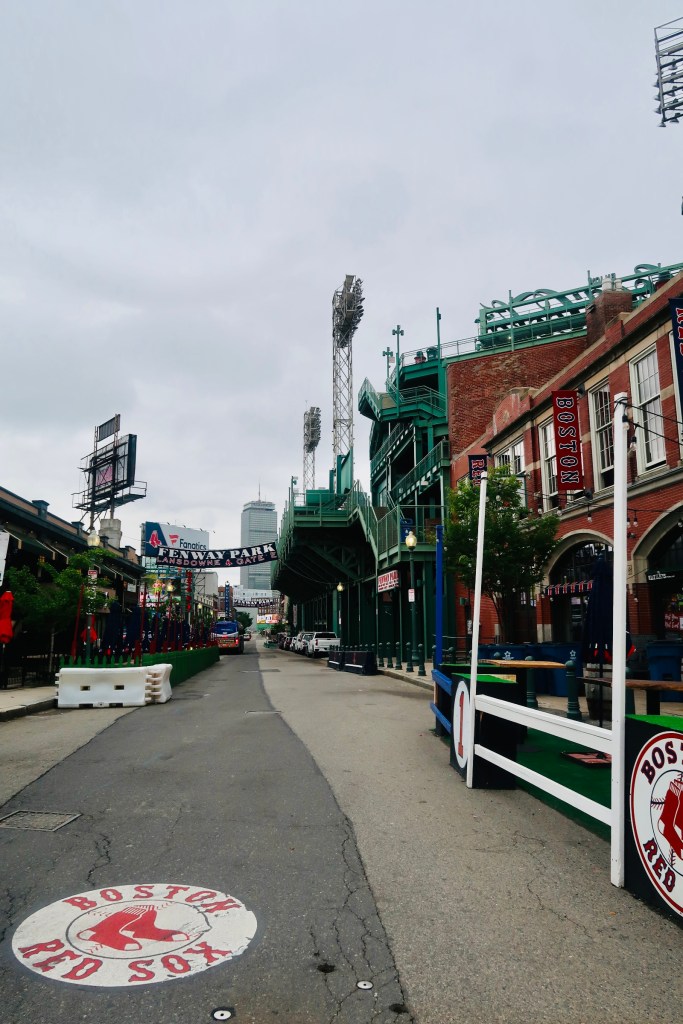
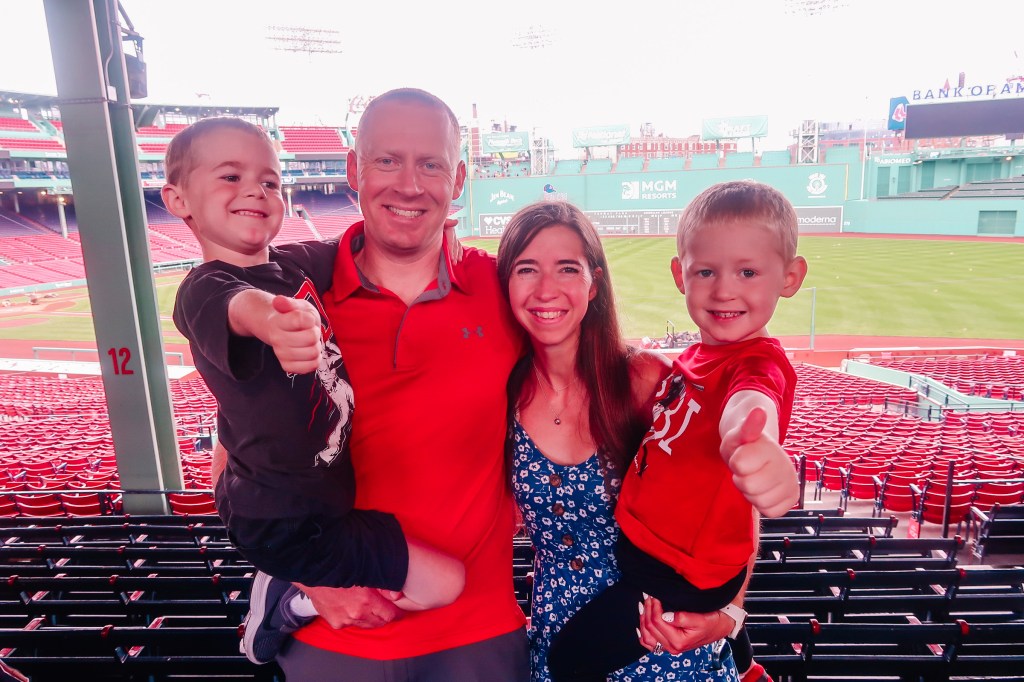
The next morning we were up bright and early to embark on one of my husbands most anticipated stops, Fenway Park (ok the kids and I were also very excited about this too). Where do I even begin with the history? I’m not going to go into the history of baseball (because oof), or of the actual Boston Red Sox (because, again oof), but rather the history of this particular ballpark. 

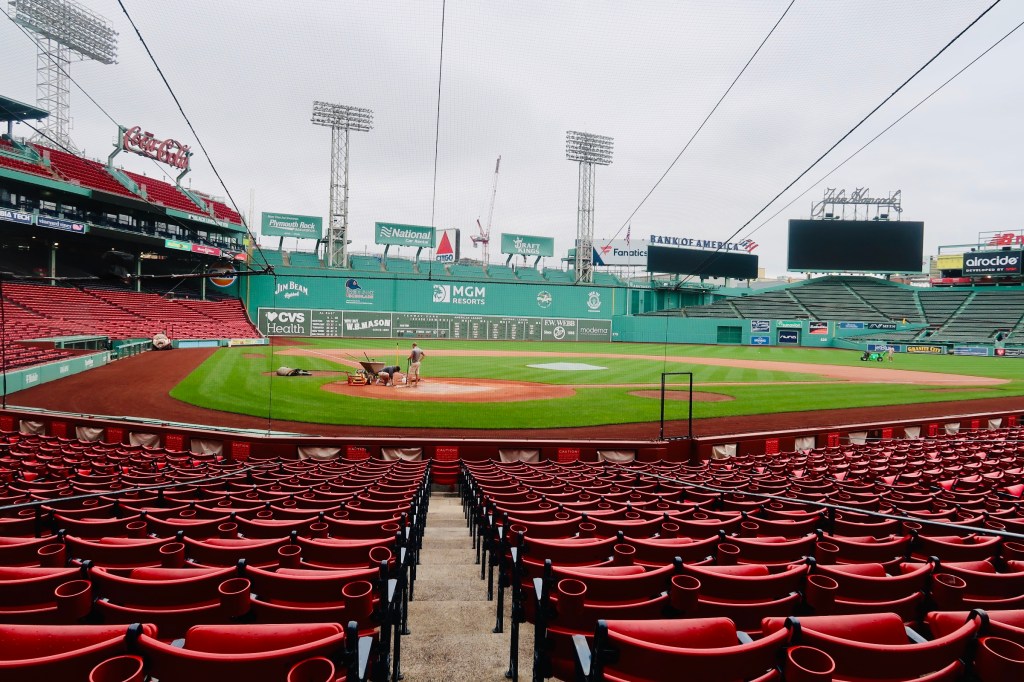
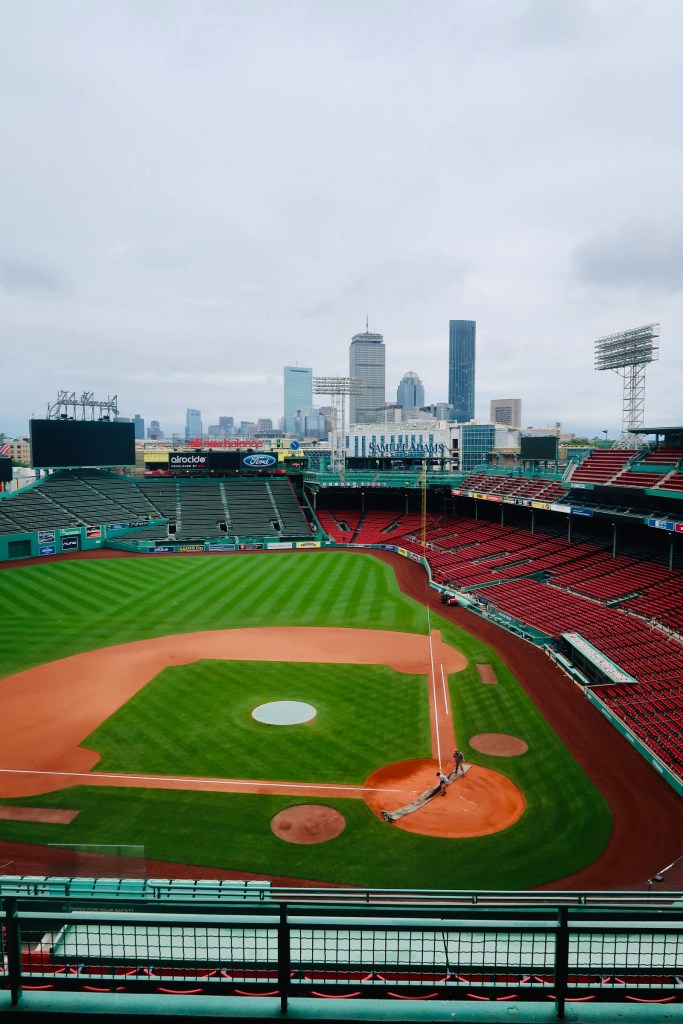
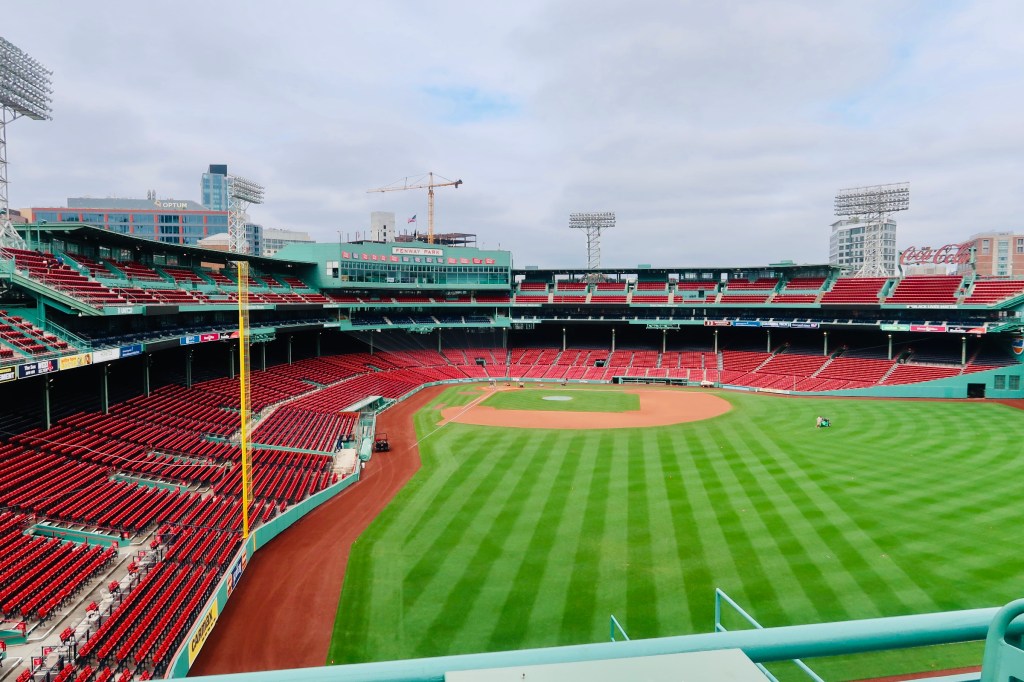
Some quick facts, Fenway Park is the oldest active ballpark in the MLB (109 years this year), it was actually rebuilt in 1934, and the location (within tight busy streets of Boston) lends itself to a unique set of features, the most popular being The Green Monster. It is the fifth smallest stadium within the MLB, only able to seat a little under 38,000. Finally, the first game ( a win for the Red Sox played in 11 innings) was actually overshadowed by the continued coverage of the tragic Titanic sinking. 

The Red Sox had been playing at the Huntington Avenue Grounds for 10 years, but Red Sox Owner John I. Taylor was looking for something different, something that would make a splash, something in Boston. He was also looking at potentially selling the team to a new owner, which played a massive role in the relocation. February of 1911 brought a group of real estate entrepreneurs together to become the “Fenway Improvement Association”. Subsequently one of the leaders, General Charles H. Taylor (yep- John’s father), acquired a large amount of land which the young John Taylor then announced his intention to use it to build a new home for the Red Sox. Ground broke for the ballpark, without the proper permits approved or assurances that they would be approved, on September 25, 1911 and by he end of the calendar year the foundations were in place, the roof framed, and plans in place to continue. Fenway Park hosted its first game April 9, 1912, with the first official game occurring 11 days later. Construction continued during Away Games, with the left and right field bleachers completed in time for the World Series. There were several renovations and additions given to the park over its long history, too many for me to actually get into and list, you can read the full history HERE, but it’s safe to say that this is a true landmark of the city and of the sport. 

The park has also been used for other sporting events, being home to matches of boxing, soccer, American football, Hurling, Gaelic Football, Hockey, Ice Skating, and Ski and Snowboard events. It also has hosted Concerts and Rallies/Public Addresses. 

There was one instance where the ballpark was in jeopardy, in 1999 the Red Sox CEO announced plans for a new Fenway Park. This, understandably, came under a lot of fire from all around, and led to a long round of talks, negotiations, and different plans. At the end of it all there was no resolution to be found and in 2005 it was announced that the Red Sox would stay at the current Fenway Park. This then led to a 10 year significant renovation of the park led by Janet Marie Smith (who is wholeheartedly credited with saving the park). 

One final note, which is the lone red seat. The lone red seat signifies the spot of the longest home run ever hit at Fenway Park. Ted Williams hit a home run June 9, 1946, which hit Joseph A Boucher right in the head (through his straw hat), then bounced several rows above. If it hadn’t hit Boucher, it could have reached a length of 520-535 feet, but rather it hit 502 feet. 

As part of the tour you are able to see the interior of the park (where two movies have been shot- including THAT scene from The Town), sit in the old wooden seats in the Grandstand section, head through the museum which contains collections of bats, balls, seating, jerseys, and more throughout the Red Sox history, head up to the top of the upper seating, go through the Press Box, and over to the Green Monster (which only added seats added to it in 2003 and they are the most expensive and contested seats in the park). All while being told the history of the stadium, a couple of dad jokes (maybe you want to hear one now? “The distance between all the bases is equal, however why does it take a runner longer to get from second to third? Because there’s a short stop” Ahahahahahaha- ok done now), and seeing some epic views from every spot in the park. It truly was an incredible tour and very well worth our time. If you are even the slightest baseball fan, this is a definite go to (but if you’re a baseball fan it’s probably already on your list to visit). 

And that wraps up this first part of my two part Boston posts. The second part (coming out this Friday!) will be focused exclusively on the Freedom Trail and the sights we saw as part of that. 

A Cuppa Cosy Summer Holiday 2021 – Plymouth MA

It is time to talk about our annual summer holiday and travels! This year we decided to do a “USA history” tour of sorts, starting in Plymouth Massachusetts, then heading up to Boston, MA, a quick stop in Salem, MA and ending in Portland ME. Honestly, the trip was overall so relaxing and enjoyable. I don’t know if it was the amount of time in each stop, or if it was just the fact that the boys are older, we are more “travel experienced”, and that we haven’t traveled (thus the excitement is greater), whatever it was, this really worked for us. A quick overview of our trip, we did two nights in Plymouth, three in Boston, two in Portland. 

We arrived mid afternoon in Plymouth on our first day, prior to the check in time at our hotel, so we decided to just head over to a first stop. We started at Plimouth Patuxet. 

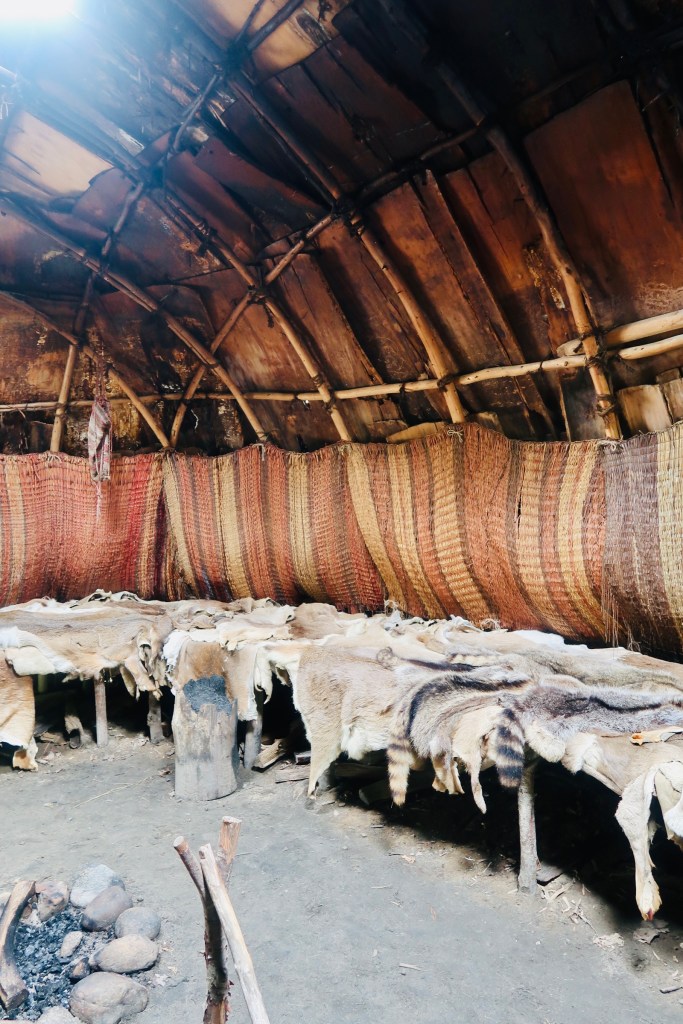
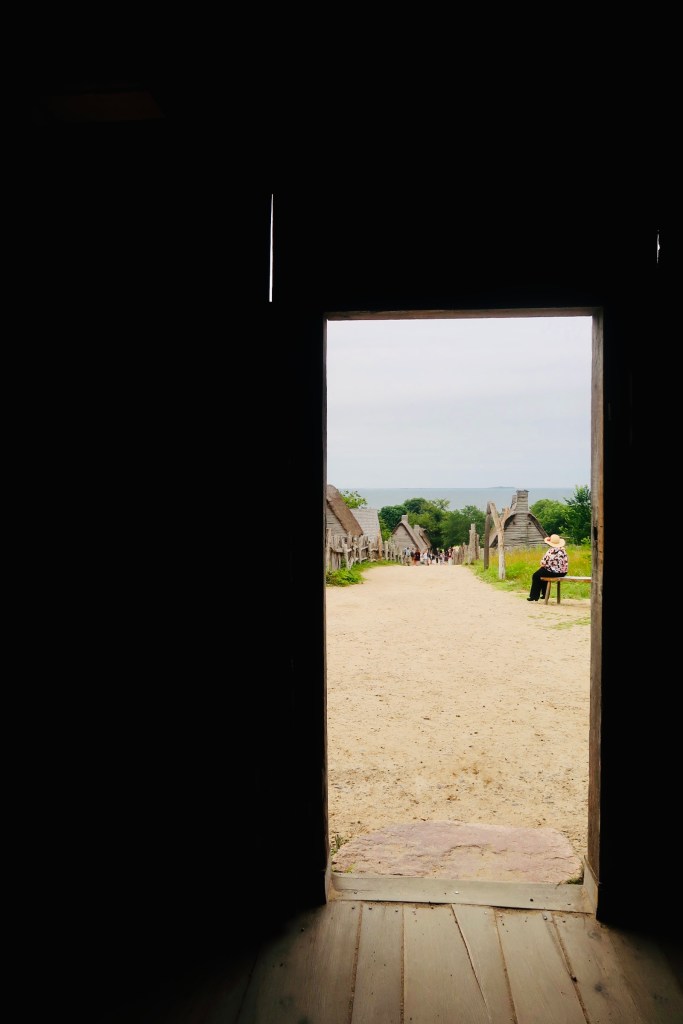
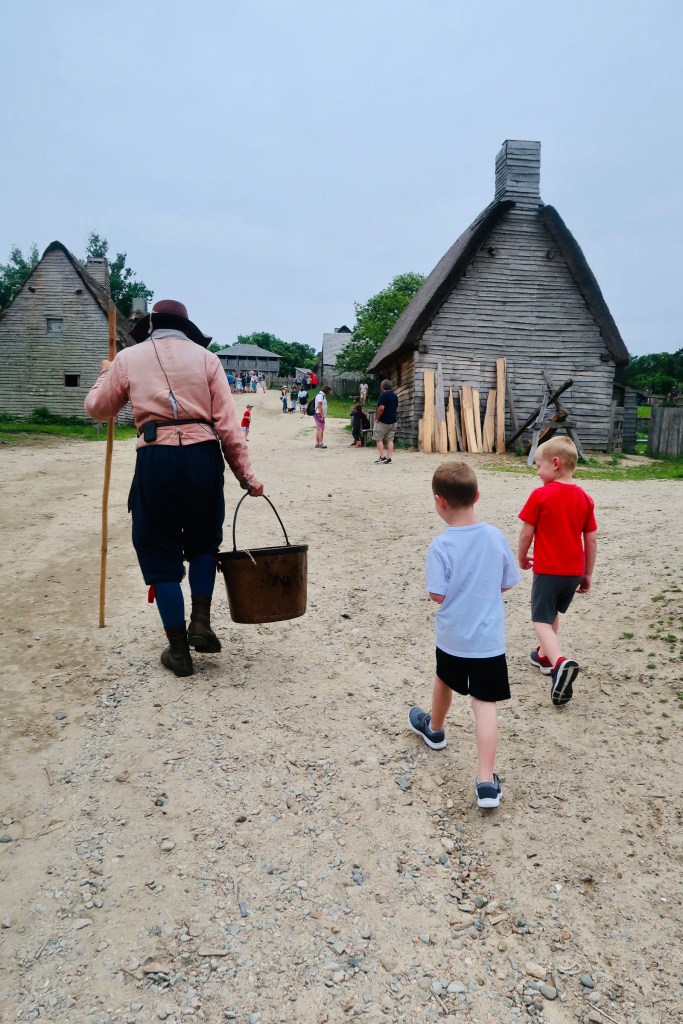
The Plimouth Patuxet or Plimouth Plantation (the original name) is what’s known as a living museum. Started in 1947 it features two central locations, plus the Mayflower II and the Grist Mill (in separate locations), one a replica of the village of Plymouth from 1627 with first person historical “actors” and the second is a replica of the Wampanoag village as it would have stood in the 17th century along with guides to help visitors understand life for them. It gives visitors an insight into not only what life would look like and be like, but a chance to learn about some of the people who would have lived in the Plymouth Colony.

Most of us know the history of America, the Colonies, etc., so I’m not going to focus too much on it, but I will say that there is a big difference between the colonies of Jamestown (the first) and Plymouth. Jamestown was founded by entrepreneurs who were seeking new land to develop, live and to expand fortunes. Plymouth was founded by a sect of Puritans (later as we all know as Pilgrims) who were fleeing religious persecution. They did not actually sale directly to the “America’s” though, they first went to The Netherlands to avoid the persecution. That didn’t end up working and they ended up making the journey towards the “America’s”. 

The Patuxet was really neat to walk through and I found it to actually be quite respectful to both the Wampanoag, the Patuxet, and the Colonists. The boys really appreciated the first person actors and being able to be involved in this living history (even though they truly couldn’t comprehend the entire grasp of it). 

We spent a couple hours at the Patuxet, then headed over to check in to our hotel. We stayed at the John Carver Inn for two reasons, one being its location right off the main street of town, and the other being the very cool pool that it offered. I will say, that while we loved the pool (which has a makeshift Plymouth rock holding the hot tub, and a slide within the “mayflower”), the hotel rooms were a bit dated. There isn’t anything wrong with that and we enjoyed our stay, just something to note. After checking in, we decided to just go venture out on the town.

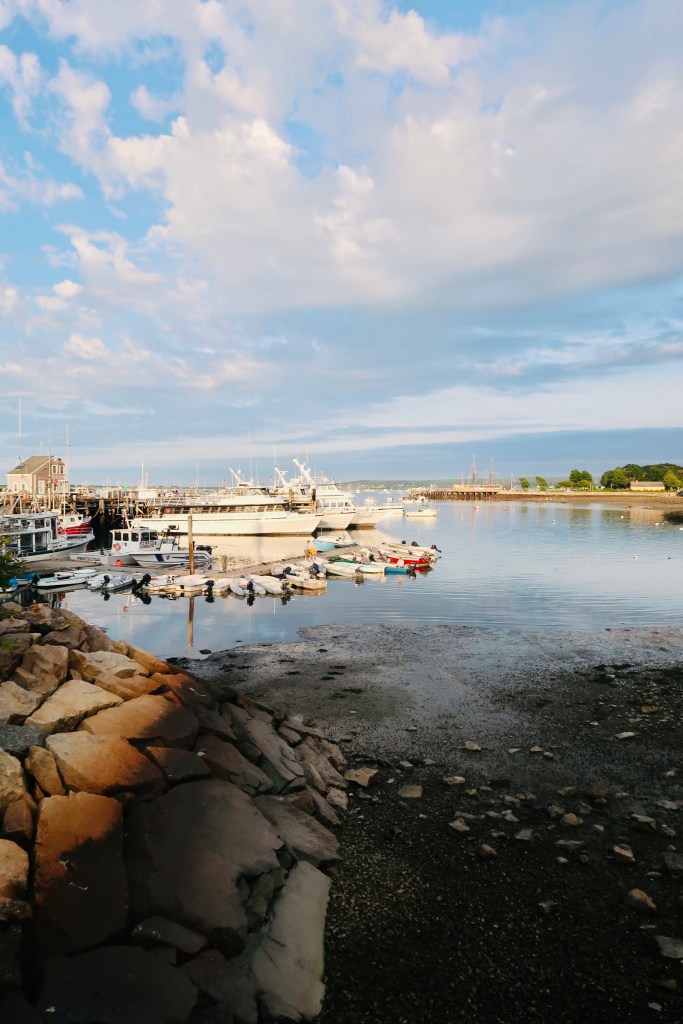
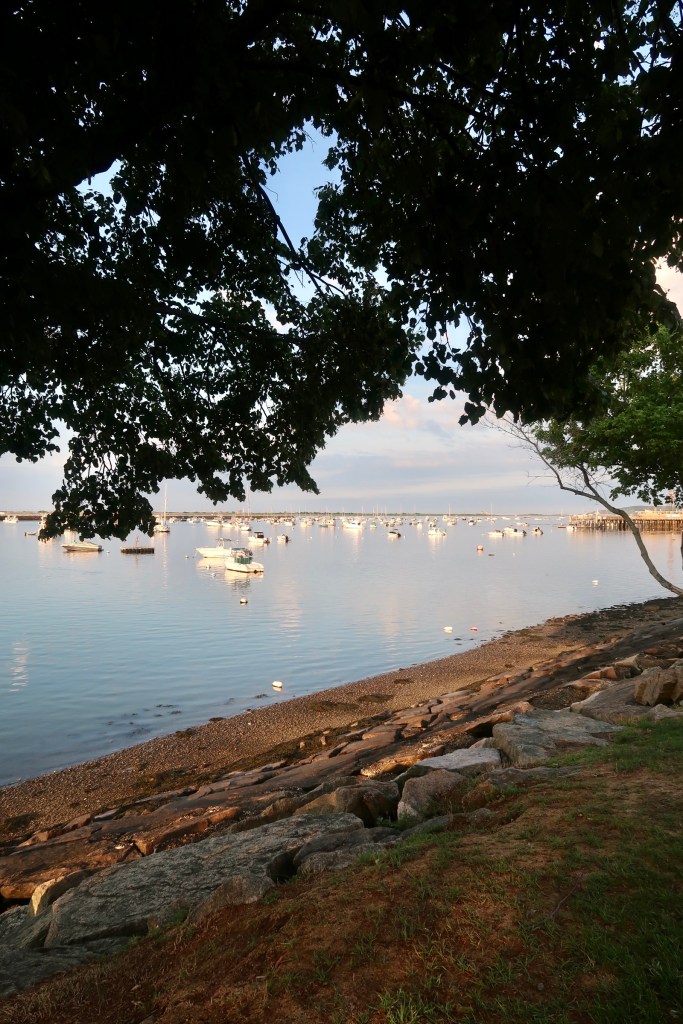
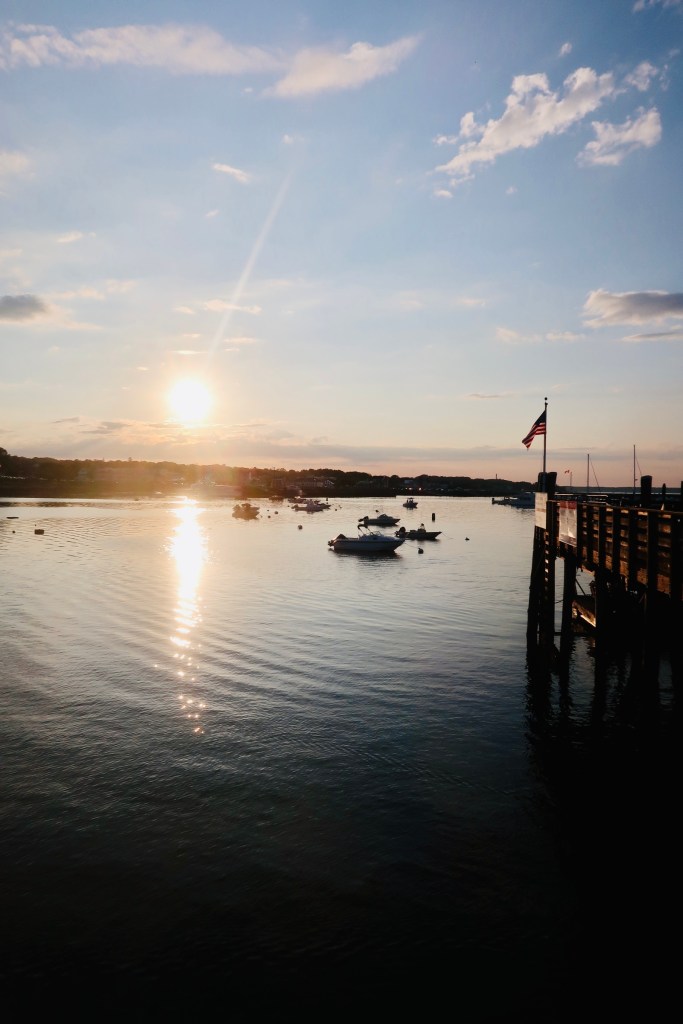
Wandering along the main streets of downtown Plymouth offered a variety of breweries, small boutiques, and tourist shops. We ended up stopping at Tavern on the Wharf for dinner that first night, watching the sun light up the water as it started to set. From dinner, we continued to walk along the bay, watching the sun set slowly over the bay. Walking along the bay puts you right at the Plymouth Rock. This is when I would recommend seeing because a) you get to see the sunset on the water, and b) it tends to not be as crowded. 

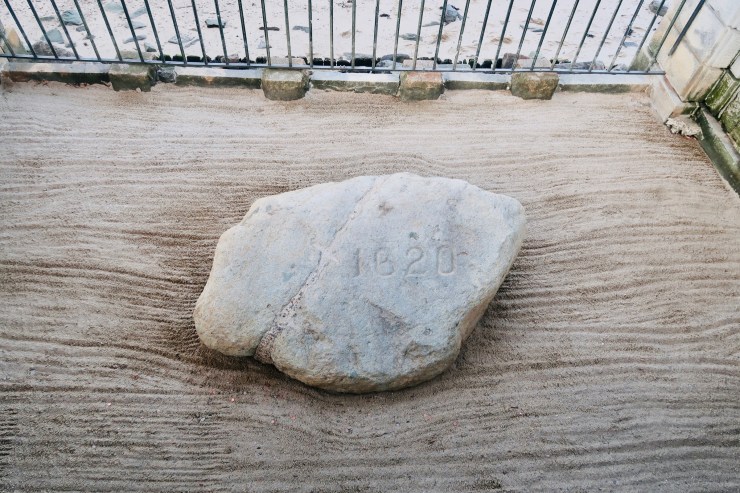
So, Plymouth Rock. I want to start with the fact that there is no writing from the Pilgrims in regards to Plymouth Rock. It wasn’t recorded until ~1715 when it was used as part of the town boundaries and was simply a “great rock” and there wasn’t even a claim to it being the landing place until 1741 (~120 years later). Second, the rock itself (as it stands today) is quite small. It is not even the full size of the “original Plymouth Rock” due to its being moved around and pieces being taken, bought, and sold. Today it stands at about 1/3 of the size that it actually was. There is also a crack in the rock where it was broken in an attempt to place it in the town square, the two portions were put back together and the date was stamped in the 1770’s. So, it’s cool to see, but also a bit anticlimactic in a way. 

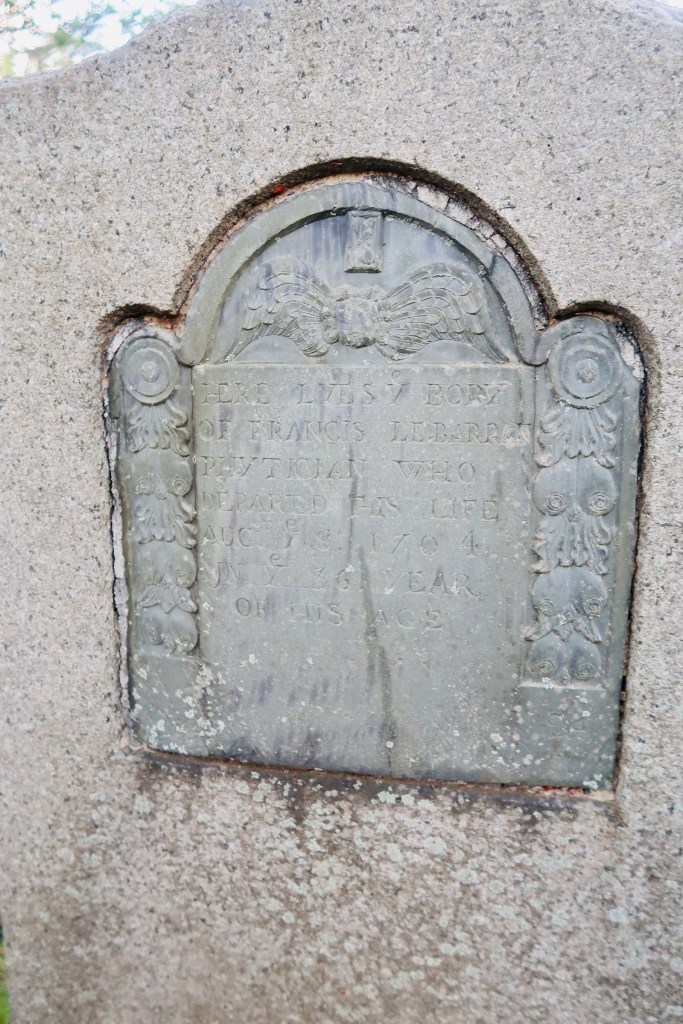
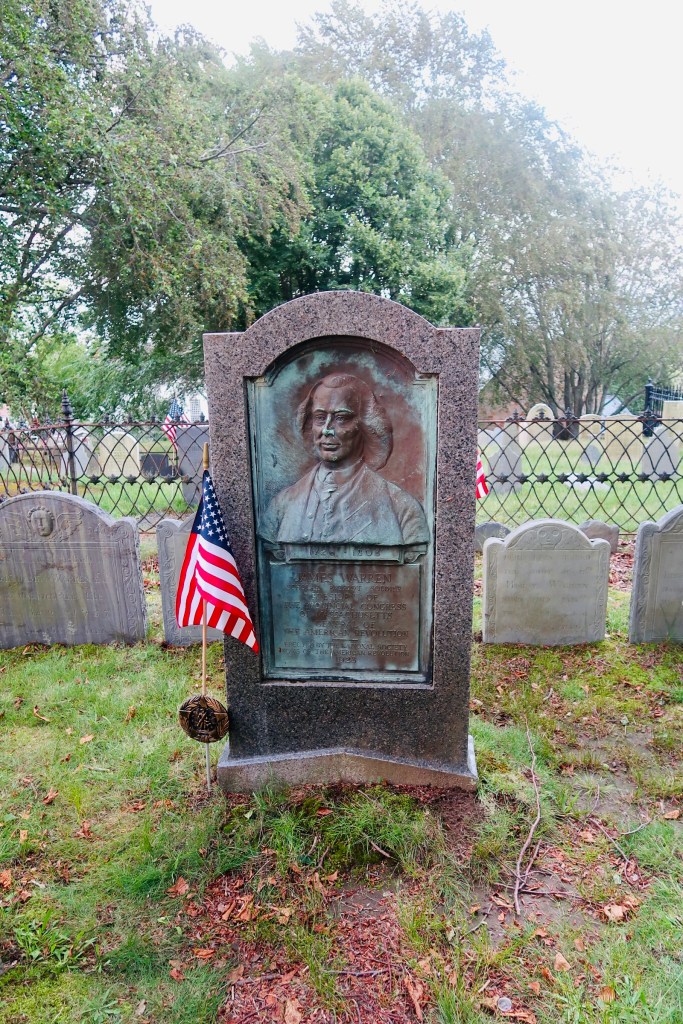
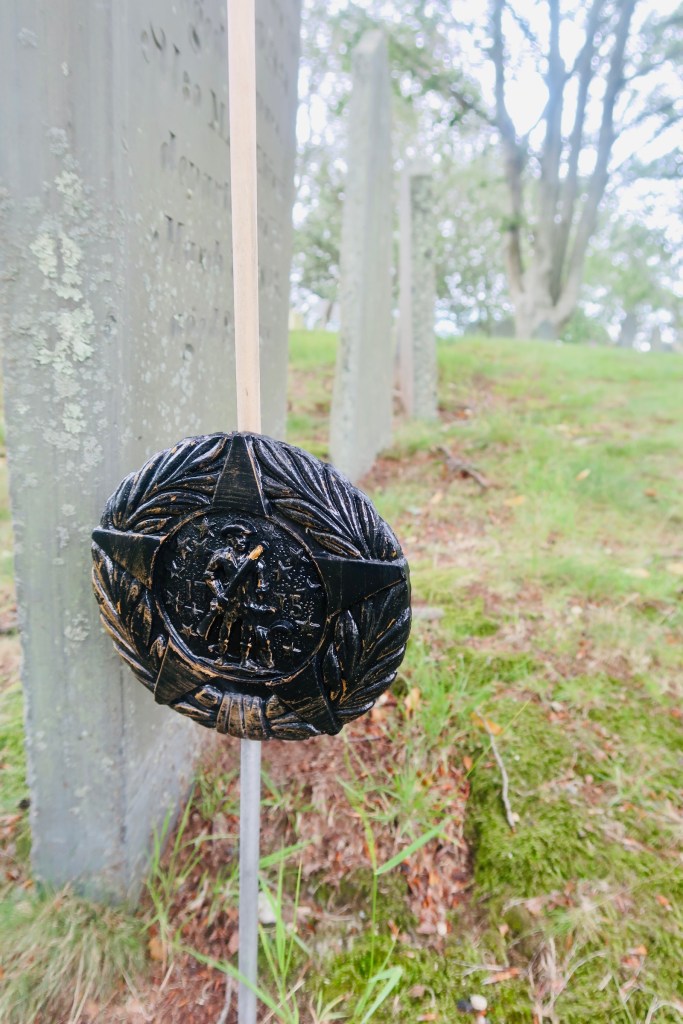
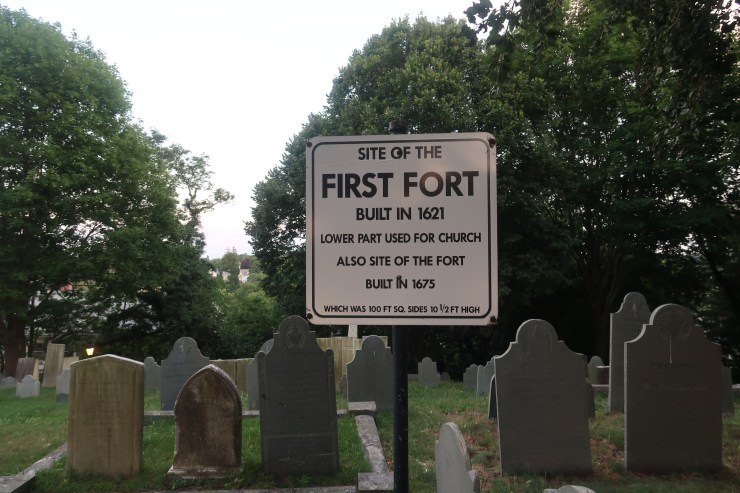
We finished out the evening with a  stop at Burial Hill, which was located right behind the John Carver Inn. Since there was still daylight (this cemetery sits much higher than the bay), we decided to take a little wander through the cemetery and see some of the oldest gravesites in our country (documented- there are much much older sites obviously from the indigenous peoples). Burial Hill was originally the site of the Pilgrims first meeting house and was first used as a burial spot in the 1620’s. There are Pilgrims and Mayflower passengers buried in the cemetery, as well as various revolutionaries and soldiers. Any person that has a history tied to a battle/war, the Mayflower, or the colonists has a medallion placed next to the grave marker (some of these still stand, some have been destroyed over time by the elements). 

The next morning we started out somewhat early, to get some breakfast from Munchies & Milkshakes. Robert had found this spot and read reviews about donuts and baked goodies, so we figured why not give it a try. I can tell you, it did not disappoint. We took our donuts to a bench overlooking the Mayflower II and the bay and had a lovely little picnic. Then it was off to tour the Mayflower II. 

As the same organization owns all three “Pilgrim”/Plymouth related attractions, you are able to purchase one ticket for all three locations, which is what we did. I can’t say that it was a cheaper option or a good bargain deal, but I can say that it was definitely easier when it came time to visit the other locations. We walked right into the Mayflower II and were able to get on the boat almost immediately. 

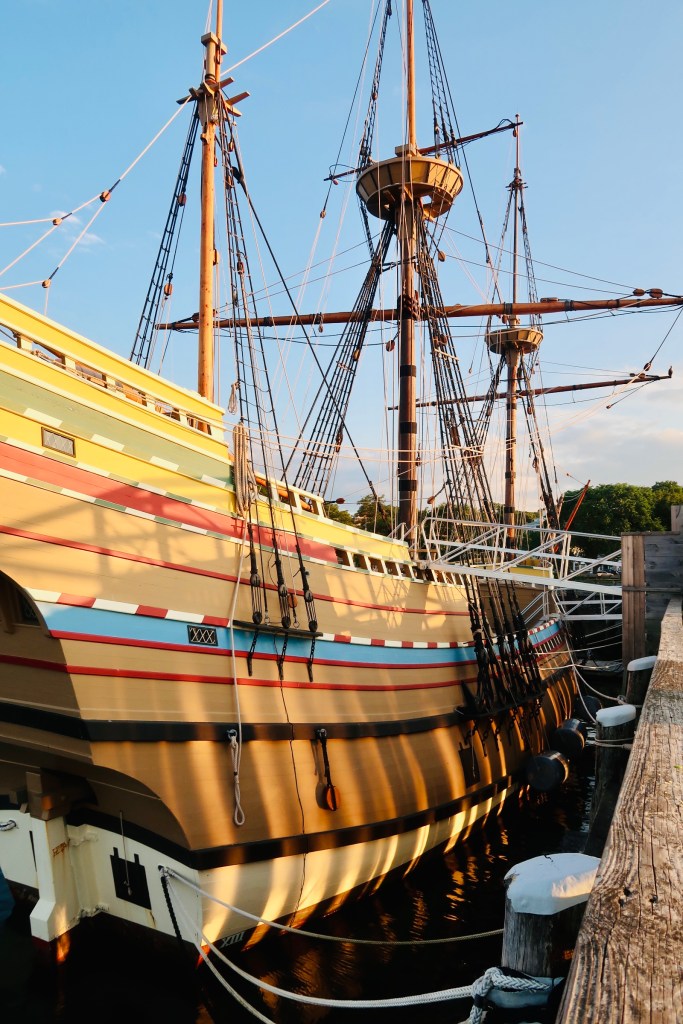
The Mayflower II is a reproduction of the original Mayflower. It was built in the 1950’s in partnership between an English builder and the Plimouth Patuxet. It was a partnership to honor the alliance between the United States and the United Kingdom during World War 2. Considered a generic reproduction with modern additions (like electric lights and a ladder) it sailed from Plymouth, Devon recreating the historical journey of the Pilgrims, landing at Plymouth Massachusetts after about 2 months. It has journeyed through various ports and cities on the East Coast both for tours and for restorations, but in 2020 it made a permanent return to Plymouth in honor of the 400th anniversary (lucky for us!). 

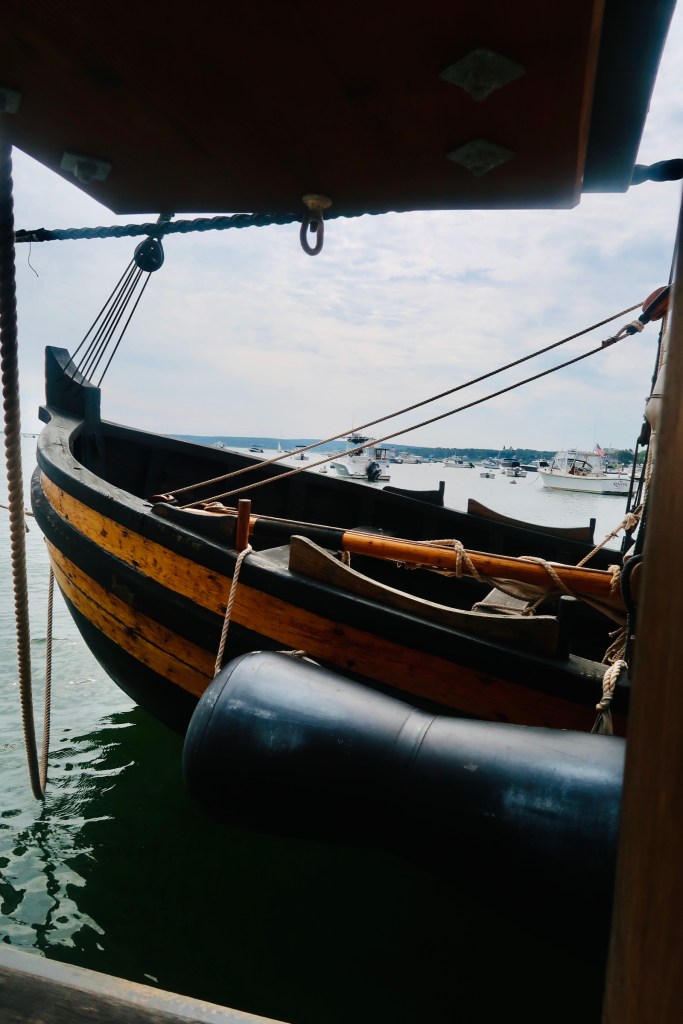
I do think that this is a very worthwhile attraction to see. Not only does it put the voyage in perspective and the conditions and turmoil that the Pilgrims faced during their voyage, but it also is neat to check out. The “crew” on board is a mixture of modern day guides and first person interpreters and you are able to see just about every area of the ship, including the mooring boat that they would have used to send expeditions from the ship to the mainland to find a settlement space. 

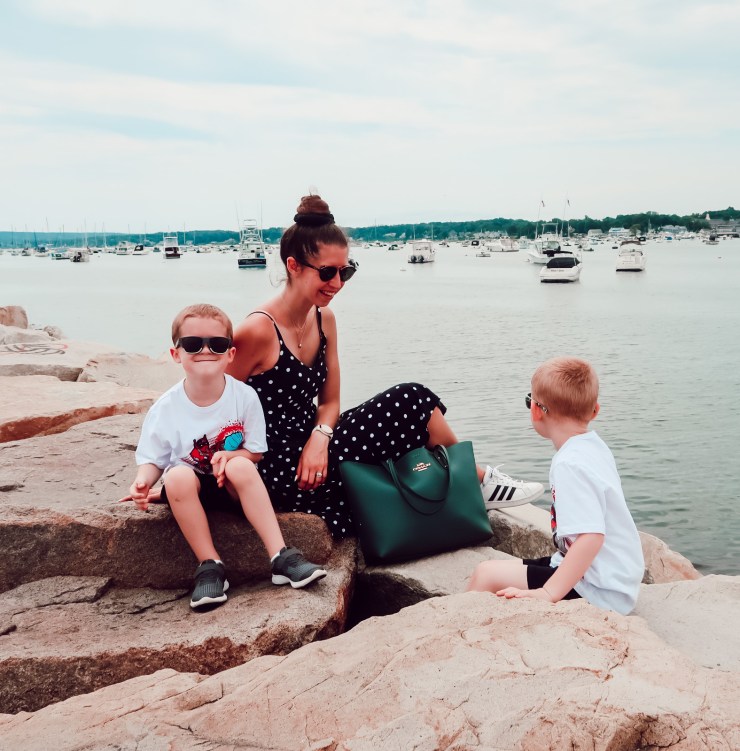
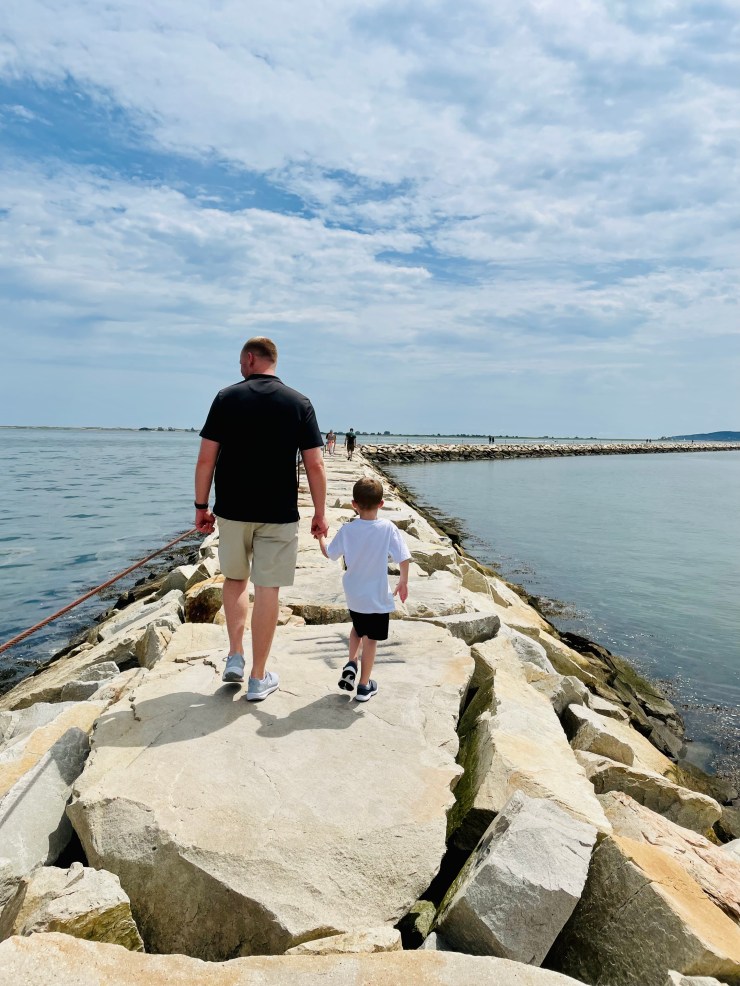
From the Mayflower II we walked the opposite direction (away from Plymouth rock and towards the shipyard area) to walk the riverfront. The town has a rocky area that you are able to walk a bit out into the bay waters and see the town from the water (in a way). Now, you are walking on rocks that have been piled up and around coming out of the water to form a walkway. It’s not a “sidewalk” or anything of that nature, just a man made path. We walked about halfway out and decided to turn back (as it’s just an outcropping to see the view). 

At that point in the day we were reaching the peak of the sun and heat, so we decided to head back to the hotel and spend a bit of time at the pool. This is something we don’t often do, but we had partly booked this hotel for the pool, so we figured we should take advantage of it. It was a lot of fun and allowed some of that sun and heat to pass over us. 

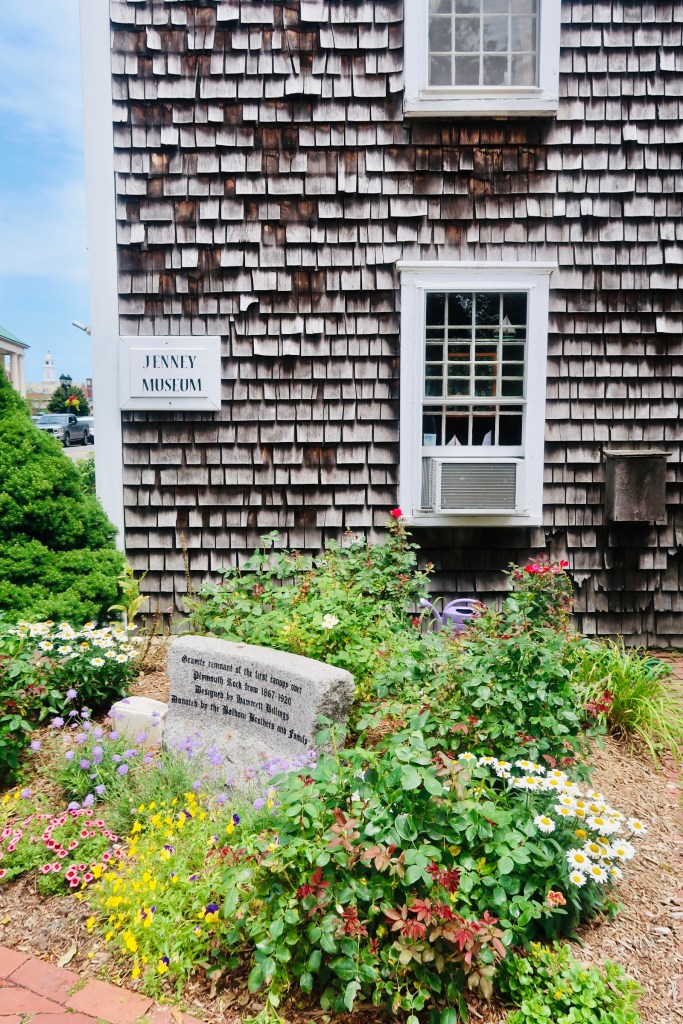
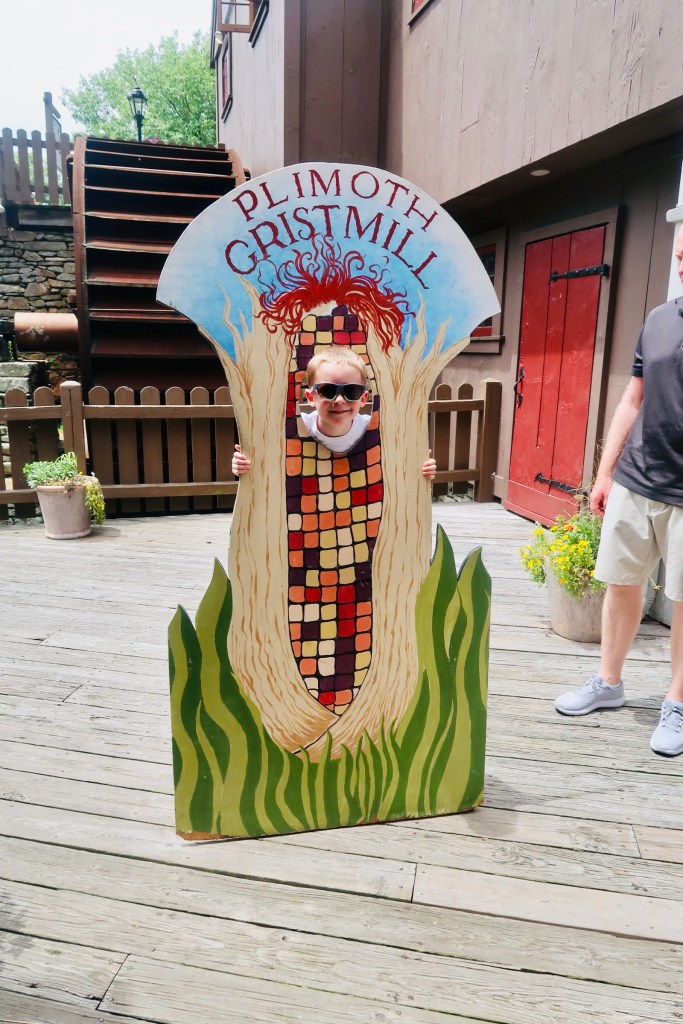
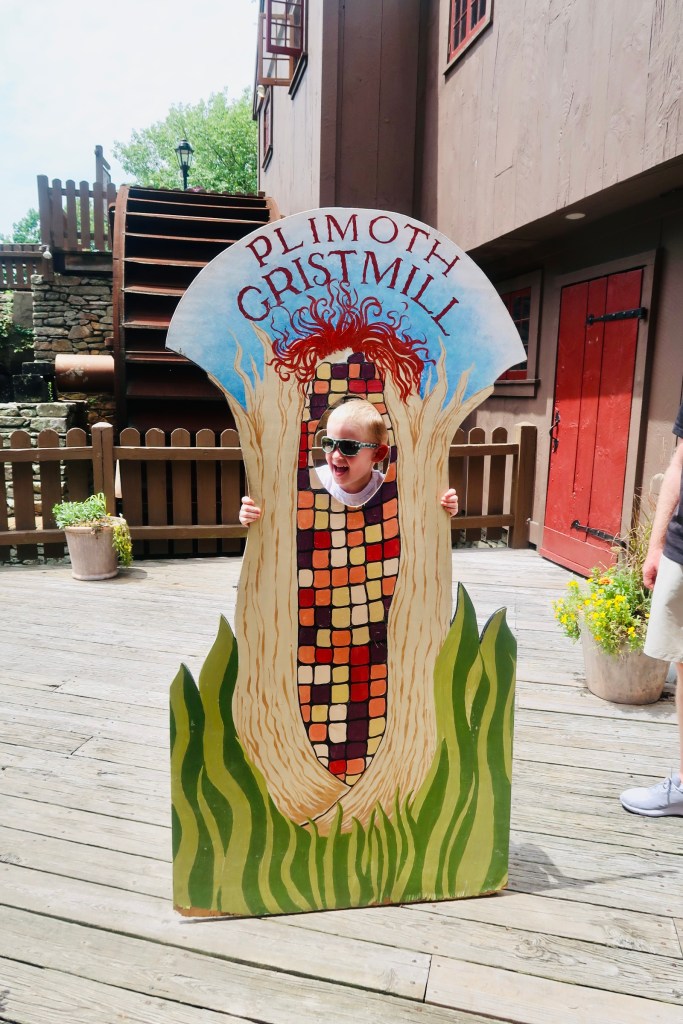
After a brief lull, we headed back out, this time to the Plymouth Grist Mill. This Grist Mill is a working mill recreated on the site (and similar to) the Jenney Grist Mill, which was one of the first operating mills from the Pilgrims in Plymouth (built and operated by John Jenney who came over on the Little James in 1623). The Mill was originally built in 1636 and remained in operation, though passing through different hands as owners passed away or sold, until it burned down in 1840’s. The property stood as it was until the town went through some re devolopment and mill was rebuilt/reproduced in 1969. It is a fully functioning mill processing what, rye, barley, and corn (which is ground on the primary millstones). You are able to watch the mill at work if it is the time of year for it to run, otherwise you are able to tour the mill and the workers will show you how everything operates. A Very kind tour guide turned on the outside portion for the boys to watch. 

I will say, this was another neat stop to make, BUT if you can’t fit it in or you are wondering which of the three attractions you don’t need to visit- this can be cut from your itinerary. It’s a short visit (which worked out really well for us), but I wouldn’t say it provided much “first hand” insight. Cool to see, but not necessary.

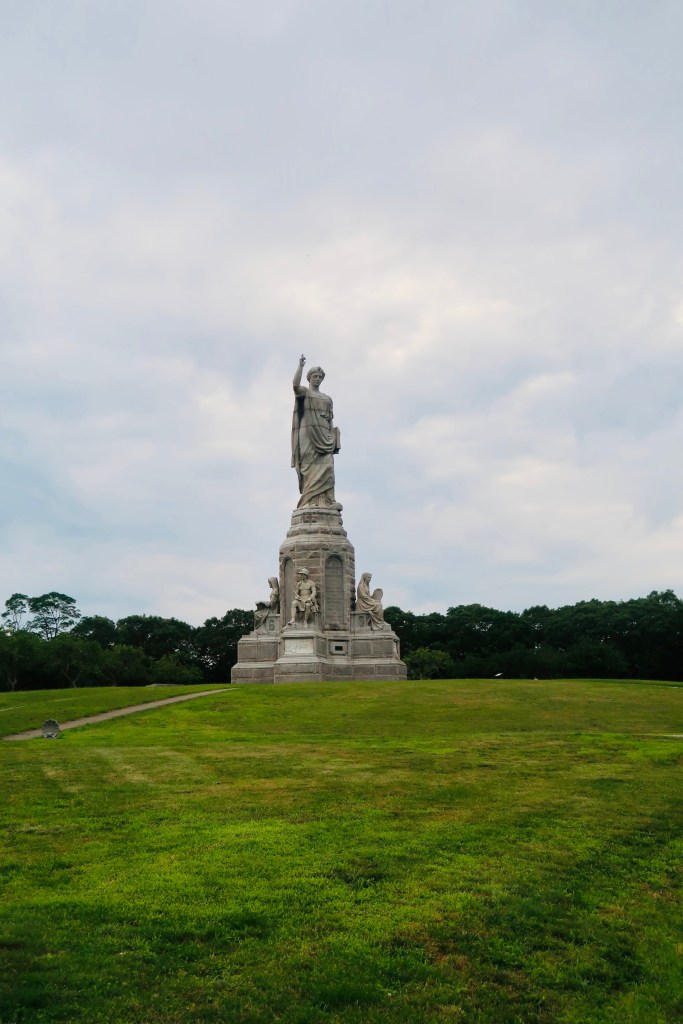
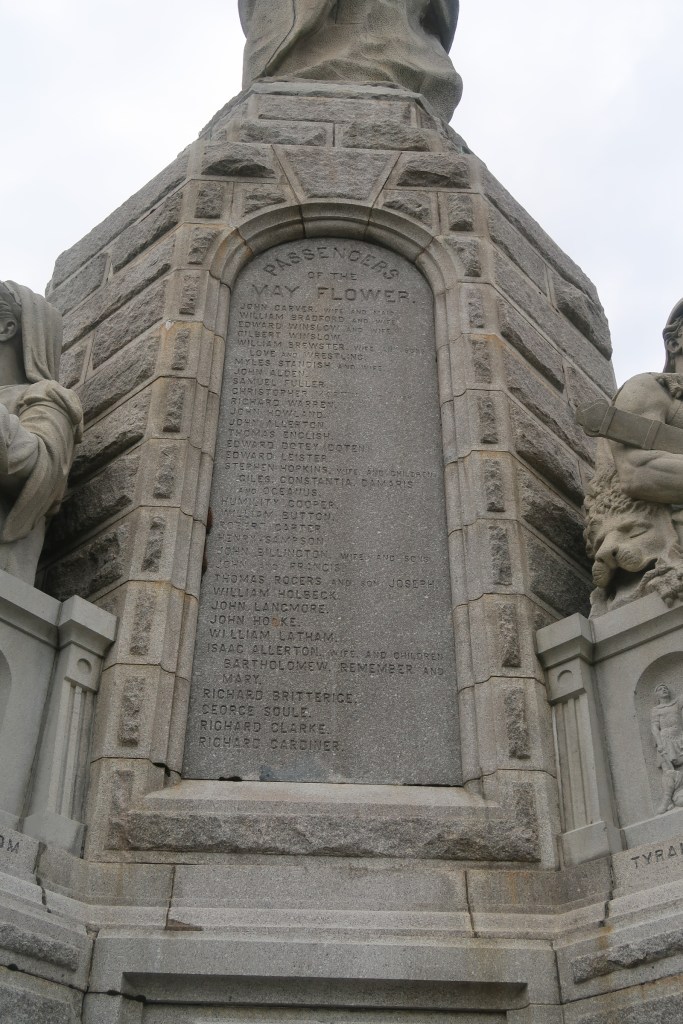
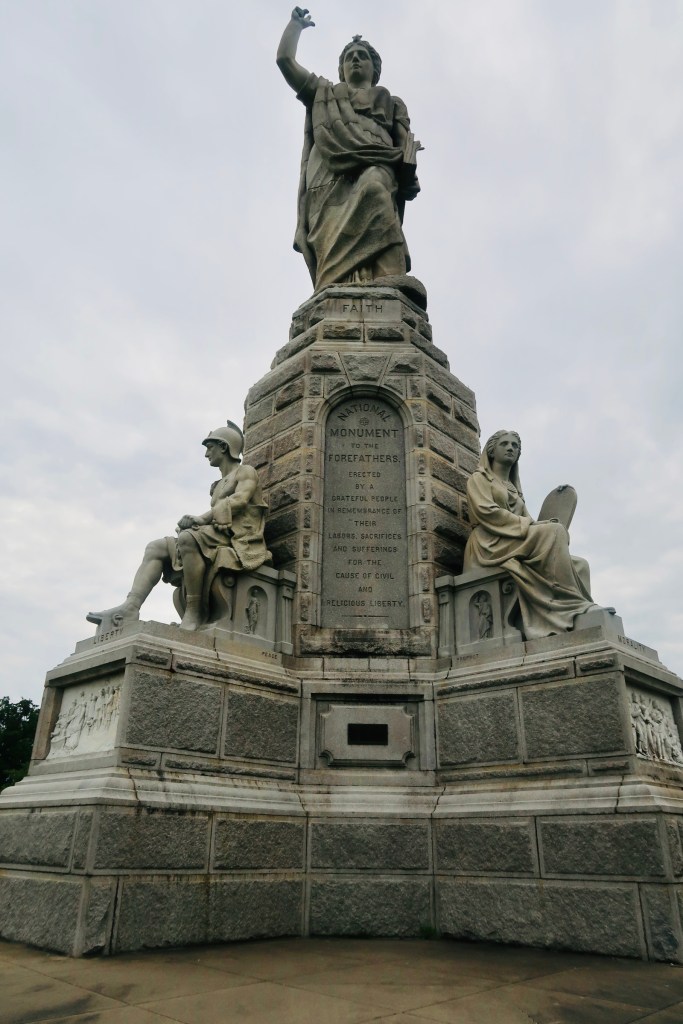
The final stop we made in Plymouth was the National Monument to the Forefathers. Originally known as the Pilgrim Monument, this is thought to be the worlds largest solid granite monument standing at 81 feet tall. It is dedicated to and commemorates the Mayflower Pilgrims and their ideals. The idea dates back to 1820, but the cornerstone was not laid until 1859 (after plans started almost 10 years earlier). It opened in 1889 and features a total of 5 figures. The top one is known as “Faith”, with the four buttresses featuring “Morality”, “Law”, “Education”, and “Liberty”. These are then broken down further on each buttress to give more ideals for each overarching concept. The front and rear panels both have quotes engraved, with the side panels containing the names of those on the original Mayflower. 

We wandered from the monument, which is tucked up on a hill back in a neighborhood, back down to the main street and stopped for dinner at the Waterfront Bar & Grill before heading back to the hotel to pack and leave the next morning. 

And that wraps up the first stop in our 2021 Summer Holiday. I will say, I’ve only ever been mildly interested in the Pilgrims tale (more so in a respectful manner of history), so while this was a cool spot and town was pretty, this wasn’t a highlight for me. It also wasn’t for the kids (minus the pool), but that’s because they much preferred the next stop on our destination…

2020 – A Year in Review

2020. What a year. Where do I even begin?

We all know the big moments of 2020. The Pandemic. The Murders, Uprise, and Unrest (I really hate calling it that though- this is simple human rights). The Election. The unprecedented highs and lows that this year has brought have been like we haven’t seen. And, I don’t know about you, but I’m kind of tired of talking about them. I feel like so much of our lives this year have been focused so heavily on these few moments, which while are drastic and life altering, are not the entire story of our year. They have shaped the year, shaped our experiences, shaped how we cope and handle things, but there are also a million other smaller moments that are overlooked as well. So, I’m going to focus on those little moments. Sure, I’ll cover the things that I have learned about myself, the things that have been shaped by those bigger things, but there not the sole focus of this post. 

Gosh, so a year in review…

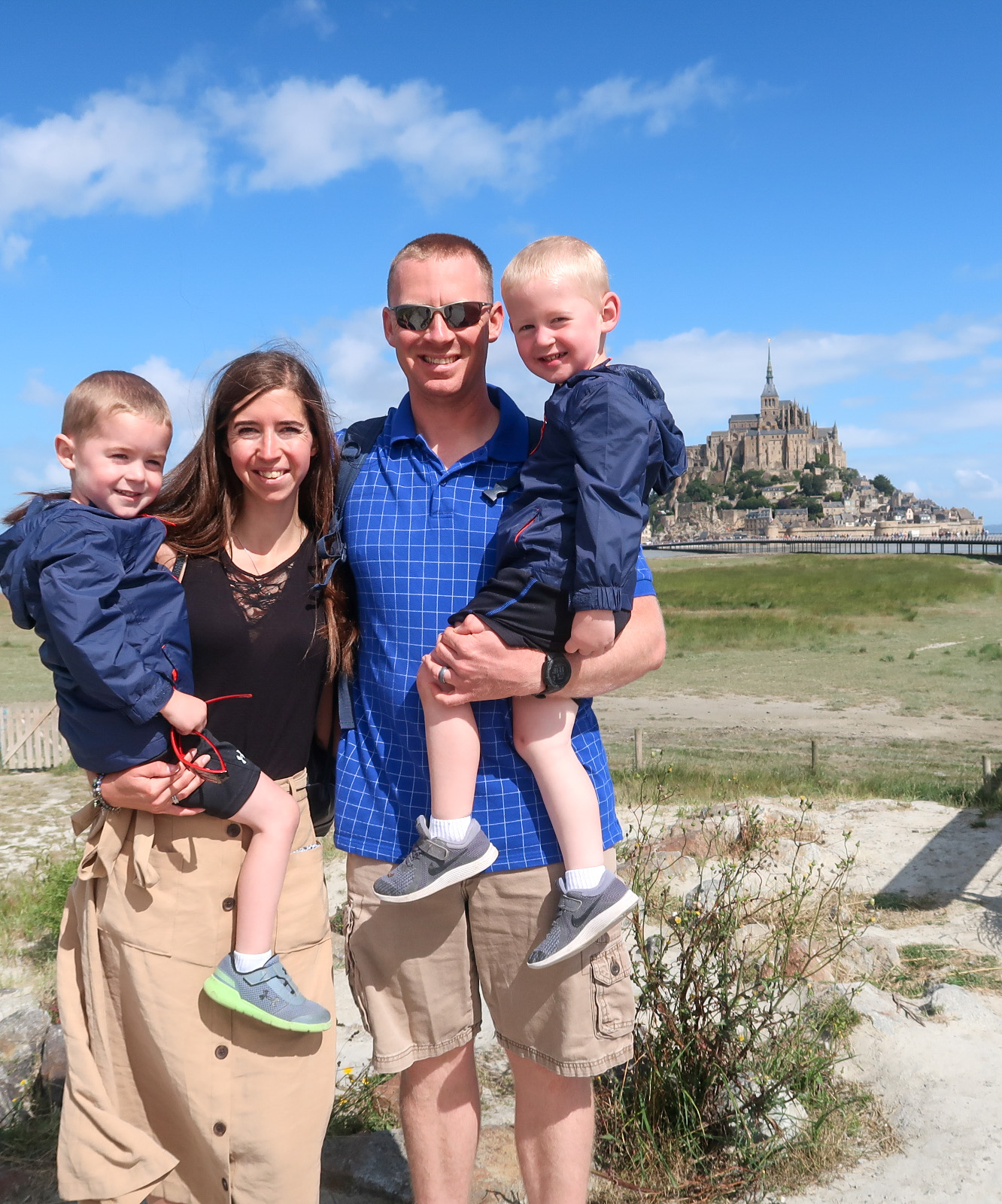
Well, our year started by getting blessed by the Pope at St. Peter’s square and then visiting the Great Roman Synagogue. A good start, no? We started our year off in Rome, which was a place that I hadn’t expected to fall in love with as much as I did (you can read my blog posts HERE, HERE, HERE, and HERE). If there is one place in our travels that I would say, “I thought I would love it, but I didn’t know how much I would love it”, Rome and Italy would be one of those places. The other? Switzerland. BUT, when it comes to Switzerland, I think that could be said for anyone. More on that in a minute. However, Rome wasn’t our only destination in the year 2020. We managed to squeeze in several trips this year due to a lessening of restrictions and safe traveling. We managed to hit a total of 5  additional countries, France (PARIS 1, PARIS 2, MONT SAINT MICHEL, NORMANDY), Luxembourg (HERE), Belgium (BRUSSELS), Switzerland (INTERLAKEN/LAUTERBRUNNEN), and Poland (KRAKOW, AUSCHWITZ). With Switzerland topping all of the lists. There really are no words on the beauty of that area of the world. It is beyond worth the trip and I think everyone should experience it. 

Our year abruptly changed/came to a halt when we got the surprising news that we would be moving back to the United States quite a bit sooner than expected…a whole year sooner! We initially got the news about mid-summer, then finalized the information late Autumn, and determined that our next spot would be in New York. I talked about it briefly in my announcement post (HERE) and I’m sure I will be talking about it once again here soon as our move date approaches. I’m still fairly heartbroken about moving back, but I am trying to stay positive and see the positives (because there are some positives to this).

Once again, our boys have grown…A LOT. I think this year, more than ever, I have keenly felt the passage of time and what things look like with these two proper, independent kids. Colton started preschool (and then promptly stopped…only to start up again virtually and then finally start the new school year in school…only to go back to virtual right before Christmas break hahaha). When I say he is a completely different child from last year, I mean he is a completely different child. His progress reports have shown drastic improvement as he surpasses the goals initially set out. He’s quite the little boy. Andrew has changed quite a bit too…gone is my little angelic little boy who would occasionally get a super serious contemplative expression. He’s been replaced with a temperamental 3-year-old that loves to exploit the rules and then give you a winning sly grin to get out of trouble. He keeps me on my toes between the troublemaker antics and the never-ending stomach room ha-ha. Together they either love or hate and they definitely make life interesting. 

But, watching how much they’ve changed, how much they’ve grown, has been bittersweet. As any parent will tell you, there is a certain sadness when your children start to grow. This year has definitely brought a level of independence for our boys (they can do SO MUCH MORE without us needing to help), which in so many ways has been nice, it has me savoring the moments where they want to snuggle up on the couch or need mommy to kiss something better. 

This year hasn’t been all sunshine and daisies and rainbows. There have been low points as well. We’ve faced a global pandemic that had us here in Germany stuck in our homes. At the height of Spring, we were not allowed to leave our homes save for grocery shopping (and this was JUST groceries, any stores that sold both groceries and home goods, you could only purchase groceries), doctors’ appointments, exercise (to be done by yourself), and for essential work. No seeing friends, seeing family, popping to wander through the aisles of a store, we were all stuck at home. While this had positives, there were also negatives. This was also a time when I learned a…not so pleasant tidbit about myself (which then led to one of my lows of the year).

I love my family. I’ve loved having extra time with my husband, for us all to be together and really soak up the extra minutes we get together. BUT I don’t like noise. I don’t like constant, loud, noise. I.E. The noise that comes when your entire rambunctious family is home with loads of energy and nothing really to do to kill off that energy (sometimes even our long walks did nothing to curb it). The kind of noise that you can’t really escape from, that only ends when everyone goes to bed and you are left alone, exhausted and trying to savor the quiet while also wanting to sleep. The kind of noise that just wears on you, day after day after day. The kind of noise that, as an introvert, I HAVE to break away from just to recharge. So, that was fun to learn…NOT. I spent quite a bit of quarantine trying to figure out how to adjust my own expectations and needs with what the situation presented, so that I could be the positive, more even keeled person. It was a time and while I don’t have the entire thing figured out (I’m mostly still dragging little moments out until I can get to the next one), I do feel a bit better than I did at the beginning. 

Another low point was the murder of George Floyd, Breonna Taylor, and so, so many others that all deserved to have their names spoken over and over and over again. Not to mention justice. This summer was eye opening in so many ways on a civil level and one that I am making sure I continue to learn and educate myself as we move away from the initial “push” of the unrest. There was also an alarming amount of anti-Semitism that popped up in 2020 as well, which is…scary. To be honest, the sheer level of hatred in our country, in our world, is scary. 

In all honesty, I am glad to wave 2020 farewell. It’s been a year of highs and lows and draining. While I don’t think we are going to wake up in 2021 and everything will magically be good, I am kind of looking forward to a new year. To another fresh start. 

Interlaken-Oberhasli District, Switzerland – A Long Weekend

We recently just spent a long weekend in Switzerland. Ok, I need a moment already, just from typing those words. Never in my wildest dreams did I think I would utter that sentence. Never. 

Ok, shock over. We recently spent a long weekend in Switzerland, and it was glorious. Where do I even begin? My husband’s only requirements for the trip was to be able to see/be at the top of the Alps, so we picked a spot right near Interlaken, in the heart of the mountains and lakes. With COVID-19 restrictions we were restricted from traveling to some of the major cities, and we wanted to be a bit…off the way. When a local friend posted about a hotel she stayed at right on Lake Brienz, I knew that was where we needed to be. 

One little, teensy, note to make about Switzerland before we get into the meat of this post. If you know anything or have heard anything about Switzerland it is that it is an expensive place to visit. This is not an exaggeration. You will need to plan accordingly for this visit and budget if you need. There are certainly ways to make it a “cheaper” trip, but it will never be inexpensive. For us, I knew that this was going to up towards the more expensive trips we took on our time here and I was 100% ok with that. It was more important to me that we did what we wanted to do and enjoyed our time without worrying about the cost necessarily. With that being said, there were a couple of things that we DID NOT do, which I will get into later. 

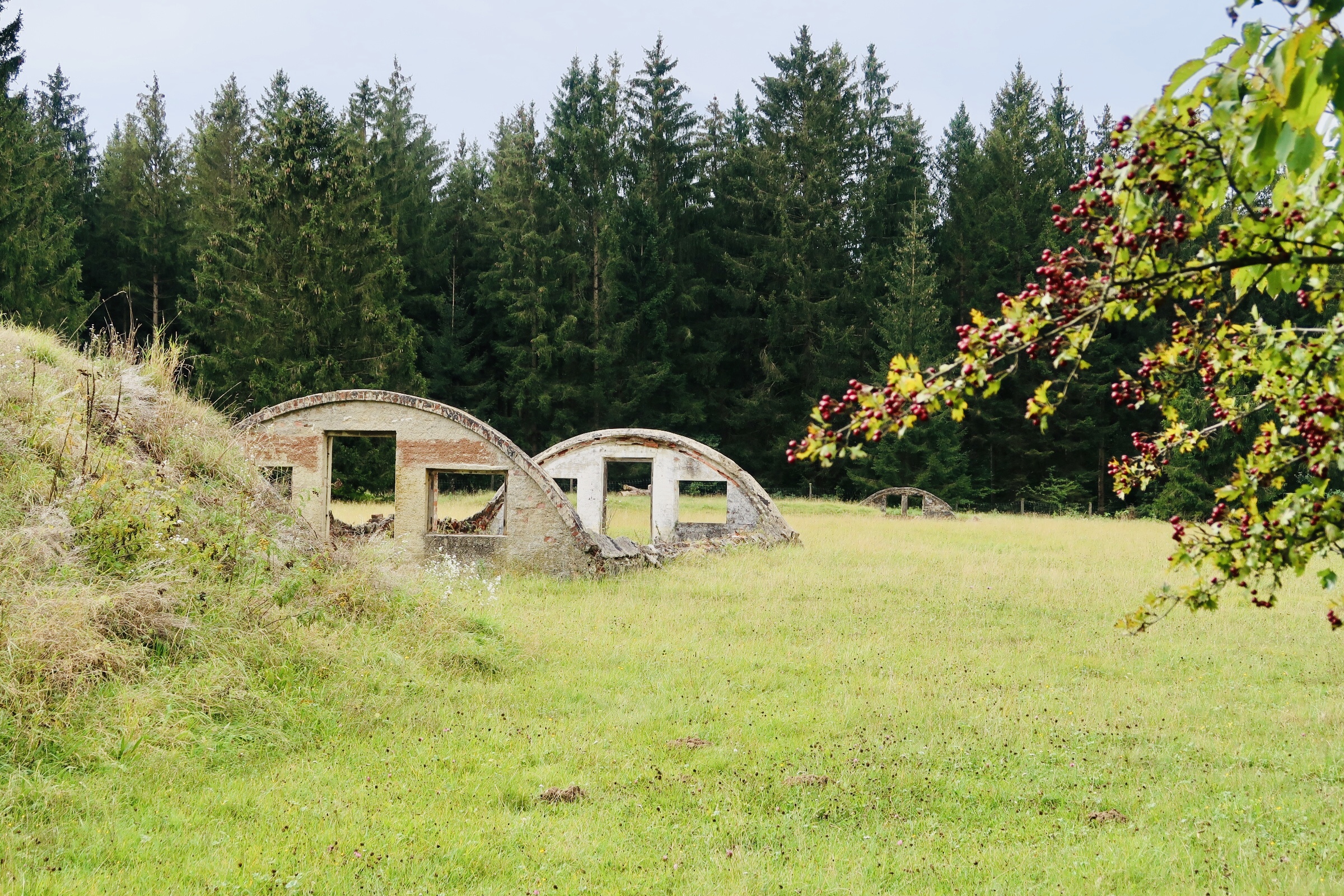
Before we got to Switzerland though, we made a stop at KZ-Lager Kaufering VII. This is a European Holocaust Memorial in Landsberg Germany and is the largest remote area (sub camp) of Dachau Concentration Camp. There was a total of 11 of these sub camps of Dachau and this one has the actual remains of the tube style barracks. In total these camps saw 30,000 prisoners, with at least 14,500 prisoners dying over the time the camp was open. Exact numbers are not known as the records do not match up (one study found upwards of 44,000+). The camps were intended to put prisoners to work on an armament project, without any consideration by the guards for the health and safety of the prisoners. During the war crimes investigation, it was discovered that these sub camps were the worst in Bavaria and the prisoners came to refer to them as “cold crematorias”.     

We were not able to walk inside the camp and see the buildings and cemetery up close, but you could still get a feel from outside the fence. This is the second concentration camp we’ve been to (Dachau Concentration Camp being the first and hopefully a visit to Auschwitz soon) and I will never be able to fully verbalize the experience. So, once again, I will let pictures say what I cannot. 

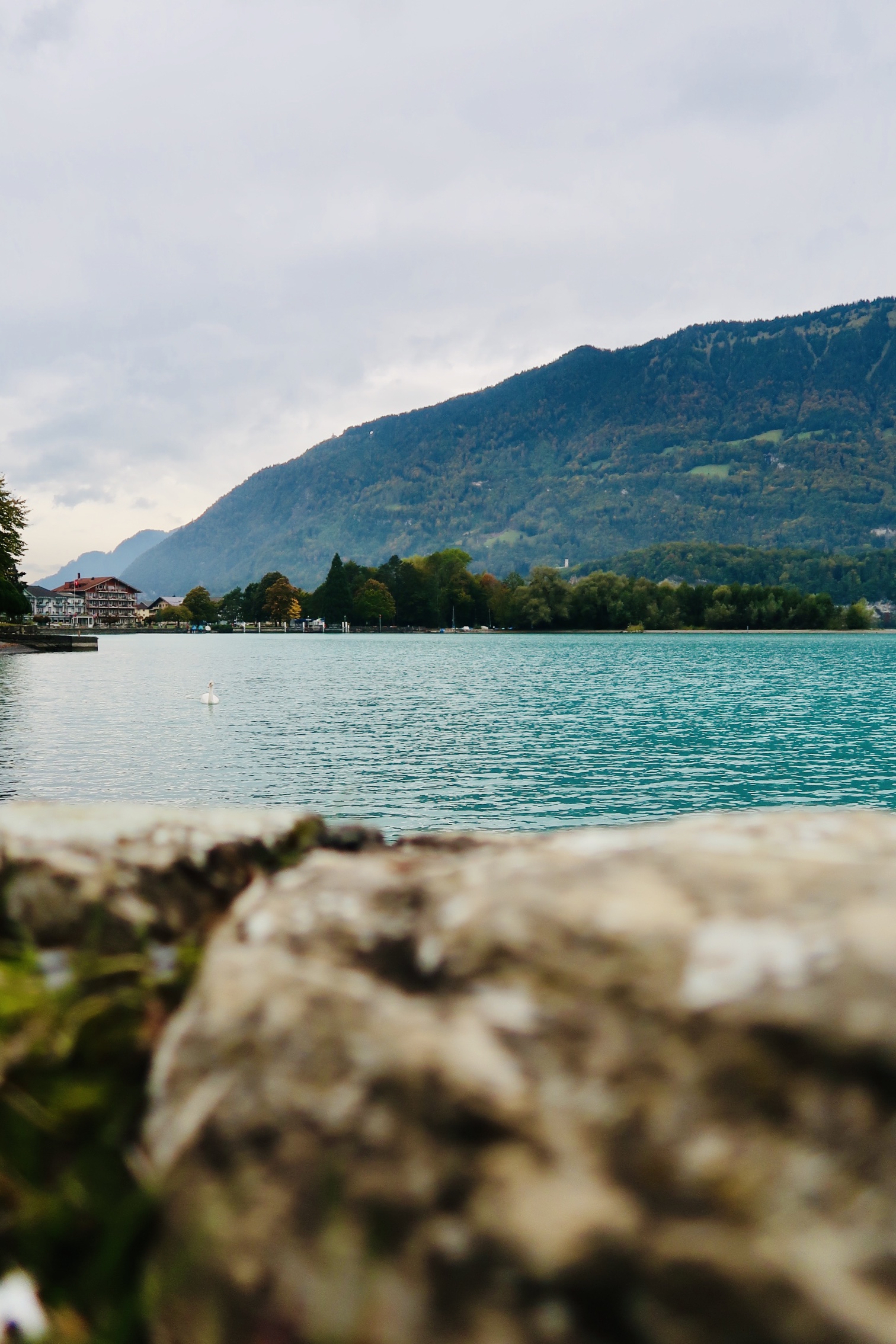
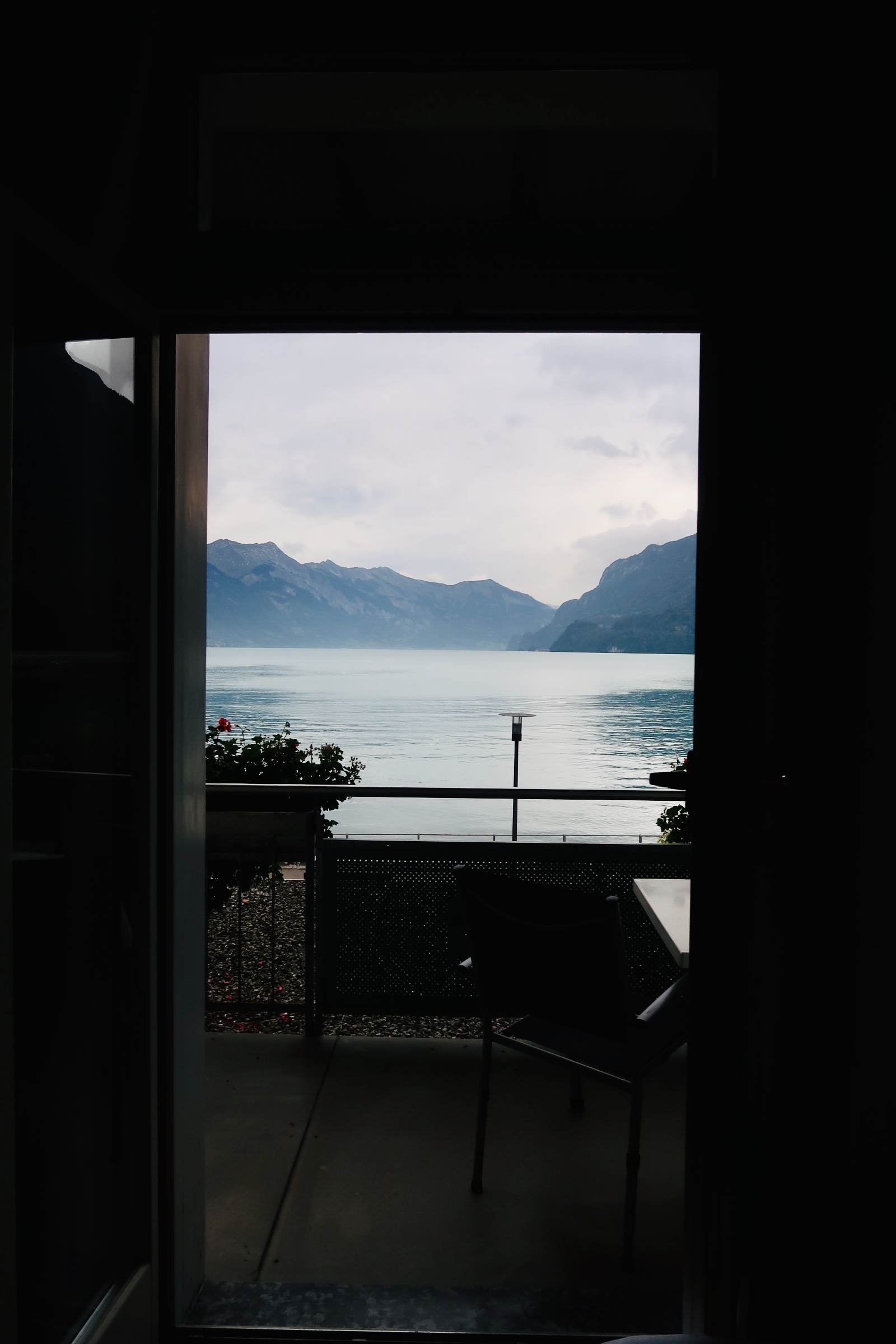
After that, we headed off on our Switzerland Adventure. We stayed at the Hotel Seiler au Lac. Not only is the hotel itself incredible (you can request a lake front room, all of which have balconies looking right out to the water- swoon), but the staff were incredibly helpful and went above and beyond our needs. We opted to have breakfast at the hotel (included), which was handled excellently with COVID restrictions. We did also opt to have dinner at the hotel restaurants (one night at each- two restaurants attached to the hotel), and both meals were delicious. This particular hotel is located in Bonigen, Switzerland, a quick distance away from Interlaken (you can walk or take a bus- passes were offered by the hotel), and only a 20-30 minute drive to either Lauterbrunnen or Grindelwald (Berne is about 45 minutes away if you want to go there as well). 

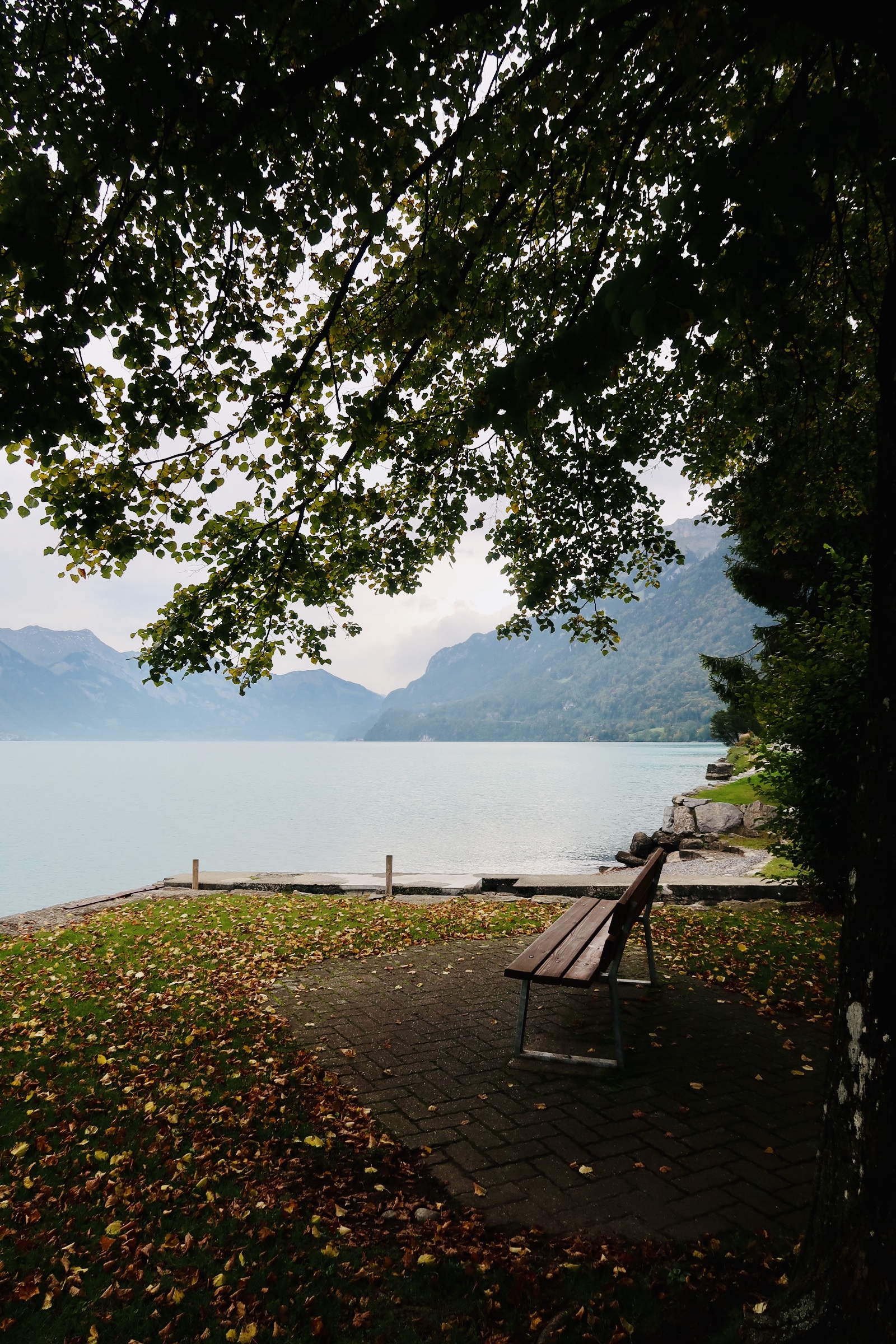
Our first evening was mostly spent wandering around Lake Brienz before settling into our hotel and grabbing dinner at the Pizzeria attached to the hotel. 

We set off late the next morning to head into Interlaken. 

Here is where I am going to clarify some of our choices in activities. There are a couple of things that I base “what we do” on, the biggest factor being the weather. It was a wet and rainy morning in our area of Switzerland, so we knew going to Jungfraujoch (the top of Europe- aka the highest point of Europe) was going to be hit or miss. The second factor, less so than weather, is cost. This is really only specific to Switzerland as things are, generally, more expensive in the country. We made the decision to pass on heading up to Jungfraujoch as the potential for bad weather combined with the cost was not worth it for us. Instead we chose to top some of the smaller peaks, and this was just as incredible as anywhere else we could have stopped. 

So, back to our day. Chances are, if you’ve tried to take a train or summit one (read: many) of the Swiss Alp peaks, then you’ve gone through Interlaken. Not only is Interlaken the central city between Lake Brienz and Lake Thun, but it is also a main transport gateway to the Alps in the region. You’ve got the two lakes, then the River Aare which flows between them (and therefore between the city). There has been a city in this location since the 12th century, but it was originally known as Aarmuhle (changed to Interlaken in 1891). It started out as the home of a convent and monastery, but as it continued to grow, it became a large city. It started to become known as a resort town in the early 19th century, with a railway opening in the 1870’s (and more following in the next 20-30 years). 

We spent most of the rainy morning walking throughout the town seeing all the beauty that is offered in the valley. I think one of the best things to do sometimes is to just walk around the streets. We didn’t have any “set ideas” of spots to see until the weather cleared, so we just walked. We stopped in for a light lunch and during that, the weather started to clear out. Faced with breathtaking blue skies, snowcapped peaks, and a new look at Interlaken, we decided to head up to Harder Kulm. 

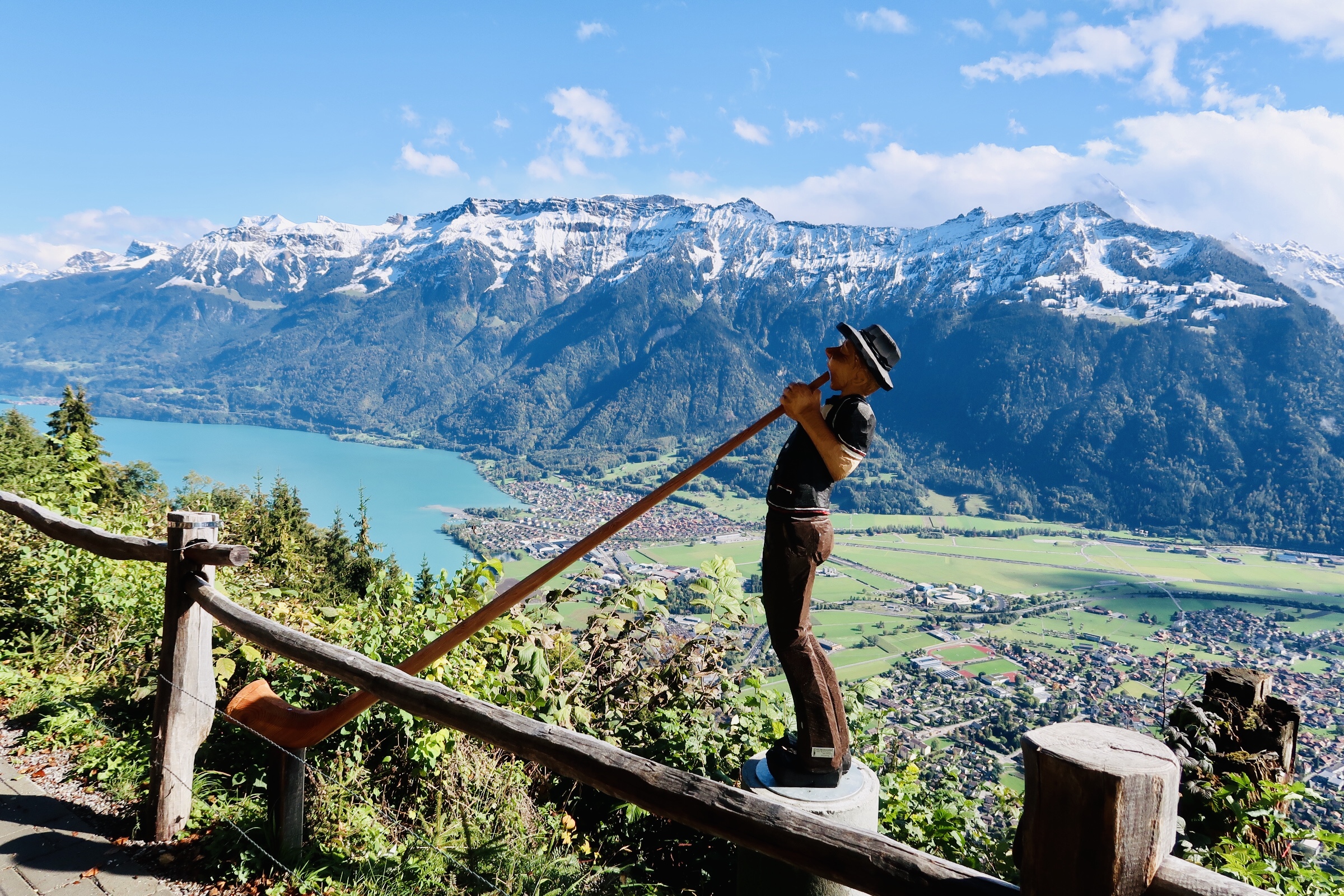
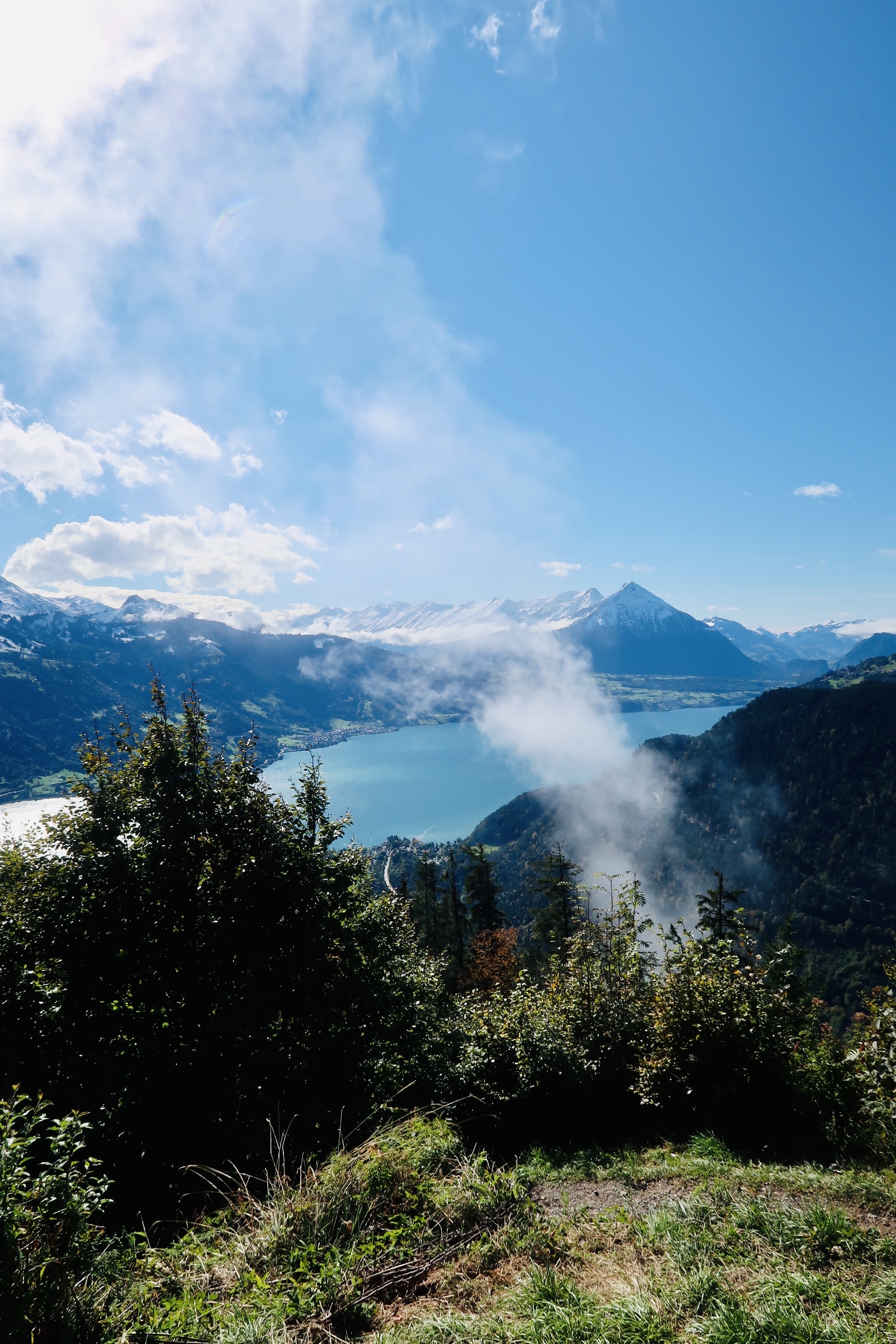
Harder Kulm is the top of Interlaken. Rising 1,322 meters above Sea Level you are able to get an incredible view of Interlaken, the peaks around the city (opposite), as well as the two lakes, Brienz and Thun. There is a viewing platform that you can stand on for a truly breathtaking experience. You don’t even have to worry about hiking up if you don’t want to (though you certainly can), there is a funicular that takes you to the top in just under 10 minutes. You are also able to go up top in the evening, and I believe there is a hotel located right above the restaurant if you would like to stay. 

We finished out the day at an indoor playground for the kids. Most of our travel is not necessarily based on our kids in terms of places we visit (maybe I’ll talk about different traveling styles in a blog post?), but we saw that there was a neat kids play park and we had a bit of time to kill between finishing up in the center of Interlaken and heading to dinner. So, we let the kids go a little wild and run off all the pent-up energy for a little while. They really enjoyed it and it was nice to be able to do something just for them on our trip. 

Our second day we decided to go over to Lauterbrunnen. It was a tough call as to whether we wanted to go to Grindelwald of Lauterbrunnen, you can’t really go wrong with either option, but I wanted to be able to see the waterfalls that Lauterbrunnen is known for. Honestly, I don’t think you could really go wrong with anywhere in this particular region, so explore it all if you can!

Lauterbrunnen as an area is first mentioned in the 13th century, with the name Lauterbrunnen being mentioned in the beginning of the 14th century. It has an early history of battles and rebellion between the villages and the Interlaken Monastery, ending in the 16th century. The villages that make up Lauterbrunnen were actually very poor. The area started out as a mining area, but all of the profits went to the noble families, and the working-class people remained below the poverty line. It got so bad at one point, that most villagers moved away, joining regiments and emigrating to the United States of America (settling in the Carolinas). At the end of the 18th century, Lauterbrunnen started to gain more traction when mount climbers would start expeditions in the town, and once the road was built from Interlaken to Lauterbrunnen, tourism exploded. Lauterbrunnen has inspired many a writer and film maker (with Goethe and Tolkien both referencing it in their own works, and the 1969 On Her Majesties Secret Service being filmed in the city). 

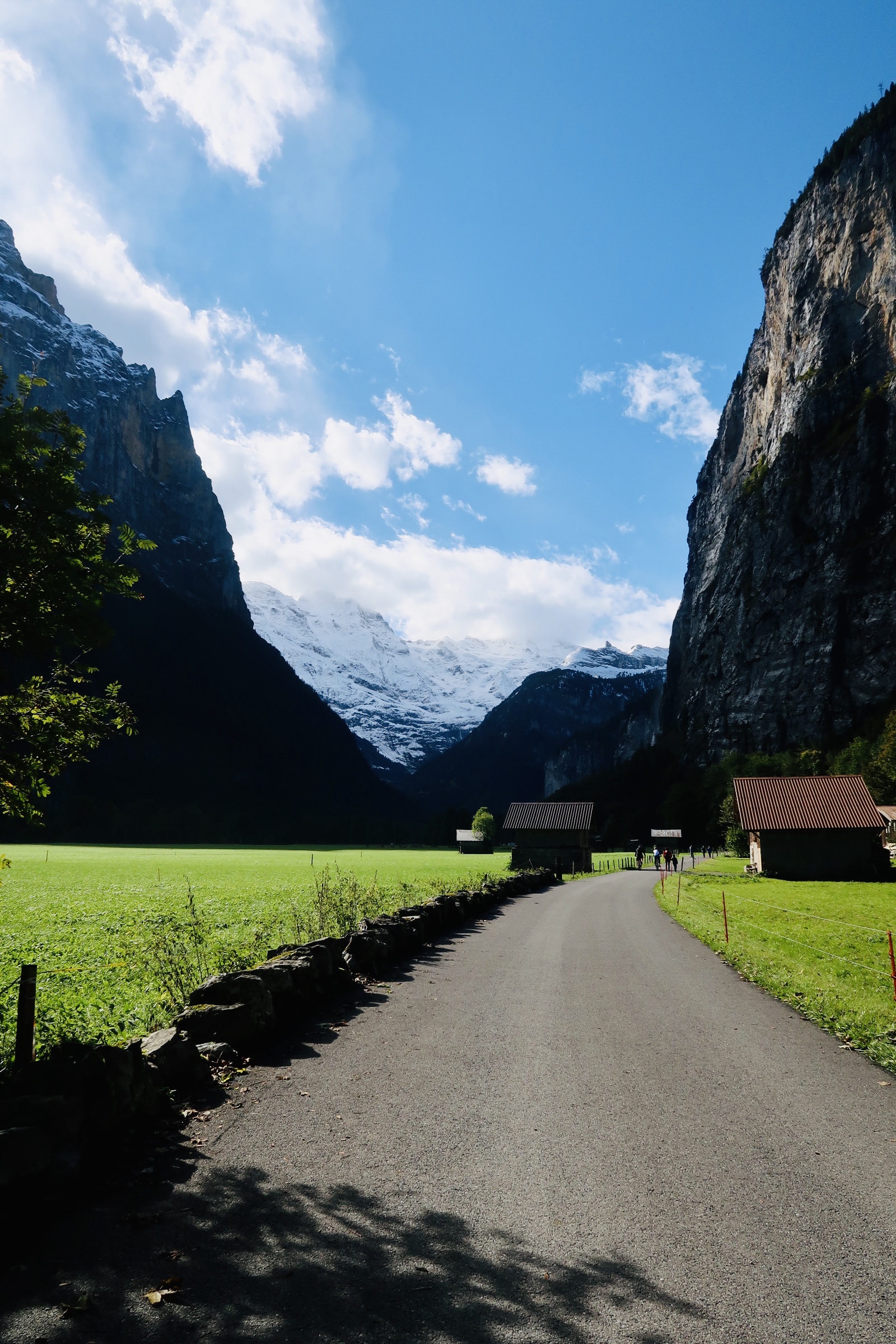
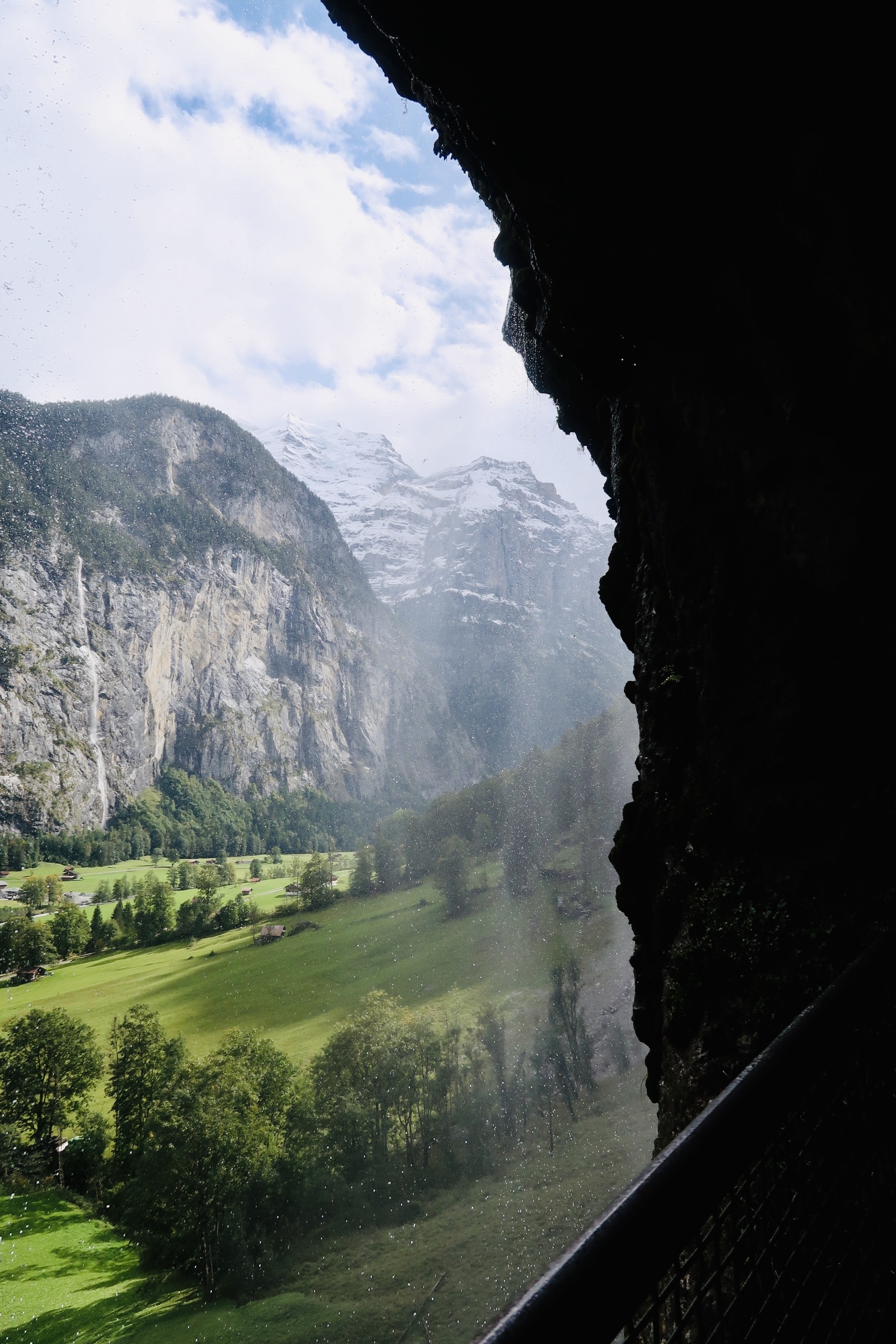
Lauterbrunnen is really known for its waterfalls and mountain peaks. It is one of the largest nature conservation areas in Switzerland and easily one of the prettiest spots we’ve ever visited. The valley is home to 72 waterfalls, the largest being Staubbach Falls which are one of the highest free-falling waterfalls. Another set that you can visit up close are Trummelbach Falls, which are a natural waterfall phenomena situation behind the rock face. 

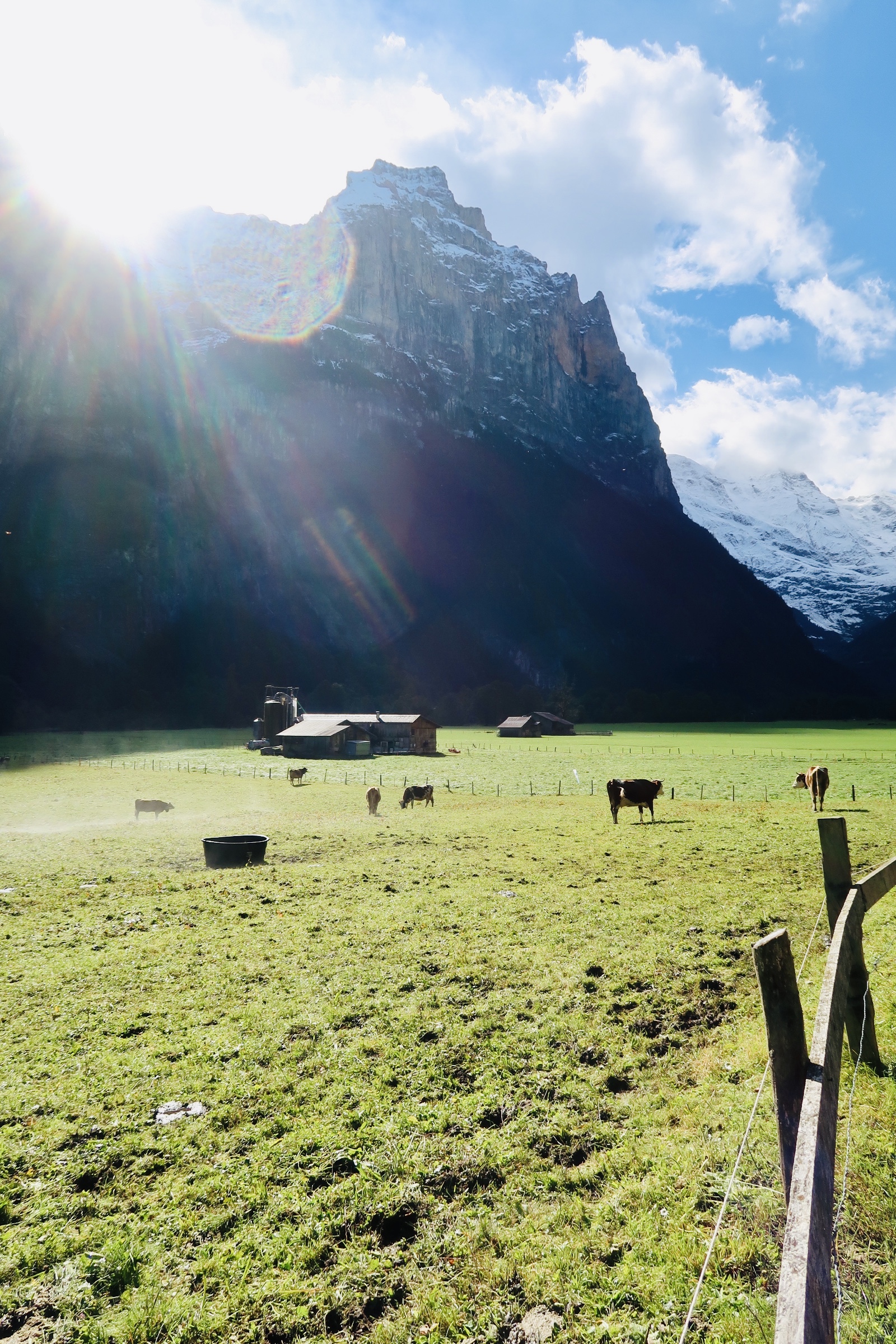
We started the morning off hiking through the valley to get to Trummelbach Falls. You are able to park right at the waterfalls if you’d like. HOWEVER, I would highly recommend parking in one of the bigger “in town” parking lots and then walking through the valley to the falls. It was an incredible semi sunrise hike (it definitely wasn’t sunrise, but the light still hadn’t reached in to the valley when we started walking) and you see so many more of the waterfalls this way, as well as get the chance to see some of the local cattle life and ranchers (we got to see a minutes old baby cow on our way back from the falls as well as buy local cheese from a little self-service booth). It’s all flat ground and we really loved being able to soak in all of the natural beauty. 

So, we started at our furthest out point, Trummelbach Falls.

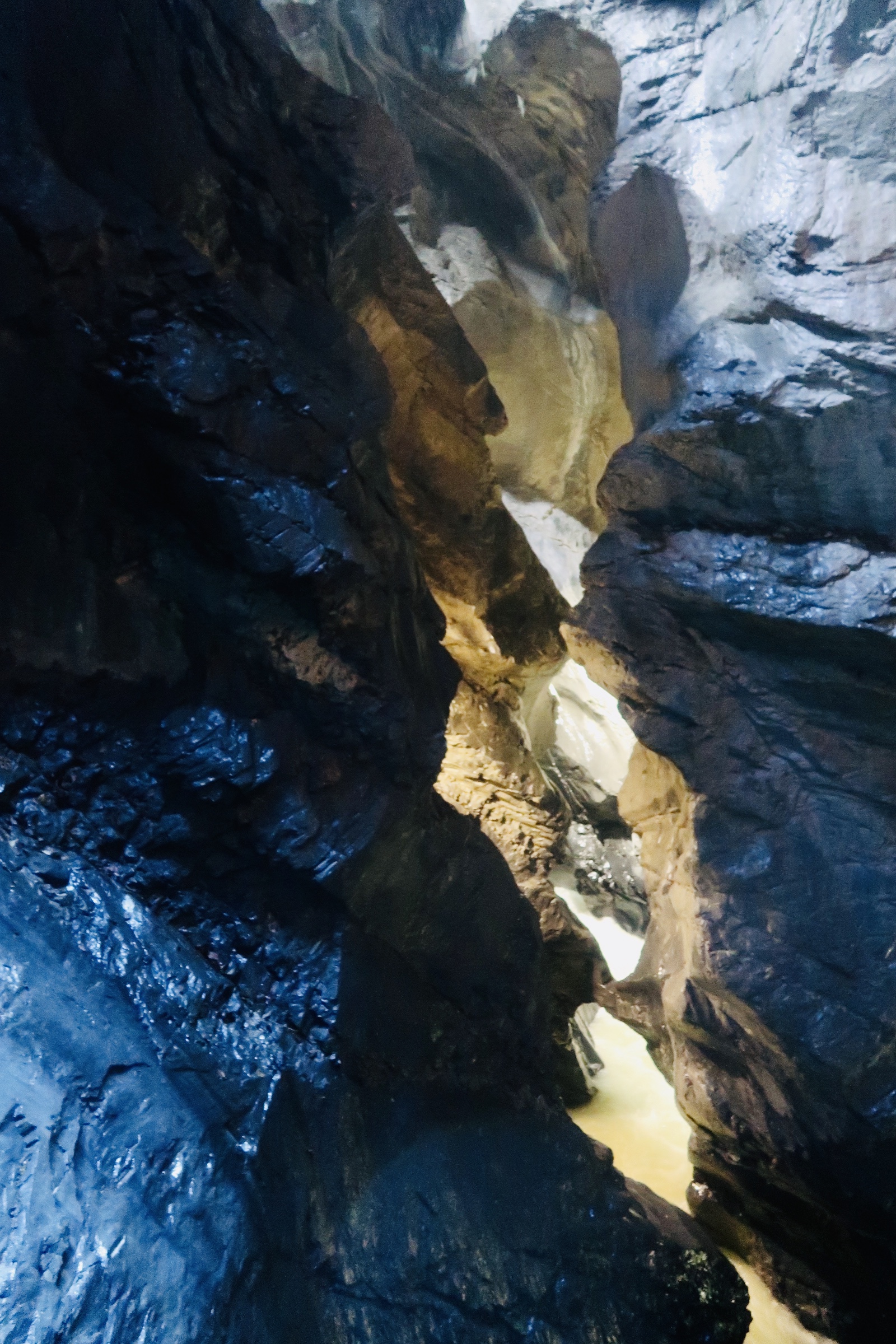
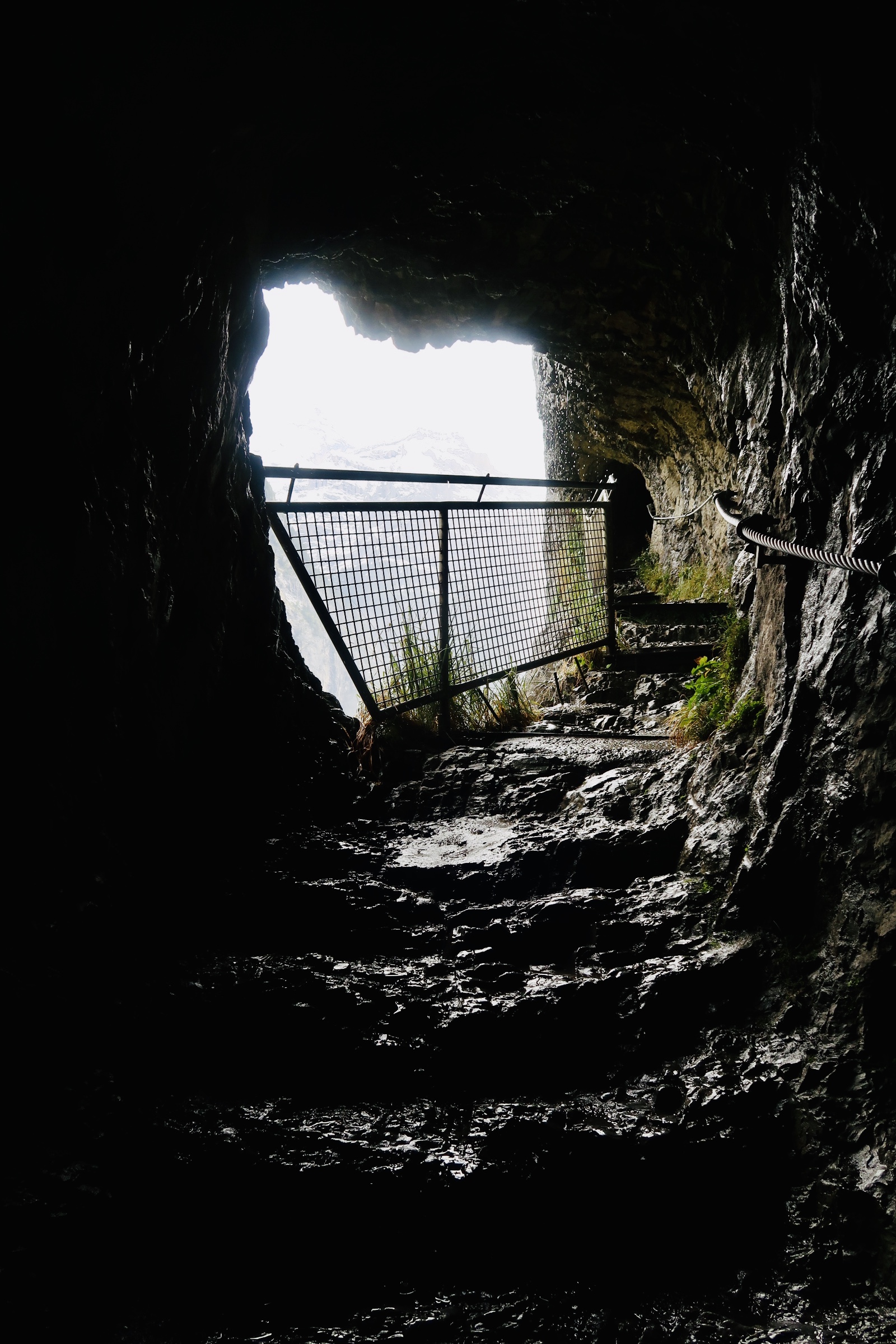
Trummelbach Falls are the largest subterranean water falls in Europe and can carry up to 20,000 tons of meltwater from the glaciers of Jungfrau. They are incredibly loud (thundering loud), cause the mountain to almost tremble at the power, and are the most incredible thing mother nature does. If you’ve read my Garmisch-Partenkirchen post, you’ll recognize a pattern of water going through rocks makes me just swoon and feel overwhelmed with amazement, and Trummelbach Falls was no different. We were lucky with our timing as we were able to see all 10 chutes of the falls (at a total height of 200 meters), whereas during certain times of year you are only able to see the top chutes. They do not recommend this activity for younger children (in fact they don’t typically allow children under the age of 4 in) and I would be careful walking through the paths- it can get very slippery. 

From there, we walked back towards town with a stop at Staubbach Falls.

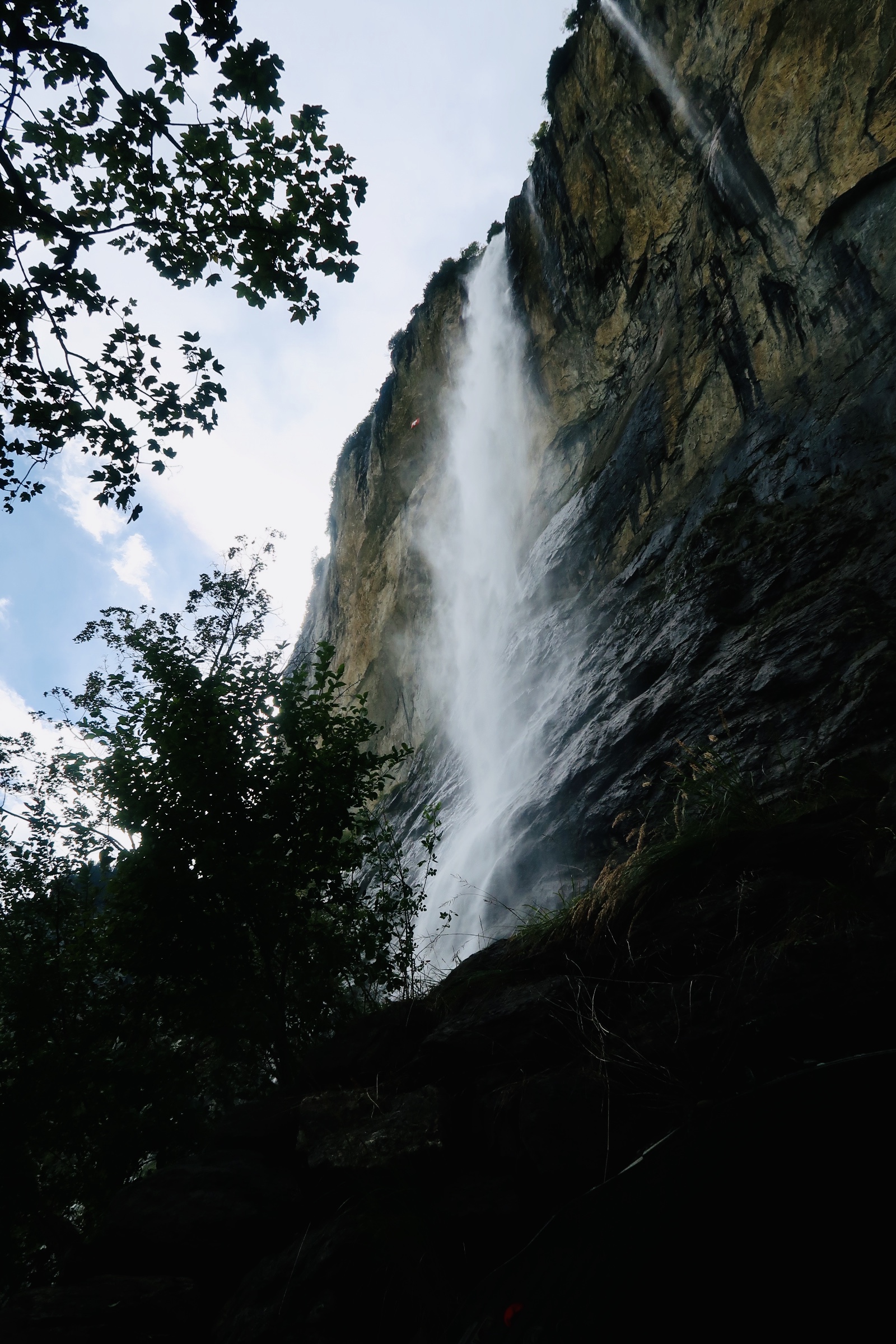
Staubbach Falls has a height of almost 300 meters (297 to be exact) and , in addition to being the highest in Europe, are the most famous of the waterfalls in Lauterbrunnen. The waterfall inspired Goethe’s poem, Song of the Spirits over the Waters and disperses water as if it were dust. You are able to climb a portion of the rockface to be “under” the waterfall; HOWEVER, I would not recommend this for young kids. I was the only one who went up the rockface and, once I reached the end, was glad my boys did not head up. It is a really cool experience though, and if you can, I would recommend it for adults.

The entire valley is one for the nature lovers and reminded us just how incredible the world around us really is. So much beauty and a place I’m glad we spent a whole day in. 

From the falls, we decided to head up the mountain towards Murren. From the base of Lauterbrunnen you are able to take a gondola up the mountain to Schilthorn, then either hike or board a train towards Murren. We chose the train (much to the boy’s excitement) and were treated to a narrow-gauge railway and breathtaking views.

Murren is a traditional mountain village at 1,638 meters above sea level. From Murren you are able to see Eiger, Monch, and Jungfrau mountains around you. I think this is a great alternative, if you just want to get up in the mountains, but don’t necessarily want to do the Jungfraujoch. There is an element of “off the beaten path” and an actual look at what life is like up in the alps, even though during the summer this is one of the more popular alps spots.  

We finished out our day in Lauterbrunnen with a hot chocolate made in a local coffee shop before heading back to our hotel and our dinner reservation. 

And that wraps up our long weekend in Switzerland! Easily one of the most incredible places we’ve visited, and it definitely makes my top 4 places we’ve traveled. I’ve used a lot of words in this post (2319 at this point to be exact), but none really can come close to what this region was like. 

A Cuppa Cosy Summer Holiday 2020- Cochem

Our last stop on our Summer Holiday was back in Germany in a small town called Cochem. This is the weird part of the blog posts as I am going to do a general blog post today on Cochem and the couple of things that we did, but one of our reasons for stopping in Cochem, was its vicinity to a couple of castles we wanted to see. I’ll be giving full details on the castle’s in separate blog posts, but wanted to get this last stop blog post out for you. We really enjoyed the time we spent in Cochem (2 nights) and it really solidified how much we’ve fallen in love with Germany (which I’ll talk about at some other time). Regardless, after leaving Belgium, we crossed the border back into Germany and headed straight over to Cochem. 

Cochem is a small town (total population ~5300) on the Moselle River.

It has had settlements from the 1stcentury onwards, was an Imperial estate in the 13th century, and was granted town rights in the early 14thcentury. It’s been under the rule of Germany, France, and Prussia. During World War 2 there was an underground subcamp of the Natzweiler Concentration Camp with 13,000 prisoners at its height. It’s important to note that Cochem is located along the Mosel River which happens to be an area of Germany that produces, and is known for, wine. German Wine is typically a Riesling wine as that is the most widely planted grape, although they do produce a variety of white wines. (Luckily for me- I love a good Riesling so I was in the very right place ha-ha). 

The first place we stopped at, the minute we arrived in Cochem, was the Reichsburg Cochem, or Cochem Imperial Castle. As I said, I’ll be doing a whole separate post on Cochem Imperial Castle, but I’ll include a brief overview here as well.

Reichsburg Cochem dates back to around the 12th century when it was occupied and declared an Imperial Castle. In the 17th century the French King Louis XIV overran it and then destroyed it. In the 19th century a businessmen from Berlin purchased in and then reconstructed it. It is now owned by the town of Cochem. After a tour of the interior, we headed to our hotel and over to dinner. We stayed at Hotel Zenthof which was another perfect spot, right off the main bridge connecting the two sides of the river, and a view of the castle out the front. We had dinner right on the waterfront and watched the sunset with a lovely glass of Riesling for myself and a beer for my husband (this is the aforementioned moment where we just realized how perfect Germany has been for us). 

The next morning, we were up and off early (only stopping at a local supermarket to pick up some pastries for breakfast) to head over to our second castle, Burg Eltz.

Again, a full dedicated blog post is coming, but this is a medieval castle located in the heart of the hills above the Moselle River.  First dating back to the 12th century, this particular castle is still owned by the same family that lived there at that time (it was actually 4 families and quite an interesting tour!). We had the dreamiest morning walking along its walls and corridors. 

From there we went to do a little…adrenaline push. In Hunsruck there is a 360-meter suspension bridge (its height is 100 meters up) that you are able to walk across. The Geierlay Suspension Bridge was first suggested in 2006 and rejected, then re suggested in 2010 for a second look.

Modeled after the Nepalese suspension bridges (which means that it is “unstiffened”), construction started in 2015 (record time as the bridge opened 130 days later), and the bridge was inaugurated at the beginning of October of the same year. The bridge itself has a layer of local Douglas fir that you are actually walking on as you walk across the bridge.  Finally, the name was picked after an open competition and refers to the land and history of the area of the bridge.  The bridge itself is center to several hiking and biking spots, so you can definitely combine a hike with crossing the bridge.

Honestly, I am terrified of heights. Well, I mean really I suppose I am more terrified of falling, rather than heights, but the two go hand in hand. So, the idea of walking across this suspension bridge that moves with every movement (even more so in some areas than others) was not…appealing. As always, while I was on it I just stepped one foot in front of the other and just focused on that. I did, from time to time, look up to take in the absolute beauty that was around me, but on the whole it was an accomplishment to make it to other side breathing normally for me. And once I got to the other side? I felt like a bad ass ha-ha.

We decided to hike our way back to the car, rather than walk back across the bridge (this would have actually been preferrable, but my older son wasn’t keen on walking back across the bridge). The hike itself is gorgeous, taking you down into the valley before up the mountain side. It’s not a terrible hike, although I would recommend wearing comfortable shoes. 

A few things to note about the bridge currently (during Covid-19)- in order to maintain the appropriate health precautions, they are restricting movement on the bridge. This means that during the heightened visitor time (11-5 I think) they only allow foot traffic one way each hour. So odd hours going from one side, even from the other. This meant that we waited in line for about 2 hours to just make one pass on the bridge. One side is easily more packed than the other (as it would be) and the line wasn’t the most socially distanced it could have been. However, they grouped people together in groups of 10 or so that they would release on the bridge at a time, so it wasn’t a massive amount of people walking through at a time.  If you are going to go, I would recommend going outside of the popular visitor hours (I would recommend this regardless though). For example, I am looking at the webcam as I am writing this (10:26AM German time on a weekday) and there is hardly anyone on the bridge at this time. No lines, no crowds. 

And that wrapped up both our time in Cochem AND our Summer Holiday! What was your favorite stop? To recap on our entire Summer Holiday (or if you missed any) you can go along with us to LUXEMBOURG, PARIS (1 & 2), MONT-SAINT-MICHEL, NORMANDY, and BELGIUM. 

A Cuppa Cosy Summer Holiday 2020 – Mont-Saint-Michel Abbey

I’m going to start our time in the Normandy Region off with our visit to the Mont-Saint-Michel Abbey. It wasn’t the first thing we did, BUT it was one (in a long list) of the most incredible things we visited. Our entire time in Normandy was full of incredible places, both in happy and heartbreaking times. 

Untitled Design 68

I’ll be honest- I’m going to give a brief rundown of the history of the abbey, a short breakdown of our visit, but I’m mostly going to just let the pictures speak for themselves in this post. It’s safe to say that this was hands down my favorite place we saw on our entire summer holiday. A place that I’ve heard about so many times, is featured on so many bucket lists, a place that you can only dream about, and a place that I can now say that I’ve been to and it doesn’t disappoint. 

Mont-Saint-Michel dates back to the 1st century (708 to be exact) when a bishop had a sanctuary built on the Mont-Tombe. This mount soon became a sacred point of pilgrimage and in the 10th century a group of Benedictines settled in the abbey. The village outside the abbey grew larger until it reached the edges of the rock island it is located on. Of course, the abbey hasn’t only been used as a religious spot, it was also used as a prison the in the 19th century. During that time, it was known as the “Bastille of the sea”. Finally, in 1874 it was classified as a historic monument and restoration work was able to begin. Restoration work is regularly done to continue to keep the abbey in the state it would have been during the Middle Ages and in 1979 it became the first property in France to be added to the UNESCO World Heritage Site list. The abbey is still, of course, in active use today as a religious site. 
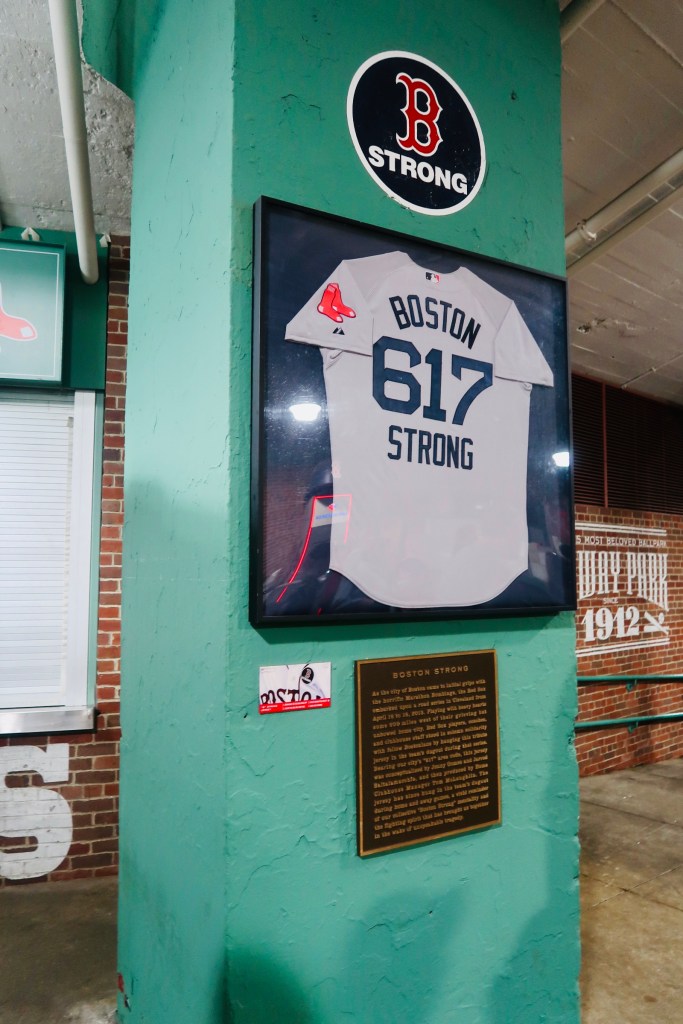
 

An interesting note to make about the architecture (before I get into our visit) is that the concept of the abbey had to be somewhat redesigned to accommodate the pyramid nature of the rock. This makes it entirely unique; unlike any other monastery. The church stands on various crypts and a platform so that the church itself doesn’t collapse. The concept applied in order to make sure the entire abbey stood and stayed were relatively new and unheard of at the time as it met both the constraints for the monks as well as the constraints placed by the land itself. Walking through the tour you are able to see how this was done and where various platforms and load bearing spots are. 
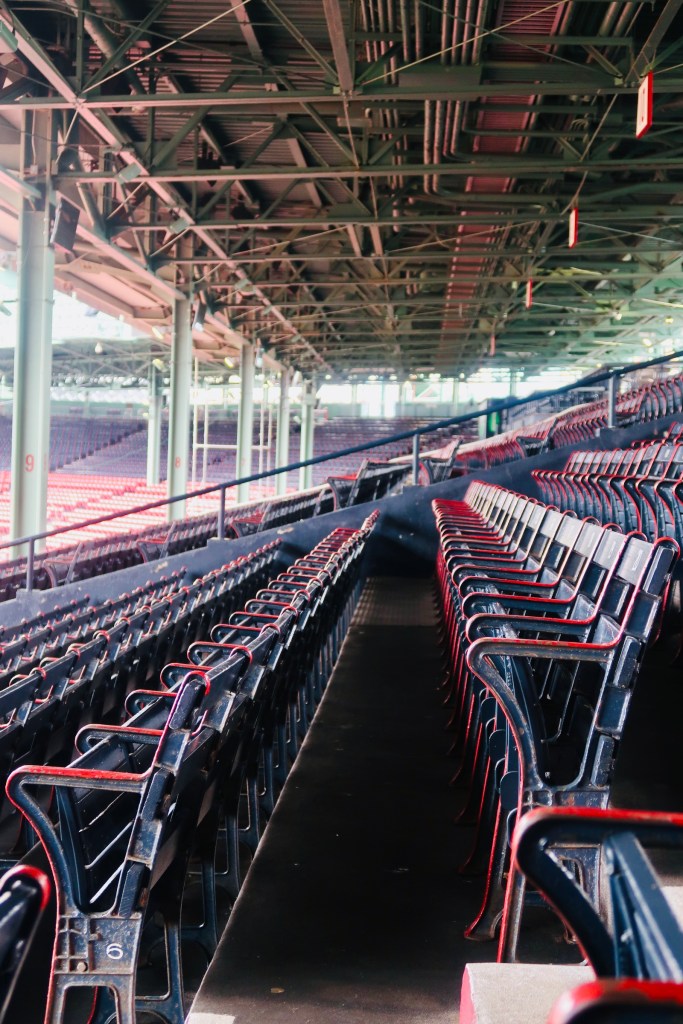
Like I’ve already mentioned, I think this was one of the spots that I was most in awe and will never forget (like most of the Normandy portion of our trip). From walking the path to the bridge to cross the water, to walking through the tight alleyways with the shops and restaurants out to get your business (it’s not nearly as sinister as it sounds- promise), climbing up the rock until it opens up to the abbey itself was a memorable experience. The view from the uppermost point is the most incredible view, you really get the sense of isolation it could have been (as – at the time – it was only accessible at low tide). The abbey itself is an incredible feat. The architecture aside, the sheer beauty of the church, the intertangling yet separation of the various spots within the abbey was really neat to see. You are also able to see one spot that is an homage to the buildings use as a prison. 

IMG_7171 3

To be honest, we spent way too long contemplating if we would actually go. It was one of those situations where we would probably not ever get *this close* again, but it was just a bit too far. We didn’t know how long we would spend there and it was across the peninsula from us. The morning we decided to go it was a spur of the moment let’s just do it and have no regrets…and I’ll be honest- it was well worth it. The drive to the abbey is gorgeous, meandering through the French countryside and then along the shoreline leading up. The parking wasn’t bad at all (we did get there early thought), and the crowds were less than what I was expecting (but still more than we had seen previous). We only stayed for a couple hours at most before heading out, but those were hours very well spent. 


In terms of Covid and general tips…

I would purchase your ticket online, park, and then walk the path to the Abbey rather than take the bus (take the bus after your visit). The walk isn’t long and it’s stunning to see the rocky island get larger and larger in front of you as you get closer. We went mid-morning (our tour was around 11:30-45 I believe) and it wasn’t that bad. The shops are fun to look into and walking through all the little back alleys was neat. You get a real gist of what it would have been like to live there. They do require masks at all times once you enter in the abbey and the tour is, as many others, a very strict one-way tour. There is also an option to rent a room and stay overnight on the island (which I kind of wish we had done, but it’s totally ok). If you choose to just go for a day, I would plan on spending a few hours on the actual island.