Lidice – An Important {1/2} Day Trip

On our way from the beautiful, quaint, relaxing Karlovy Vary to the full of life, architecture, and history Prague, we made a very important stop. We stopped at a little town called Lidice. Never heard of it? You probably haven’t as it was completely wiped out, silently, during World War 2. The survivors of the town and their families, along with others, have worked hard to create a memorial and share the story of this unjust act. There isn’t much to see, as everything was wiped out, BUT it is an important stop, the memorials are incredible, and the history is so important.

IMG_1815

To know the town of Lidice, you need to know a little bit about Operation Anthropoid as everything stems from this operation. I am going to make the information about the Operation as brief as possible, but just know that I am summarizing A LOT. As with any war, battle, or really any major history, there is A LOT more that is going on. If there is anything I have learned about this particular spot is just how interconnected everything can really be.

So, Operation Anthropoid was the assassination of Reinhard Heydrich. Reinhard Heydrich was an incredibly high-ranking Nazi Official, instrumental in Hitler’s rise, was in charge of the “Final Solution to the Jewish Question”, and was given the Protectorate of Bohemia and Moravia. At the time of his assassination he was living just outside of central Prague. The Czechoslovakians took charge of the operation with the approval of their own government. This assassination is the only government approved high ranking Nazi assassination in World War 2. The assassination occurred on May 27, 1942 in Prague, with Reinhard Heydrich dying from his injuries in early June.

So, how does the above lead to an entire village being wiped away? Well, after Reinhard Heydrich died there were reprisals. False Intelligence linked the two assassins to hiding out in Lidice as well as the town hiding resistance officers in general. Hitler and Heimler met and determined the way forward to make those who may have helped Reinhard Heydrich’s killers pay: The men would be executed immediately, the women would be sent away immediately to a concentration camp, the children would be divided up into those who could pass as German and those who could not (with those who could not being sent away- the words used are “bring the rest of the children up in other ways”), and the village would be burned to the ground, completely leveled.

The Nazi’s surrounded the village so no one could escape, and the massacre began. As in the proclamation, the men were rounded up and shot early in the morning at one of the barns. The Nazi’s had collected mattresses from the houses near the barn to place against the barn to prevent ricochets.

IMG_1813
The barn where the men were executed

173 men dead. The 11 men who were not in the village at that time were sought out, arrested and executed. Only 3 men survived and of the 3, only 1 was actually in Czechoslovakia at the time of the massacre. He was in prison at the time of the massacre for something completely unrelated and didn’t hear about it until after he had been released (after hearing about it, he tried to turn himself in out of sheer heartbreak, but the SS did nothing and he survived the rest of the war).

The women, 203, and children, 105, were held in the village school and then to another nearby school for 3 days. The pregnant women were taken to hospital and forced to have abortions and then went on to concentration camps. 184 women were loaded on to trucks to go to Ravensbruck. Some of the women survived the war (I am not sure the exact number). 88 children were sent to a former textile factory where they received minimal care and were looked over to determine which would pass for German. 7 children were chosen to be fostered into German SS families. The rest were sent to Chelmno extermination camp. Out of the 105 children, 17 returned home.

Untitled Design 17

Any animals in the village were killed prior to the destruction of the village itself. Before setting the village on fire and using explosives to further destroy any buildings, the Germans looted everything. They went through the houses and dug up the dead to search for anything of value. After the village was destroyed, the Germans sent in workers to do a final removal of any signs that the village was in fact there, which included re-routing the stream and roads and planting crops.

This was not the only village, another nearby village, Ležáky, was given the same treatment after a radio transmitter was found there.

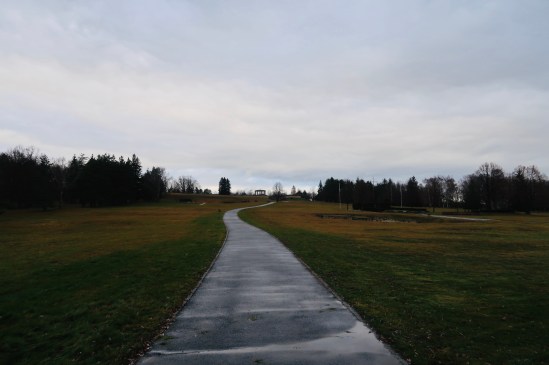
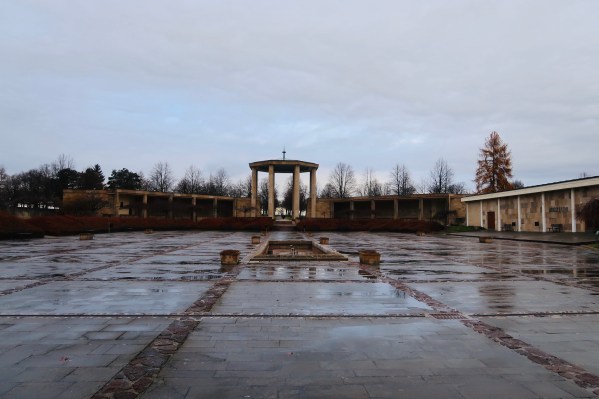
While the Nazi’s extolled the great destruction, the rest of the world started raising funds to rebuild the village and some cities renamed to include Lidice in their names. Movies, books, poems, and artwork were all created out of the response to the massacre and a new village was created overlooking the destroyed one. The two villages are connected by a street lined with trees. There have been various memorials added throughout the years, including the incredible children’s sculpture.

IMG_1797

Up until this point I have tried to give just the facts and the photo’s (similar to my post on Dachau Concentration Camp) as I believe those two items speak for themselves. But, the more I’ve been visiting these spots, the more I’ve been doing research into these spots, the more I’ve been learning, the more I’ve realized just HOW MUCH there was to World War 2 that we just don’t know or talk about, the more I don’t think I can keep my opinions out of these posts. My mind just goes racing with all these random thoughts, my heart breaks for the heaviness, the loss of life, and that’s not even mentioning what it feels like to walk through these spaces. Dachau Concentration Camp was incredibly difficult, Nuremberg Courthouse was incredibly difficult, Lidice was incredibly difficult. These are important, heartbreaking, impactful spots and I can’t even begin to articulate what visiting them feels like. Those are big feelings that don’t really have words.

What I will share are some of the things that just stick in my mind. That flabbergast me. That break my heart. That make me just stop. That make me go “WTF”. If you want to stick with the facts and such, I completely understand. If I ever insert these bits into a post, they will always be at the end, with some sort of warning ahead of time. Feel free to stop reading at that point, BUT please read up until that point. These are important places and important moments for all of us to learn about.

So…

The first bit I want to touch on is the wording that was used in the proclamation about making all those who were guilty pay in regard to the children. Here’s the specific wording:

Gather the children suitable for Germanisation, then place them in SS families in the Reich and bring the rest of the children up in other ways

“Bring the rest of the children up in other ways” is a very coded way of saying- execute them. This wording that is used just sticks in my mind. What a pretty way of conveying something so beyond horrific. I cannot get passed it. And that’s not even getting into the whole concept of them picking and choosing children who would live and die. I cannot even fathom, let alone discuss.

The second bit that I want to touch on is the lengths that they want to to ensure that everything and everyone was dead or gone. No survivors. To seek out those who weren’t even in the village at the time, who were away for whatever reason and kill them too…again, my mind can’t process that. All, except the one survivor who was in prison on something unrelated. They went to such lengths to prove some point? Again, not even getting into the fact that this was unverified intelligence. It’s just…

There is so much more I could touch on, the abortions, the separating moms and children, the murdering of the children, the digging up of bodies to loot, the killing of the animals, THE IDEA THAT AFTER EVERYTHING, THEY NEEDED TO JUST TRIPLE MAKE SURE IT WAS GONE SO THEY PLANTED CROPS OVER EVERYTHING AND RE ROUTED ROADS AND STREAMS. I mean, I keep saying my mind cannot process this, but it’s true…I cannot wrap my mind around this.

That was our stop in Lidice. Lidice was a place that I didn’t know much about going into World War 2 and it has definitely taught me a couple lessons.

Karlovy Vary – A Day Trip

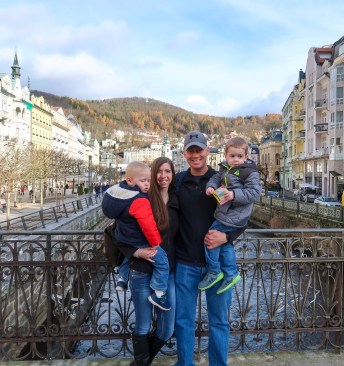
IMG_1651This year we decided to go away for our Thanksgiving Weekend and do a trip to the Czech Republic. We stopped at a total of three locations and I’ll be doing a blog post on each location and a Recommendations/Tips post for Prague. With that little tidbit of business out of the way, let’s get into our first stop!

We spent Thanksgiving Day in a small little town called Karlovy Vary. Karlovy Vary is the most visited spa town in the Czech Republic containing 13 main springs and 300 smaller springs coming from the Teplá River. Charles IV founded the city in the late 1300’s and quickly shared high praises to the “healing powers” of the hot springs. This led to Karlovy Vary becoming incredibly popular and growing in size.

There isn’t a lot to the history of Karlovy Vary as it seems to have stayed out of all the major conflicts and just been a little escape area, so I’ll share some fun facts that I’ve learned…

IMG_1673

Karlovy Vary is home to two funiculars; the Imperial Funicular which is the oldest in Europe and one of the steepest in the Czech Republic and the funicular to Diana’s Tower.

Karlovy Vary is also quite popular in the film industry with several movies having been filmed there OR being the inspiration for backdrops/sets. They also host the Karlovy Vary Film Festival which is one of the oldest film festivals in the world and one of the more popular ones in Europe.

Karlovy Vary also boasts of some famous residents and visitors over the years. Apparently both Beethoven and Goethe visited frequently and would take walks along the colonnades and rivers. Fryderyk Chopin vacationed with his parents in Karlovy Vary (then Karlsbad). Princess Michael of Kent lived there for a time, as well as various sports and fashion persons.

Finally, Karlovy Vary was actually a mostly German Speaking, German populated city UNTIL 1945 when they expelled all the German Residents.

So, with the history bits out of the way, let’s talk about our visit and any tips that I have for YOUR visit.

To start with, we spent about 24 hours or so in Karlovy Vary and I think that that is probably about the perfect amount of time. You can “add it on” to a trip that you are already planning to the Czech Republic (granted it isn’t too far out of your way) and just spend a day or so wandering the streets and seeing the sights. We stayed the night at the Krasna Kralovna Hotel (Hotel Renaissance Krasna Kralovna), which is a very nice hotel right on Stará Louka. I would definitely recommend checking the hotels out on this street as you are right in the main town area and within walking distance to most of the sites.

After checking in, we started off just walking down the streets. The sites that you’ll want to see, including the various bath buildings, the river, and then the churches and statues, will be found just by walking around. We didn’t really have a plan of anything that we HAD TO see (save for one church and a memorial), but more just decided to walk around and see whatever came across our path. I honestly think this is the best approach to a town like Karlovy Vary. In Karlovy Vary specifically there are hiking/walking trails and the funicular, but again, you’ll find those by walking around the town.

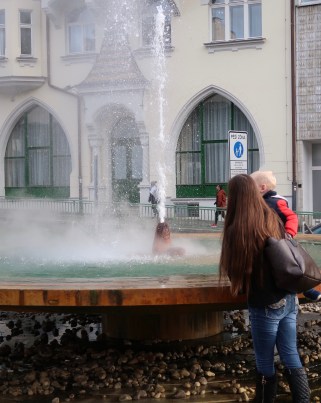
The first “site we saw” was the famous Hot Spring. IMG_1674The Hot Spring was the first hot spring to be discovered around the 16th Century. The geyser of the Hot Spring is a natural phenomenon gushing to ~12 meters high and giving ~2,000 liters of mineral water in a minute. It was absolutely incredible to see, and it is almost completely continuous day and night.

We also got to see two churches while we were in Karlovy Vary, the first being the Church of St. Mary Magdalene. This is a catholic church originally dating back to the 14th Century. The current church on sight dates back to the 1730’s. The second church we got to see was the Orthodox Church of Saint Peter and Paul. This is an incredible Russian Orthodox church (modeled after a church near Moscow- very obviously) that dates back to the very {very} late 1800’s. This particular church was paid for by money contributed from the wealthy and aristocratic Serbian and Russian patrons.

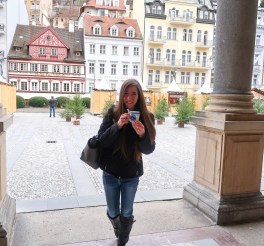
We were able to stop at both the Mill and Market Colonnade’s. The Market Colonnade was originally a wooden colonnade and is in the location of the oldest baths in Karlovy Vary. The present-day Colonnade dates back to the late 1800’s and is the largest colonnade in the city. It seeps five of the mineral springs and is where we decided to test out the waters healing powers.

IMG_1728We purchased a little souvenir cup and decided to go for a cup from the Libuse Spring. This spring was discovered while they were rebuilding the colonnade in the 1800’s. I will say, I don’t know that the water is healing, but it pretty much just tastes like mineral water. It was a fun little bit and the souvenir cup leads to a good memory.
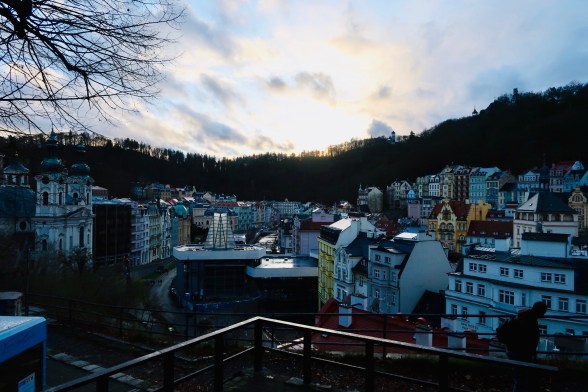
We took a little mid-day break for tea/coffee and cakes at Café Franz Joseph and enjoyed a little rest with some delicious treats.

We walked along the main streets a little more before heading up the hill a little way. We made an end of the day stop at the Jean De Carro Park. This spot gave a beautiful overlook of the city (although there are several spots to do this!). IMG_1773This park was founded in the late 1850’s and contains a little fun legend. There is a sculpture of a cat sitting atop a column in the lower portion of the park. Baron Lutzow used this cat sculpture to protest the location of another statue in a neighboring park. The cat is facing away from the town hall as a way of highlighting the “good for nothing” nature of the councilors work.
We stopped for dinner at a charming little restaurant called Restaurace U KŘÍŽOVNÍKŮ near the Church of St. Mary Magdalene. The food was delicious, and they had a good variety of Czech options to choose from.

And that was our day in Karlovy Vary! I think if I had to do ONE more thing, I would have done the funicular up to Diana’s Tower. This was one of the things that was on my maybe list, but I kind of figured we wouldn’t be able to get to it due to other circumstances. So, if I had to share something that I wanted to do and think you should do, it would be that. I would also recommend doing the hike on the far side of town as there are quite a bit of rotunda look out points to see the sheer beauty of the area.

We had a lot of fun on our little day trip to Karlovy Vary and I would say that if it fits into your itinerary, you should totally go! It’s a great little town to just wander through and take in the sights (and waters ha-ha)!

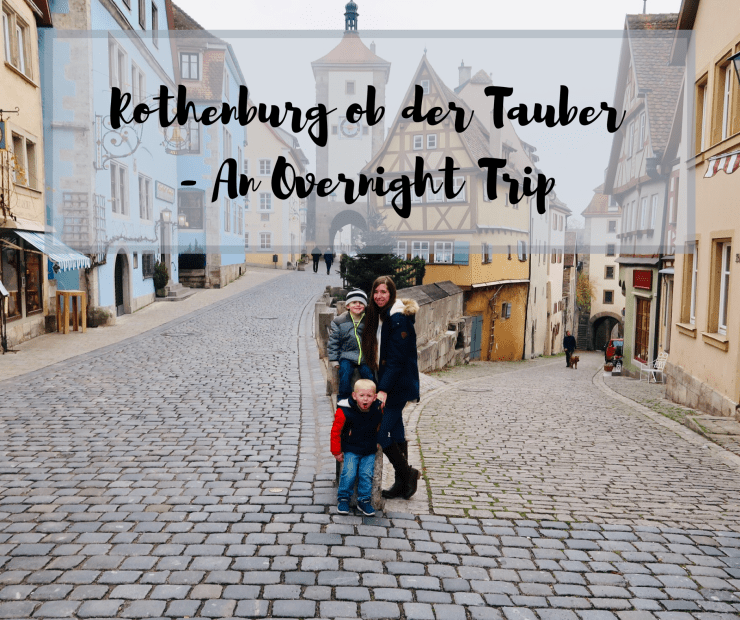
Rothenburg ob der Tauber – An Overnight Trip

It is probably one of the most frequently recommended stops in our area of Germany (and really Germany as a whole) and we finally got to experience the charm of Rothenburg ob der Tauber in the middle of November.

Let’s start with a little history of the town. Rothenburg ob der Tauber (I’ll be shortening this down to Rothenburg o.d.T, but you want to be sure you are indicating the full city name in order to find it on a map as there are several different Rothenburg’s and Rothenberg’s in the country) dates it’s history back to the Celts around the 1st century. However, most of what you will find in Rothenburg o.d.T today dates back to around the 18th century (more on that in a minute- it’s a fun legend!). Around the 13th century Rothenburg o.d.T was granted Free Imperial City status, which allowed the city to charge a toll on all those who passed through the city itself. This allowed the city to become quite prosperous and grow rapidly as Rothenburg o.d.T. is pretty well located for pilgrims and travelers. At one-point Rothenburg o.d.T. was one of the larger cities in the country.

The downfall of Rothenburg o.d.T. came during the Thirty Years War (to narrow that down, we are looking at 1631). The walled city was taken under siege by the Protestant County of Tilly. They quickly fell and the Count of Tilly’s troops quickly gained access to the city. Town legend says that when the Count demanded the councilmen’s deaths and the city burned to the ground, the councilmen made a bargain- if one of the councilmen could drink 3 ¼ liters of wine in one go, Tilly would spare them all. The mayor succeeded in doing this and the Count’s men withdrew from the city that winter. At this point, the city was left nearly empty and when the bubonic plague came in 1634 it wiped out most of the remaining townsfolk. That is why Rothenburg o.d.T. remains in the state it is.

Rothenburg o.d.T. played quite a role during the Nazi era both being given the title “ The epitome of the German Hometown” and being listed as a regular day retreat for members of the Kraft durch Freude (a Nazi organization). Rothenburg expelled all of its Jews in the late 1930’s and became a “poster town” for what Hitler and the Nazi party wanted Germany to look like. Rothenburg survived untouched for the majority of World War Two, until the last couple of weeks when Allied Bombers dropped bombs on the town destroying a total of 321 buildings and killing 37 people. Hitler had ordered all of his troops to continue to fight to the end, but the troops at Rothenburg decided to defy the order, meeting with American Soldiers in an attempt to save what was not already destroyed in the town.

Rothenburg o.d.T. has played a lot of roles in the film and book industry, being the inspiration for the town of Pinocchio, was in Chitty Chitty Bang Bang, small bits in Harry Potter, as well as many more. Rothenburg o.d.T. is also widely known for its Christmas spirit and Christmas Markets. This past trip was a little too early to attend the market, BUT we will be heading back for the market, so stay tuned for that upcoming post. They were getting everything prepped, putting up the shop decorations and stalls, as well as Christmas Tree’s all around.

And that concludes today’s history lesson ha-ha. (Information sourced from rothenburg.de and the town itself) I didn’t mean to include so much, but it is just incredibly fascinating to look at all of the history of the places that we are visiting. It’s not only so vast, but full of so much turmoil. I hope that you enjoy getting to hear not only about our trips, but also about the history that we are learning during our trips.

Now on to what we actually did during our 24 hours there. We started off by walking the wall.

You are able to walk the entire wall of Rothenburg and I highly recommend that you do. It gives you not only a unique view into the city, but also a unique view into history and what it would have been like to live/man the walls during the days. It’s narrow stairs and walkways are great too, although a struggle if you have any disabilities or young children. It is still entirely possible to walk them with young children, but tread carefully. We did not walk the full length of the wall, just about a quarter of it and then we descended into the city streets.

We spent most of our time strolling along the different streets, stopping and shopping at times, taking pictures, and just reviling in the ambiance that is a quaint German town.We wandered through the Western Gate to stroll the gardens and the lower part of the outer wall outside the city walls.

The kids loved being able to just run around the walls and little side streets as well as see all of the older buildings.

We did stop at the famous Old Forge (Gerlachschmiede) and see the famous half-timbered half between the Rödertor and Galgentortowers. This is actually a restored version as the original was on the buildings destroyed in World War 2.

We stopped for a quick cup of tea and cappuccino at the café right off the Marktplatz. No matter where you sit in this small little café, you will have a great view of the town square and it’s the perfect little mid-afternoon stop. If you do stop here, try out the truffles as they were delicious!

We ended our day with the Night Watchmen Tour.

This tour is given twice a night (times vary due to time of year), one in English and one in German. In the olden days, at night the town was guarded by a Night Watchmen. This watchman was intended to keep the peace and watch for trouble. Without any real training or experience, they walked the streets with a horn in hand to blow should trouble arise. These days the Night Watchmen leads a tour of the city at dark with his lantern, telling stories and the history of the town. We learned quite a bit about the town as well as about Germany. A definite highlight of our time there!

We stayed the night in a hotel right off the marketplatz called Gasthof Griefen which was nice and quaint. We had both dinner and breakfast in their restaurant and the house itself is beautifully done.

What I would recommend for a trip to Rothenburg o.d.T. (as well as a couple tips). Start by parking right outside the city walls. If you are just planning a day trip, then you can park outside the wall with a day parking ticket (Tages Ticket), that costs about €5.50. There are several different parking lots outside the city of varying sizes and various entrances to the city. Each entrance has stairs to climb to get up the wall as well, so you really cannot go wrong with parking outside the city. There is parking inside the city as well, though depending on the day that you go there may or may not be any spaces available. It’s also not very easy, realistically speaking, to driving within the city walls, so parking right outside is your best option.

Once you’ve got the parking settled, I would start by walking the upper length of the wall. You can walk most of the wall this way, then descend and walk the lower ramparts. If you’ve had enough after walking the upper level, then head towards the cobblestone lined streets of the main town. Again, you can’t really go wrong as to where you start as you will see everything by the time you have finished. I personally would start at the central marktplatz with the Rathaus and Astronomical Clock. From there, wander the various streets, see the two churches, and head out the Western Town Gate to see the gardens and various overlooks. I believe you can walk all the way down to the Tauber river from this spot, which is a pretty nice hike down. There are also several museums to visit that detail the history of the justice system, a Christmas museum, a puppet museum, and a craft house that shows the everyday life of the craftsmen and the families that lived there. There are also two towers that you can climb to get the scenic views of the city (the Roedertor Tower does charge for the overlook).

Here comes the make or break part. I would highly recommend sticking around for the Night Watchmen Tour. For us, that meant staying overnight, but it doesn’t necessarily have to mean that. The English tour starts at 8PM and goes for about an hour. The watchman is not only very well informed, he also throws in some funny jokes and tells history in a very captivating way. I waffled on whether or not we really needed to do this tour and in the end, I am very glad that we stayed to do it. By staying till 8, we also got to see the Meistertrunk scene from the astronomical clock that depicts the famous town legend of drinking the wine to save the town (even if you don’t do the Night Watchmen Tour I would still recommend at least staying to see the clock). It’s the perfect way to end the day in Rothenburg o.d.T..

And there you have it! Our 24 hours in Rothenburg o.d.T. Have you been? Do you want to visit? Stay tuned for our Christmas Market visit 🙂

Thankful – 2019

Ah, Thanksgiving. A day to celebrate family and friends, parades with massive floats and balloons, food, and various sports (read American Football- that’s the only sport on that exists on Thanksgiving). While I’m thankful all year long, one of my favorite things about Thanksgiving is celebrating all that we are thankful for and doing that with family and friends.

This year Thanksgiving looks a little bit different for us. Not only are we in Germany, who doesn’t celebrate Thanksgiving like we do (or when we do), but we are actually in the car on our way to visit our ninth country since moving here. We are taking a long weekend away to Czechia, specifically Karlovy Vary and Prague. We are going to be experiencing their history as well as visiting a couple of Christmas Markets (trying to contain that excitement). While Thanksgiving looks different for us, I still wanted to take a minute and just jot down (rather type up) a couple of the things that I am thankful for.

I mean to start with the obvious I am thankful for my little family, for my husband and children, and for the joy that they bring me. I’m thankful for our continued good health and that we’ve weathered all the challenges of this past year so far.

I am thankful for our friends, old and new, who we try to keep up with at all hours. We’ve made some really good friends in our move here, friends who I know will continue to be friends long after we leave here. With an international move to a foreign country, friends become your surrogate family. They become the people that you bond with and rely on when you are in need and we’ve been very blessed in that respect.

I am thankful for the home and life we’ve created over the past 5 months in our home. We had quite the journey to get to this house, and we’ve really made a home in it and in our neighborhood. We are finally in the country and it’s been the biggest blessing.

Finally, another obvious one, I’m thankful for the opportunity to be here in Germany. Some of it is just us being blessed with the opportunity, but a lot of hard work went into this as well. My husband worked incredibly hard to get to this point in his career where he could choose the job that he has here. So, I am thankful for this opportunity that was given to us and again thankful to my husband for the incredible work that he has done to allow this opportunity.

How are you spending your Thanksgiving? What are you thankful for this year?

A Little Judgement Chat

Here is something that has been kind of frustrating me lately. This may seem like something coming out of left field with me and maybe it is a little bit, but I’m also starting to get a little tired of holding my tongue. I’m not going to be going all gung-ho into certain topics, but I do want to share a little bit more of the things that weigh on my heart. I want to say a little bit more about things that I see. I want to try and use my voice for a little bit more if I can/when I think it is appropriate. This is one of those times as I have not only experienced this, but have seen it in action firsthand.

Here’s the deal…we all judge. Say whatever you want, we all have judged someone or something at one point in our lives. Whether we pass judgement simply in our mind or to our significant others, or actually speak your commentary out loud it really doesn’t matter. As much as I try not to, I have definitely passed judgement. Look, it’s human nature (similar to comparison, but that’s a whole other conversation).

We talk and judge about looks, actions, relationships, speech, just about anything. Whether it is perceived or real, everything we do/say or don’t is judged.

The problem that comes with passing judgement is that we don’t know what someone else is going through. Even if they give us their life story, if they are a public persona, if they are private, we quite simply don’t know the full story. We may think that someone looks unkempt and make our own remarks on that, but they could be dealing with things that we could never imagine.

Another problem with judgement: it doesn’t give either person a chance to even begin to understand. Look struggling doesn’t discriminate on any level. You could appear to live a lavish, privileged life, and be dealing with an extreme amount of depression. Yes, you are in a privileged position, but you still struggle. Someone can recognize their privilege and yet still have down days. We cannot understand someone and whatever issues they may or may not be experiencing if we judge them before they can even open their mouths.

Judgement isn’t just external either, we are prone to a lot of internal judgement which can sometimes be even more damaging. There are a lot of instances where we feel certain assumed/perceived  judgements or roles that are placed on us. We feel as if we may not be living up to a role, doing things with smiles on our faces. Some of this can come from judgements we have in the past thought or expressed, or heard someone else express.

And this judgement is what prevents a lot of people from talking about problems. It prevents a lot of people from opening up about whatever they are dealing with. And when someone feels like they can’t share what is going on it festers inside them until they can’t handle anymore, and we get an explosion of some sort. Often times we then wonder, “what happened?”. “How did this happen?”. “Why didn’t they say anything?”.

It’s a vicious circle and it’s one that only we, as individuals, can break. If each person opens with a little more kindness, a little more of an open mind, and a little less judgement or unsolicited advice (again, a whole other topic), then maybe others will feel a little bit better to share. It only takes one person to start a change in this cycle. One person. Will you be that person?

A Little Insight into Travel Weariness

Untitled Design 9

Traveling is one of the best ways to spend our time, not only do you get to see new places, but you are experiencing new things, seeing new cultures, seeing different ways of life. It is so great, and I completely understand how a big chunk of advice that people give/receive when talking about life is to travel as much as possible. It is in fact a piece of advice I give out now as well. There is just so much to the world and so much to learn, see, and experience.

However, there is another aspect to traveling that we don’t talk about it: the sheer exhaustion of it all.

There are a couple of reasons as to this, one of those being that we feel as though we can’t complain. We are in an extraordinary position of being able to travel, to be able to see the world. Not many people are able to from just the standpoint of cost, let alone getting time off work, dealing with children and school schedules, and much more. It can feel even worse to be in these great opportunities and not 100% loving or enjoying them. Another reason we may not talk about it is that we don’t want to remember those moments. Nobody wants to see/hear/remember the hard times.

But, as we know, life is not sunshine and rainbows ALL the time and while traveling can be a blast and eye opening, it isn’t all sunshine and rainbows either.

So, travel weariness. Beth Sandland actually speaks about this in one of her blog posts, which you can find HERE, and she does a much better job than I do at articulating this. We all hit a point, no matter what kind of traveler we are, either while we are traveling, or shortly after getting home, where we just crash. We can’t go any further, we sleep longer hours, our bodies and minds needing all the rest they can possibly get. We find our energy to be at odds with what we want to accomplish, and we end up having a day or two of just catching up with ourselves.

This is a very real feeling. It’s something that happens to me usually after a couple of weekends away. I actually try to schedule our weekends away where we have at least a week or so in between a trip that is going to be more than one night. We can do back to back to back trips, but then we need a bit of a longer home time in between. We’ve found a way to make it work for us.

All this probably sounds a bit whiny, or a bit of “you shouldn’t complain” and maybe in a way it is. We are so incredibly blessed (as is anybody who is able to travel) and we don’t turn a blind eye to that. We wholeheartedly recognize the situation we are in and are trying to make the most of our time here. But, I also don’t want to shy away from sharing some of the harder bits either.

Traveling is exhausting. Traveling with two toddlers is even more so exhausting. It’s stressful. There are so many levels to that stress and exhaustion. Trying to balance family fun, with photos, with remembering everything, with making sure our kids are behaving. (I’m well aware of how this all sounds, but it’s really fun and it’s quite easy once you fall into what works for yourself/your family. I just want you to know that it is a lot).  There is a lot of planning and organization that goes into even just the long weekends away, let alone our longer holidays. But we love it. We love every minute of it. So, we put up with the exhaustion. On our longer holidays we try to keep a day of nothing, and when planning any trips, we try to book in a day after travel to catch up on home stuff before heading back into work.

So, there you have it. My look into Travel Weariness. Have you experienced it? Let me know in the comments below.

I Didn’t Give Germany A Chance

Untitled Design 7When we first started tossing around the idea of moving to Germany it felt surreal. The concept of actually living in Europe wasn’t something I could have wrapped my head around. I had been to England and Scotland when I was a baby, but Europe was this distant dream that I dreamed for a long time, but never really thought would be able to be a reality.


When we got orders, it still felt surreal. I couldn’t believe that this dream I had would be a reality. That we would be so blessed. The concept of being able to travel Europe, to go to all these countries was just too good to be true. Incredible. I thought of all the sights we could see, all the countries we would visit.

And I’ll be honest- I treated Germany as simply a location. A central spot that we could then travel out of. Not as a place to explore beyond a few historical landmarks. I knew about Germany, knew its history, it’s big cities, some of its culture (like Oktoberfest), and that was about it. I focused solely on EVERYWHERE else we could go, all the other things that we could see, all the dreams that would no longer be just dreams.

I now realize how much of a mistake this was.

Germany is stunning. That’s not to say it doesn’t have its own spots ,it doesn’t have troubles, but I definitely should have thought more about everything that we could do within its borders, rather than just looking outside the country. There is so much to see here, so many little holes in the wall spots that no one really thinks about that are just stunning. A lot of the little towns are old world quaint and each has its own history. Take Tubingen (HERE) or even Weltenburg Abbey (HERE), we had considered these both a nice little day trip, but both are so perfectly European and German, and I loved it. This was something I hadn’t really thought about when we got orders. The history here goes back much further than I had even anticipated (yep, I’m naïve) and there is a never-ending number of things to do and places to see.

And, since we can’t ignore the elephant in the room…Germany has such a way with its own history. They have quite the history here, quite the troubled past, but they’ve managed to settle with it. One of the things that has stuck with me in our time here so far is how they handle their own history. They don’t hide behind it; they don’t bring it up time and time again. They acknowledge what happened, they acknowledge the hurt and pain that was caused, they punish those responsible. They take steps to make reparations, they don’t destroy everything relating to their own history, choosing to make the most incredible memorials that I’ve seen out of the pieces. The Berlin Wall Documentation Center, The Berlin Wall, The Eastside Gallery, Dachau Concentration Camps, Nuremberg Rally Grounds, Nuremberg Court House…the list goes on. All of these places are landmarks, marking down what happened for everyone to see. They’ve made changes, they’ve learned, anyone who visits these places learns. They move forward.

We can all take a lesson from that.

Not to mention just the sheer amount of history here. In a city right near us they are excavating bodies from Roman times and have a set of Roman archways from… It’s incredible to think that some of the places that we see have that much history.

We won’t even start to get into the culture of this country. Festival season is such a fun, warm and welcoming time, not to mention the season we are about to go into…the most wonderful time of year. The way of life, the idea of a slower pace. We live in the countryside (something we’ve been wanting for a long time) and the number of animals and crops that we see daily is something else. It’s been an incredible bit of time and one that we are looking forward to continuing for the next couple of years.

I’ve found a true home in a place that I hate to admit that I discounted. I figured it would be a home base for everywhere, but we’ve really made a home here in such a short time. I won’t discount a place again.


Round the Kettle Ep, 21 – A Bit of Wanderlust

Happy Sunday…is it Sunday?…It is Sunday. The days of this past week have kind of blurred together. Combine that with my husband having an extra two days off (Monday and Friday) it’s all kind of become a mess in my head.

Now that we’ve gotten that out of the way, Happy Sunday! How has it been? I haven’t actually sat down to write a blog post in what feels like ages (although in reality it’s only been a couple of weeks). It feels good to be using my brain again in a way that doesn’t involve my little boys. To be fair, I use my brain a fair amount in conversations with friends, but this is a little different.

Anyways, I’m really over here waffling about today about nothing, aren’t I?

I’m going to be completely honest; I think we’ve gotten a whole travel, home, travel, home routine down now. It’s funny because we will spend a fair amount of a month to a month and a half away, between day trips and long weekends, and then we will have a month to a month and a half at home. It’s become a bit of a thing over the past bit of time that I’ve noticed. It’s interesting because right when I start to want to just be home for a bit, or starting getting that travel bug, we will go into a stretch of that time.

We’ve been home for about a month and a half (at this moment), since our last Castle-ing Weekend (HERE, HERE, HERE), and I’m starting to get that travel itch. I’m starting to long to explore new places, find new adventures, and learn about different places around us. LUCKILY, our travel times line up well with this, otherwise I’d be looking for last minute options just to do it. We have two trips planned in November, A LOT of Christmas Market trips in December, and a Winter Holiday after Christmas. I would guess that by the time we will finish our Winter Holiday, I’ll be ready to be home for a while again.


I’m not sure of any other way to do it. It’s funny because I always figured we would approach traveling as maybe do one to two bits a month, with the longer vacations whenever they factor in. That hasn’t really worked for us though. Between Robert’s schedule for work, and just how the cookie has been crumbling we’ve found these stretches of time that we can do a lot during before everything buckles down. It’s like an on again off again schedule and it really ends up working out better for us.


Truth be told, I don’t know if I’d like to travel any other way than for what seems like weeks on end (it’s not really weeks on end, but more back to back day/long weekend style trips).


Tell me, how would you like to travel? Would you like to go, go for a chunk of time and then be home for a chunk of time OR just take a long weekend every couple weeks, with the bigger trips factoring in the same two times a year? I’m curious as I feel like everyone is different in this aspect.


I would also be curious to know whether you would start off your travel with close to “home” short trips OR if you would go as far as you could? We are all such different travelers that this is something fun to chat about and share experiences.


Beyond that, I’ve been spending the past couple of days looking forward. I’ve been looking at December’s blog posts (all travel and/or Christmas related) as well as starting to look at some of the intentions and goals that I have for 2020. It’s crazy to think that the year (and decade as everyone keeps reminding us all) is coming to an end. It’s been a wild one for us and I’m excited to look back at it, as well as look forward into the new year.


What else to share? There’s not really anything else. It really hasn’t been too exciting over here. But it’s coming. The excitement is coming.


How are you? How have things been? I’d love to hear!

Planning Big Trips

Untitled Design 5Today I am going to talking about something that we have done and will be doing in the next month and that is planning big trips. We have taken summer vacations for three years in a row now with our little family to all different destinations (Maine, Canada/New York, United Kingdom) and are planning a Christmas/Winter getaway over the next few years too. There is a definite difference in planning between planning these bigger travel events than with planning Weekend Getaways. Not only are these usually further distances away, but they are usually intended to be to see more and do more. I have talked about long weekends (HERE) so today, I’m going to talk just a little bit about how we plan our longer trips.

I’m going to be using our Summer Holiday as an example as I work through this post which you can read about in these posts: Calais and Dover, London, Edinburgh, Inverness, Bastogne, Luxembourg, and Heading Home.

The first step is determining where we want to go. This is actually one of the most overwhelming bits as there are a lot of travel options. We have a very large list of places we want to go while we are over here in Germany, and are adding more to that list every day, and we split that into two categories. These two categories are places that we want more than a day or two and places that we don’t need much time in. So, we knew that we wanted to have a decent amount of time to explore London and Scotland, and since those are neighboring countries and it made sense to take one longer trip to visit both, than two or three “shorter” trips. The same will be for our future trip to Italy. Italy is a country that we want to spend a longer amount of time in to see more to the country, rather than taking a few 4-day weekend trips to. If we can combine spots, we will combine spots, but more on that later.

So, we know where we want to go. The next step is deciding how to get there. Here in Europe there are a couple different options: driving, flying, or train. There are pros and cons to each option, and we tend to weigh kids, luggage, timeframe, and cost into our decision. Flying is something that we will probably be doing more in the winter months as it starts to snow, and the roads get a little more treacherous. Trains are something that we are having to hold off until the boys get a smidge older, Andrew is just a little bit too young to really understand. Driving usually seems to be a…”dull” and longer option (although we like it), but you also can control your timeline a little bit more as well as your luggage situation. The other benefit of driving or taking a train is the ability to add more stops to your itinerary which may change your mode of transportation.

Perfect Segway into our third step, which is mapping a route. This goes hand in hand in some ways with how to get there. This also happens to be one of my favorite parts of the planning process. There are two ways to do this, depending on what you prefer: electronically or physically. What you will want to do is map out your trip. We start with our main points. For our Summer Holiday we knew we wanted to go to London, Edinburgh and Inverness. Those were our main spots. We also leaned towards driving due to cost, ability to control our schedule a little more, and the ability to see a little more. So, we pulled out a map and started to look at different options. You are actually able to do this electronically on Google Maps (plan a trip) which we have done, but you can also do this on a physical map, which I prefer. Looking at a map we kind of eye balled our distances and eye balled what countries we would be traveling through or bordering up against in this travel. We knew that we would probably have to stay a night in Calais and potentially somewhere between Inverness and Dover and then again Calais and home. We also tried to look if there was anywhere that we wanted to stop on our route, which was how we managed to visit the American Cemetery at Luxembourg and the War Museum in Bastogne (also Dover, but that would have been too obvious not to miss). Look at your destinations and if you are driving or taking a plane is there anywhere on your route that you want to stop? How much time do you want to spend in this location? How feasible is this?

So, we know where we are going, how we are getting there, and what stops we want to make roundtrip, it’s time to find a place to stay. This is more my husband’s forte than mine and he typically handles all of our accommodation. I’ll give you an idea though from what we’ve talked about and the little bit that I have seen/tried to do. Depending on where we go we will either book a hotel or an Airbnb. We prefer Airbnb’s as we can typically get a little more bang for our book, a little more space to stretch out, and some version of a kitchen for us to put all of our snacks and such. The only time we really stay in hotels is in bigger cities where it just makes more sense (London and Berlin). We filter our searches on Airbnb based on location and just map where the locations are to where the things are that we want to see. We like to use Public Transportation as much as we can when we travel to new spots, so somewhere nearby either a station OR walking distance to what we want to see is perfect. I wish I had more to say on this one, but I really don’t. We just hunt through Airbnb, our Credit Card company, and then Trivago and sites like that.

Finally, the optional fifth step: planning activities while you are there. This is completely dependent on what kind of traveler you are. When it comes to big trips I have a little bit of an itinerary problem in that I like to have at least one or two ideas for each day. I don’t plan to the last minute, but I do like to have a bit of a plan going into these longer trips. For London, we had planned on one day of just walking London seeing all the sights, one day at The Tower, and one day at the Globe and any last-minute idea’s that we had. This allowed us to have a little structure, a list of things we wanted to do, but still have a little flexibility with the kids. At the very least I would suggest just looking into and maybe making a list of different things to do, you don’t have to come up with any schedules or anything like that, but at least an idea of what to do and when is best to do it ahead of time will be a help.

And that is it! That’s how we plan our longer trips. Do you have any tips for planning long holidays? Let me know down below 🙂

Welcome to Our House: Entry and Kitchen!

While the library/office may be one of my favorite areas of our home, the Kitchen is the heart of our house. It’s the first room that I fully unpacked and put together, the room where I probably spend the most amount of my time, and it is an area that brings me a lot of joy (and practical utility). Our kitchen is a pretty fair size here in Europe and I have found different ways of maximizing our space and trying to keep the counters as clear as possible.

Untitled Design 10

I am attaching our little front entryway to this as it is the second thing you see when you walk into our home (the first being a welcome sign) and I really like how it came together. Also, I will put where things came from if I know, or where you could find something similar in parenthesis after.

So, we’ve got a tall wardrobe right when you come in which holds handbags and coats, as well as cleaning supplies and some kitchen linens. Spinning around you see our “home” sign which changes out seasonally (given to us as a gift), and then our storage cabinet (Target). The top drawer is a sort of “junk drawer” and the bottom cabinet portion is full of cookbooks and such. On top of the cabinet will rotate seasonally, in the spring/summer I’ll typically have fresh flowers, then in Autumn/Winter I’ll have a candle burning. This is also where any mail or papers that need to be handled will congregate.

IMG_1146

The pictures on the wall were all taken by me. From Left to Right: Stream at Balmoral Castle, Scotland, Cherries from our Backyard, Taco Night, Tea in Northern Virginia, Neuschwanstein Castle, Germany.

Now, to the kitchen…

Before I get really far into this- I think my favorite part is that our kitchen has its own door to the backyard. It’s a benefit not only for hosting in our backyard, but with keeping the kitchen cool. We don’t really have too many wall decorations in our actual kitchen, aside from a little bit here and there and I don’t know if that will really change as time goes on. We will see.

So, now getting into the actual kitchen. It’s a fairly basic set up, the first two drawers being our cutlery, the bottom cabinet being baking dishes and pie pans. The first top cabinet is my little tea and mug heaven at the front of our kitchen. On the counter we have our produce basket (I would recommend looking at Home sense/Home goods for one), toaster, and cookbook stand (Amazon). All of our cookbooks are stored just outside the kitchen except this one, which holds the recipes I use the most often.

IMG_1175

The next cabinet holds our spices and baking things (flour, sugar, brown sugar, etc.) and as you can see, the shelf above that holds various drink items. The drawers hold all of the cooking/baking utilities and measuring cups. The cabinet underneath holds pots, pans, and bowls. We’ve also got our most used cooking items, knife set, kitchen aid, and cutting boards on the counter. I feel like our counters are right at the cusp of being too cluttered, but I feel like it still works out well and the kitchen is able to be used without much complaint this way.

IMG_2986Before we get to the next rounds of counters, you can see our meal board and recycling station. I’m a big meal planner and found that having a board that lists the dinners for the week for everyone to see really helped eliminate the “what’s for dinner” conversation I seem to have daily with my family. Recycling is very big here in Europe and we have a total of 4 of these containers to separate out almost all of our things. The three you see here are for plastic, mixed, and glass. The basket on top is for paper recycling and our metal bin is above the fridge. Bins are from IKEA.


The second side upper cabinets holds all of our plates, bowls, and drinking glasses. We’ve also got the smaller cabinet for to go cups and water bottles and a portion of another larger cabinet is for my husband’s work meals/snacks. The bottom cabinet holds our large collection of Tupperware.

We have a large cabinet at the end of the kitchen that serves as our food storage/pantry. We bought a shelving unit from IKEA to add some much-needed space and it’s been working out very well for us at this point. Honestly- our pantry never ends up being as organized as I would like it to be (never has been), so it is something that I am continuing to work on. Shelving unit was perfect though (IKEA).

Finally, one of our only décor pieces is this sign above the door. We purchased this at a Cracker Barrel right after we got married on our way to our Honeymoon. It’s just one of those phrases 🙂

And that’s our kitchen! I hope you enjoyed! We’ve got one more room to “unveil” and I’m just working on putting the last touches on it before showing you.