A Weekend in the City

Before I get into this post, I want to put a little…not disclaimer, but a little word about the delay. We went on this long weekend over Memorial Weekend, which…is now like 3 weeks ago. But let me tell you…the NYC exhaustion is NEXT LEVEL. It took me a week to feel like I wasn’t…tired and then another week to process and write, and now you’re reading it a week later. Sorry, but that’s reality for you! Now, into the post…

So, New York City. One of those “iconic” cities from the U.S. I’ve been several times to the city, but my husband had only been once (though he’s driven through it) for a work trip. Since we live ~5 hours from the city, we figured we could take a long weekend and see all the…big touristy things. Let me say one {more} thing…I let my husband and kids take the lead on this trip. Since I’ve been to the city before, I’ve done most of the highlights…and some of the hidden gems. And…to be honest, New York City is big enough that you won’t see it all unless you live there and even then, you might not. So…we wanted to kind of hit some of the popular highlights of the city. If I go back, I plan on going as a girl’s trip and can do a couple of different things that may not have interested my husband or children (like a Broadway show, some of the neighborhoods, etc.). 

Two more things before I get into the weekend, we stayed very much outside the “city proper”. We stayed on the south end of Brooklyn, and, for us, it was worth it. The public transport in NYC is decent and it was very easy for us to just hop into the city when we wanted, but then be able to hop out for a breather. Second, we had really great weather for the trip! I know, weather?! BUT I feel like you never really know what you’re going to get in the city when it comes to weather, and we had one thunderstorm at the beginning and then blue skies and mild heat the rest of the weekend. 

So, to start off…

We started off our great City adventure by walking to the city across the Brooklyn Bridge. I’ve seen this bridge a million and a half times between photo’s, TV, and movies, but never actually walked across. Since we were staying on the Brooklyn side of things (like very much outside the city), I figured, this would be a great way to “meet” the city for the first time. The Brooklyn Bridge connects Lower Manhattan with Brooklyn Heights over the East River. When the bridge was initially completed in 1883, it was the longest suspension bridge in the world. It has been reconstructed several times to meet larger traffic demands, as well as to install specific bike lanes. It was designated a National Historic Landmark in 1964 and a National Historic Civil Engineering Landmark in 1972. The views crossing over the Brooklyn Bridge are great- you can see just about the entire city, plus the Statue of Liberty. 

We grabbed dinner at a hole in the wall Italian joint and I finally got to have my fast-food pizza. After dinner, we just wandered around the Financial District into the evening. We got our first glimpse at the World Trade Center area, as well as a hint of the battery (looking down- not quite The Battery). 

The next morning, we had an early start as we booked an early security check in for our ferry and tour of the Statue of Liberty and Ellis Island. I think most of us know the history of the Statue of Liberty, so I won’t go too deep into all that history. Gifted to us by the French in 1886 to celebrate the friendship of France and the U.S., Lady Liberty is full of a lot of symbolism. Across the statue, from what she carries, to her stance, even the carved facial expression- everything has meaning. While France financed and created the statue, the U.S. had to supply the Pedestal on which she would stand. Originally it was a copper color, but by 1906 the copper oxidized and the gorgeous green that we see today had arrived. The statue has been renovated once but closed several times during her tenure. For many years following the September 11 attacks the crown was closed to visitors, once re opened it was a limited amount per day (240/day total). 

We spent about an hour and a half or so on Liberty Island, walking up to the pedestal, around the base, and then through the museum. From there, we hopped back on our ferry and headed to Ellis Island. Again, I won’t go through too much of the history as I feel like most of us (well in the U.S.) know the basics of Ellis Island. Built initially in 1892, due to the high volume of immigrants at the time, Ellis Island served as the first stop for any and all new immigrants for 60 years. Over 12 million immigrants walked through its’ doors, though not all got to stay, and some faced rigorous testing and inspections. Upon arrival if you were traveling on anything other than a first- or second-class ticket OR you were sick, you would be sent to Ellis Island. Upon arrival at the island, you would go through several rounds of testing, some just a health screening, others a full interview and evaluation. Around 2% of the immigrants would not be granted entry and would be sent back- reasons being either disease or work concerns. The Island was closed in 1954 after a slowdown in the need of extensive processing (this was when embassies, and more ports started coming in to play). Once closed, Ellis Island became a ghost town. It deteriorated into a group of abandoned buildings, even though it was a recognized landmark (1965). The Foundation, that restored the Statue of Liberty, worked tirelessly on restoring, combining, creating, and finally opening Ellis Island as well now know it. 

I will say, even if you aren’t the family of immigrants or if you know the history, it’s still a pretty incredible place to visit. Not only for the history of the immigrants that went through their (and to learn their history pre-Ellis, during Ellis, and post Ellis), but it’s also pretty incredibly to think about the restoration and rebuild that occurred at the Island. And to know that it’s funded by the public through donations and contributions. Again, it’s just a place to visit and learn about what was a big place for so many. So many of these immigrants have made incredible and everyday contributions to our country. 

Once we got the ferry back to Battery Park, we headed out, once again, to explore the Financial District. We stopped over at the New York Stock Exchange, which is always a bit…smaller than one would think in person. We saw the little girl standing up to the male corporations dreaming of being in their one day (I don’t know if that’s exactly it, but that’s how I see it), the bull of Wall Street (which was packed and I didn’t even bother to re-create any pictures from the past two visits to it), and then over to One Trade Center. Visiting the World Trade Center Memorial, One World Trade Center, and the rebuilt area was something that was important to me. The first time I had ever visited New York City, I had gotten to go inside the Twin Towers, my mother worked with folks who worked inside the Towers, I vividly (like many many others) remember September 11, my husband vividly remembers September 11, and it was important to us that our children know that space and history. So, we visited. It’s such a peaceful spot, somewhere that you can sit for a bite and remember those who died, were injured, or are forever missing from that day. We stopped by the name that my mother knew and rested a bit.

From there it only seemed fitting that we headed to the New York City Fire Museum (mostly for our firetruck crazed 4-year-old). The museum showed not only the history of the fire trucks, fire response, and fire departments, but it also had a spot dedicated to September 11. It was actually quite interesting to see how the city handled fires when it was horse and buggy (here’s a hint…the firemen would pull the buggies) and how it evolved to the modern trucks and water capacity we have now. 

From there we headed over to The Strand, one of only two spots that I requested to go to, and I promptly became incredibly overwhelmed. Dating back to 1927 on “Book Row”, it is a family run business and the only bookstore still open from that street of bookstores. Now The Strand carries well over 2.5 million new and used books and to be honest…as much as I absolutely loved walking through those doors and literally just seeing books from floor to ceiling…nothing can prepare you for that. I need like a full day by myself just to take a crack at what they had. So, needless to say I loved it…definitely need a second go round there. But it was also kind of the perfect way to end the first full day we spent in the city!

The second day we were there, we decided to do a little bit of an easier, slower day and spend some time in Central Park. We always try to seek out parks/nature trails/ anything along those lines wherever we go, and Central Park is so known, that it was a good stop. But before we went into the park, we headed to the second place that was on my personal list, Zabars. Zabars originally opened in 1934 offering a variety of niche high quality food. You can purchase standard fair (pasta, canned options, and the like), but also bringing in small brands and foods from around the world, and fresh made bakery items (the rugelach is incredible, coffee, and lox (and other fish). It is, in so many ways, a Jewish staple, but it also has some of the best bagels and lox and cream cheese there is. I’m obsessed. Initially I went in for bagels, but instead opted for some black and white cookies, wafers, and rugelach for us to eat as we wandered throughout Central Park. 

We wandered not too deep into central park, but enough to hit the high spots and the Zoo. We started at the Alice in Wonderland statue (a favorite of mine), then along the main walk, over to the Zoo, and dropped down to Gapstow Bridge from Home Alone. While it was incredibly peaceful and really cool to see the juxtaposition of the city architecture against this massive nature expanse, it was also frustrating at times. Bathrooms are few and far between and we found ourselves racing from place to place to find a spot for the kids. Just wanting to let other parents know (it’s a struggle if your kids are still learning how to use restrooms in the sense of adults). Regardless, we ended up spending almost the whole day within the park. The Zoo was a real highlight – it has enough to make it worthwhile to visit while you’re already in the park, but not too much that you spend your entire day just within the Zoo. The animals are also fairly active, so you actually get to see them out and about. A quick note- there are two tickets, general admission and a second, higher admission. The only real difference between these two tickets is the 4D movie experience. While we liked the movie, we didn’t NEED to see it.

From Central Park we made our way over to NBC Studios, Rockefeller Center, St. Patrick’s Cathedral, and finally Times Square. 

The next place we actually stopped at (unlike the studios, and Rockefeller, where we just walked and looked) on that list was St. Patrick’s Cathedral. This historic cathedral came up almost side by side with the city itself. The cornerstone was laid in 1858 and the original doors opened about 20 years later for services. The construction was paid for both by immigrants AND the upper echelon of society at the time. The cathedral itself is incredible- very reminiscent of the European Cathedrals. I didn’t stay in too long, they were having a ceremony of some sort, so I felt like I was treading on something special and didn’t want to stay long. 

Our final “stop” of sorts was a quick moment in Times Square. Originally named Longacre squared, Times Square became Times Square in 1904 when the New York Times moved to One Times Square. One intersection within Times Square is also the beginning of the Lincoln Highway (on the Eastern side), which is the first road across the U.S.  To be honest, Times Square is probably one of my least favorite spots, but it was something that my family wanted to see…just to see, so we made it the last thing we did. It was…well Times Square. I don’t have too much to say about it to be honest. 

So, that wraps up our weekend in NYC! We had a lovely weekend, and it was a great kick off to our Spring/Summer/Autumn of travel. 

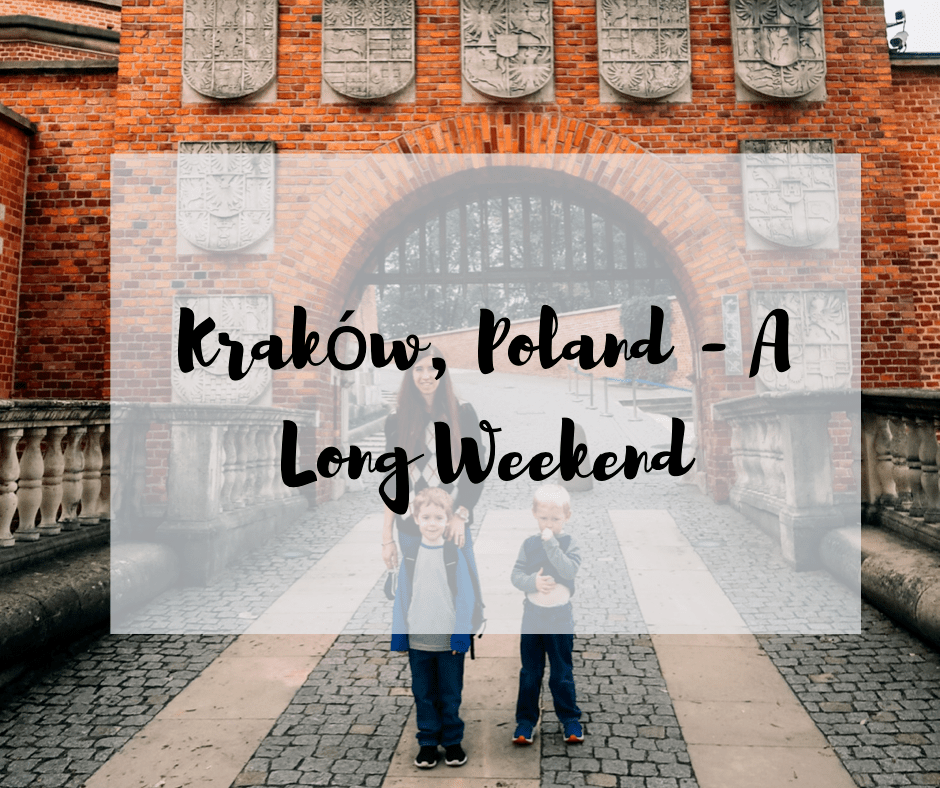
Krakow, Poland – A Long Weekend

I’ve spoken about our visit to Auschwitz (HERE), but we spent a good amount of that weekend checking out Krakow, Poland. A sprawling city development that still has the European Charm that we’ve come to expect (castle, legends, cobblestones), we found our time in Krakow (a total of 36 hours tops) to be the perfect amount of time to see what we wanted. Krakow is the second largest city in Poland and, dating back to the 7th century, one of the oldest in the country. In fact, Krakow’s Old Town was declared the first UNESCO World Heritage Site. 

The city began with a small settlement on Wawel Hill. Legend says that Krakus built the settlement above a cave that was home to a dragon, Smok Wawelski. During the 10th century is when Krakow saw it’s first significant growth. The castle was constructed, churches and a basilica, as well as a flourishing trade center. That first city was then sacked and burned (by the Mongolians), however rebuilt identically in the following years. During the 14th century the city started to head into a Golden Age, with the construction of a university. That Golden Age continued through the 15th and 16th centuries. This was when the Jewish Quarter was created, and the Old Synagogue was built. Things came to an end though in 1572 when the last ruler, King Sigismund II passed without any children. His death was followed by many many changes in leadership as various other countries ruled. Finally, an outbreak of Bubonic Plague and a Swedish Invasion spelled the end of their Golden Age and the end of the ruling houses residence in Krakow. Things didn’t really get any better in Krakow as it continued to almost bounce between various countries rule until 1866 when Krakow started to see a degree of political freedom and, once again, became a national symbol of Poland. 

When Poland was invaded by Nazi Germany, Krakow became the capital of the German General Government. They saw Krakow as a vision of Krakow becoming completely “Germanized”. Krakow had a very large communities of Jews living in its city at this point (statistics say over 5% of the entire population of the Krakow District was Jewish). Prior to the invasion and subsequent creation of the Ghetto (and then camps) the Jews were encouraged to flee the city. Things started to go sour shortly after the invasion with the creation of the “Judenrate” or Jewish Councils. These were run by Jewish citizens for the express purpose of carrying out Nazi orders, such as tax collection, forced labor, and citizen registration. Around 4 months later the Jewish Ghetto was created in the Podgorze District. The ghetto was only in existence for 2 years, with residents really only living there for 15 months (the majority of deportations were completed by June 1942- though the final Krakow Jew deportations were until September 1943-, after the ghetto initially being “designated” in March 1941). Many people know the story of Oskar Schindler, his enamel factory, and his work to save as many as he could.     

Aside from the destruction of the German occupation and the immeasurable loss of life, Krakow remained undamaged as a whole throughout the second world war. Once the war ended the city was turned from a university to industrial with the new government. 

One final note, the Pope John Paul II was Karol Wojtyla, archbishop of Krakow. He was elevated to papacy in 1978 and was the first non-Italian pope in 455 years. The same year of his election, Krakow was officially approved on the UNESCO World Heritage List. 

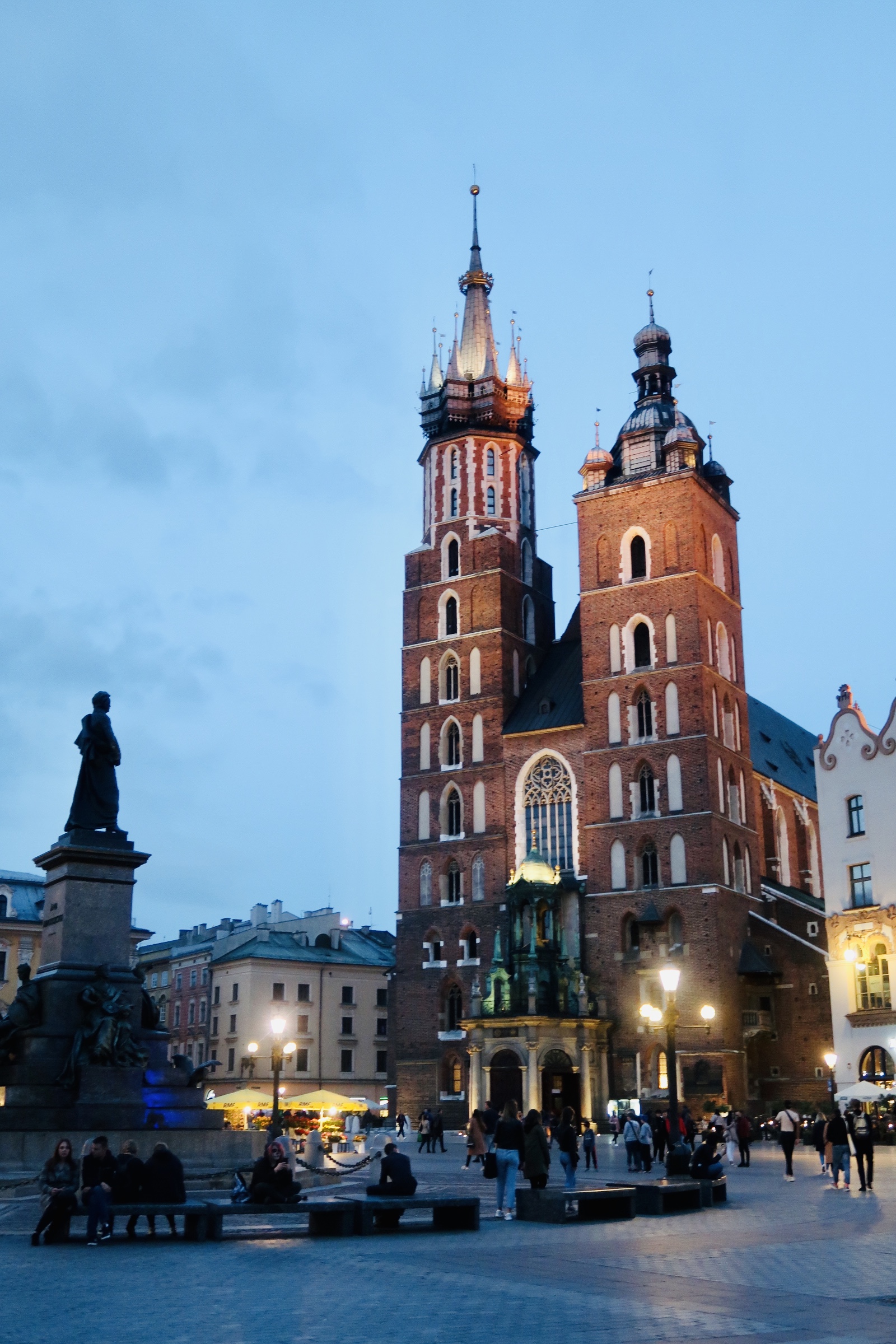
So, we actually started our trip in the early evening with a dinner in the main Old Town Square. We were able to watch the sunset on the Town Hall Tower as well as see the what the city is like in the evening. We stayed just outside of the Old Town (we actually walked our entire time in the city- no public transport, that’s how close we were to most everything).


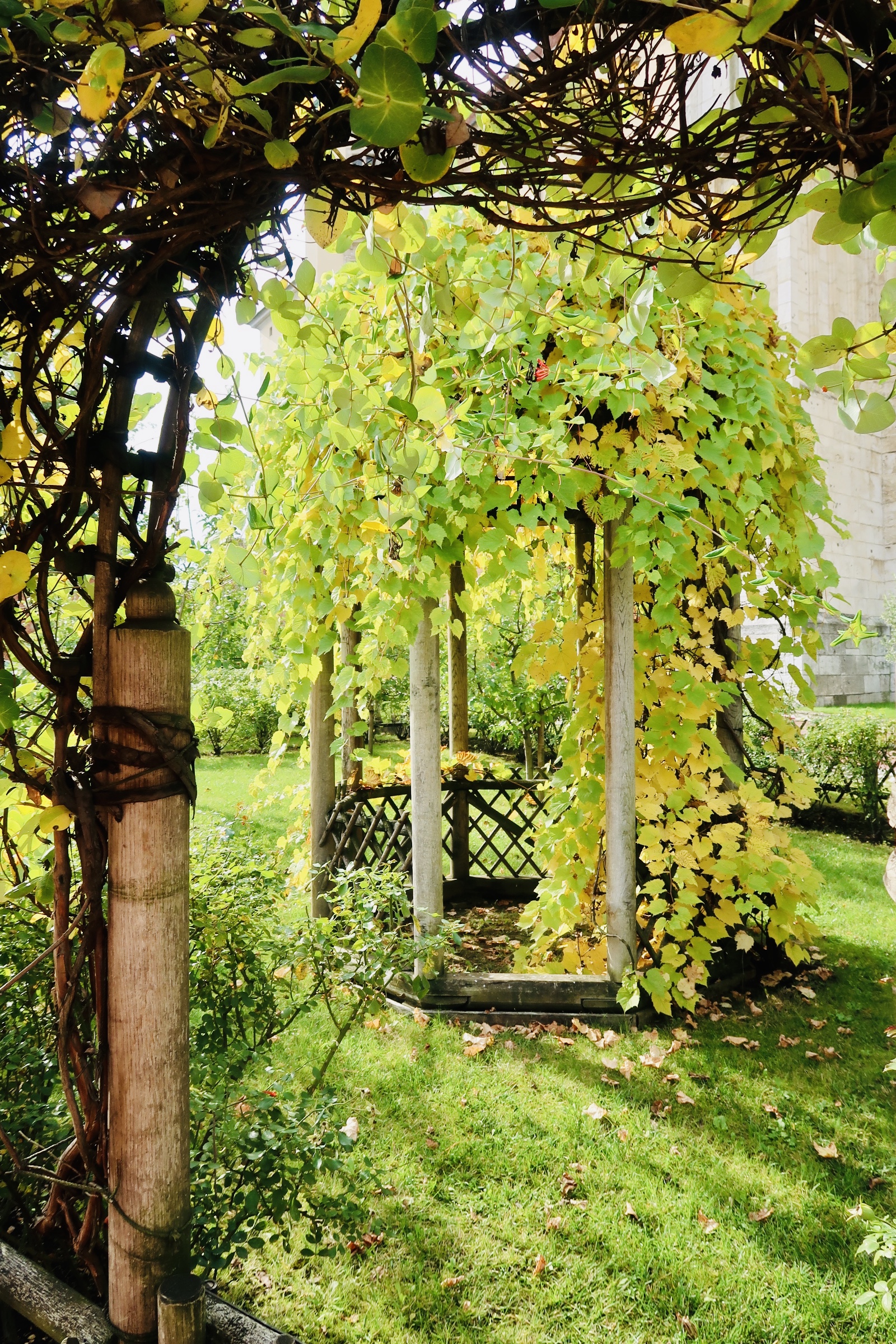
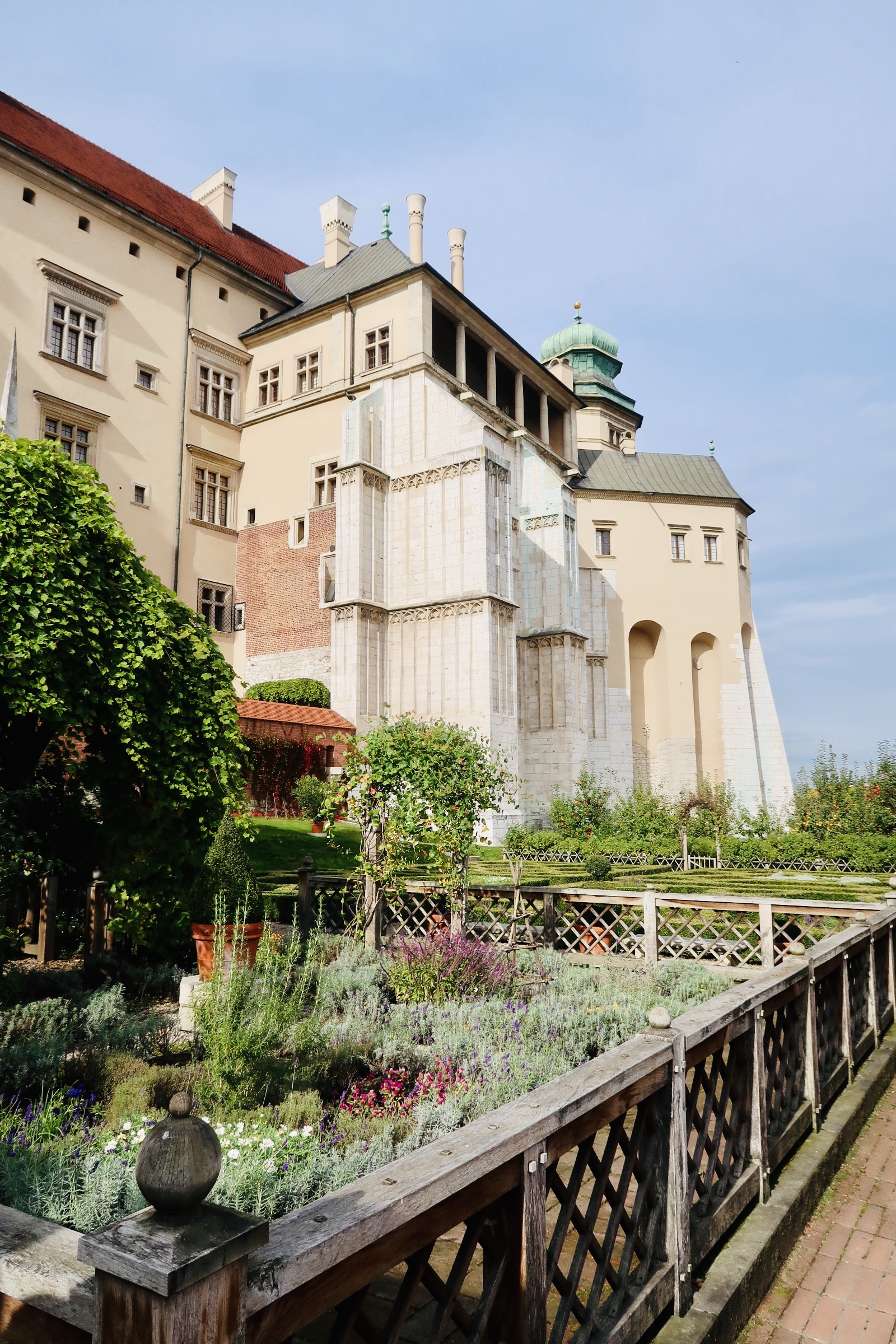
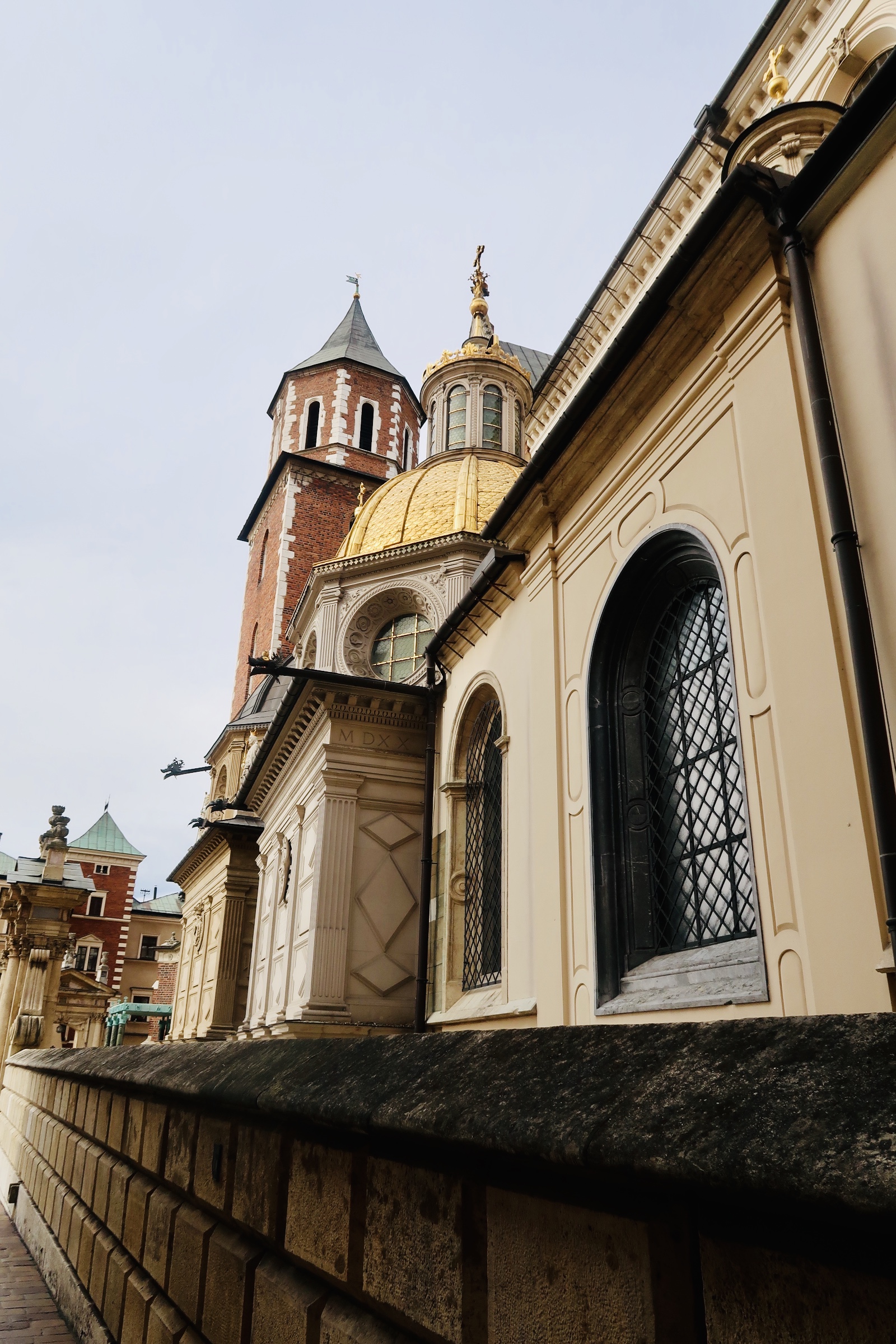
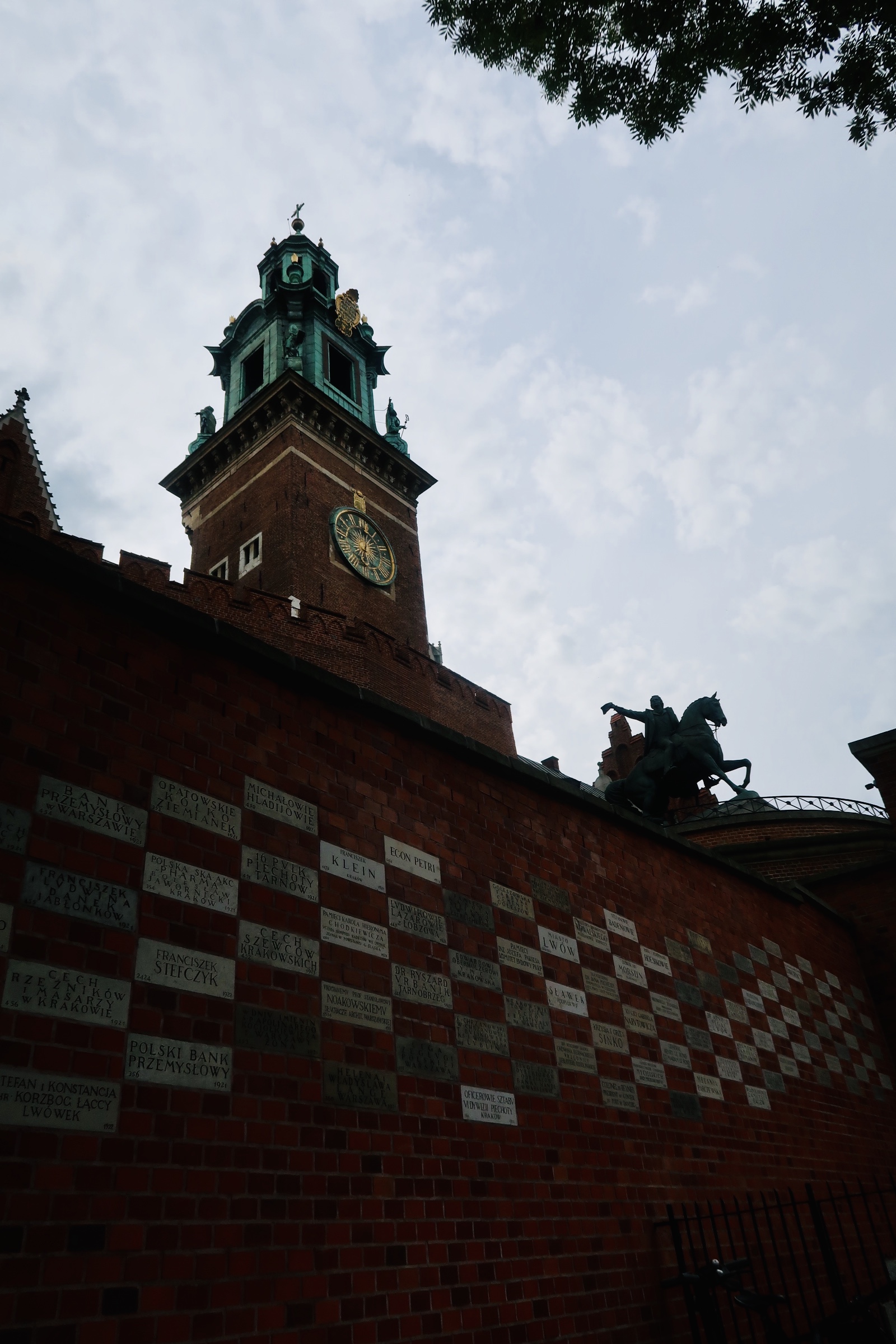
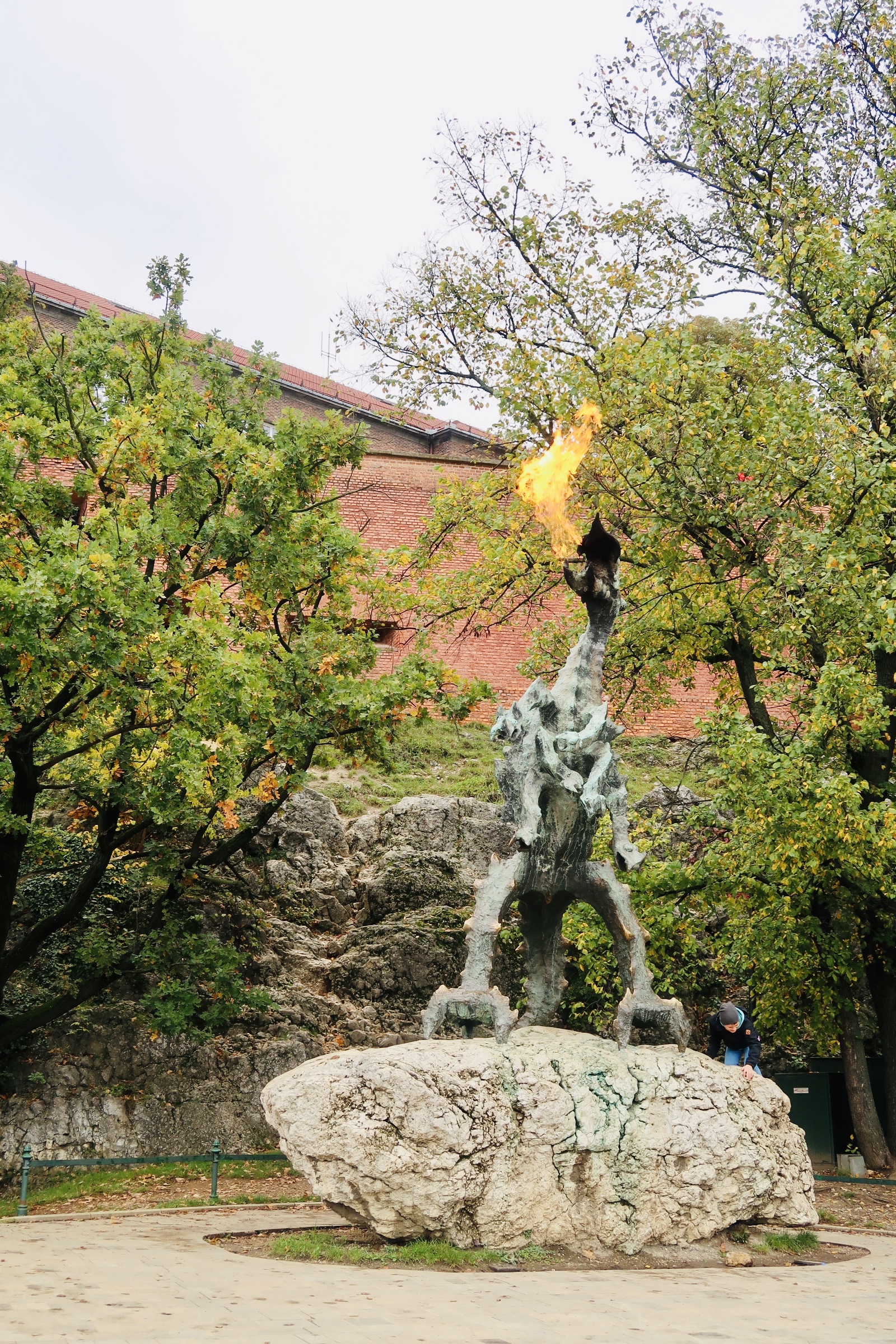
Our only full day in the city we started off at Wawel’s Castle and Wawel Hill. The castle was commissioned by King Casimir III the Great, but the current castle dates back to the 14th century. I’ve already touched on the legend of the Wawel Dragon, but it’s important to note just how deep that legend runs. Legend says that the dragon terrorized residents before being slayed by Krakus, a polish prince who then went on to found the city of Krakow and built the first royal residence on the hill above the dragon’s lair. These days, if you walk by the river you will see a metal statue of the dragon that is situated in front of the “den” and it shoots fire from time to time. The castle complex as it stands today consists of galleries, collections, and gardens. You are able to pick and choose which exhibitions you would like to visit on the castle grounds, as well as the option to visit the Cathedral once on the property. We chose the Private Apartments, Royal Chambers, the gardens, and then a walk into the Cathedral. 

I think one of the coolest bits on the interior was what was known as “Wawel’s Heads”. I don’t have any pictures (as pictures inside the castle were not allowed). In the throne room if you looked up at the ceiling there were a series of Heads that were carved out of the ceiling. In its height, there were a total of 194 heads looking down from the ceiling, overlooking the Polish King as he conducted business. Now there are only about 30 of the original heads left hanging. They depicted citizens from every walk of life that lived in the 16th century. There aren’t any true explanations as to why this was done, or how the people were selected, but it was a really interesting decoration to see. 

The final stop at the Castle is to stop in and see the Cathedral. The Cathedral is formally known as the Royal Arch cathedral Basilica of Saints Stanislaus and Wenceslaus on the Wawel Hill. This Roman Catholic church and cathedral is the home of the Archdiocese of Krakow and serves as the coronation site of the monarchy. The current standing cathedral is the third to have been built after the first (11th century) and second (12thcentury) were both destroyed by fire. Construction on the current cathedral began in the 14th century and is a true site to behold. Seemingly never ending with its various chapels, and little quiet spots. This cathedral is also the main burial site for the monarchy as well as national heroes, military members (generals), and other individuals important to Polish history (including two poets!). You are able to walk along the crypt to see the all the various tombs (although there are several on the main floor of the church as well). 

From visiting the castle, we headed back towards the main old town, wandering through cobblestoned side streets, stopping in to purchase some Polish pottery, lunch on the opposite side of the square as our dinner the night before, and then a walk through the Krakow Cloth Hall. 

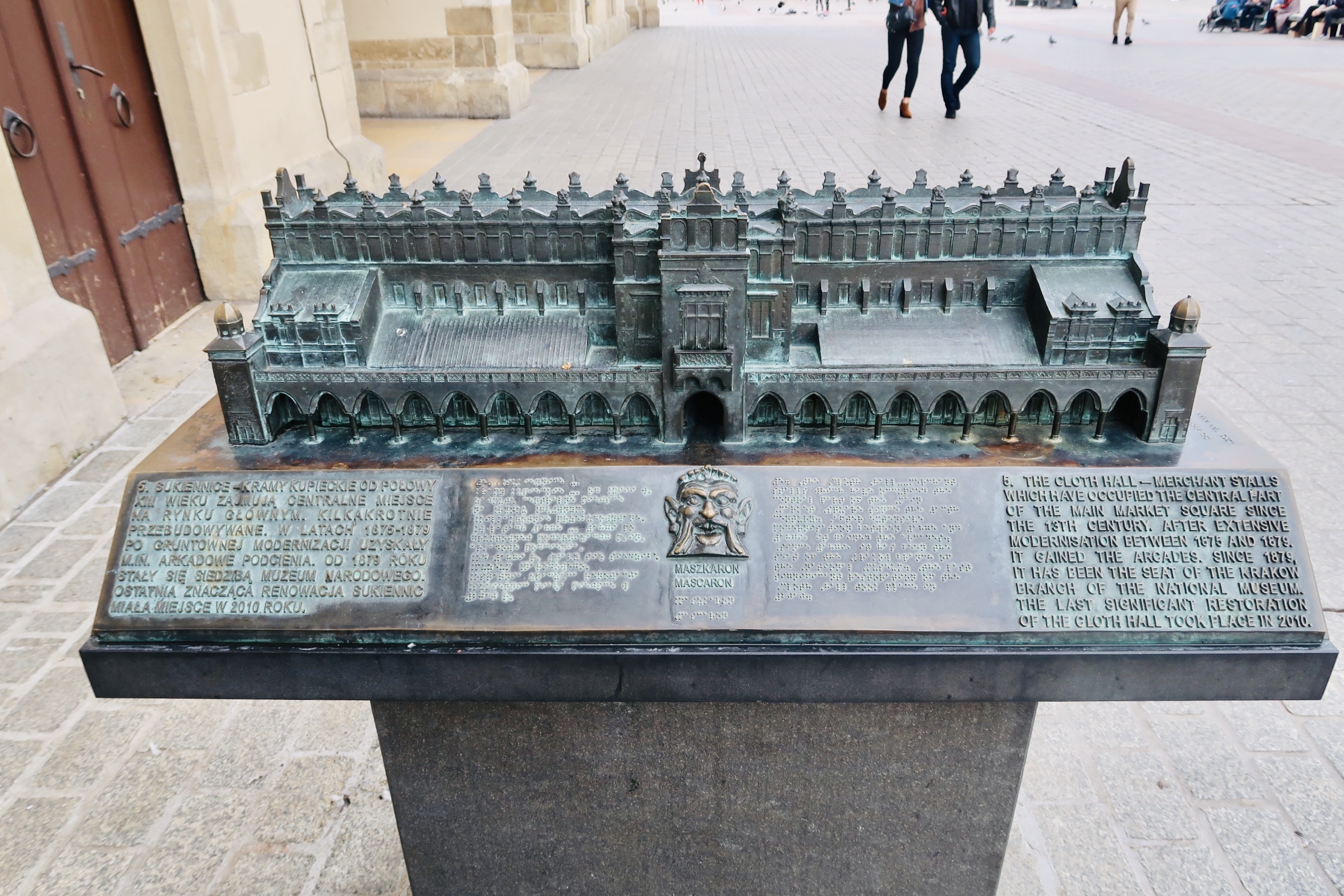
The Krakow Cloth Hall is one of the most recognizable features of Krakow and Krakow Old Town. Situated at the center of the Main Market Square, it dates back to the Polish Renaissance (that Golden Age in the 15th& 16th centuries). The interior of the hall contains shopping stalls which once held the bulk of the textile industry in Krakow. Buyers and Sellers would flock to the covered shopping center. It now not only serves as a shopping market, but also has an Upper floor museum that contains the largest collection of Polish painting and sculpture, and hosts monarchs and politicians from other countries (Prince Charles and Emperor Akihito visited in 2002). We did a little shopping within the hall and enjoyed seeing the variety of items offered, from tourist tchotchkes to hand crafted designs.

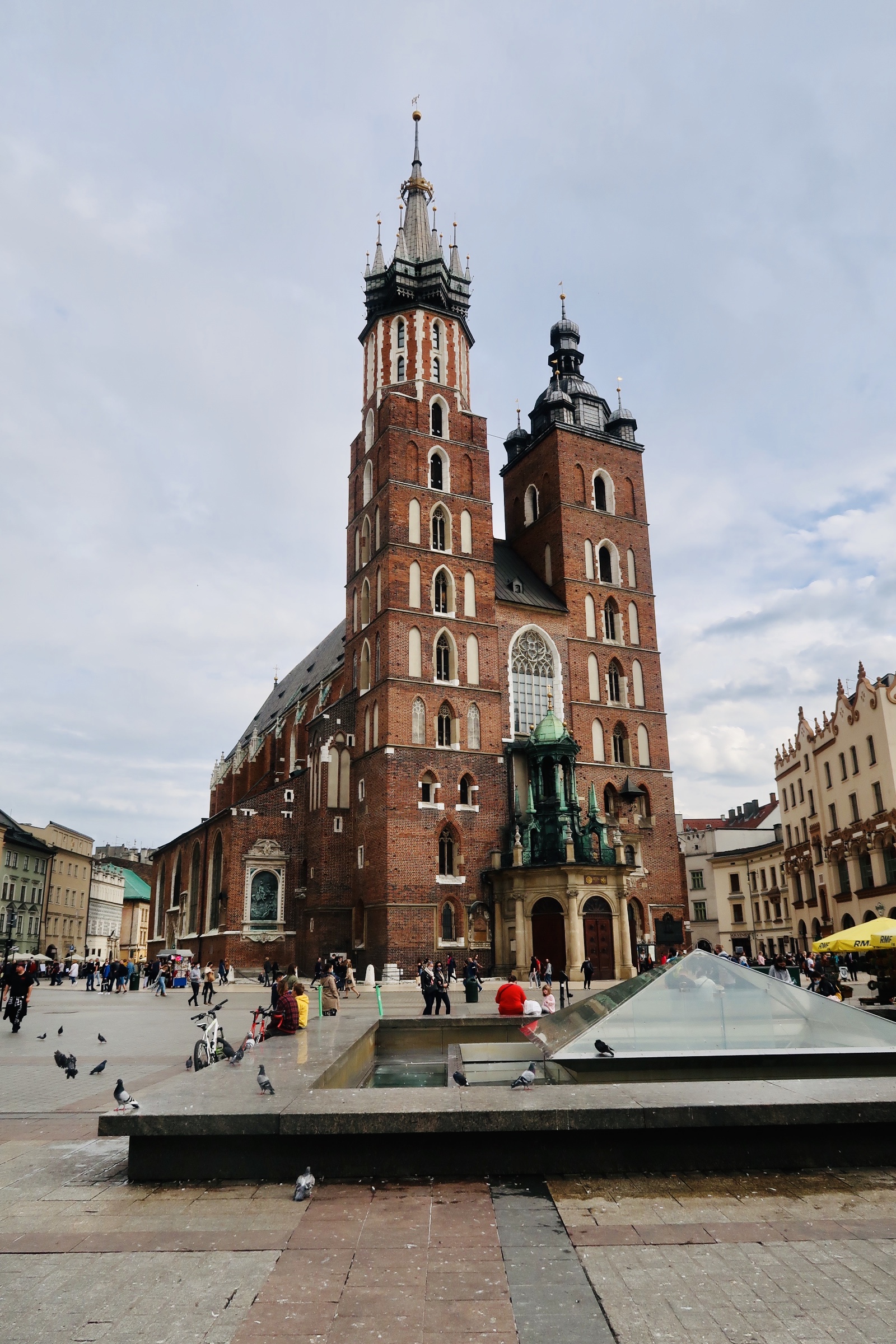
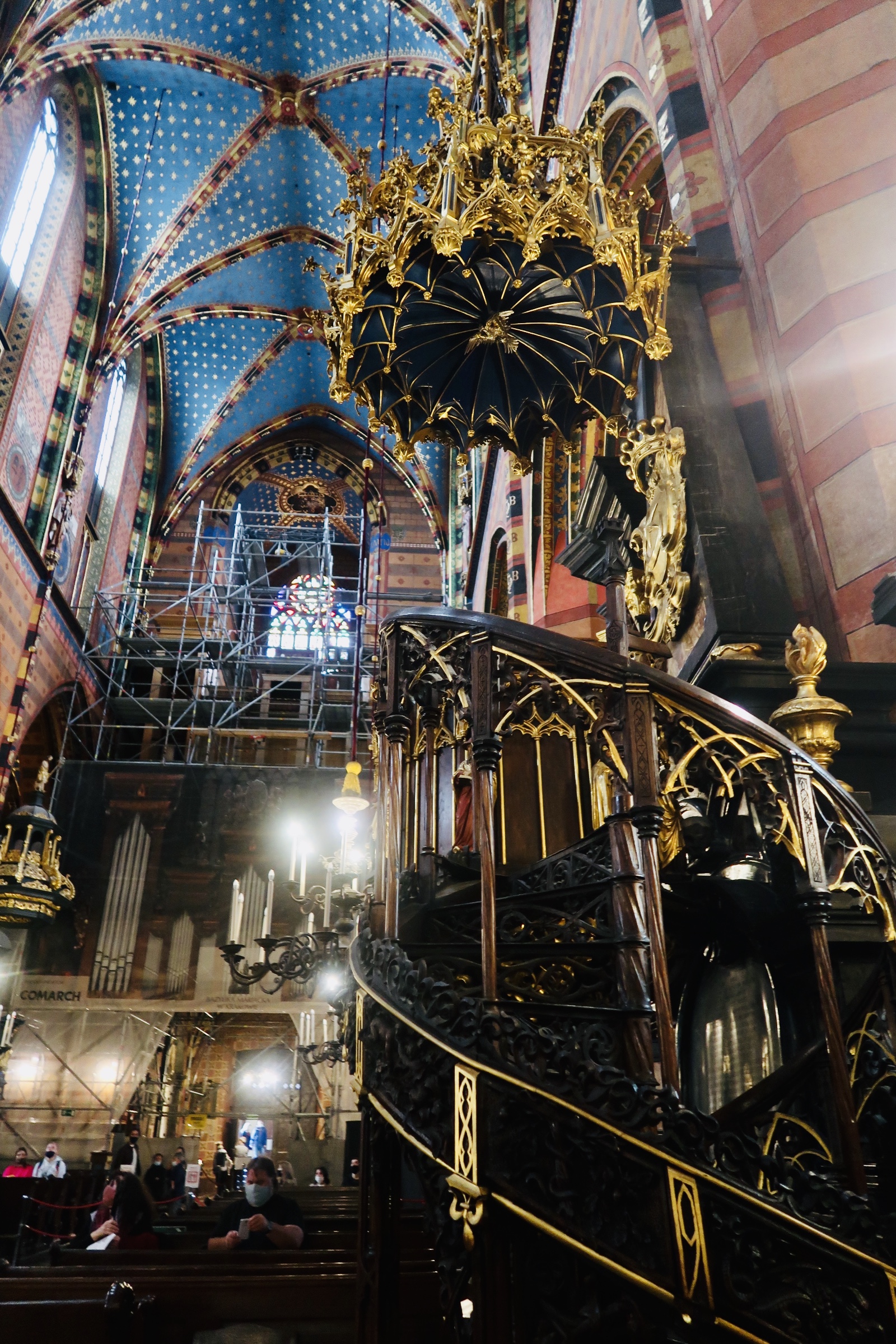
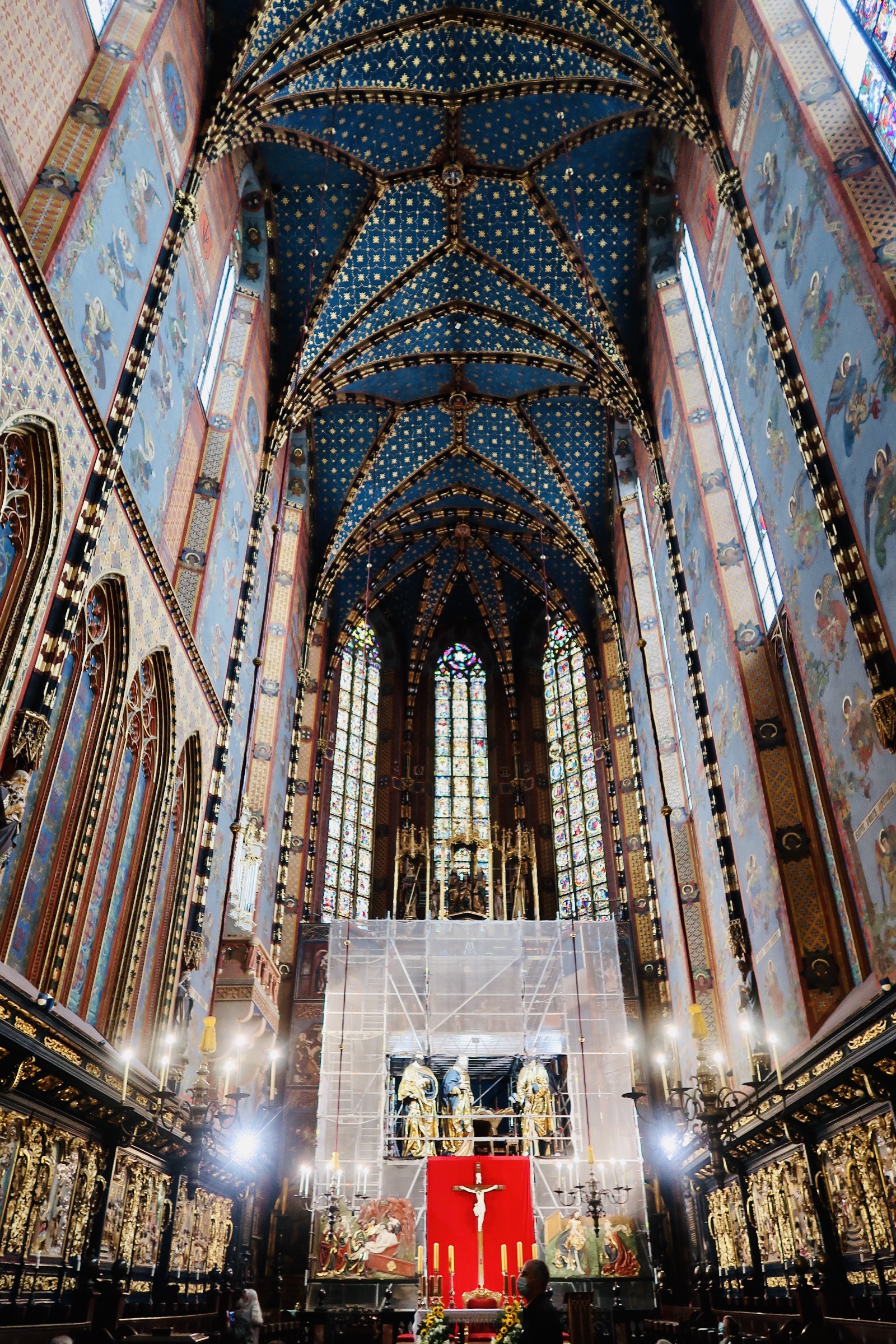
We also stopped in to see Saint Mary’s Basilica. With the foundations dating back to the 13th century (completion in the 14th century), this church is a great look into the Gothic Architecture of Poland. The current standing church is the third one, as the original (from the 1200’s) was destroyed by the Mongolians, and then the second was rebuilt under Casimir III’s rule. The interior is, one again, incredible. There are two main “focal” points of the Basilica. The first is the interior altarpiece. This was undergoing some restoration work, so we weren’t able to get a good view, but what we did see was stunning. The second point is the trumpeter of the basilica. A trumpet signal (the Hejnal Mariacki) is given at the top of every hour from the top of the taller tower. An interesting note while you listen- the song seems to end rather abruptly; this is to commemorate the trumpeter who used the signal to warn the city of the Mongolian Attack. During the signal he was shot in the throat. The signal is rumored to have been initially used to signify the open and close of the city gates (this was done across Europe), but there is no concrete evidence as to where this specific signal originated. 

We started off our Sunday morning with a visit to Auschwitz I and Auschwitz II-Birkenau. I’ve done a separate, dedicated blog post on this concentration camp, which you can find here. 

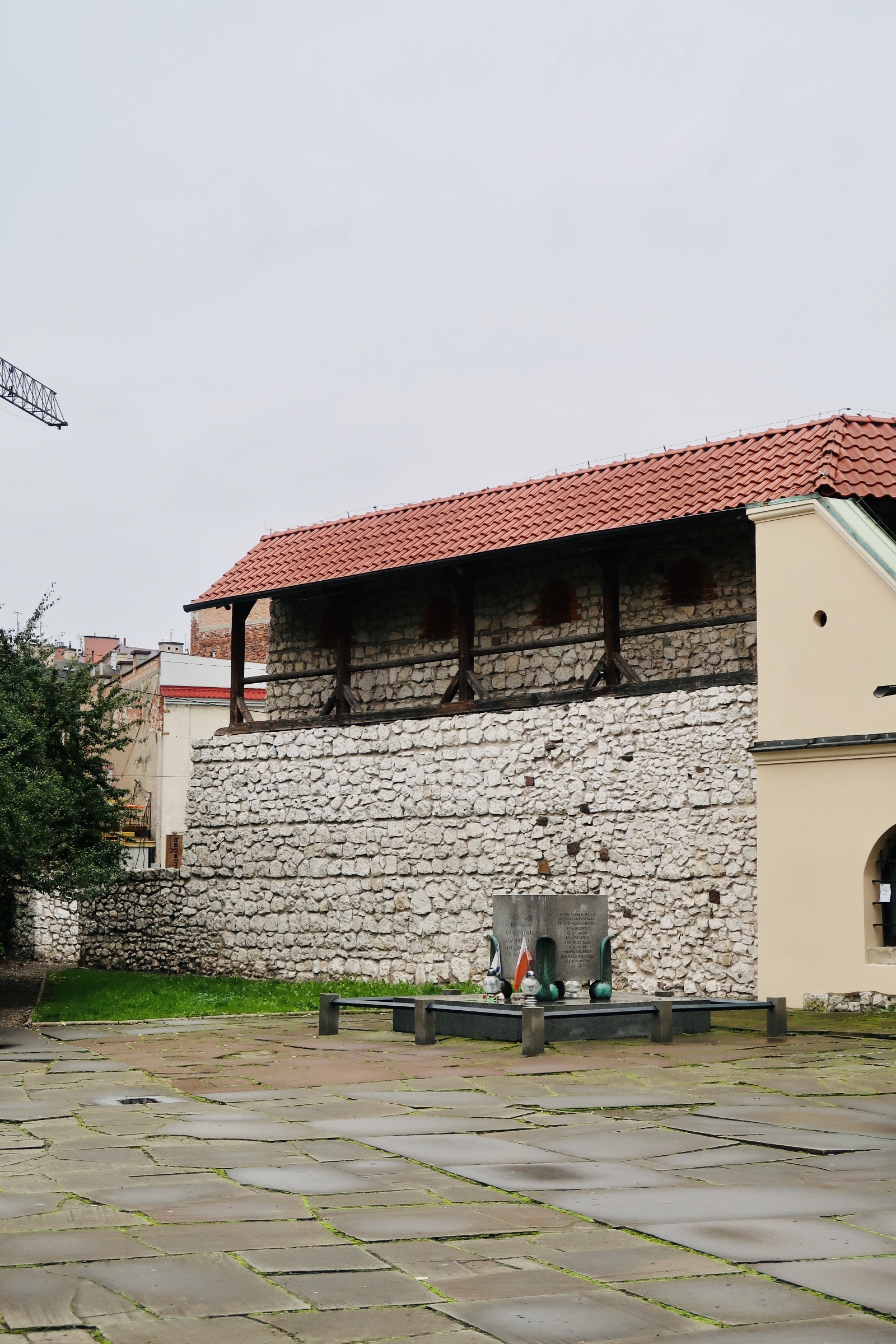
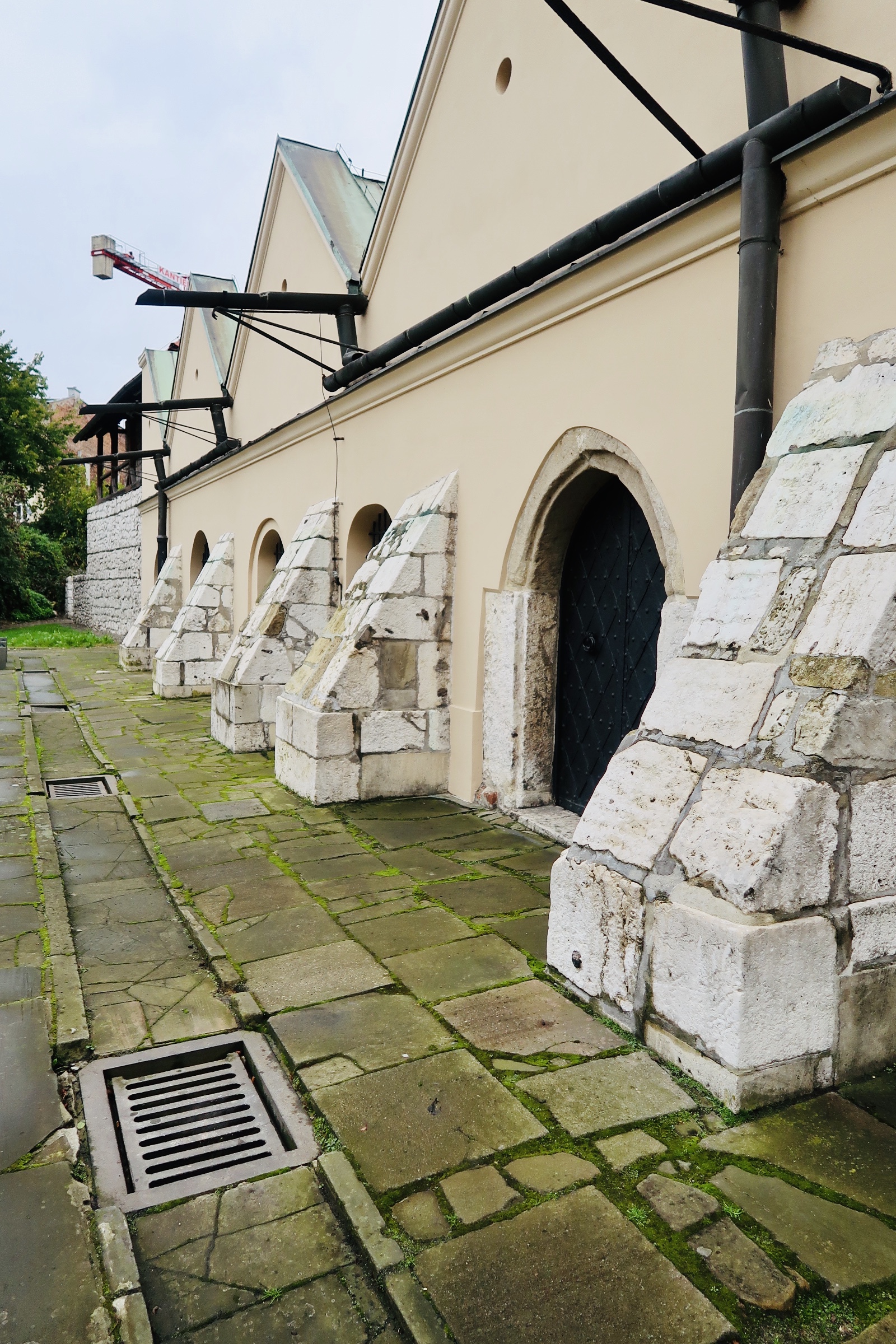
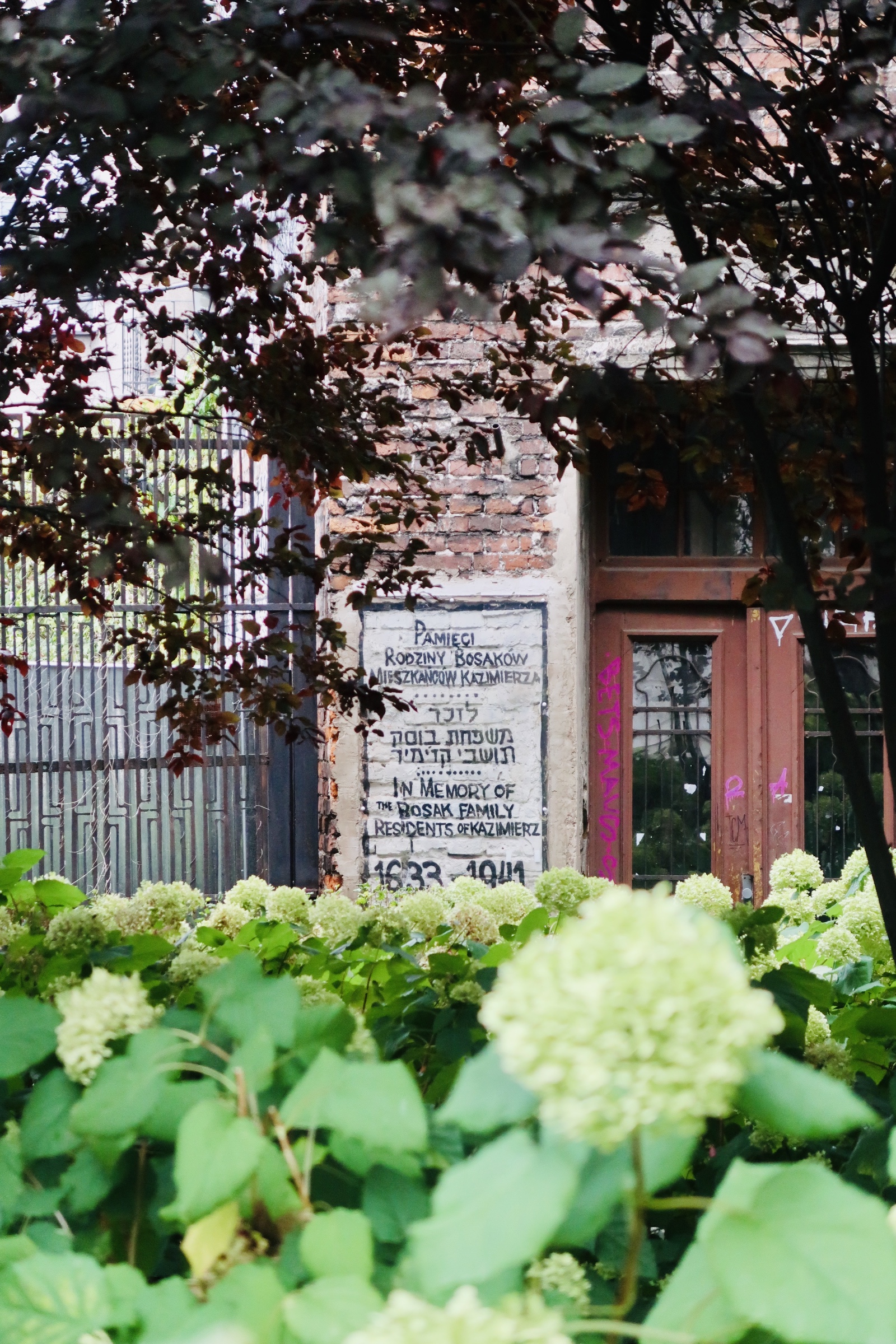
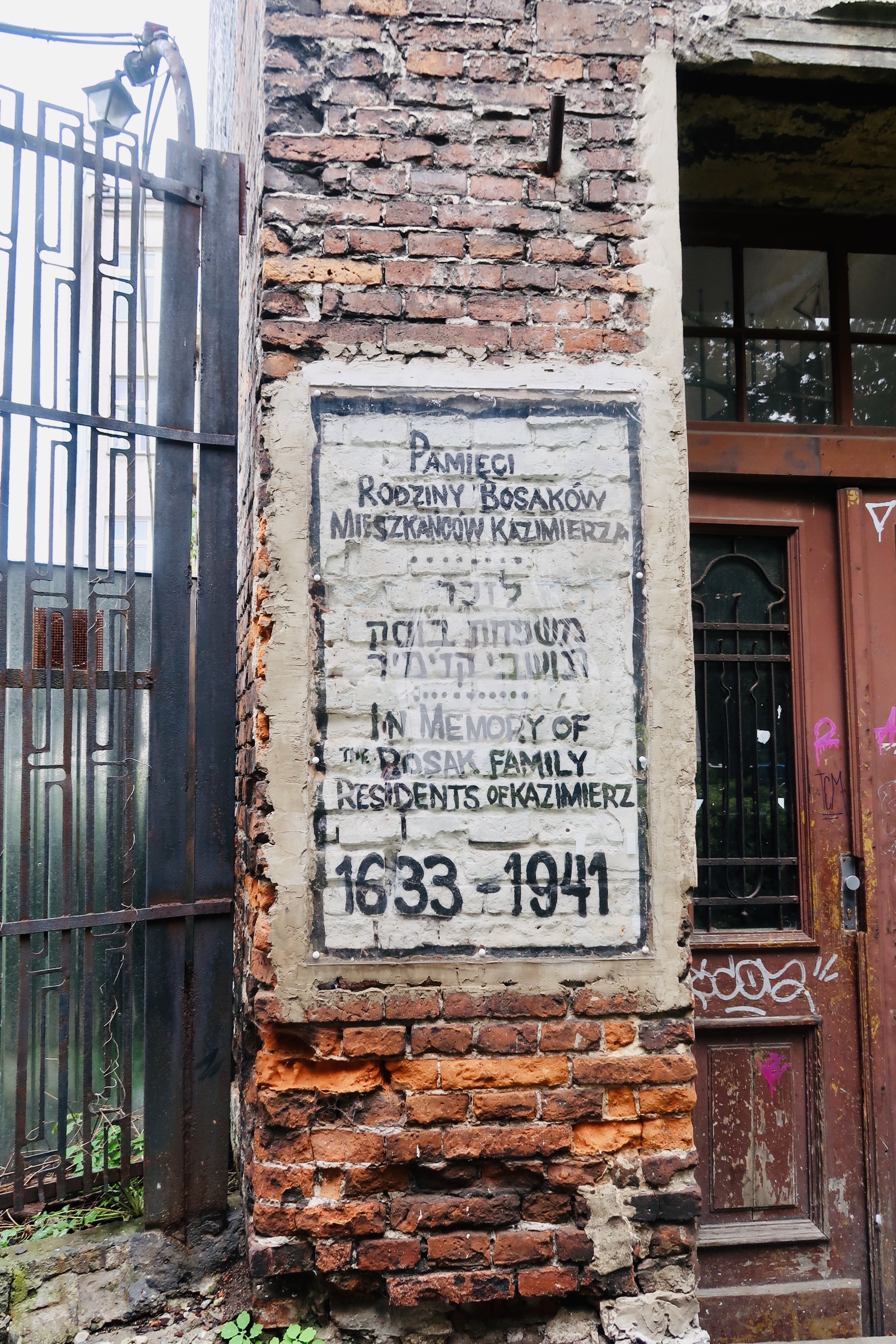
On Sunday afternoon we headed over to  the Jewish Quarter, Kazimierz. We visited during the High Holiday, Sukkot, so we were not able to go into any of the synagogues or such, but we still were able to see quite a bit walking around and get an idea of the history of the area. A Jewish community focus in Kazimierz came about in the 1400’s when anti-Semitism started to run rampant through Krakow. When a fire burned down a large part of Krakow in 1494, the Polish King transferred the Jews from the Old Town to the Bawol District of Kazimierz. The Jews then petitioned for rights to build its own defensive walls. The area within the walls was known as the Oppidum Judaeorum and was, geographically, only 1/5th of the size of Kazimierz, but held nearly half of the people of the city. The oldest Synagogue in Kazimierz was built in the early 1400’s (the actual year/date is disputed) and was an Orthodox fortress synagogue (known in Yiddish as Alta Shul). The initial golden age for the Jewish Quarter came to an end in the 18th century when the Austrian Emperor disbanded the area and tore down the walls. Not long after that, Kazimierz lost its city status and was brought into the newly formed district of Krakow. Kazimierz kept the “Jewish District” status due to the fact that the majority of the Jews stayed close and within the limits of the city. 

Up until the invasion of Poland by the Nazi’s, this was the most important synagogue in the city and the main center of the Jewish community (beyond just religion- it also was a social and organizational center). During the Nazi’s reign, the synagogue was ransacked, destroyed, and used as a warehouse. It also has one (at least) instance of the defensive wall being used as an execution site for Polish hostages by the Nazi’s. Kazimierz was not the location of the crowded ghetto of Krakow though, most of the Jews of Krakow were transferred to a ghetto location in Podgorze (another heavily Jewish area across the river in Krakow) and then either killed in the ghetto or at the death camps. After World War 2, the Jewish District was largely neglected, but starting in the 1980’s started to see growth and a resurgence of Jewish Culture. It now has quite a community built to celebrate. 

Once we finished up in the Jewish District, we headed back over to Wawel’s Castle to visit the dragon and walk along the river. I’ve already talked about the legend of Wawel’s Dragon, but we wanted to see the statue for ourselves. The boys also got to pick up a couple of stuffed small dragons to take home as a little souvenir. We didn’t stay out too long as the temperature very quickly started dropping and we had had quite the long day. One final dinner in the main market square and back to the hotel we went. 

And just like that, our weekend in Krakow came to an end. 

Interlaken-Oberhasli District, Switzerland – A Long Weekend

We recently just spent a long weekend in Switzerland. Ok, I need a moment already, just from typing those words. Never in my wildest dreams did I think I would utter that sentence. Never. 

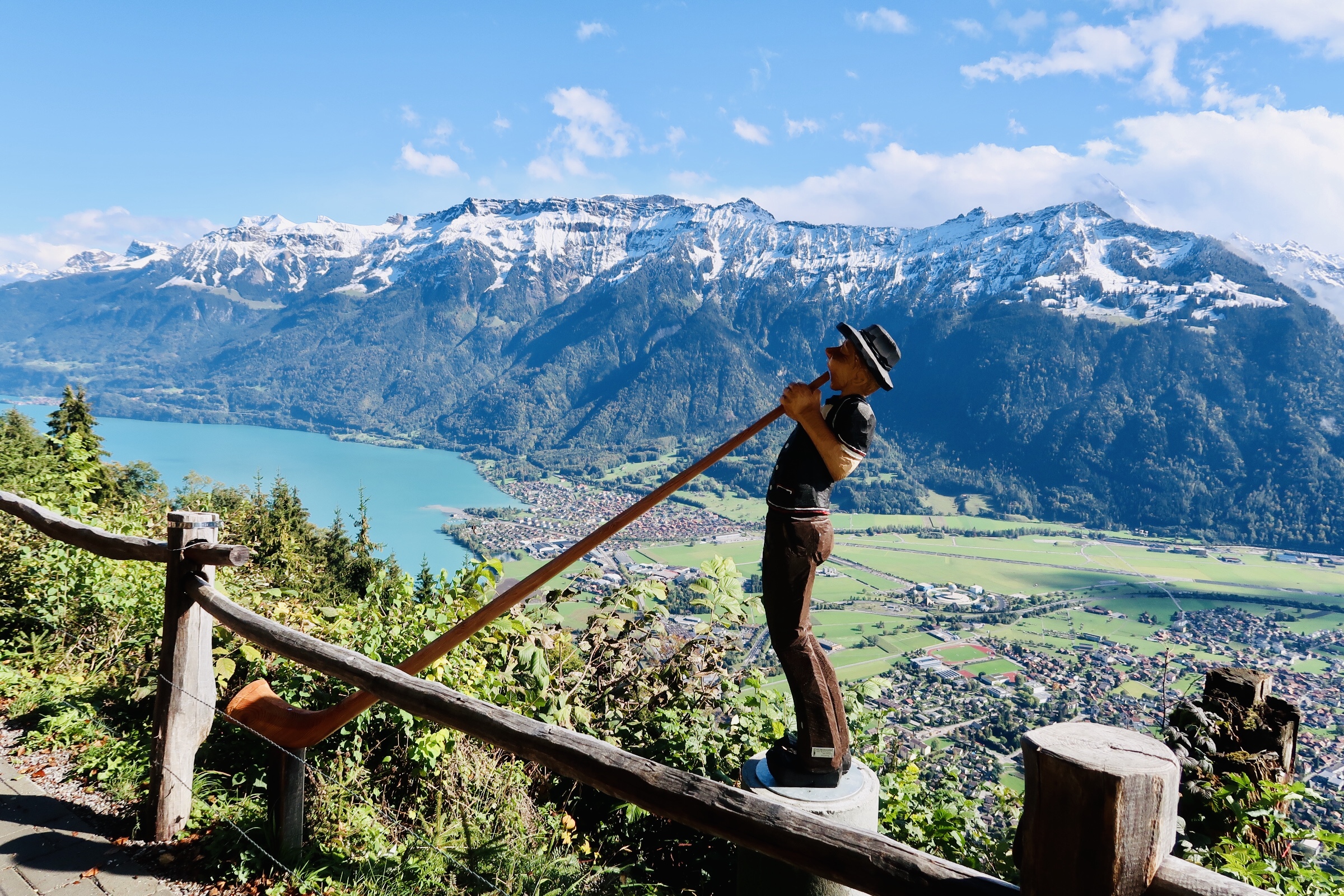
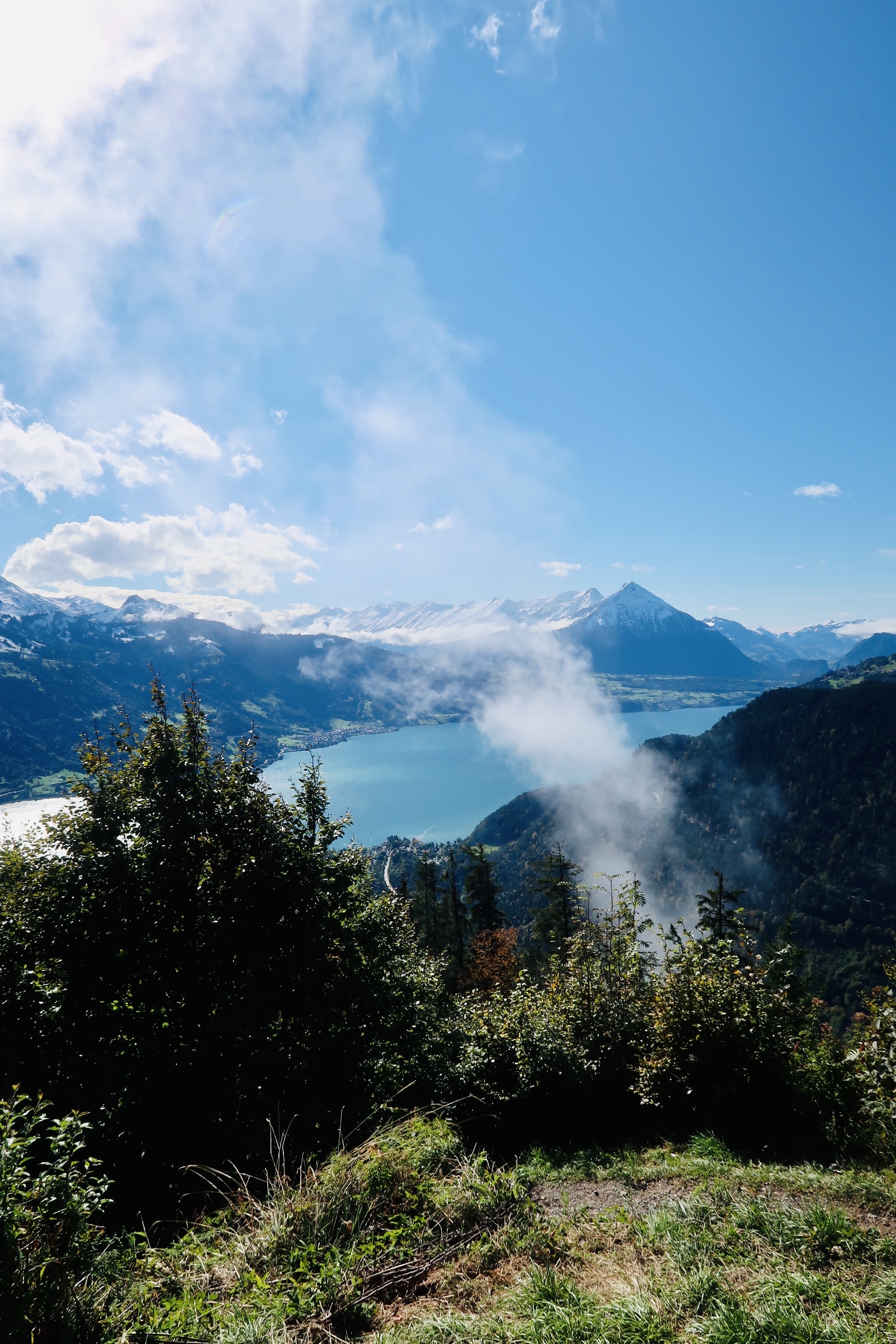
Ok, shock over. We recently spent a long weekend in Switzerland, and it was glorious. Where do I even begin? My husband’s only requirements for the trip was to be able to see/be at the top of the Alps, so we picked a spot right near Interlaken, in the heart of the mountains and lakes. With COVID-19 restrictions we were restricted from traveling to some of the major cities, and we wanted to be a bit…off the way. When a local friend posted about a hotel she stayed at right on Lake Brienz, I knew that was where we needed to be. 

One little, teensy, note to make about Switzerland before we get into the meat of this post. If you know anything or have heard anything about Switzerland it is that it is an expensive place to visit. This is not an exaggeration. You will need to plan accordingly for this visit and budget if you need. There are certainly ways to make it a “cheaper” trip, but it will never be inexpensive. For us, I knew that this was going to up towards the more expensive trips we took on our time here and I was 100% ok with that. It was more important to me that we did what we wanted to do and enjoyed our time without worrying about the cost necessarily. With that being said, there were a couple of things that we DID NOT do, which I will get into later. 

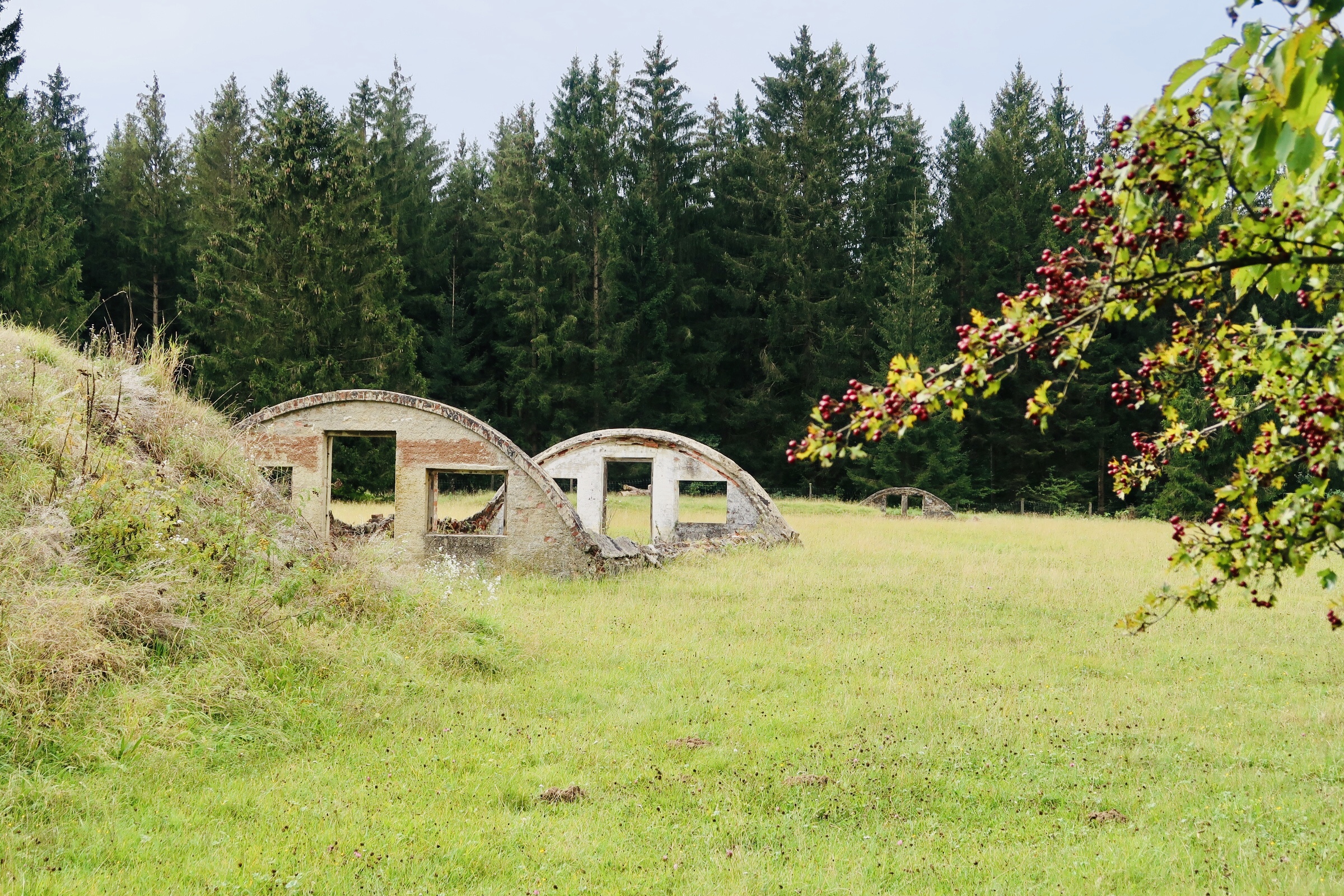
Before we got to Switzerland though, we made a stop at KZ-Lager Kaufering VII. This is a European Holocaust Memorial in Landsberg Germany and is the largest remote area (sub camp) of Dachau Concentration Camp. There was a total of 11 of these sub camps of Dachau and this one has the actual remains of the tube style barracks. In total these camps saw 30,000 prisoners, with at least 14,500 prisoners dying over the time the camp was open. Exact numbers are not known as the records do not match up (one study found upwards of 44,000+). The camps were intended to put prisoners to work on an armament project, without any consideration by the guards for the health and safety of the prisoners. During the war crimes investigation, it was discovered that these sub camps were the worst in Bavaria and the prisoners came to refer to them as “cold crematorias”.     

We were not able to walk inside the camp and see the buildings and cemetery up close, but you could still get a feel from outside the fence. This is the second concentration camp we’ve been to (Dachau Concentration Camp being the first and hopefully a visit to Auschwitz soon) and I will never be able to fully verbalize the experience. So, once again, I will let pictures say what I cannot. 

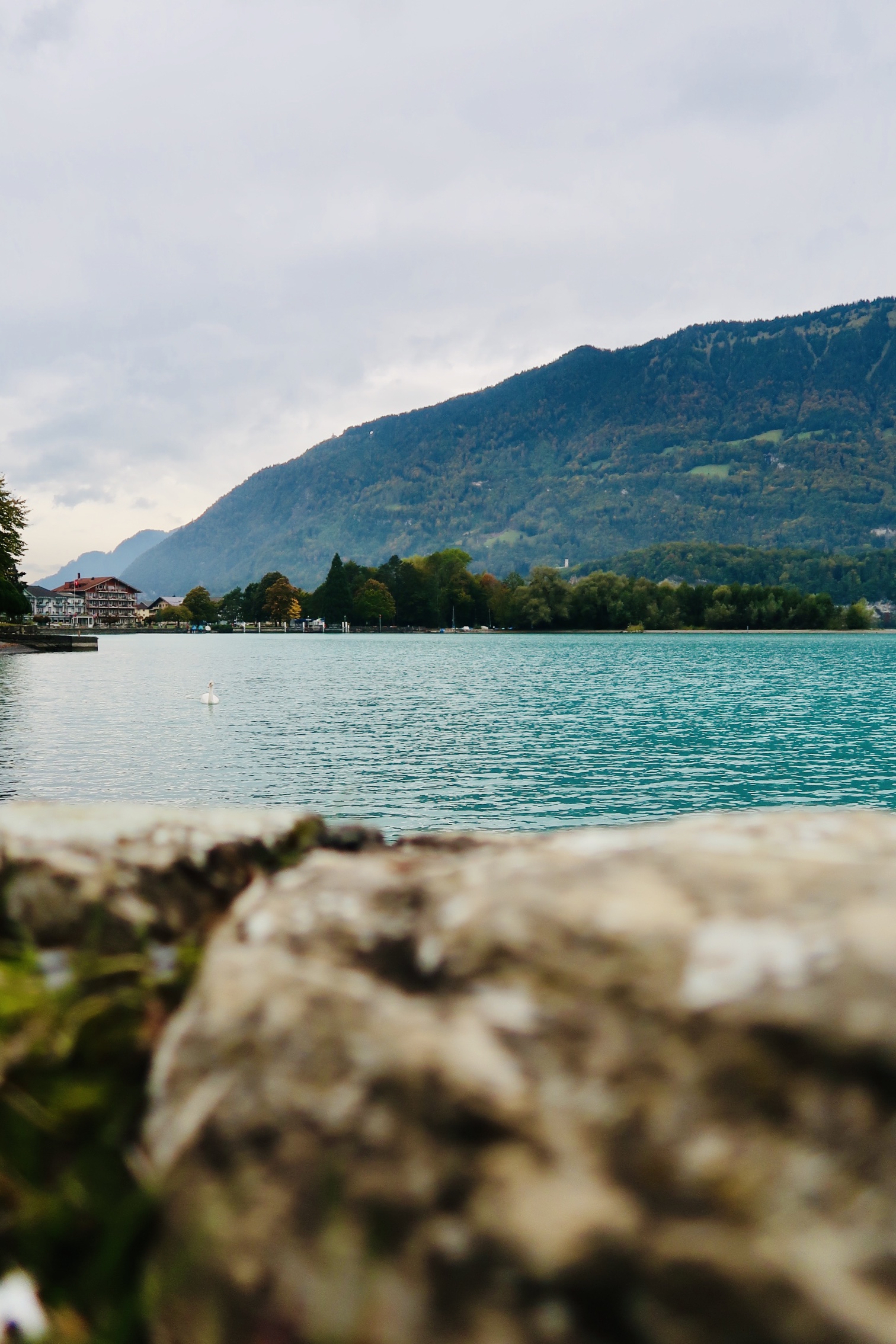
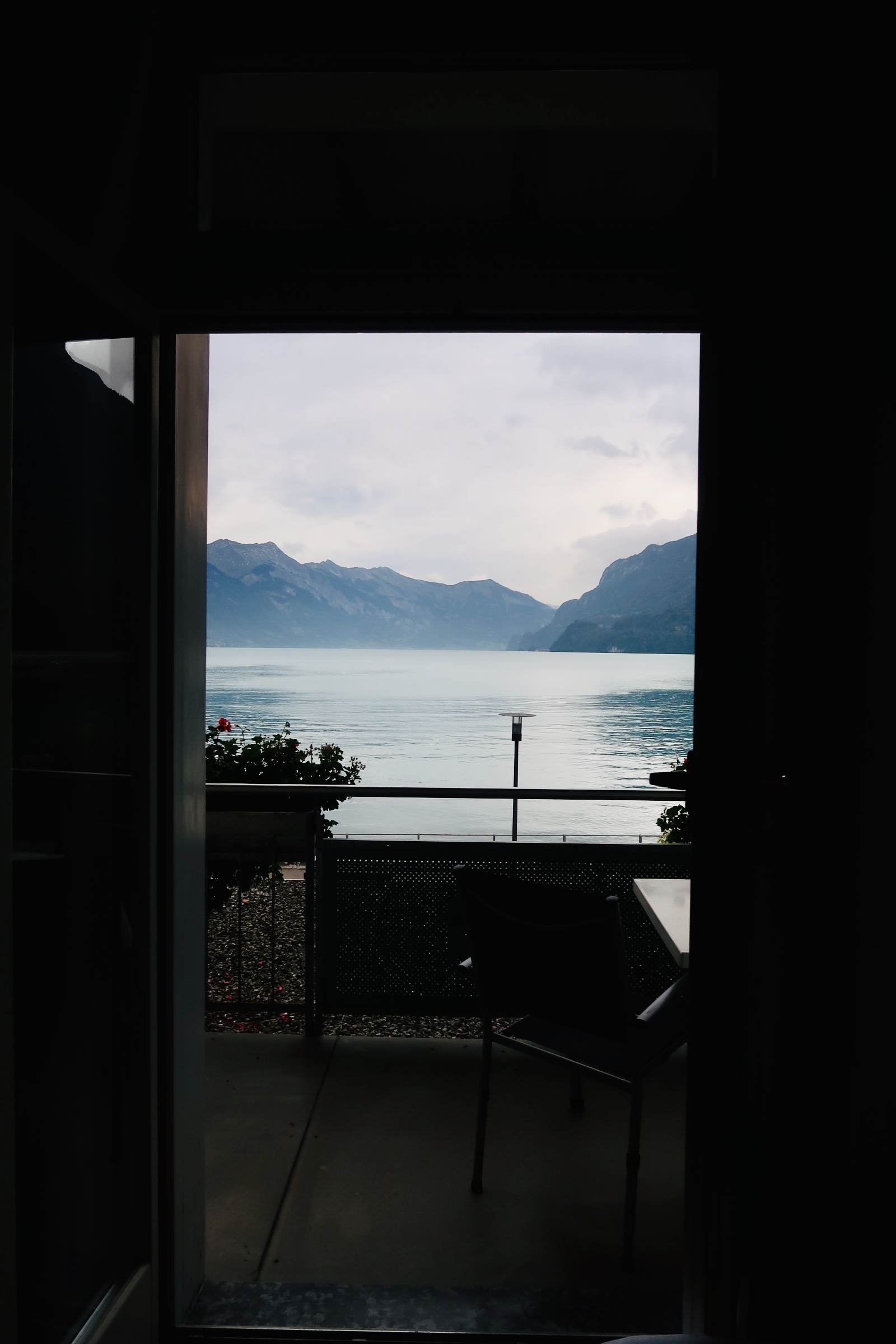
After that, we headed off on our Switzerland Adventure. We stayed at the Hotel Seiler au Lac. Not only is the hotel itself incredible (you can request a lake front room, all of which have balconies looking right out to the water- swoon), but the staff were incredibly helpful and went above and beyond our needs. We opted to have breakfast at the hotel (included), which was handled excellently with COVID restrictions. We did also opt to have dinner at the hotel restaurants (one night at each- two restaurants attached to the hotel), and both meals were delicious. This particular hotel is located in Bonigen, Switzerland, a quick distance away from Interlaken (you can walk or take a bus- passes were offered by the hotel), and only a 20-30 minute drive to either Lauterbrunnen or Grindelwald (Berne is about 45 minutes away if you want to go there as well). 

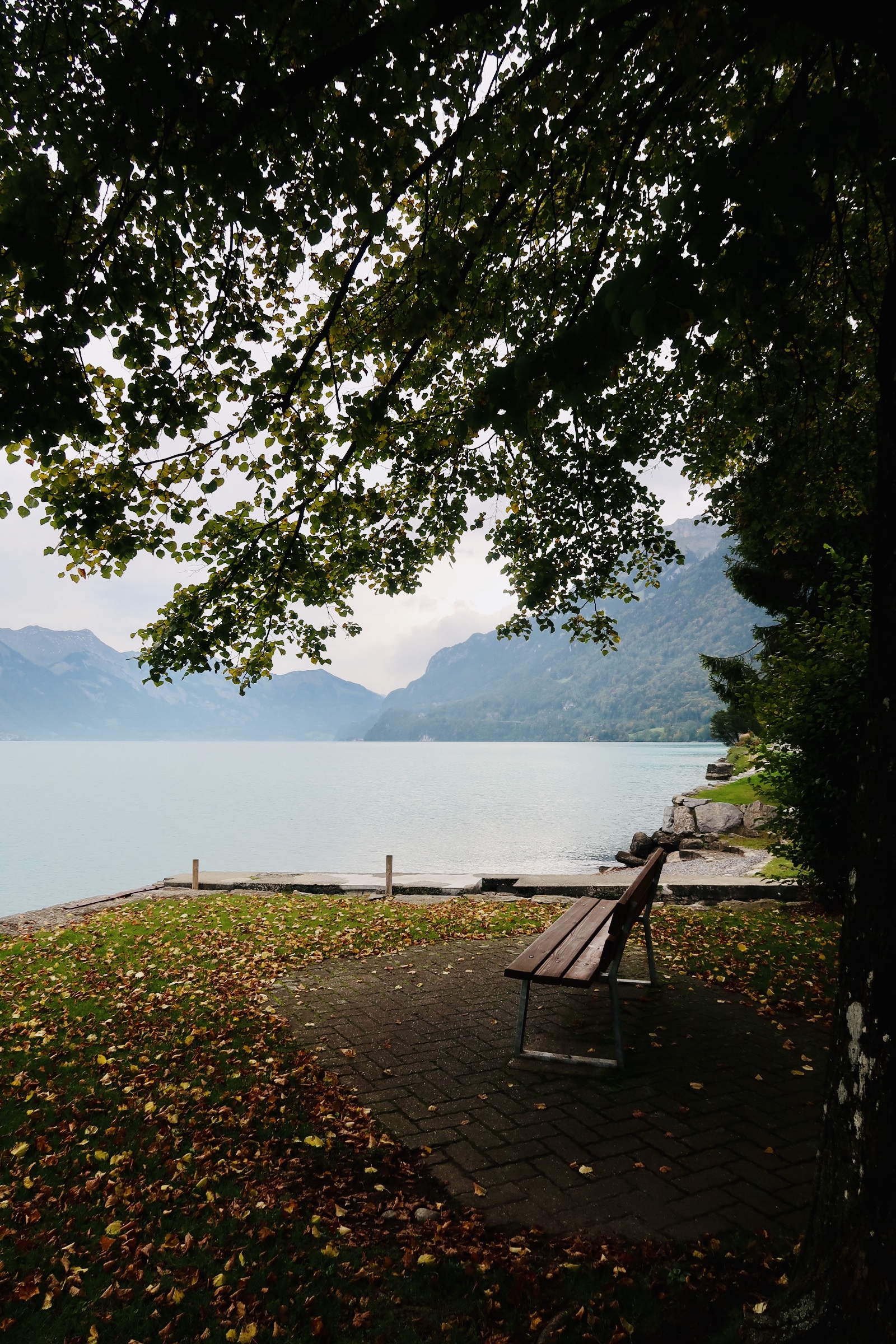
Our first evening was mostly spent wandering around Lake Brienz before settling into our hotel and grabbing dinner at the Pizzeria attached to the hotel. 

We set off late the next morning to head into Interlaken. 

Here is where I am going to clarify some of our choices in activities. There are a couple of things that I base “what we do” on, the biggest factor being the weather. It was a wet and rainy morning in our area of Switzerland, so we knew going to Jungfraujoch (the top of Europe- aka the highest point of Europe) was going to be hit or miss. The second factor, less so than weather, is cost. This is really only specific to Switzerland as things are, generally, more expensive in the country. We made the decision to pass on heading up to Jungfraujoch as the potential for bad weather combined with the cost was not worth it for us. Instead we chose to top some of the smaller peaks, and this was just as incredible as anywhere else we could have stopped. 

So, back to our day. Chances are, if you’ve tried to take a train or summit one (read: many) of the Swiss Alp peaks, then you’ve gone through Interlaken. Not only is Interlaken the central city between Lake Brienz and Lake Thun, but it is also a main transport gateway to the Alps in the region. You’ve got the two lakes, then the River Aare which flows between them (and therefore between the city). There has been a city in this location since the 12th century, but it was originally known as Aarmuhle (changed to Interlaken in 1891). It started out as the home of a convent and monastery, but as it continued to grow, it became a large city. It started to become known as a resort town in the early 19th century, with a railway opening in the 1870’s (and more following in the next 20-30 years). 

We spent most of the rainy morning walking throughout the town seeing all the beauty that is offered in the valley. I think one of the best things to do sometimes is to just walk around the streets. We didn’t have any “set ideas” of spots to see until the weather cleared, so we just walked. We stopped in for a light lunch and during that, the weather started to clear out. Faced with breathtaking blue skies, snowcapped peaks, and a new look at Interlaken, we decided to head up to Harder Kulm. 

Harder Kulm is the top of Interlaken. Rising 1,322 meters above Sea Level you are able to get an incredible view of Interlaken, the peaks around the city (opposite), as well as the two lakes, Brienz and Thun. There is a viewing platform that you can stand on for a truly breathtaking experience. You don’t even have to worry about hiking up if you don’t want to (though you certainly can), there is a funicular that takes you to the top in just under 10 minutes. You are also able to go up top in the evening, and I believe there is a hotel located right above the restaurant if you would like to stay. 

We finished out the day at an indoor playground for the kids. Most of our travel is not necessarily based on our kids in terms of places we visit (maybe I’ll talk about different traveling styles in a blog post?), but we saw that there was a neat kids play park and we had a bit of time to kill between finishing up in the center of Interlaken and heading to dinner. So, we let the kids go a little wild and run off all the pent-up energy for a little while. They really enjoyed it and it was nice to be able to do something just for them on our trip. 

Our second day we decided to go over to Lauterbrunnen. It was a tough call as to whether we wanted to go to Grindelwald of Lauterbrunnen, you can’t really go wrong with either option, but I wanted to be able to see the waterfalls that Lauterbrunnen is known for. Honestly, I don’t think you could really go wrong with anywhere in this particular region, so explore it all if you can!

Lauterbrunnen as an area is first mentioned in the 13th century, with the name Lauterbrunnen being mentioned in the beginning of the 14th century. It has an early history of battles and rebellion between the villages and the Interlaken Monastery, ending in the 16th century. The villages that make up Lauterbrunnen were actually very poor. The area started out as a mining area, but all of the profits went to the noble families, and the working-class people remained below the poverty line. It got so bad at one point, that most villagers moved away, joining regiments and emigrating to the United States of America (settling in the Carolinas). At the end of the 18th century, Lauterbrunnen started to gain more traction when mount climbers would start expeditions in the town, and once the road was built from Interlaken to Lauterbrunnen, tourism exploded. Lauterbrunnen has inspired many a writer and film maker (with Goethe and Tolkien both referencing it in their own works, and the 1969 On Her Majesties Secret Service being filmed in the city). 

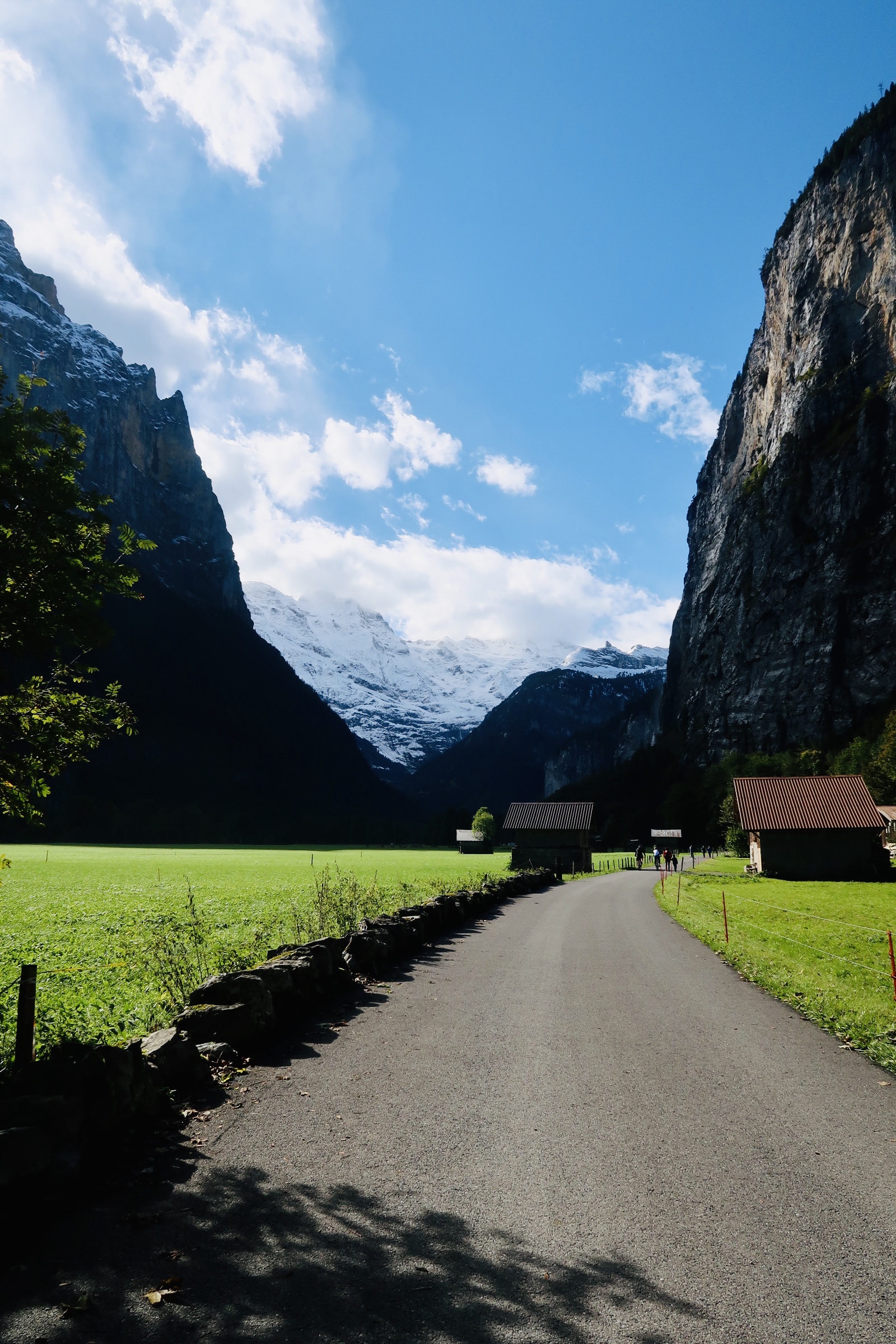
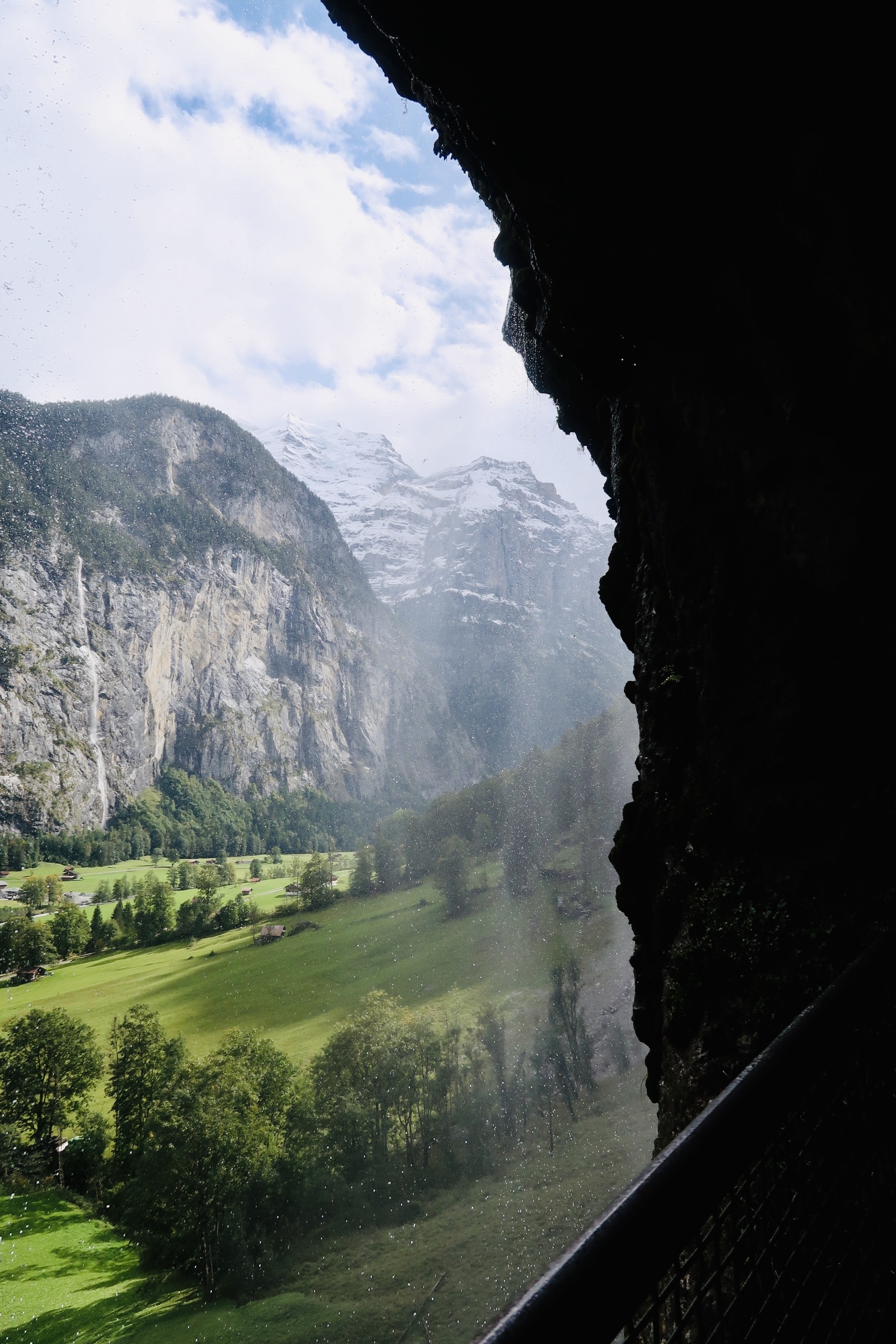
Lauterbrunnen is really known for its waterfalls and mountain peaks. It is one of the largest nature conservation areas in Switzerland and easily one of the prettiest spots we’ve ever visited. The valley is home to 72 waterfalls, the largest being Staubbach Falls which are one of the highest free-falling waterfalls. Another set that you can visit up close are Trummelbach Falls, which are a natural waterfall phenomena situation behind the rock face. 

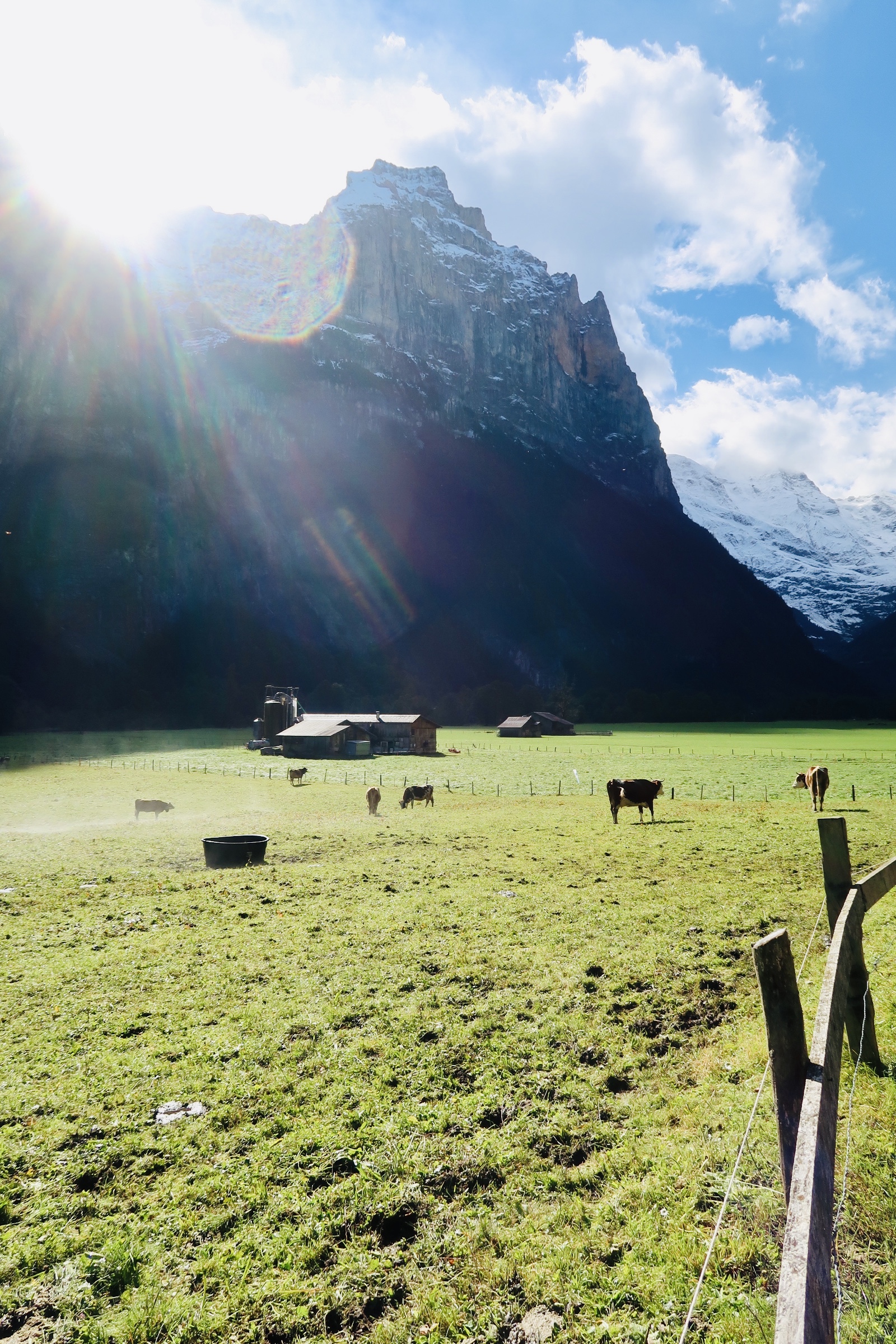
We started the morning off hiking through the valley to get to Trummelbach Falls. You are able to park right at the waterfalls if you’d like. HOWEVER, I would highly recommend parking in one of the bigger “in town” parking lots and then walking through the valley to the falls. It was an incredible semi sunrise hike (it definitely wasn’t sunrise, but the light still hadn’t reached in to the valley when we started walking) and you see so many more of the waterfalls this way, as well as get the chance to see some of the local cattle life and ranchers (we got to see a minutes old baby cow on our way back from the falls as well as buy local cheese from a little self-service booth). It’s all flat ground and we really loved being able to soak in all of the natural beauty. 

So, we started at our furthest out point, Trummelbach Falls.

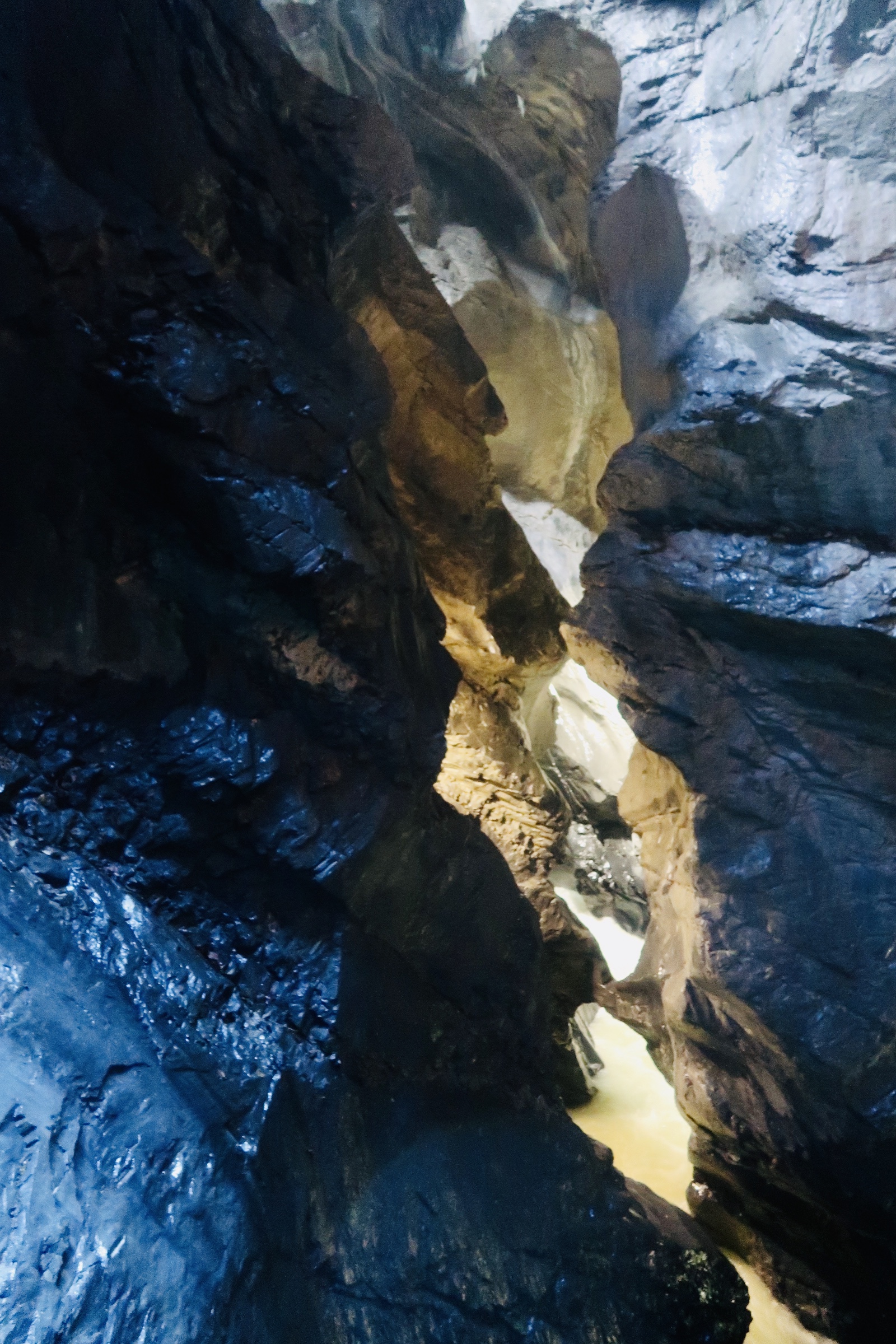
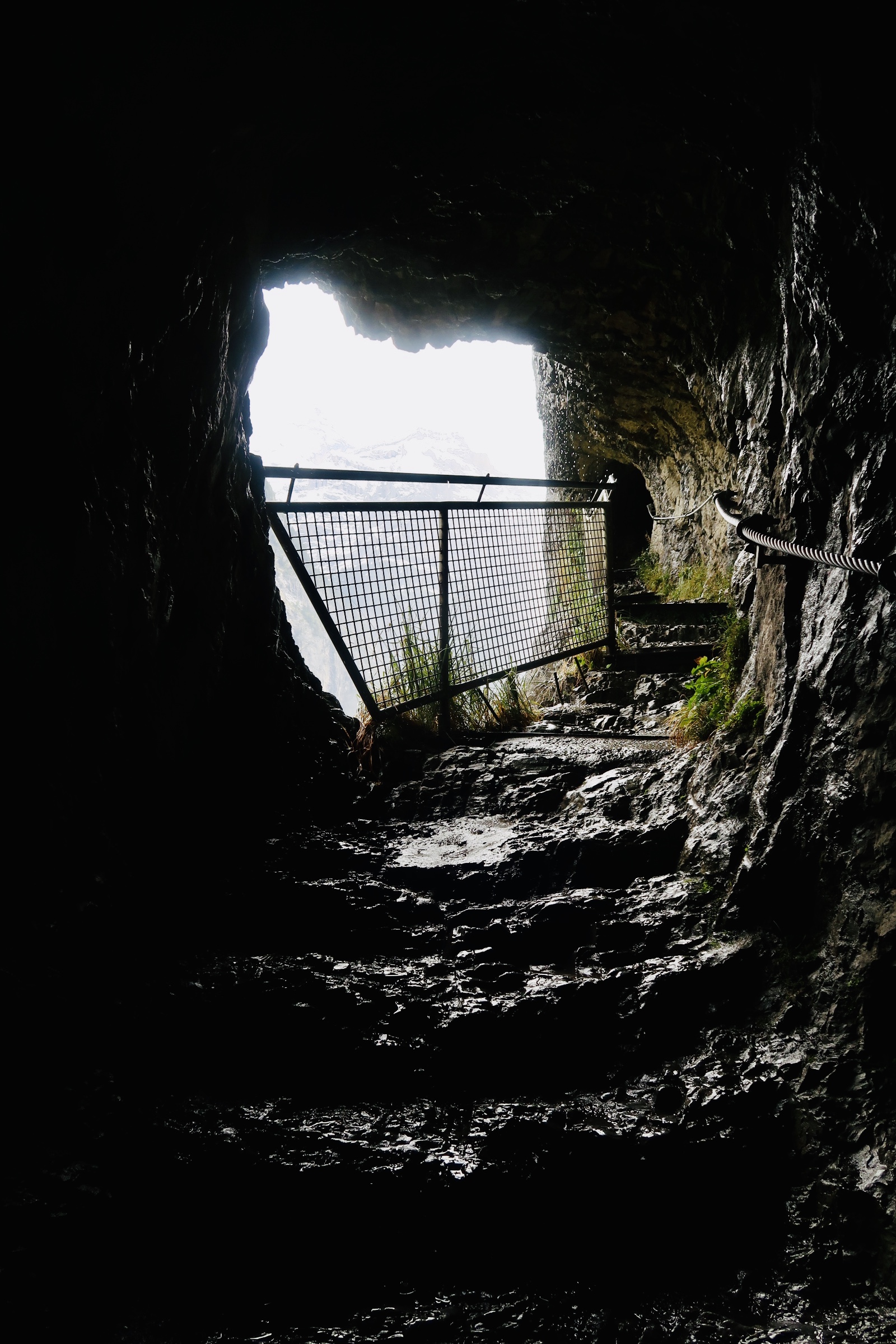
Trummelbach Falls are the largest subterranean water falls in Europe and can carry up to 20,000 tons of meltwater from the glaciers of Jungfrau. They are incredibly loud (thundering loud), cause the mountain to almost tremble at the power, and are the most incredible thing mother nature does. If you’ve read my Garmisch-Partenkirchen post, you’ll recognize a pattern of water going through rocks makes me just swoon and feel overwhelmed with amazement, and Trummelbach Falls was no different. We were lucky with our timing as we were able to see all 10 chutes of the falls (at a total height of 200 meters), whereas during certain times of year you are only able to see the top chutes. They do not recommend this activity for younger children (in fact they don’t typically allow children under the age of 4 in) and I would be careful walking through the paths- it can get very slippery. 

From there, we walked back towards town with a stop at Staubbach Falls.

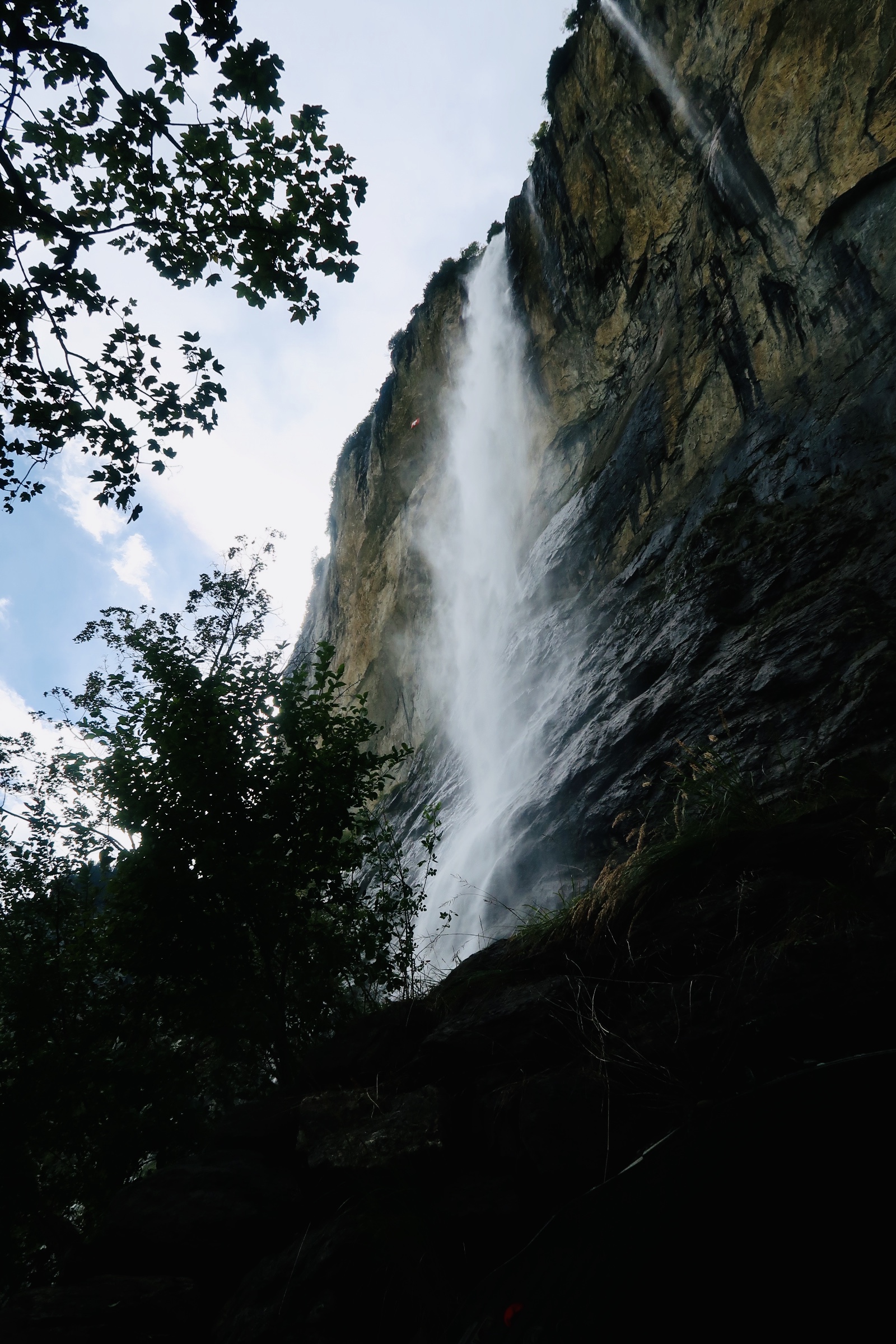
Staubbach Falls has a height of almost 300 meters (297 to be exact) and , in addition to being the highest in Europe, are the most famous of the waterfalls in Lauterbrunnen. The waterfall inspired Goethe’s poem, Song of the Spirits over the Waters and disperses water as if it were dust. You are able to climb a portion of the rockface to be “under” the waterfall; HOWEVER, I would not recommend this for young kids. I was the only one who went up the rockface and, once I reached the end, was glad my boys did not head up. It is a really cool experience though, and if you can, I would recommend it for adults.

The entire valley is one for the nature lovers and reminded us just how incredible the world around us really is. So much beauty and a place I’m glad we spent a whole day in. 

From the falls, we decided to head up the mountain towards Murren. From the base of Lauterbrunnen you are able to take a gondola up the mountain to Schilthorn, then either hike or board a train towards Murren. We chose the train (much to the boy’s excitement) and were treated to a narrow-gauge railway and breathtaking views.

Murren is a traditional mountain village at 1,638 meters above sea level. From Murren you are able to see Eiger, Monch, and Jungfrau mountains around you. I think this is a great alternative, if you just want to get up in the mountains, but don’t necessarily want to do the Jungfraujoch. There is an element of “off the beaten path” and an actual look at what life is like up in the alps, even though during the summer this is one of the more popular alps spots.  
We finished out our day in Lauterbrunnen with a hot chocolate made in a local coffee shop before heading back to our hotel and our dinner reservation. 

And that wraps up our long weekend in Switzerland! Easily one of the most incredible places we’ve visited, and it definitely makes my top 4 places we’ve traveled. I’ve used a lot of words in this post (2319 at this point to be exact), but none really can come close to what this region was like. 

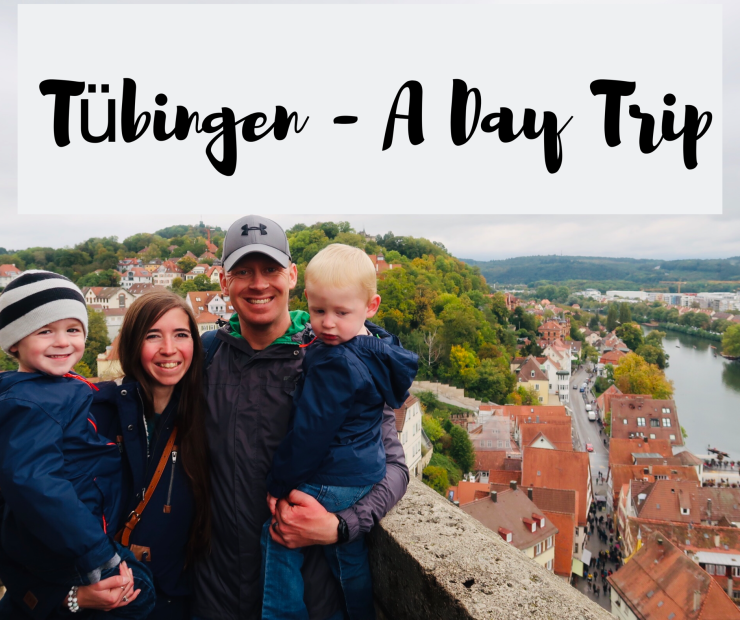
Tübingen – A Day Trip

On our weekend away we had a free day in between the castle’s we had planned on seeing. We decided to spend this free Saturday in nearby (to where we were staying) Tübingen. Tübingen is a university town in Baden- Württemberg that is full of old-world charm. My favorite bits happen to be what it’s known for: cobblestone streets (full crooked, tight, bumpy cobblestone) and the traditional timber homes that line the streets.

Tübingen has a very long history (dating back to the 6thor 7thcentury), although the first time there is any official notice of the town involves the town’s castle: Hohentübingen (this is Germany after all – and everything involves castles). Tübingen formally became a city in the 1200’s and “shortly” after that (about 30 years) a monastery was established by the Pope. In the 1400’s the Collegiate church was built AND the Eberhard Karls University was founded. This particular university is one of the oldest universities in Central Europe. The university continues to make a name for itself as one of the biggest universities in Germany and the biggest source of income for the city’s residents. Tübingen has also been a spot for quite the political history being involved in The Thirty Years War, Kristallnacht during WW2, being a center of the German Student Movement, being a part of Protests of 1968, and having student ties to a terrorist group (The Rote Armee Fraktion).

A quick fun fact for you: Tübingen’s Altstadte is one of the few completely intact Altstadte’s in Germany. It was not destroyed during WW2, which allows a visitor to get a real glimpse into what the city would have looked like throughout the years.

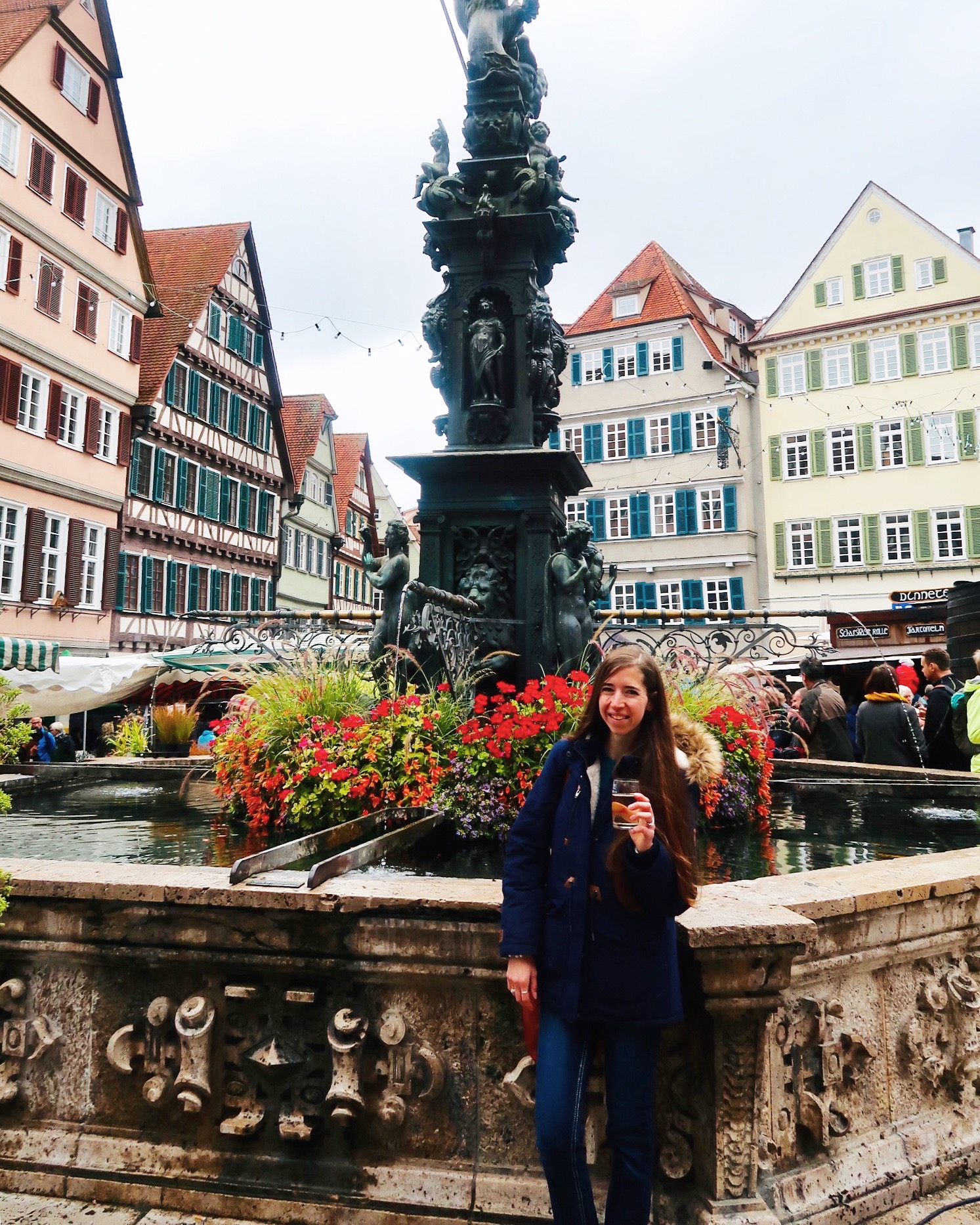
We visited Tübingen on a grey rainy day, but that didn’t dampen our spirits. We started out our day walking through the Market Square (Marktplatz). This market square also holds the Town Hall (Rathaus). The day that we went happened to be the day they were holding their Regional Market, so we got to sample a wide variety of goods, including a home made from scratch fresh pizza and Birnensecco ( a locally made pear prosecco). Both were delicious. We also got to peak around the stalls for local handcrafted goods including floral, produce, clothes/crochet/knitted goods, and different salami and cheese products. It was a fun little start to our day (and provided us lunch). This to me was just the European/German experience.

From the market square we wandered up to Hohentübingen to peak around the castle.

By best guesses the castle was originally marked in the 11thcentury, but was completely demolished and rebuilt in the 1500’s. In current day the castle holds the Museum Alte Kulturen, which was opened in 1997 to the public. There is also a section in the castle covering the advances that were made in the realm of sciences- this castle held one of the first biochemical lab worldwide, and talks about DNA. The rooms cover both modern-day sciences, as well as artifacts and the discoveries made at this particular location.

4FF8A7E4-9755-4D36-A77A-DF1F69F12EB0.JPGFrom the castle we wandered back down the street to stop once again at the market to pick up some food/drink and take a little break. Once refreshed (see above for what we ate) we headed over the St. George’s Collegiate Church (also referred to as Stiftskirche).

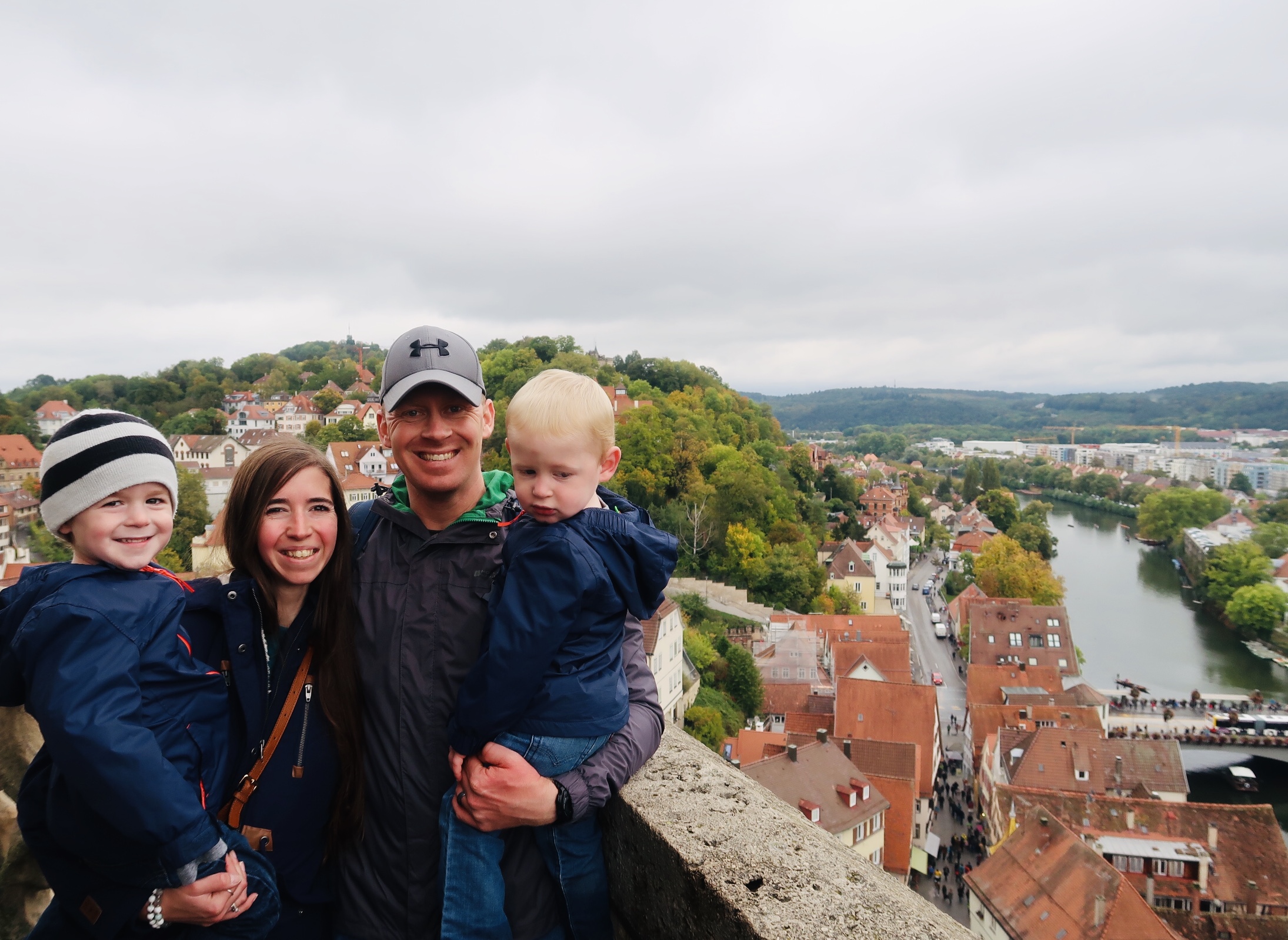
Dating back to the 15thCentury, this is one hell of a church. Fun fact: this church was one of the first to convert to Martin Luther’s Protestantism, although it still has several Roman Catholic features. We wandered through the main church, then paid a slight fee to head up the church tower. In this particular church, as long as the bells aren’t actively ringing, you are able to walk up the numerous stair steps to get an “eagle eye” view from the tower.

Not only is that an incredible view, but you get to see how the bells actually work from the bells themselves, the weights at the bottom, and the gears that make them ring. Looking at the bells it is actually incredible to think that a long time ago, people actually rang the bells themselves without the benefit of the gears.

IMG_0148

The view from the top really can’t be beat as you get a great 360 view of Tübingen and beyond. You can see the Marktplatz, the Altstadt, the river, the Schloss and so much more. It was worth the very slight fee to pay to be able to see the red roofs, the people milling about, walking along the cobblestone. We made it down the stairs just in time to hear the bells sing in the afternoon. They played beautifully and rang through the entire city.

Finally, we headed down to the Necker River. Crossing the bridge, you can get a view of the brightly colored historic homes and businesses, along with Holderlin’s Tower.

Holderlin’s Tower was the home to poet Frederich Holderlin and is a popular museum and destination. We took a little stroll on part of the Neckar Island (Neckarinsel). On the day that we went they were having their Rubber Duck Race (which we missed by about 30 minutes), so the little Island was packed with various exciting activities.

And with that final stroll our day in Tübingen came to an end! I think this little town might top my list of favorite towns in Germany so far. It is very close with Fussen (which I loved) and may edge it out of that top spot.

I hope you enjoyed seeing Tübingen though our eyes! Honestly, I hadn’t really heard too much about this town until we were in the area, but I feel like it should be on a travel list if you are wanting that German town experience.


Making the Most of Long Weekends

It’s happened…Europe has turned us into weekend travelers. I think we’ve traveled 90% of the “long” (3-4 days off, Fri-Mon, Thurs-Sun) weekends. It’s so easy here to hop into the car and just go somewhere new, spend a couple of days and return home. As easy as it is to do, it can seem daunting. There is always so much to do and so much to see that doing it in such a short period of time can seem…overwhelming. I like to think that we’ve got a fairly good system down for how we tackle long weekends and am going to share some of the tips that we’ve picked up over the past months of living here.

Tip#1: Narrow your travel list down to places that are 4-day places (with a realistic total of 2 ½ days of sight seeing) and places where maybe you want to spend a little more time at. This is where people can get stuck the most, because, honestly who wants to feel rushed when traveling? There is also SO MUCH to see and do here that that in itself is overwhelming. Here’s the thing (in my opinion/our perspective)- we are going to be here for three years. We will have numerous long weekends to travel (as opposed to a week or longer) and numerous places to go. If there are spaces that we want to see, but don’t have as much “sight seeing” to do, those are places we can go to on a long weekend. Our first long weekend was to Berlin. Totally doable on a 4 day weekend (in my opinion), our second was to The Netherlands. Both of those fit the 4 day mold fairly perfectly (although there are a couple of spots in The Netherlands I’d like to see one day) as there were sights to see, but we could go, go, go to all those sights.

Tip #2: Pick your top 5. When we decide to go on a long weekend trip we will pick our top 5 before we even leave the house. What are the things that we have to do? What do we absolutely not want to miss if we could not come back here? This lets us narrow down our list of spots to see (so less overwhelming) and when we head back home, we feel like we hit everything we wanted to. 5 is the perfect number and totally doable over a roughly 2 ½ day time period.

**I recognize I keep saying 2 ½ day, that’s what I’ve calculated out as actual sight seeing time on a 4 day weekend. You typically spend a day or so traveling to and from your destination, and then sleep and eating). **

Tip #3: Be ruthless in your packing. (Seems ridiculous to even include this tip) When we have long weekends, I take the bare minimum of what we will need. I grab 4 outfits for each of us, toiletries (that we already have pre packed and travel sized in a suitcase at any given time), and one book (the most important part haha). I pack the day before a trip so being able to just grab and go for a long weekend is super helpful. There have also been a couple weekends where we have literally decided the week before that we wanted to go, so it’s a much faster option to just grab a few outfits and pack the medium suitcase for all of us. Also, it’s a long weekend, you don’t need a lot (I’m talking to all of us women- we tend to overpack).

Tip #4: Don’t be afraid to be flexible. Here’s the thing, travel is all about flexibility. Sometimes you don’t get to everything, sometimes you’re priorities change with having little ones with you. Sometimes the weather impedes. Life happens. It’s more important to enjoy your time and do what you can than stress everything else. Just roll with the punches as they fly. I know that seems different from what I’ve said above, but honestly keep your spirits up and just go with it.

I think, above all, it is important to know what kind of a traveler you are. If you are a go, go, go traveler, long weekends are probably a breeze for you. For reference- we are typically go, go, go travelers, especially on long weekends. We like to see as much as we can with whatever time we have and aren’t keen on sitting around. Our kids have just kind of folded into that mold, being up for whatever we are up for. They nap/eat/live life on the go when we travel and they love being able to see all sorts of different things.

Once you know what kind of traveler you are, and what kind of traveler those with you are, it is easier to figure out what long weekends look for you.

What tips do you have to make the most out of a Long Weekend of travel?

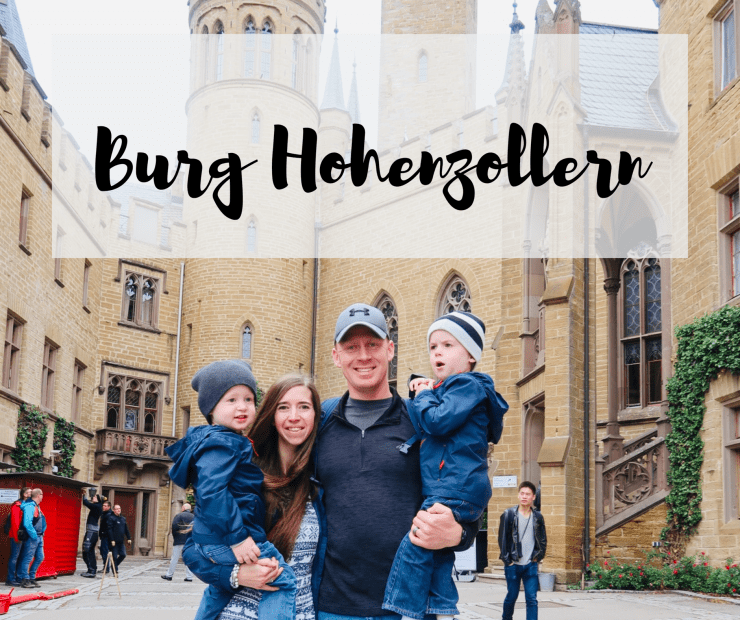
Burg Hohenzollern – A Day Trip

Full disclaimer- this was supposed to be one post on our full weekend away, HOWEVER I just had so much I wanted to share about each place we visited that I just couldn’t justify having yall read one super long post. Instead, I am going to break this up into three posts over the next couple of weeks covering each outing we did. We only had 3 days over the weekend, so we decided to knock out a couple of the castles that we’ve been wanting to check out. There are two castles that are within an hour (or so) of each other, so we decided to book an Airbnb somewhat in between the two and just go from there.

So, Friday morning we headed out and over to Burg Hohenzollern.

IMG_0003.jpg

Hohenzollern is possibly one of the most popular, but quietly popular castles in the region. It sits high on top of the hill, with views around all sides. It has quite the history of owners and destruction/reconstruction. To start with, Hohenzollern is the ancestral seat of the Prussian Royal House and references to this spot date back to the 1000’s. The house was reconstructed in the 1400’s to make it bigger and more formidable. It became a fortress, but after the war turned into ruins. In the 1800’s is was reconstructed and became the castle that we see today. It is heralded as “one of the most imposing Castle complexes in a neo-Gothic style” (via the website: https://burg-hohenzollern.com/castle-history.html).

Hohenzollern was very well worth the drive. Incredible from the moment you lay your eyes on it driving into the region, it definitely gives off all the castle on a hill vibes. We parked on the property and did a short hike to get to the entrance. There are two hike options, one where you can park at a lower level and hike through (this is the free parking I believe) or the one that we did, a shorter hike with paid parking (2 Euro for a car for parking). You are also able to take a shuttle bus from the paid parking area to the castle itself (the cost varies depending on what ride option you choose and how many are in your party). The hike is actually quite pretty, but steep and quite a few stairs.

This particular castle is one with two entrance areas. There are two large gates, one to simply “get into the property” and the second to get into the main courtyard. Before you pass the second gate you are treated to an interior garden lining the round walls, as well as some stunning views from the first lookout. This area is lined with various paths and the views of the town and valley below are stunning. You can walk all along the exterior to see the 360 views, but if you head inside and follow the tour, you will get this chance anyways.

When we went, there was a display at the second gate to see all of the coocoo clocks from area makers (this castle is quite near the Black Forest area- which is known for its coocoo clocks and woodworking). There are also festivals at different times of the year (A spring festival, Mother’s Day event, several performances/open air cinema days, an Autumn festival mid-October and then a Christmas Market in December).

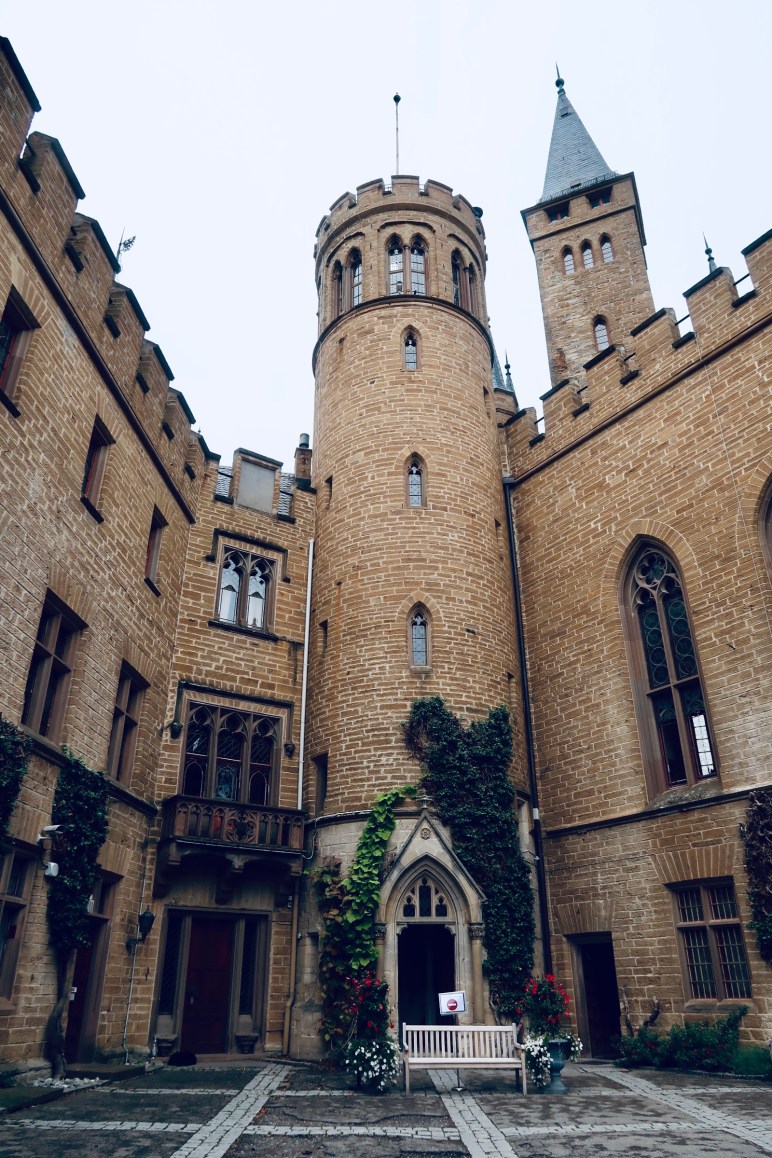
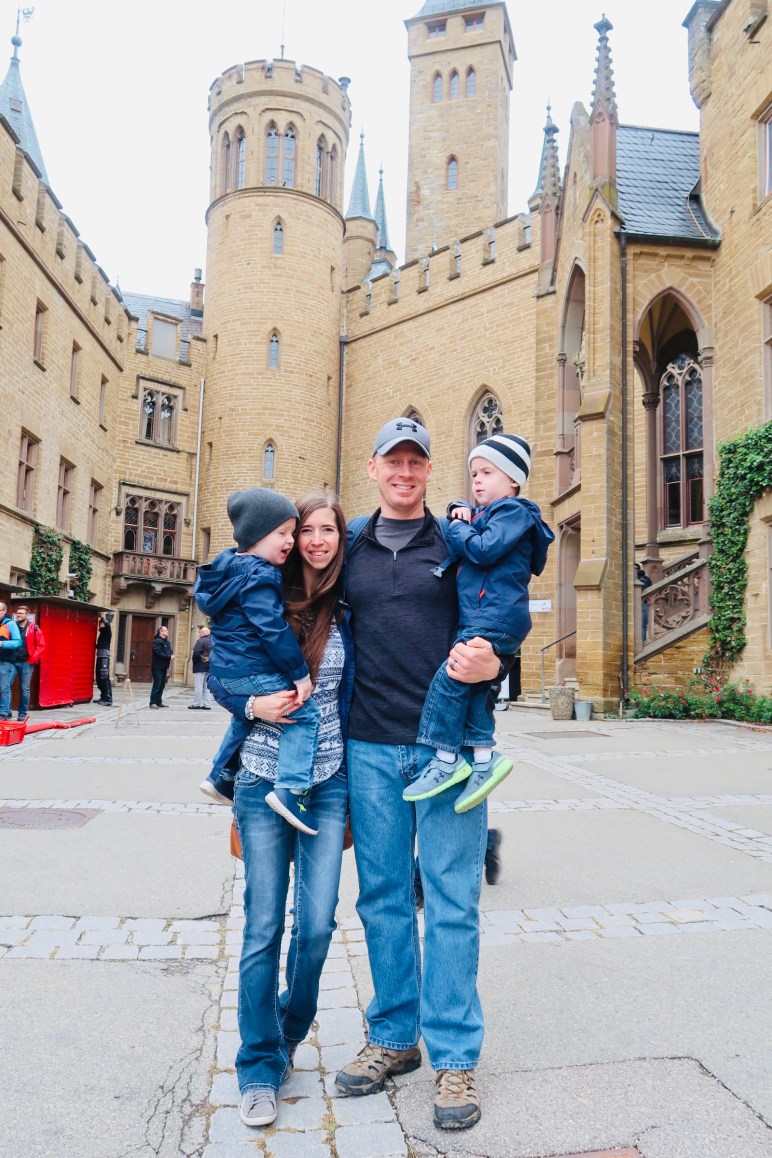
IMG_9935.jpgAfter the second gate, you are able to look right into the heart of the castle with the central courtyard. This particular courtyard is one of my favorites, just due to the look and views of it. I love the bench, the ivy, the brick. On your right is the chapel and church with stained glass windows dating back to the 1300’s. Then you see the “main event”, the castle itself.

There are two options to see the castle, a guided tour or a “casual stroll”. The only real difference between the two is what you would assume, the guided tour gives you intimate details on the history of the castle and family, while the casual stroll only allows you in the castle. They do have a brochure that details out the information of the castle and its rooms if you want a little bit of both. Typically, the guided tour is given in German, but they do offer other languages on certain days and times.

We did the casual stroll and I don’t feel like we missed much by doing that. It allowed us to meander through the rooms how we wanted, and I felt like I got the chance to actually look around (although that might also be because I wasn’t spending the whole time trying to shush a toddler during a presentation). We saw several rooms, each more incredible than the last (my favorite was the Count’s Hall and The Blue Room). In order to preserve the interior, you are not allowed to take photos and you must wear the slippers they provide.

In addition to the interior rooms of the castle, you are also able to see the cellar, which has all the silver stores, and the casemates. These spots have their own special history and charm to them, and once finished you climb the steps to the outer embankment. This stroll gives you a chance to see just about everything the castle has to offer. I do want to note that there is also a café to eat at and a gift shop to get a little souvenir.

IMG_9992.jpgOverall Hohenzollern is 100% worth the trip and I think it should definitely go on your list of castles to see if you get the chance. We loved our time there and the views are quite gorgeous. You can definitely make this a good mid drive stop (as you only need a couple hours tops to visit and explore) or combine it with a couple other stops in the area as we did.

May In Travel

I feel like I say this every month, but how has this month already come to an end? We are looking at the end of May and almost being halfway through 2019! I can’t believe we are a)already at that point and b) have already been in Germany for almost 4 months!!! It seems like time is simultaneously flying by and standing still…if that makes sense.

We did a relatively decent amount of travel in May between day trips and weekends away. In fact, I think it’s safe to say that this might have been my favorite month of travel so far! It’s been a fun month of new experiences and although I don’t have all the details tracked out for you yet (coming in the next 2 weeks- stay tuned!!), I will give you guys little peaks into each place.

The first weekend wasn’t too terribly exciting as we adventured back to the big city that is going to be near our house (yes, you read that right, we have a house- more on that at the end of the post!!) and seeing what all the shopping options are in that city.

Our second weekend we did a day trip through our local Outdoor Recreation program that involved taking a steam train through the countryside and trekking through a cave. It was easily one of those cool things that you can do in an absolutely gorgeous location. The boys LOVED the steam train (they thought it was the coolest thing ever) and we all enjoyed leaning out of the windows on the train. The cave has quite the history and we emerged to a gorgeous sunny sky (after a bit of a cloudy start) and a beautiful overlook. It was a really fun day spent with friends. You can read more about it HERE.

Our third weekend in May we spent in one of the prettiest spots that we could ever imagine. Fussen Germany looked like it was a set straight out of a movie (and maybe it was-I’m not sure). I’ve got a full blog post coming detailing our entire trips as well as some tips/recommendations, but safe to say this is a favorite spot. It was the perfect pairing of slow, small town, and beautiful nature/scenery. We were gutted to leave on Sunday morning.

Our final weekend we spent in the absolute beauty that is Austria. We actually flitted back and forth on the border between Germany and Austria throughout the weekend, spending one day in Berchtesgaden and the second day in Salzburg. Once again as with Fussen, I will have a full blog post coming with all the details, but Austria is seriously just so beautiful. The overlooks to see the town are breathtaking, you see the alps from every area and the pacing of the town is just so nice. We aren’t even going to get into all the Sound of Music singing.

And that was our month in travel! We had a lot of fun this month, but are ready for a little breathing room. June is going to be a more “close to home” traveling month with day trips, some down time, and then an exciting move at the end of the month. We’ve finally got a house to move in to, so that along with a very exciting July is playing into a quieter June. As much as I love traveling and we’ve been enjoying it, we are homebodies at heart and are looking forward to a little quiet and peace.


Things You Should Do and Tips For: The Netherlands and Amsterdam

Good morning! We recently spent a long weekend away in The Netherlands, which you can read all about HERE, and this morning I am going to talk about some of the tips/tricks that we learned and what I would recommend you do as well as maybe some things that are maybe a little over hyped.

As always, this will heavily depend on your own interest, how you are traveling, and the time of year that you are going. This is the first (and only) time that we have been to The Netherlands and we went to see two spots, Amsterdam and the Tulip Gardens. We were only there for 3 nights total, so we didn’t get to see everything that we had wanted to. We also traveled with our two young children, which as with Berlin, factored into what we did and didn’t do. I am going to do these as two separate sections, one for Amsterdam and one for everything else, that way if you are only interested in Amsterdam you can only read that part or if you are only interested in the Tulips you can only read that part. It is also too much and too different to try and consolidate into one long recommendations and tips section.

Recommendations for Amsterdam

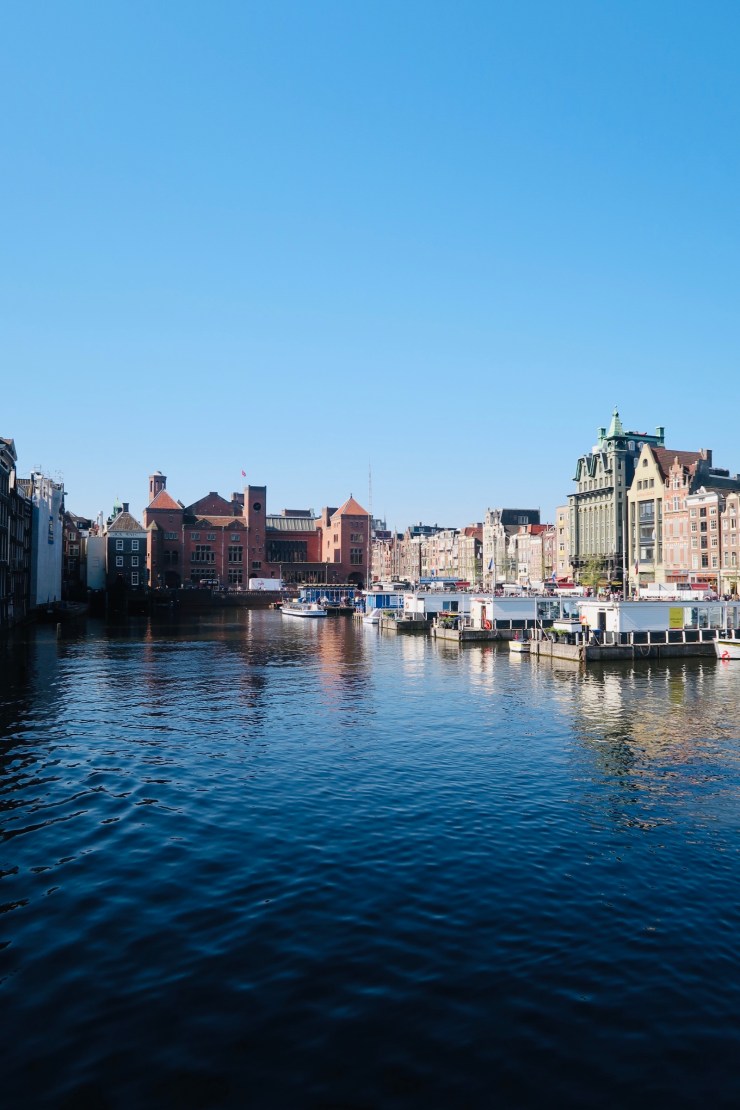
It may seem overly touristy but take advantage of the boat rides along the canals. To be completely honest this is one of the best ways to get an overall look at the city, the canals, the different “high points”, but without all of the tourists. You aren’t fighting a crowd to look at a church or tower. It also gives you a unique point of view from what it would have been like in history.  If you take the train in, you can find plenty of options all along the exit of the station, as well as options all throughout the canals. Depending on what you are more interested in, you’ll find a boat tour that will meet those needs (we saw everything from a romantic cruise, to all about the alcohol, to a standard hear the history and nothing more). We didn’t originally plan on doing a boat ride, but our older son insisted, and it didn’t look too bad when we got out there.

I would also recommend heading over to Dam Square. This is the main town square and there is usually always something going on. From here you can get a good view of the exterior of The Royal Palace, see The National Monument, and the Nieuwe Kerk Church. There are also a couple other spots right off the square if you’re interested, Madame Tussauds and Ripley’s Believe It or Not. We did not go in either of those, but we did go inside the Royal Palace. I’ll be honest, The Royal Palace tour is not a necessity to a trip to Amsterdam. If you are interested you can certainly do it, but it is not like a “must see”. I really enjoyed it, but I am a royal fan and think that seeing different palace’s and other type of government buildings is really interesting.

A couple of the spots that I wish we could have gone to, that were on our list but didn’t end up being an option, were: The Anne Frank House, Foodhallen, and The Rijksmuseum Amsterdam. I’ll get into The Anne Frank House in my tips/tricks, the Foodhallen is a food court that came highly highly recommended to us, and the Rijksmuseum as a lot of Dutch history that we wanted to learn about.

I’ll touch on one more spot as I feel like I need to make a note on this because to be honest, not a lot of people talk about Amsterdam without talking about The Red Light District OR the booming cannabis market/options. We walked through the Red Light District and I found it to be just like a regular stroll (in a weird way). Here’s the thing, first off you cannot take video or pictures in the District. This is to protect the workers that are there, and I can completely understand. These are regular people who are doing what it is that they do. Just because it is not something that we see every day, or something that may not be as popular or destigmatized in our area of the world, does not mean that they need to put in a spotlight situation. If you choose to stroll along the District, do not leer, do not linger, just be respectful. These are people just as we are, and they are doing what they choose and want to do.

 Tips for Amsterdam:

Tip #1: Bikes have the right of way and they will exercise that right of way whether you are aware of that or not. Amsterdam (and The Netherlands in general) has a huge biking community, it’s how the majority of their population gets around. Most places will have designated bike lanes, so don’t hover in those lanes and make sure that you are aware of where they are when there are no designated lanes.

If you want the true experience, there are so many different bike rental spots!

Tip #2: Make it an Adult Only or Girls Trip. This one is going to be a little bit hard to explain, or maybe it won’t, but I think Amsterdam would be so much different if it was just adults. I don’t say this for any “content” warning for what is in Amsterdam or for any lack of enjoyment reason. We loved (and do still love) taking our kids out throughout the world, exposing them to new cultures, places, people that they would not otherwise get to experience. HOWEVER, Amsterdam is so packed with people that you are spending a good amount of your time just shuffling along with the crowds and worrying about being separate from those you are with, until you get out of the main area. I think I worried a little bit more than normal with having our kids there.

Tip #3: Look at staying outside of the City Limits and taking the train in. Amsterdam is quite expensive and staying in a hotel in the city is very expensive. It is also, once again, full of people and traffic. We stayed outside the city in a little town and took the train in to Central Amsterdam. We were able to book a little cottage on AirBnB for a very reasonable price and it gave us a little breathing room. We didn’t have to worry about fighting traffic in a car or finding parking for the day. I am already a really big believer in public transportation, and this weekend away really confirmed that for me.

Recommendations for Tulips/Flower Season

As for how I would recommend you approach the tulip season that is going to depend on what you actually want to see. If you want to see just the Tulip Fields, there are a couple of different farms that you can go to. Lisse is the most popular spot and has the largest amount of options to see Tulips. MAKE SURE that you check my Tips out though, because there are some rules you will want to be available of. You can also see the Tulips just driving along the road and throughout train rides. I believe you can also see them from the sky, but I couldn’t confirm that.

We went to Keukenhof Tulip Garden, which is one of the more famous well-known spots for the Tulips. I knew that I wanted to see a bit of both the Tulip Fields AND the more manicured growing plots. Keukenhof has the best of both worlds for that. They boast about 7 Million Bulbs are planted and grown in their garden and I would believe it. Plus, believe me when I say there is something for everyone here. They have a kid’s area in the center where there is a playground, petting zoo, and park to eat at. There is also a maze for the kids to run through. There is a windmill that gives you a view over the fields, water, and gardens as well as two other overlook spots. Finally, you also have the indoor flower shows that follow along with themes for the year (one changes weekly). They have a unique planting and growing system that allows them to have blooms for eight weeks, so you have plenty of time to check them out.

My other recommendation would be to bike through the countryside. This is an excellent way to not only see the beautiful countryside of The Netherlands, but also see the Tulip Fields, the windmills, and be true to how the people get around. It is such a fun way to get around and see the country.

Tips for Tulips/Flower Season

Tip #1 (Possibly the Most Important One): DO NOT just go traipsing through the tulip fields all willy nilly to try and get the perfect picture or see them better. The Tulips are not only part of The Netherlands and the culture, but it is also a HUGE business for them. They work incredibly hard to grow and maintain the tulips and walking through the actual field itself ruins the flowers and the field. Only do this at the land owners permission (and if you’ve paid for it).

Tip #2:Go as early in the day as possible. No matter when you go or how you choose to see the Tulips it is going to be crowded. We went the peak weekend for the blooms, which also happened to be Easter Weekend and I didn’t feel like we were fighting the crowds until the very end of our time in the park. We went shortly after they opened and a few hours later everyone else seemed to start coming in. So, go early!

Tip #3:Just enjoy the beauty around you. I am a big one for documenting everything, taking all of the pictures, capturing every bloom and even I had to take a step back and just enjoy the sheer beauty around you. This is such a special place and time and honestly, not to get hokey, just take a step back from the camera/phone and enjoy the moment.

And on that note…

Those are all of my Things You Should Do and Tips for Amsterdam/The Netherlands! We do hope to go back and see some other area’s in the country one day, but this was one of the best trips we’ve taken. If you have any specific questions I will try to answer them in the comments below and if you have any of your own tips, please leave them below!

Berlin – A Long Weekend

Good morning! This morning I am going to talk {A LOT} about our recent long weekend trip to Berlin. My husband had his first 4-day weekend through is work and we felt as if it would be remiss to not go SOMEWHERE for the weekend. We debated between going to Berlin and Munich and Berlin ended up winning (obviously…). We did this a little bit last minute (although we have a bucket list of places to choose from, as well as a breakdown of potential amounts of time that we would need to feel comfortable traveling those places), but we booked the hotel and such only a few days before we actually left. I won’t go on too much longer as I have A LOT to tell you. I’ll be doing a whole “Things We Learned” post separately, so this will just be what we saw/did…which is still A LOT.

I will say, it is currently mid-March. This means rain, cloud cover, occasional snow and 40-50Farenheit temperatures. We had planned for this to happen and while the weather didn’t impede us from doing what we wanted to do, it is definitely a factor.

We left for Berlin early Friday morning and had decided to drive there, but then park the car and rely on public transport while we were actually there. It’s about a 4.5-5 hr drive for us (including stops) and that was a decent distance for both us and the kids. They were able to be occupied for most of the drive by everything outside and they napped for a little bit. It was a pretty easy drive, just a hop on the autobahn and away we went.

IMG_0279

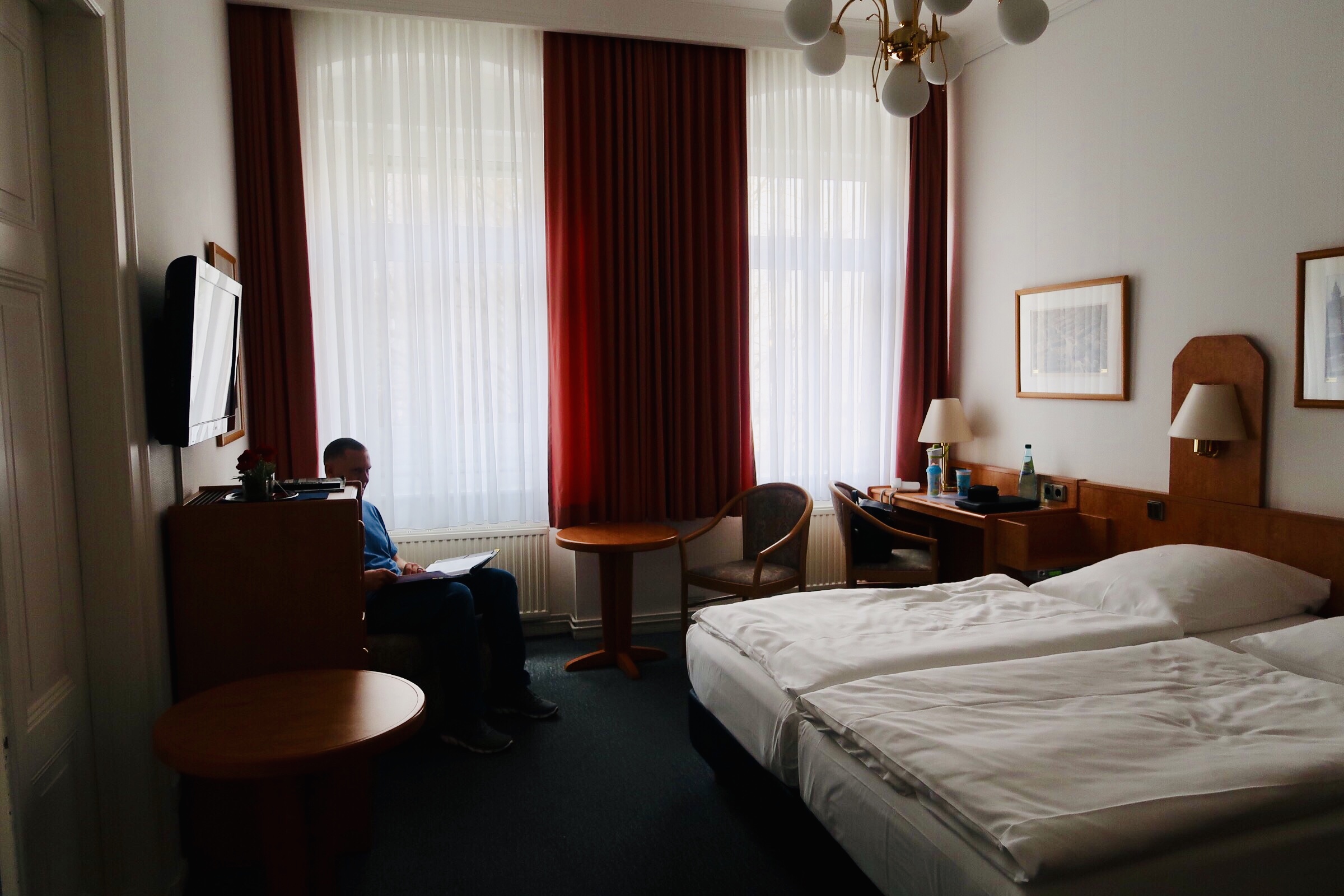
My husband had done a bit of Expedia shopping around and settled on the Kastanienhof Hotel. This was such an incredible hotel to stay at. A little on the pricey end, but it’s also Berlin, so it could be a more inexpensive option. We got a “suite” option which had a separate little bedroom set up for the boys that we could close the doors on at night for sleeping. We had a good-sized bathroom and a little minibar set up. The best part is the hotel is right next to a pick-up point for the Streetcar, so it works perfectly.

We spent Friday afternoon/evening at the Berlin Wall Memorial. This is a notorious spot in the wall, which bisected an apartment building, park, and was one of the original crossing points, the wall has portions that are still intact and portions that were picked at when it “came down”. This is a running theme throughout quite a bit of Berlin. There are portions of the wall still up in a quite a few areas, both museum/historical and just regular spots. Across the street from the tower/wall you can head in to the Documentation Center and up to the overlook. The overlook gives you a good look from above at what the wall was like. There is an exterior and interior portion, with a tower in the middle.
IMG_5373.jpgOnce we finished there, we headed out for dinner at a local hole in the wall barbecue joint, Chicago Williams BBQ (which was delicious) and then back to the hotel for some sleep. I will say- just on this first day we had walked just over 2.5 miles, and this was our “light day” (we walked a total of around 20 miles through the whole weekend and I don’t know how many flights of stairs).
IMG_5413.jpg

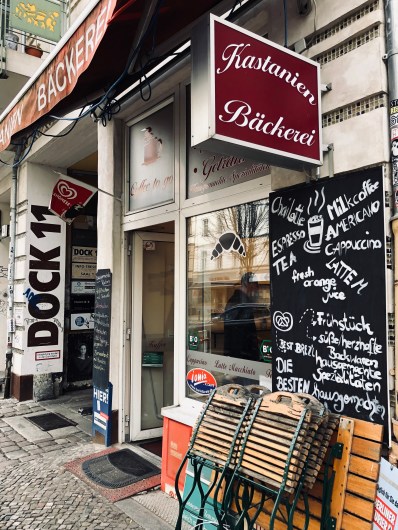
The next morning, we woke up somewhat early after a night of…”sleep”…amongst the city sounds of Streetcars, Bikes and regular cars outside our window. I am not opposed or even mad about this, it was just something that we had to spend that first night adjusting to. Saturday morning, we decided to head over to another hole in the wall restaurant, this time a bakery for a quick breakfast before heading out for a day of exploring. We had lofty plans for the day and even the forecasted rain wasn’t going to stop us.

IMG_0352.jpg

We started at Checkpoint Charlie. Checkpoint Charlie is probably about the only crossing point you’ve really heard about in terms of crossing at the Berlin Wall. It has seen demonstrations, stand offs, escape attempts and was demolished in a full formal ceremony. Now they have the building for the checkpoint where you can take pictures (they even have a couple actors that you can pay to take pictures with) and a full museum across the street. The museum covers a brief history of the wall, but focuses mostly on different escape attempts, including vehicles and such that were actually used, and people that are closely tied to the Berlin Wall. This was a must see on our list.

The second must see on our list was the Memorial to the Murdered Jews of Europe/Holocaust Memorial. I had heard about what walking through this memorial was like and let me say, words cannot begin to describe it. The site is filled with concrete slabs of varying height and there is an underground area that lists out the names of the murdered Jews of the Holocaust. It has a cold, sobering almost inhuman affect as you walk through it. It feels like a cemetery, but the slabs do not have any notations (like tombstones would) which I think adds to the sobering affect. It can be a bit overwhelming when you think about the actual facts and numbers, but this is one of the most well-done memorials I feel.

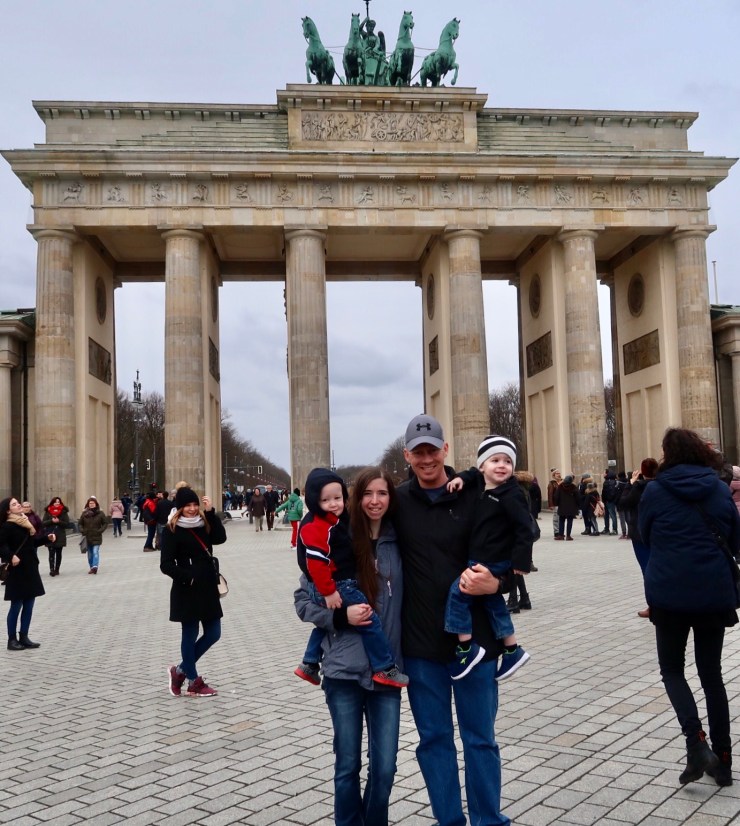
Since we were in the area (and needed a bit of an uplifting view), we headed over to one of the biggest tourist spots in Berlin, the Brandenburg Gate. It certainly did not let us down as we fought around people, street performers, and cars to take a look. It was totally worth the fight. From there we decided to walk down the road a little bit and take a look at The Soviet War Memorial. This commemorates the Soviet soldiers who fought and died at the Battle of Berlin in Spring 1945. You can walk through the memorial and into the Tiergarten on the other side. With the Tiergarten you can walk the paths and head over to the Reichstag Building Deutscher Bundesta- Plenarbareich Reichstagsgebaude). This building has a long and storied history of being built, fires, wars, divided country and reunification. It currently houses the Parliament of Germany and if you would like to tour the inside, you will need to purchase a pass/ticket and go through background, etc. Think of it along the lines of The US Capital or White House. It is an official government building.


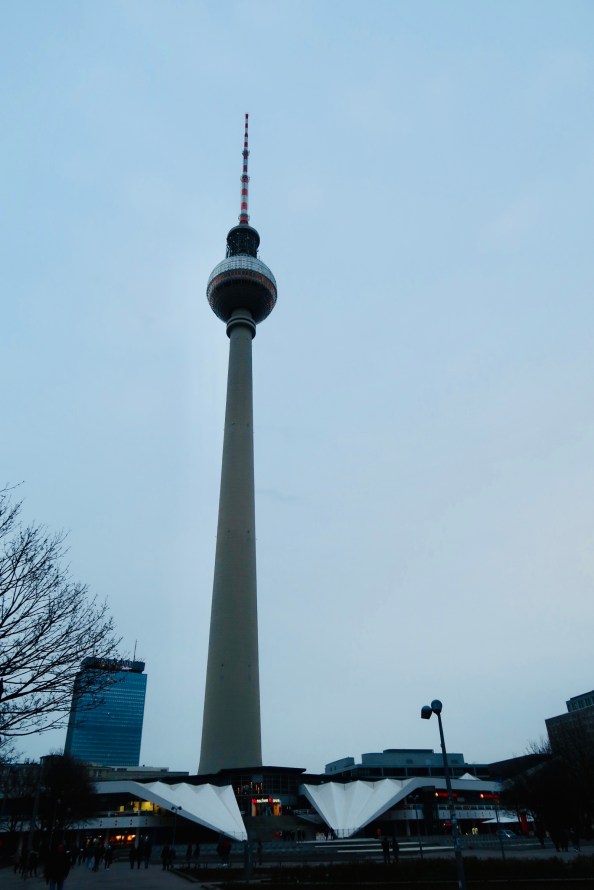
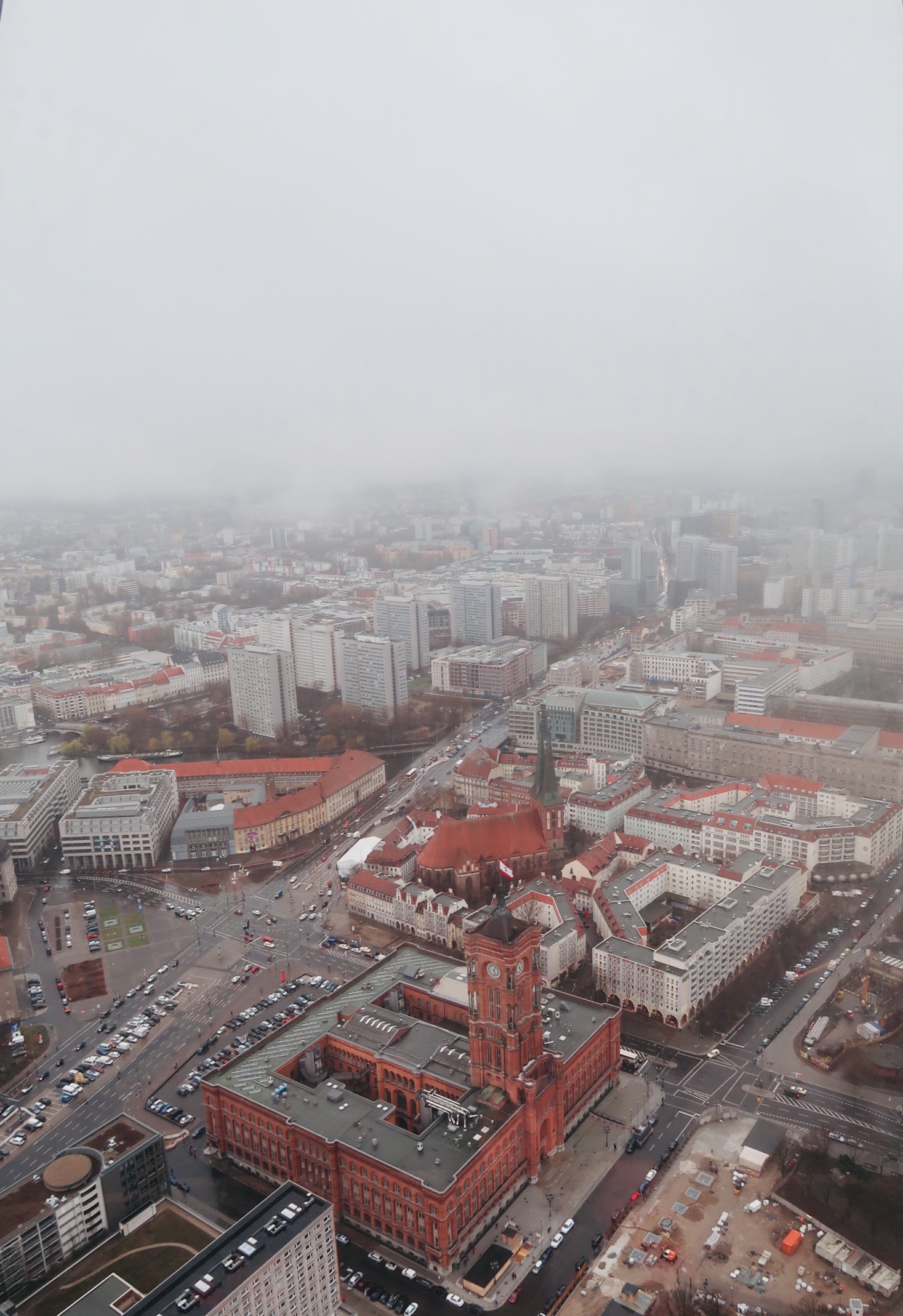
1231152903949824964_IMG_0581.jpgThe last place we stopped at on Sunday was the Fernsehturm Building (or the TV Tower). Built in the 60’s and at 368 meters, this is the tallest structure in Germany, and it serves a couple of purposes. It serves as the location for TV and Radio, but also has a viewing platform at 203 meters up and a restaurant at 207 meters up.
IMG_0434

We picked the very wrong day/time to go up to the observation deck as the fog was coming in just before we went up, but we still enjoyed a decent view. The longest part of the timeline was waiting to go up. We finished the day with dinner at a restaurant right near our hotel and then headed almost straight to bed afterwards.

Sunday started out as a beautiful day. We wanted to make the most of the sunshine, so we headed out early for breakfast and then planned to go over to the East Side Gallery. For breakfast my husband had found this little bakery on Trip Advisor that he decided we needed to go to.

Called Zeit Fur Brot it had the most delicious variety of Cinnamon Rolls I’ve ever had. They are huge, heaping with both icing and cinnamon, but not too sugary sweet, baked right there in the shop fresh throughout the morning (you can watch them do this as well which is really cool). This is hands down a MUST stop place (in fact my husband went and got them to go on Monday morning for us).

After a delicious breakfast we hopped on the underground (and then a bus) and headed to see the East Side Gallery. This is a mile-long portion of the wall that has been painted by various artists. It showcases artists from around the world and some of the paintings are quite moving.

It was so beautiful and truly showed how you can take something that is such a horrid piece of a history and turn it into something good. The way this has been repurposed is wonderful. It also sits right on the water and once we were done walking (and while we were trying to figure out our next stop) we sat and watched the water, the birds, and the storm come in. It was so relaxing and a nice little moment.

Noting the incoming rain storm, we decided to head over to a museum, this time The Topography of Terror which (I think) is the only museum dedicated entirely to World War 2. The landscape has both Berlin Wall remnants AND WW2 building remnants which was very interesting to see. This site was where the most important institutions of the Nazi’s were located. It served as the headquarters of the Gestapo, the Leadership and Security Service, and the Reich Security Main Office. The museum goes through the specifics of the command and people that were involved in these offices as well as facts about the Nazi rise to power, their actions, and their downfall. You can walk through portions of the build site on the outside.

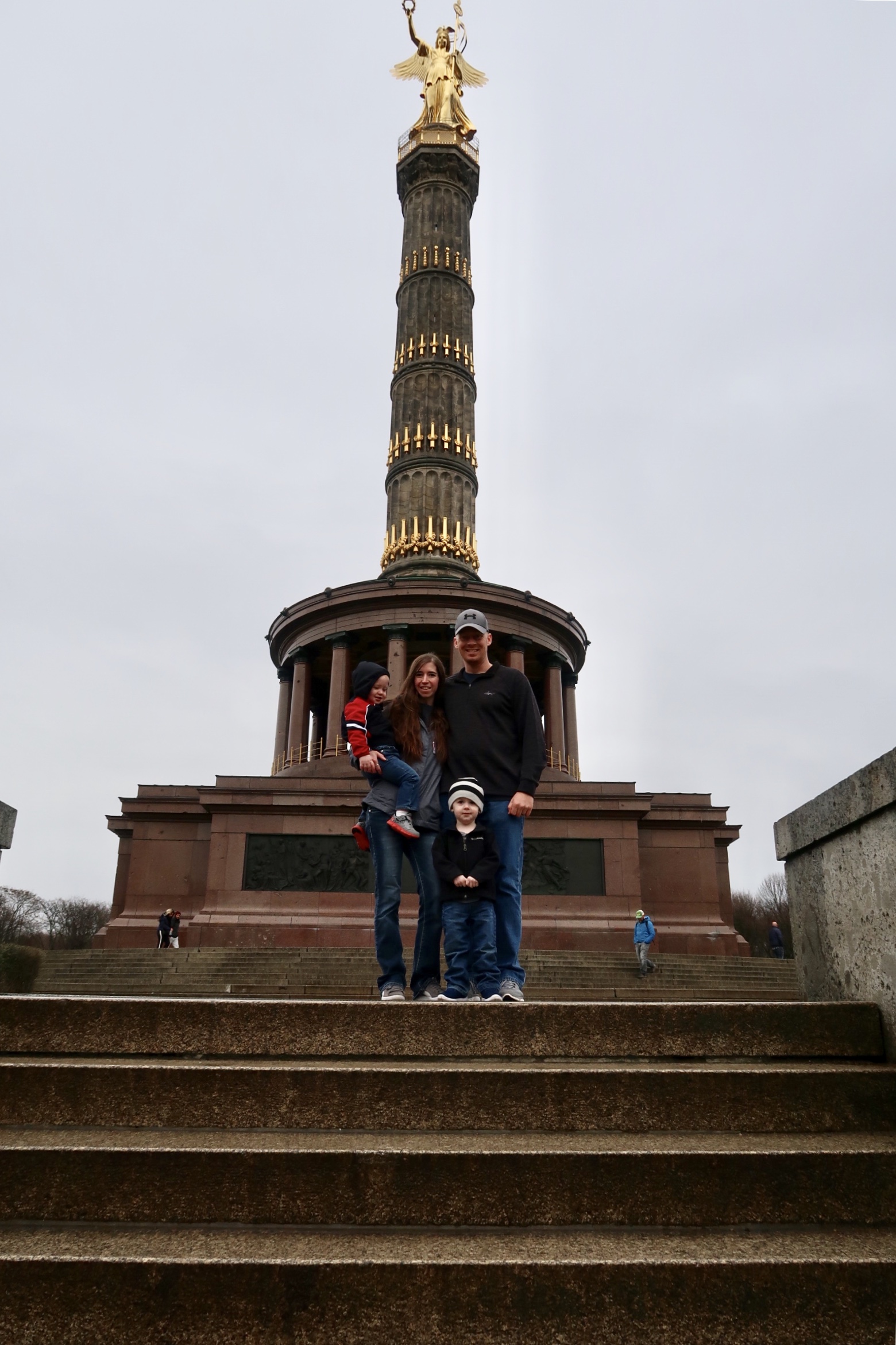
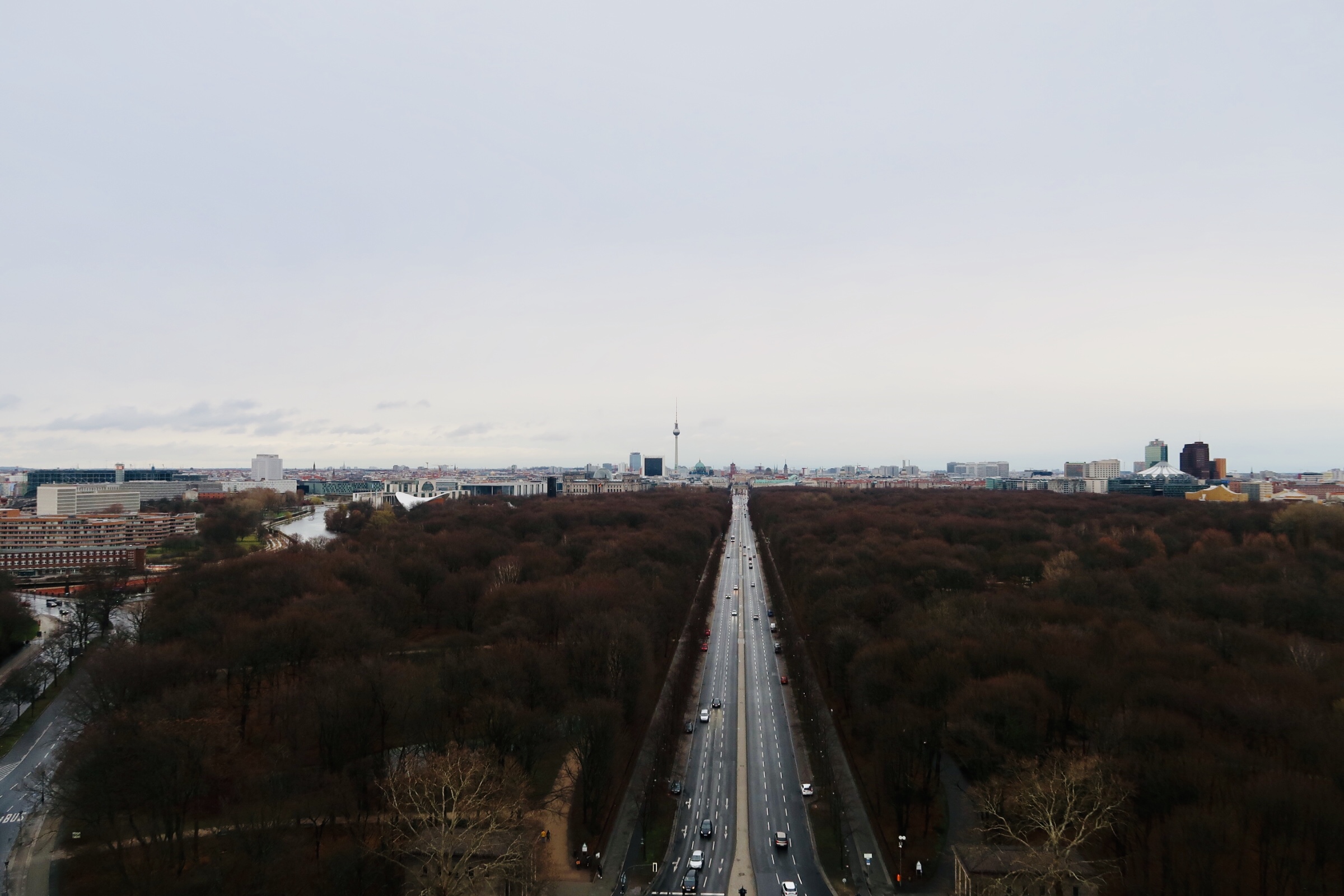
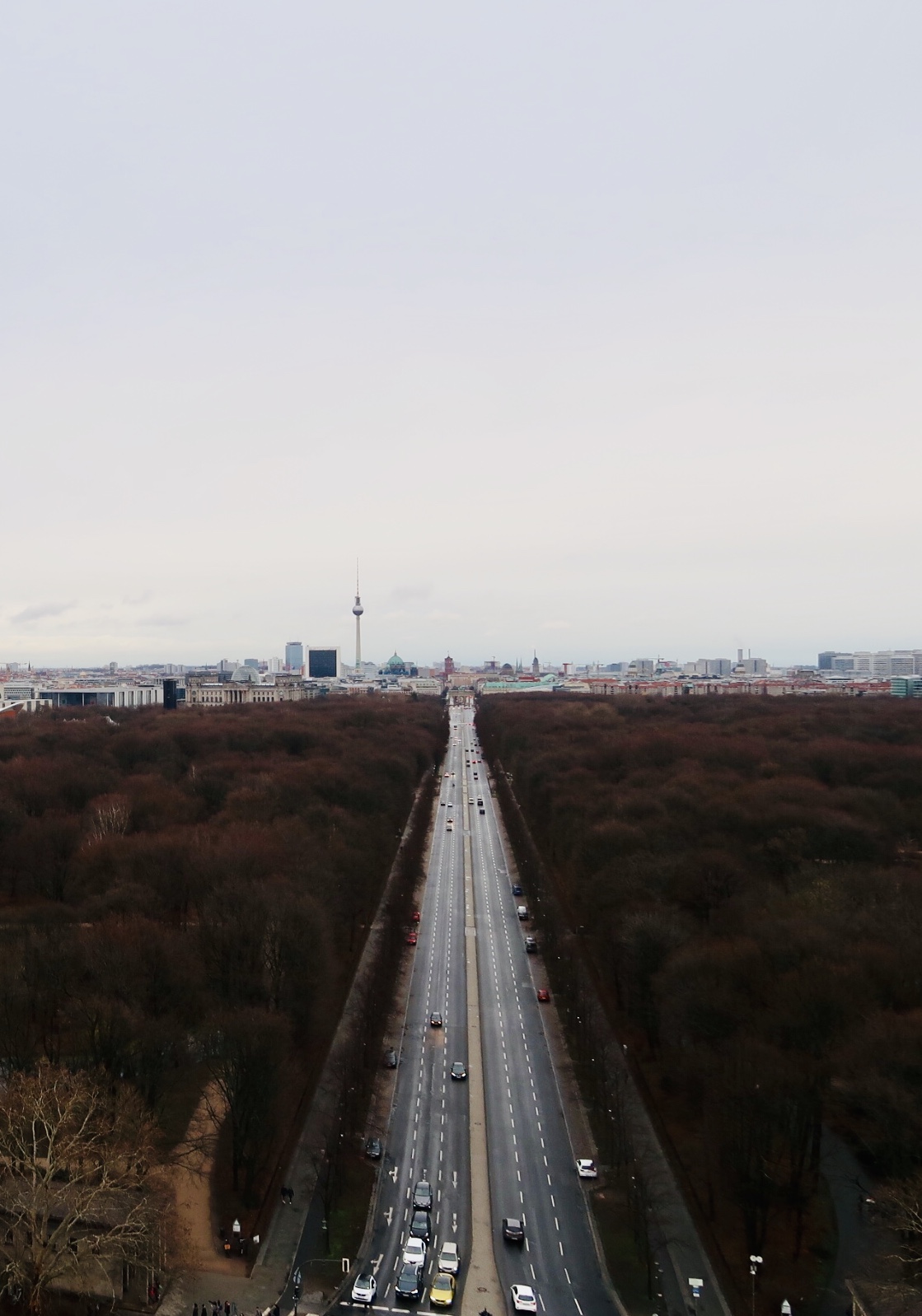
7297860356480843521_IMG_0542Our second to last stop we made on Sunday was to the Berlin Victory Column. This is actually not the original spot of this particular monument; the Nazi’s had moved it from its original location to where it now stands. At 66 Meters (almost 67) the open-air viewing platform is dizzying, not to mention the thin circular stairs that you climb to get to the platform itself.
 

-1694393697050839084_IMG_0549

From the platform you can see all across Berlin and we got a much clearer view of the city. There is also a lower platform (much much lower) that gives a nice all-around view as well. As terrified as I am of heights (and the almost panic attack I had on the tiny platform), I really think that this is a spot to visit! The view was unforgettably beautiful even on a cloudy day.

3040987143947964619_IMG_0563

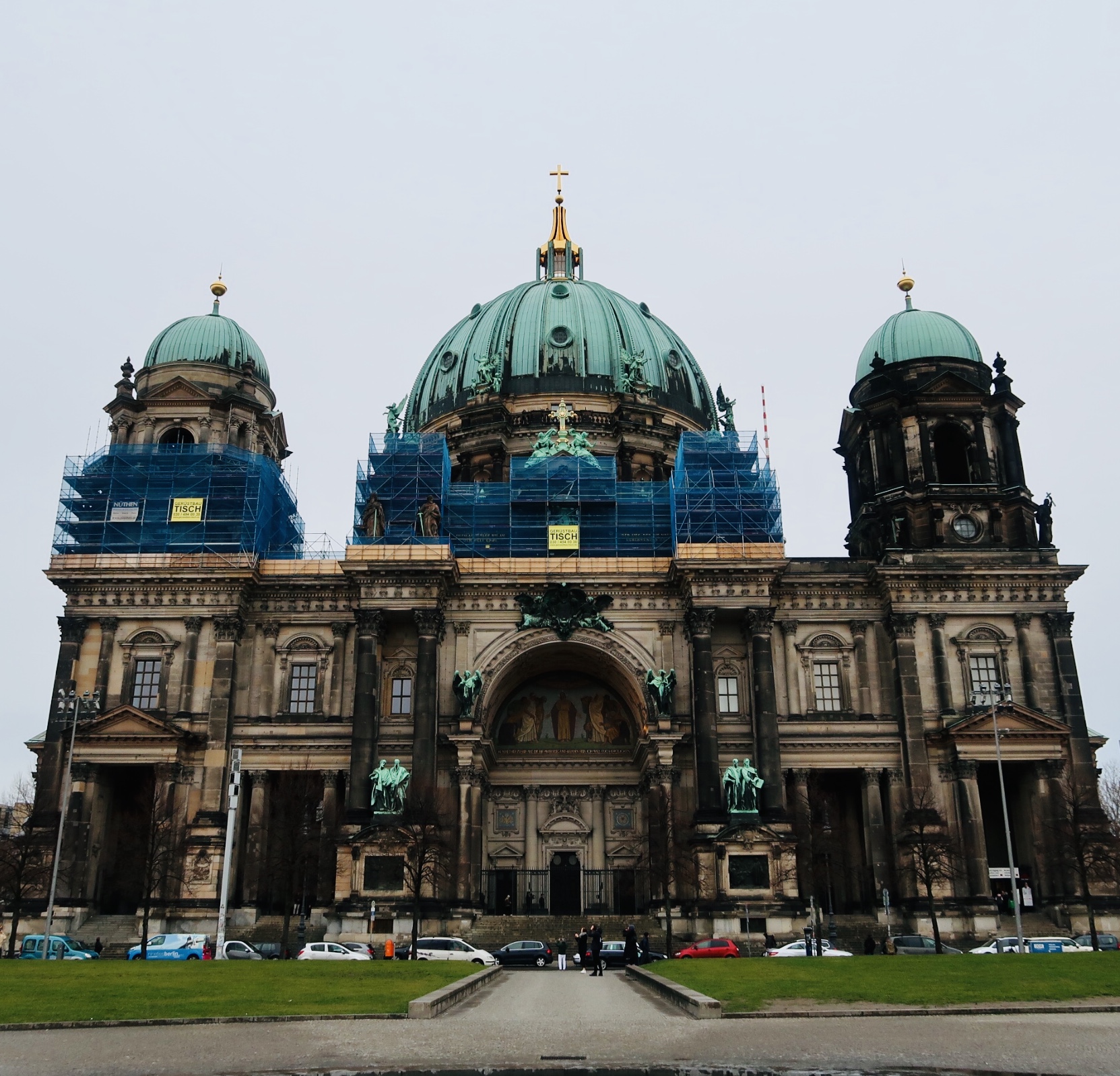
We stopped over at the Berlin Cathedral to take a peak. I really enjoy seeing cathedrals, with their massive domes and bells that ring every hour. We weren’t able to go in due to a service starting and dinner rapidly approaching, but we were in awe of what we did see.

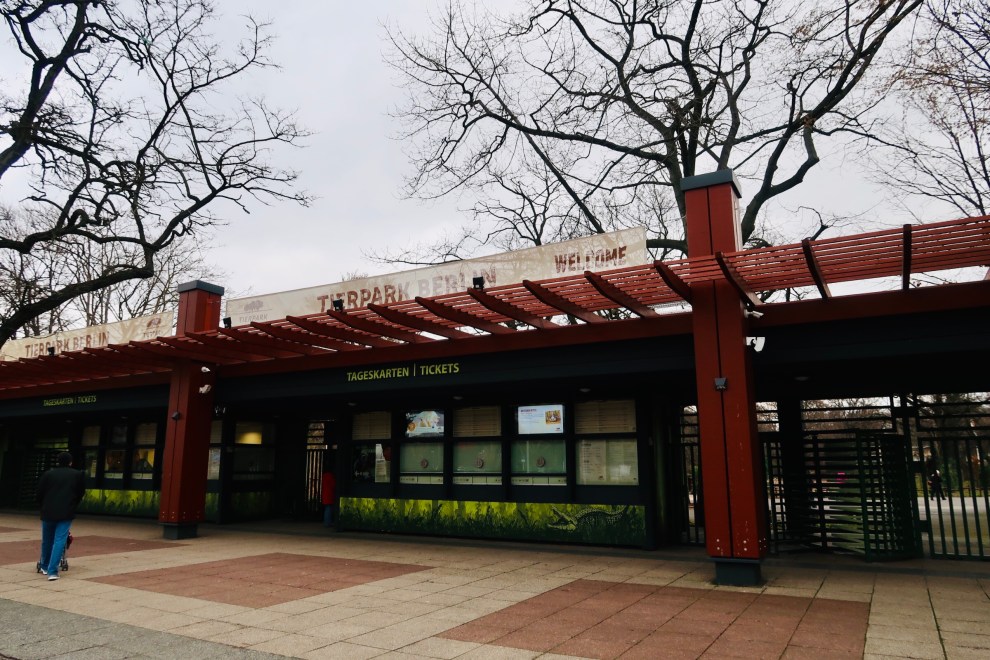
-3894708180345114520_IMG_0604.jpgOur final morning in Berlin we decided to make a last-minute decision and head to one of the animal attractions that Berlin boasts of. We figured this one would be solely for the kids (although we got a lot out of it too) and it would be a good energy release before the long drive back home. We didn’t go to the Berlin Zoo, rather we opted for Tierpark. We had several reasons for this, I think this one is the bigger more spread out option and it took us out of the city a little bit. We picked the right spot.

Let me be clear, we spent 3 hours here and didn’t even see a fraction of the animals that they have. Not only do they have a large {mostly} open air zoo, it also serves as a park, and they currently have several baby animals. We saw so much mother/baby animal bonding going on it was too much for my momma heart to take! I can’t even begin to tell you how incredible the little bit of time we spent here was. Not only do I highly recommend it, but I would caution you to budget a whole day for it.

That about sums up our Berlin Weekend!I know this was a LONG post, but we just did so much, and I wanted to share some information about each of the spots that we went to. I’ll be sharing my own recommendations and tips in a separate post coming soon. I also have a video up on Facebook that shows some clips of our travels. I hope you enjoyed seeing Berlin through our eyes.-1279016770161338670_IMG_0552